Do You Need a Motorcycle License in Texas?


Every article on this site is researched by our internal team, reviewed for legal accuracy against current Texas law, and held to State Bar of Texas advertising standards before publication. We do not publish content that overstates outcomes or makes promises about results.
Learn more about our
editorial standards .
Key Takeaways
- Texas requires a Class M license or endorsement to legally ride a motorcycle on roads.
- A learner permit bans riding from midnight to 5 a.m. and bars carrying passengers.
- An unlicensed rider over 50% at fault cannot recover damages for a crash in Texas.
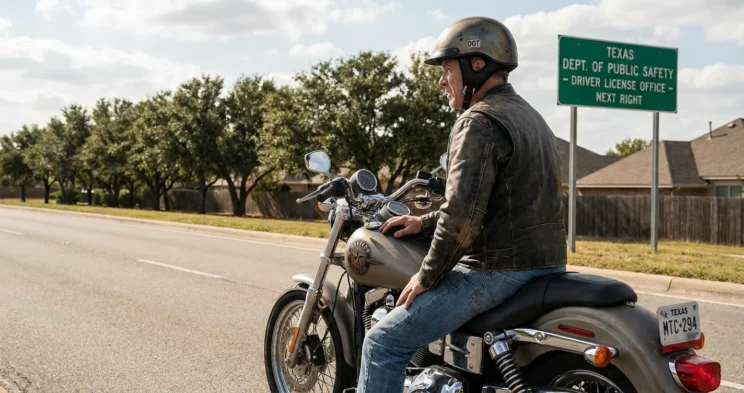
You finally bought the bike you have wanted for years, and the open road through Deep Ellum is calling. Then a friend asks whether your regular license actually lets you ride it. Suddenly you’re not sure if you are about to break the law on your first trip out.
Texas Motorcycle License Requirements
Texas law requires a valid Class M license or a Class M endorsement before you can legally ride a motorcycle on public roads. Riding without one is a traffic violation under the Texas Transportation Code section 521.021, which requires every person operating a motor vehicle on a Texas highway to hold the appropriate class of license for that vehicle.
Your standard Class C driver license does not cover motorcycle operation on its own. You need the motorcycle credential added before you ride.
That credential comes in two forms:
- A standalone Class M license is for riders who do not already hold a Texas driver license.
- A Class M endorsement, sometimes listed as Class CM, gets added to an existing Class C license and covers the same riding authorization.
Which license you get depends on your starting point. If you already hold a valid Class C license, you follow a different pathway than a first-time license applicant. Both pathways end with approval from the Texas Department of Public Safety (DPS).
How To Get a Motorcycle License in Texas
If you are 18 or older and hold a valid Class C license, the fastest route is a state-approved safety course that waives both written and skills tests. Riders who skip the course must instead pass a written knowledge exam and a road skills test through DPS.
The safety course path is straightforward. Here is how it works.
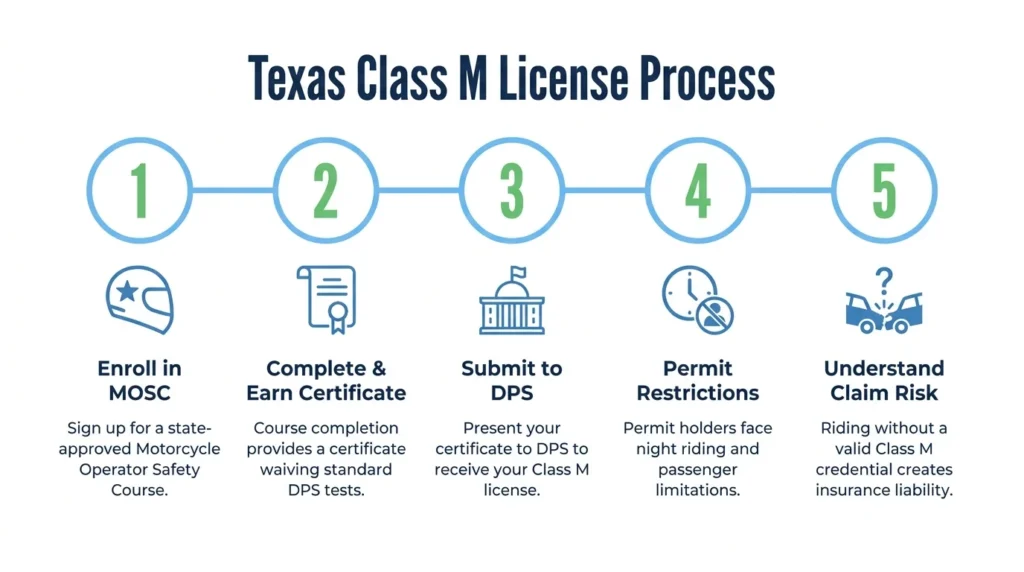
Step 1: Enroll in a state-approved safety course. Sign up for a Motorcycle Operator Safety Course (MOSC) or a Motorcycle Operator Training and Safety Course (MORC) approved under the Texas Transportation Code section 662.0033.
Step 2: Complete the course and collect your certificate. Finishing produces a certificate (MSB-8 or MSB-R) that DPS accepts in place of the standard written and skills tests.
Step 3: Submit your certificate to DPS for the credential. DPS issues your Class M license or endorsement once it accepts the certificate.
Step 4: Find an approved provider before you commit. The state school-finder tool lets you locate approved course providers. Metro-area classes book up fast, so register early.
Age changes the rules. Riders under 18 must complete the safety course no matter which testing route they prefer. A restricted license (MR) may apply to younger riders operating smaller bikes.
Texas Motorcycle Learner Permit Rules
A motorcycle learner permit lets you practice on public roads before earning the full Class M credential. This learner license falls under the Texas Transportation Code section 521.222, and it comes with firm limits.
You cannot ride between midnight and 5 a.m. while holding the permit, except when traveling to or from work, school-related activities, or in an emergency. You cannot carry passengers. Depending on your age, supervision requirements may also apply.
The permit doesn’t last forever. It carries an expiration window, and if you don’t convert to a full Class M credential before it lapses, you have to restart the process.
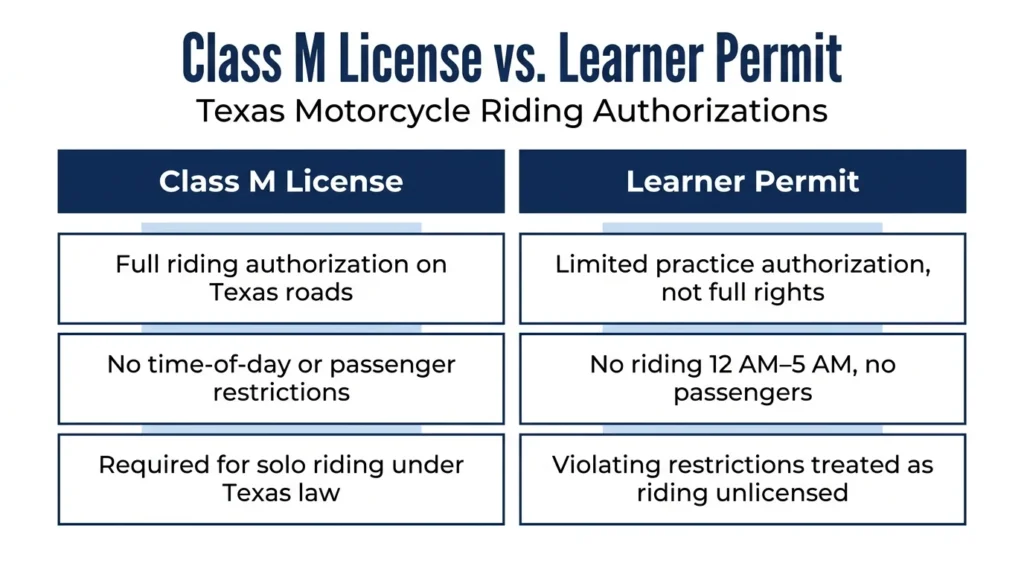
The restrictions are not just paperwork. Riding while violating a permit restriction carries the same legal exposure as riding unlicensed if an insurance or fault dispute follows a crash. If a permit issue could complicate a claim, it helps to understand how Texas splits fault between drivers.
Riding Without a License & Your Accident Claim
Riding without a valid Class M credential is a statutory violation, and insurers know it. They routinely raise it as a comparative fault argument when a crash claim involves an unlicensed rider.
Texas uses a modified comparative fault system, also called proportionate responsibility, under the Texas Civil Practice and Remedies Code § 33.001. If you are found more than 50% at fault, you cannot recover damages at all.
A licensing gap alone does not automatically cut your recovery. The other side has to prove the violation was causally connected to the crash itself. Lacking a credential is not the same as causing the wreck.
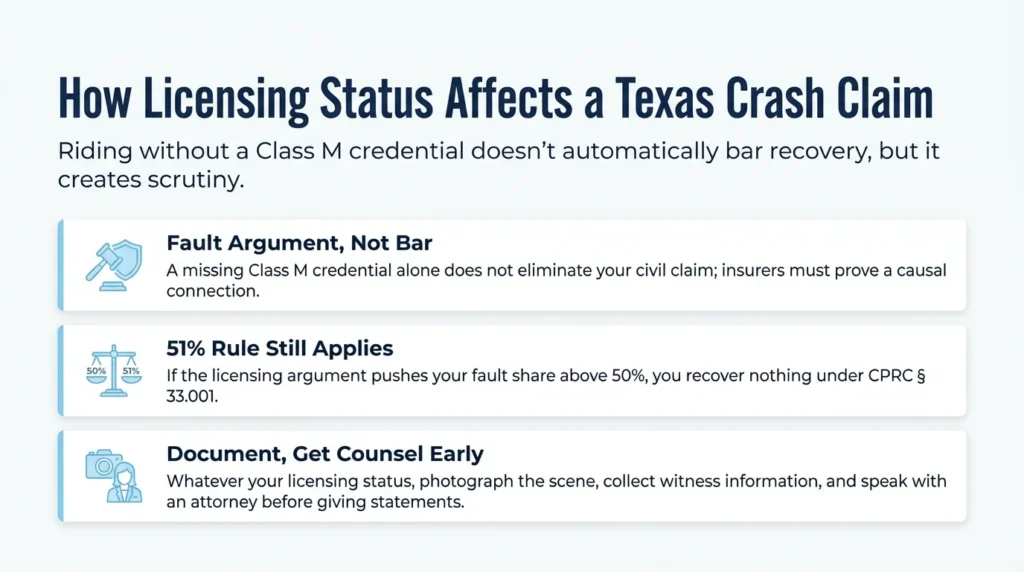
Still, an unlicensed rider or a permit holder who broke a restriction faces sharper scrutiny during the claims process. Document the scene, gather witness information, and record how the crash happened, whatever your licensing status. An attorney who handles motorcycle accident cases can help before you give a statement to an insurer.
Talk to an Accident Attorney About Your Case
Licensing questions get a lot more serious after a crash, especially when an insurer starts treating your credential as a reason to pay you less. You do not have to sort that out alone. Angel Reyes & Associates has guided injured Texans for more than 30 years, and our team has recovered more than $1 billion for clients.
We work on contingency, which means no fee unless we win, and your first consultation is always free. We serve the entire state of Texas, our attorneys are available 24/7, and you can reach an office near you across our more than 20 locations statewide.
If your licensing status is being used against you, contact us for a free consultation so you understand your options first.
Past results do not guarantee future outcomes.
Texas Motorcycle License FAQs
Do you need a motorcycle license to ride a moped or scooter in Texas?
It depends on the vehicle. A moped that tops out at 30 mph and has an engine no larger than 50cc can be ridden with a standard Class A, B, or C driver’s license. Larger scooters or any bike that exceeds those limits require a Class M license or endorsement, just like a standard motorcycle.
How much does it cost to get a motorcycle endorsement in Texas?
The DPS fee to add a Class M endorsement to an existing license is about $15. If you use the safety course path to waive the written and skills tests, course fees from approved providers typically add $200 to $500 on top of that.
If you move to Texas with a valid motorcycle license from another state, do you have to take the tests again?
You must get a Texas motorcycle credential within 90 days of establishing residency. Texas does not simply transfer out-of-state motorcycle endorsements, but holding a valid out-of-state motorcycle license can waive the safety course requirement when you apply at DPS.
Can a motorcycle endorsement affect your insurance rates?
Many insurers offer lower premiums to riders who hold a valid Class M credential and have completed a state-approved safety course. Riding without that credential, by contrast, can give an insurer grounds to raise your rates or dispute coverage after a crash.
About the Authors

Angel Reyes
Writer
Angel L. Reyes, III is the Founder and Managing Partner of Angel Reyes & Associates. A nationally recognized trial attorney and business leader, Angel has helped over 70,000 injury victims recover more than $1 billion since founding the firm in 1993. Named to the Texas Super Lawyers list annually since 2008, Angel brings Wall Street experience, Ivy League education, and a deep commitment to client advocacy. He is a frequent legal commentator and published author with extensive contributions to legal scholarship, trial strategy, and consumer protection.

Kyle Nicolas
Editor
Kyle Nicolas is the Web Content & SEO Manager at Angel Reyes & Associates. He has more than 10 years of experience as a marketing co...

Angel Reyes
Reviewer
Angel L. Reyes, III is the Founder and Managing Partner of Angel Reyes & Associates. A nationally recognized trial attorney and business...