E-Bike Battery Fire Lawsuits


Every article on this site is researched by our internal team, reviewed for legal accuracy against current Texas law, and held to State Bar of Texas advertising standards before publication. We do not publish content that overstates outcomes or makes promises about results.
Learn more about our
editorial standards .
Key Takeaways
- E-bike battery fires result from manufacturing defects, design flaws, or non-UL-certified components, not user error.
- Manufacturers are the primary defendants; U.S. importers bear manufacturer-level liability when foreign brands are unreachable.
- Texas product liability law allows recovery for property damage, medical expenses, lost wages, pain and suffering, and potentially exemplary damages.
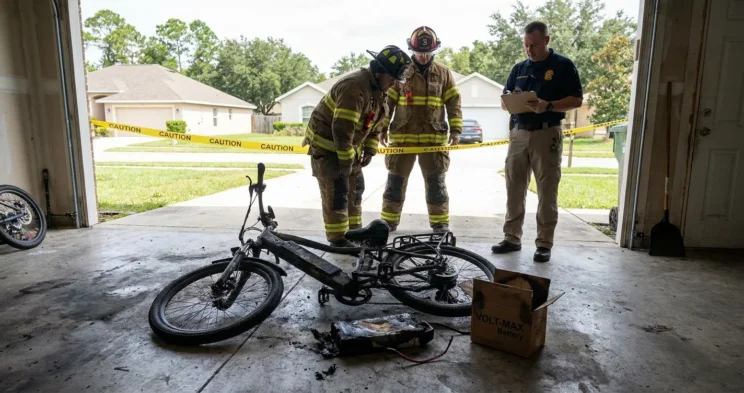
Your e-bike battery caught fire while charging in the garage. Or maybe it ignited while sitting in storage. Now you’re dealing with property damage or, worst case, an injury. Battery fires like these are often linked to defective products, not consumer mistakes. In some situations, the manufacturer, importer, or seller may be legally responsible for the damage caused by the fire.
Why E-Bike Battery Fires Happen
Lithium-ion batteries store a large amount of energy in a small space. If a battery cell is damaged, poorly manufactured, or lacks proper safety protections, it can overheat and enter a chain reaction known as thermal runaway. When that happens, the battery may catch fire or explode. Battery fires may also result from defective chargers, faulty wiring, poor battery management systems, or low-quality components that fail during normal use.
The Consumer Product Safety Commission (CPSC) has documented a growing number of e-bike battery fires in recent years. Investigations and recalls have identified problems involving defective batteries, unsafe electrical systems, and products that failed to meet recognized safety standards.
E-Bike Battery Recalls & Safety Standards
Between 2024 and 2026, the CPSC issued battery warnings or recalls involving brands including Rad Power Bikes, FENGQS, VIVI, and Pacific Cycle. In one warning involving Rad Power Bikes, the CPSC documented 31 fire reports. Some of those fires occurred while batteries were being stored unconnected to a charger.
Safety standards have become a major focus of these investigations. UL 2849 is the recognized safety standard for e-bike electrical systems, including the battery, charger, and drivetrain. In 2022, the CPSC called on manufacturers, importers, retailers, and distributors to comply with this standard because of the risk of fire and serious injury.
Who Can Be Held Liable in a Texas Battery Fire Lawsuit
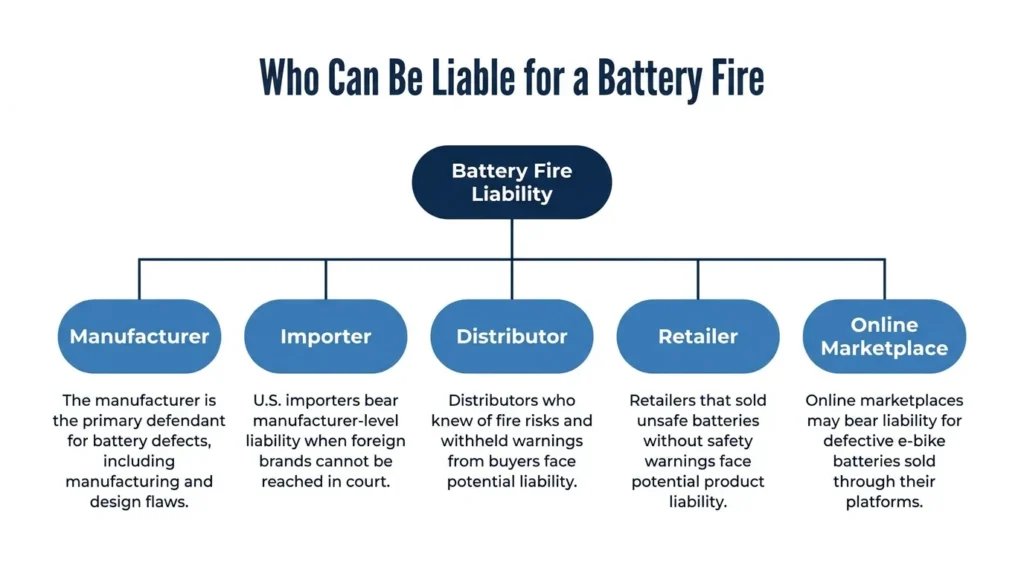
More than one party may be responsible for your e-bike battery catching on fire. Liability often depends on where the defect originated and who played a role in getting the product to consumers.
The Manufacturer
The manufacturer is the primary defendant in a battery fire lawsuit. Texas product liability law allows claims against manufacturers for defective products that cause injury or property damage. A claim may proceed under manufacturing defect, design defect, or failure to warn theories, and the manufacturer’s knowledge of the defect matters most for exemplary damages.
The Importer
Many defective e-bikes come from foreign manufacturers that are insolvent, out of business, or located overseas. When the foreign manufacturer cannot be brought before a Texas court, the U.S. importer steps into the manufacturer’s role. Under Texas law, an importer who introduces a product into U.S. commerce can bear manufacturer-level liability.
Distributors & Retailers
Under Texas Civil Practice and Remedies Code § 82.003, sellers have limited liability in product liability actions. A seller is not liable unless it participated in the product’s design, altered or modified the product, made a misrepresentation about the product’s safety, or failed to exercise reasonable care with respect to a known product risk. A retailer that sold a battery brand it knew had documented fire incidents without warning customers may fall into one of those exceptions.
Online Marketplaces
When a defective product is sold through an online platform, questions may arise about the marketplace’s role in the transaction. Depending on the circumstances, liability may extend beyond the manufacturer and seller.
What a Texas Product Liability Claim Requires
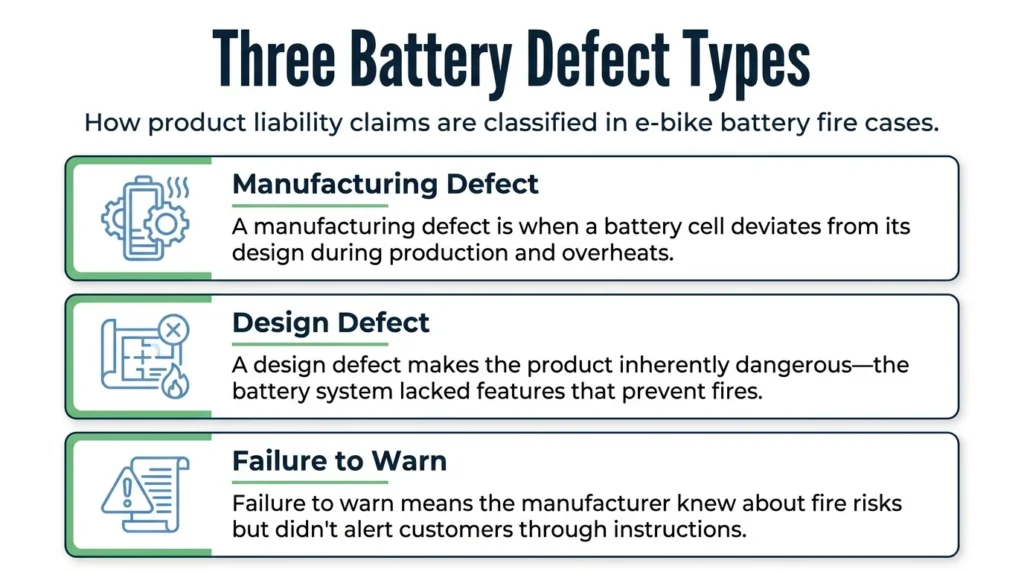
If an e-bike battery fire caused injuries or property damage, you must show that a defect in the product caused the loss. E-bike accident claims involving property damage generally fall into three categories.
1. Manufacturing Defect
A manufacturing defect exists when the product deviates from its intended design during production. A battery with a faulty cell that causes it to overheat and ignite is a manufacturing defect even if the design itself was safe. Similar issues often arise in cases involving defective e-bike parts and manufacturer liability.
2. Design Defect
Sometimes a product is unreasonably dangerous because of its design. In battery fire cases, allegations may involve unsafe battery systems, non-certified components, or the absence of safety features that could have reduced the risk of fire. Under § 82.005, the plaintiff must show that a safer design was economically and technically feasible.
3. Failure to Warn
A failure-to-warn claim under § 82.006 applies when the product lacked adequate instructions or warnings regarding a known fire risk. For example, a company that knew its batteries had a tendency to overheat but failed to warn consumers about that risk may face liability.
Regardless of the type of defect involved, you generally must show that the product was defective, the defect existed when it left the manufacturer’s control, the defect caused the fire, and you suffered actual harm as a result.
What Victims Can Recover
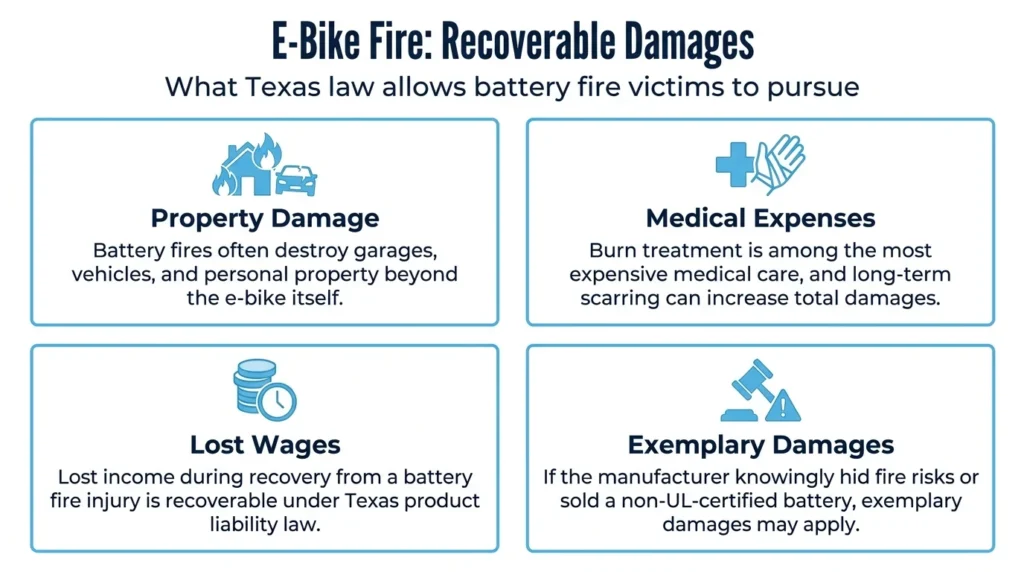
You may have lost much more than just the damage to your bike itself. You may be able to recover more damages. Property damage covers the cost of repairing or replacing your home, vehicle, garage, and the personal property destroyed in the fire. Fires that start in garages or charging areas can cause extensive structural damage beyond the e-bike itself.
Medical expenses cover treatment for burn injuries, smoke inhalation, and any physical harm caused by the fire. Burn treatment is among the most expensive forms of medical care, and long-term scarring or impairment can increase both economic and non-economic damages.
Lost wages compensate for income lost during recovery. Pain and suffering compensate for physical pain, emotional distress, and reduced quality of life.
A Consumer Product Safety Commission (CPSC) recall or stop-use warning involving the same battery model may help support a claim. Evidence that a product failed to meet recognized safety standards may also be relevant when investigators evaluate the cause of a battery fire.
Talk to an Attorney About an E-Bike Battery Fire
If an e-bike battery fire damaged your property or caused injuries, you may have questions about what happened and who may be responsible. Battery fire cases often involve defective products, recalls, and evidence that can disappear. We can help investigate the cause of the fire, identify the companies involved, and determine what legal options may be available to you.
Angel Reyes & Associates has represented injury victims across Texas for more than 30 years. We have recovered more than $1 billion for our clients. We offer free initial consultations and work on a no-fee-unless-you-win basis. Our case results include examples of claims we have handled across Texas. To discuss your situation, contact us for a free consultation.
Past results do not guarantee future outcomes.
E-Bike Battery Fire FAQs
Does a CPSC recall mean I automatically have a claim?
Not automatically, but a CPSC recall or stop-use warning is strong evidence that a defect existed and that the manufacturer or seller was aware of it. If a recall and a fire cover your e-bike or battery occurred, you have a solid foundation for a product liability claim. An attorney can evaluate whether the known defect caused your specific injury or property damage.
My e-bike came from a company I can't find online. Can I still pursue a claim?
Possibly. Many e-bikes and replacement batteries are manufactured overseas. If the manufacturer cannot be located or brought before a Texas court, a U.S. importer or another company involved in the distribution chain may still be responsible.
What if the fire happened while the battery was not charging?
A battery does not need to be connected to a charger to fail. Some recalls and fire investigations have involved batteries that ignited while in storage or sitting unused. The circumstances of the fire can help investigators determine whether a defect was involved.
Can I sue if my e-bike battery caught fire?
Yes. If a lithium battery defect caused the fire, you may have a product liability claim against the manufacturer, importer, or seller. Texas product liability law applies when a defective product causes property damage or personal injury.
What should I do after an e-bike battery fire?
If it is safe to do so, keep the battery, charger, purchase records, and photographs of the damage. These items may help investigators determine what caused the fire. Avoid disposing of the battery.
About the Authors

Angel Reyes
Writer
Angel L. Reyes, III is the Founder and Managing Partner of Angel Reyes & Associates. A nationally recognized trial attorney and business leader, Angel has helped over 70,000 injury victims recover more than $1 billion since founding the firm in 1993. Named to the Texas Super Lawyers list annually since 2008, Angel brings Wall Street experience, Ivy League education, and a deep commitment to client advocacy. He is a frequent legal commentator and published author with extensive contributions to legal scholarship, trial strategy, and consumer protection.

Kyle Nicolas
Editor
Kyle Nicolas is the Web Content & SEO Manager at Angel Reyes & Associates. He has more than 10 years of experience as a marketing co...

Angel Reyes
Reviewer
Angel L. Reyes, III is the Founder and Managing Partner of Angel Reyes & Associates. A nationally recognized trial attorney and business...