Early Total Loss in Texas: ACV Valuation, Salvage Titles & What Happens If You Still Owe on the Loan


Every article on this site is researched by our internal team, reviewed for legal accuracy against current Texas law, and held to State Bar of Texas advertising standards before publication. We do not publish content that overstates outcomes or makes promises about results.
Learn more about our
editorial standards .
Key Takeaways
- Texas insurers can declare a car a total loss before completing a full teardown estimate, making it essential to verify the accuracy of your vehicle's ACV valuation inputs.
- If your loan balance exceeds the insurance payout, you're responsible for the deficiency unless you have gap coverage.
- You can challenge a low total loss offer by requesting the valuation report, gathering comparable sales evidence, and using your policy's appraisal process if negotiation fails.
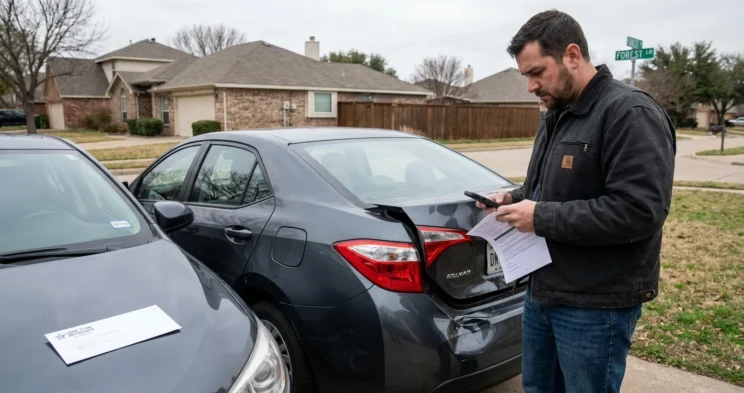
You were rear-ended in rush hour traffic on I-635 last week. The body shop hasn’t even finished tearing down your car, but the insurance adjuster already called it a total loss. Now you’re staring at a payout offer that won’t cover what you still owe on your loan.
This situation is more common than you might think for Dallas-area drivers, and understanding how Texas handles early total loss decisions can help you protect your claim rights.
Why a Car Can Be Declared a Total Loss Before a Full Teardown
Insurance companies don’t always wait for a complete repair estimate before making a total loss decision. When visible damage suggests repairs will exceed a certain percentage of your car’s value, adjusters often rely on preliminary assessments combined with information from valuation software.
Common triggers for an early total loss call include structural frame damage, airbag deployment, flood exposure, or damage patterns that historically lead to expensive supplemental repairs. Parts delays and labor costs in the current market can also push borderline cases into total loss territory faster than in previous years.
This doesn’t automatically mean the insurer made a mistake. However, early decisions create more room for errors in calculating your car’s value. The adjuster may have used the wrong trim level, missed factory options, or assumed your car’s condition was average when you’d actually maintained it meticulously.
The dispute usually isn’t about forcing the insurer to repair your car. Once a total loss decision is made, the real question becomes whether the actual cash value (ACV) they’re offering accurately reflects what your vehicle was worth immediately before the crash. Understanding how insurance handles car accident claims can help you spot where the process went wrong.
How Texas Law Defines Actual Cash Value
Actual cash value represents what your car was worth on the open market right before the collision. Texas doesn’t mandate a single formula for calculating ACV, but insurers typically use the replacement cost minus depreciation or comparable sales data from your area.
The Texas Department of Insurance explains that ACV should reflect what you could have sold your car for immediately before the loss.
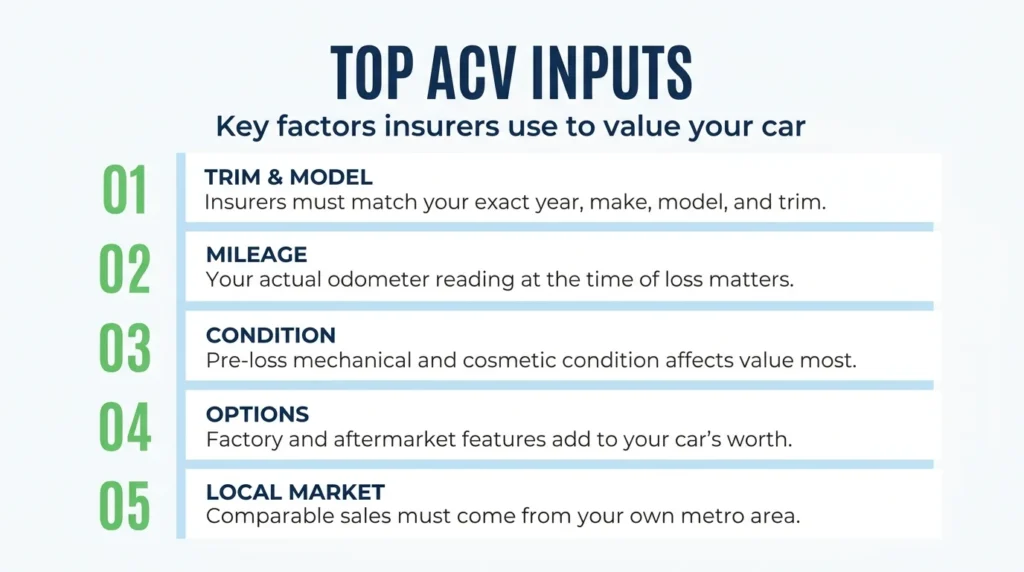
Key inputs that affect your ACV include:
- Year, make, model, and trim level
- Actual mileage at the time of loss
- Pre-loss mechanical and cosmetic condition
- Factory and aftermarket options
- Recent maintenance, new tires, or repairs
- Local market conditions in the Dallas-Fort Worth area
If any of these inputs are wrong in the insurer’s report, your ACV will be wrong too.
Valuation reports often pull data from services like CCC, Audatex, or Mitchell. These reports compare your car to similar vehicles sold recently in your region. Problems arise when the comparable vehicles don’t actually match yours. A base model comparison for your fully loaded vehicle, or comps from Houston when you’re in Collin County, can significantly undervalue your car.
Texas Title Branding & Salvage Thresholds
Under Texas Transportation Code Chapter 501, a vehicle becomes a “salvage motor vehicle” when damage exceeds a certain percentage of its ACV. The Texas Department of Motor Vehicles uses this threshold to determine when to brand a title.
Once your car receives a salvage title brand, that designation follows the vehicle permanently. Even after repairs, the title will show a “rebuilt” brand. This matters if you’re considering retaining your totaled vehicle or if you believe the insurer declared it totaled prematurely.
The salvage threshold connects directly to the ACV calculation. If the insurer undervalued your car, the damage-to-value ratio looks worse than it actually is. A vehicle that might have been repairable under an accurate valuation could cross into salvage territory under a lowball ACV.
If you live in a neighborhood like Austin’s West Lake Hills or Dallas’s Preston Hollow and own a newer vehicle, an incorrect early total loss decision can mean losing a car that you could have safely repaired. This is another reason to scrutinize the valuation report carefully.
What Happens When You Still Owe Money on a Totaled Car
When a lienholder is on your title, the insurance payout doesn’t come directly to you. The check goes to your lender first to satisfy the loan balance. Whatever remains after the loan payoff belongs to you.
The problem: your loan balance reflects what you borrowed plus interest, not what your car is currently worth. If you financed a new car with a small down payment, you may have been “upside down” on the loan before the crash ever happened. Depreciation hits hardest in the first few years of ownership.
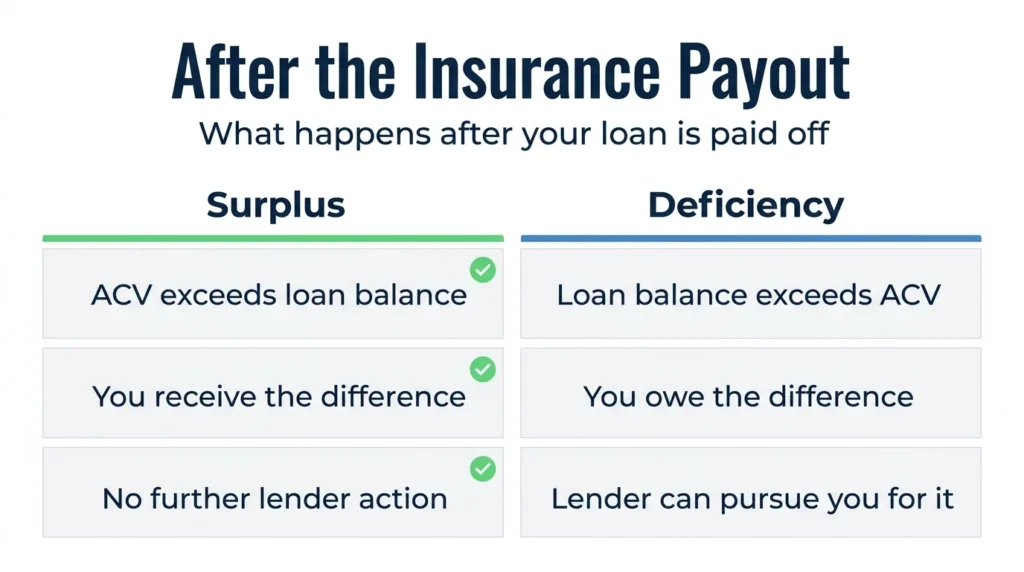
If the ACV payout is less than your loan balance, you’re responsible for the difference. This remaining amount is called a deficiency balance. The lender can pursue you for this money even though you no longer have the car.
Here’s how the payout typically flows:
- Your insurer determines the car’s ACV and issues payment.
- The check goes to the lienholder to pay off your loan.
- If the ACV exceeds the loan balance, you receive the surplus.
- If the loan balance exceeds the ACV, you owe the deficiency.
This is where gap insurance becomes critical. Gap coverage pays the difference between your car’s ACV and your remaining loan balance. If you purchased gap coverage through your lender or auto insurer, now is the time to file that claim.
Without gap coverage, you could find yourself making payments on a car you can no longer drive while also needing to finance a replacement vehicle.
How to Challenge a Total Loss Valuation in Texas
You have the right to dispute an ACV offer you believe is too low. The Texas Department of Insurance outlines several options for resolving payment disputes with your insurer.
Start by requesting the complete valuation report. This document shows exactly which comparable vehicles the insurer used and what condition adjustments they applied. Review it line by line for errors.
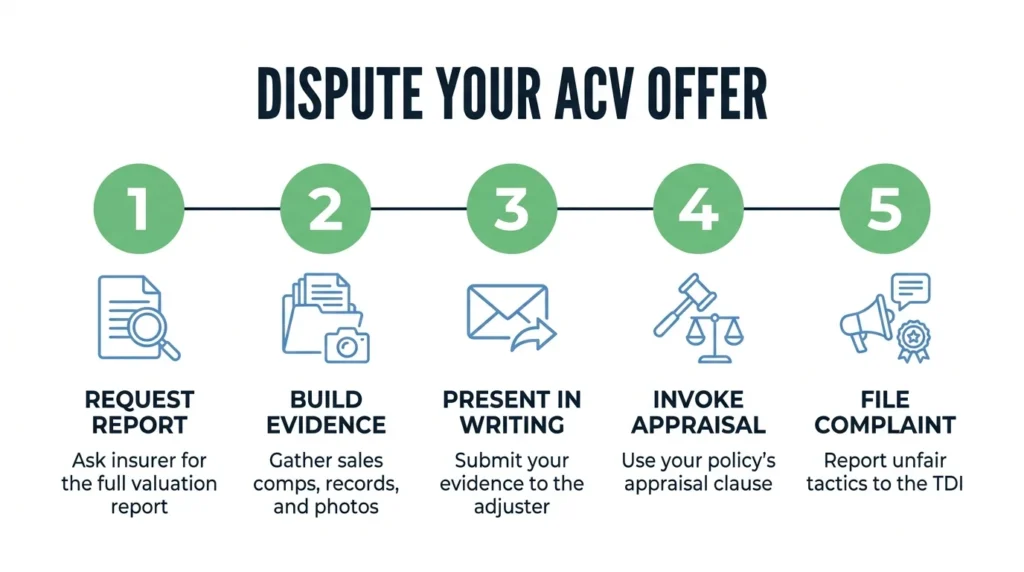
Build your own evidence packet:
- Gather recent sales listings for vehicles matching your exact year, make, model, and trim in the DFW area.
- Document your car’s pre-loss condition with maintenance records, photos, and receipts for recent repairs or upgrades.
- Note any options or features the insurer’s report missed.
- Check that the mileage in the report matches your actual odometer reading.
Present this evidence to the adjuster in writing. You may be able to resolve the dispute at this stage if you can demonstrate specific errors in the valuation inputs.
If direct negotiation fails, check your policy for an appraisal clause. Under appraisal, you and the insurer each hire an appraiser, and a neutral umpire resolves any disagreement. Recent Texas legislation (SB 458) requires binding appraisal provisions in many personal auto policies issued or renewed on or after January 1, 2026.
You can also file a complaint with the Texas Department of Insurance if you believe the insurer engaged in unfair settlement practices. Texas Insurance Code Chapter 541 prohibits insurers from misrepresenting policy provisions or failing to attempt good faith settlement when liability is reasonably clear.
Protecting Your Rights After a Total Loss
Knowing what to do after a car accident in Texas includes understanding your options when the at-fault driver’s insurer or your own company undervalues your claim. Texas Insurance Code Chapter 542 sets deadlines for how quickly insurers must acknowledge, investigate, and pay claims. Unreasonable delays or lowball tactics may violate these prompt payment requirements.
Keep copies of all communication with the insurance company. Document phone calls with the date, time, and name of the representative. Save every version of the valuation report and any written offers.
If you’re dealing with injuries from the same car accident, truck accident, or motorcycle accident that totaled your vehicle, the property damage claim is only one piece of your recovery. An attorney can help you understand how the total loss settlement affects your overall case.
We’re Here to Help Texas Drivers Navigate Total Loss Claims
Dealing with an early total loss decision while still owing money on your car creates real financial stress. Insurance companies are businesses that focus on resolving claims efficiently, which sometimes means offering less than your vehicle was actually worth.
At Angel Reyes & Associates, we’ve spent over 30 years helping Texas drivers protect their rights after accidents. Our clients’ experiences reflect our commitment to fighting for fair compensation. We offer free initial consultations, and you pay no fee unless we win your case.
If you believe your total loss valuation is too low or you’re facing a deficiency balance you shouldn’t owe, contact us today to discuss your options. We serve clients throughout Dallas, Collin, Denton, and Rockwall counties, and we’re available 24/7 to answer your questions.
Past results do not guarantee future outcomes.
Texas Totaled Car FAQs
Can I keep my car after it's declared a total loss in Texas?
Sometimes, yes, but the insurer may deduct the vehicle’s salvage value from the payout, and title branding rules can affect whether the car can be driven, repaired, or later sold. Whether owner-retention is practical often depends on the damage, the title status, and lender approval if there is still a loan.
Does gap insurance automatically pay the difference after a total loss?
No. Gap usually requires a separate claim, and coverage can exclude missed payments, late fees, warranties rolled into the loan, or negative equity from an earlier vehicle.
Will my extended warranty or service contract be refunded if my car is totaled?
It may be. Some vehicle service contracts, maintenance plans, and credit insurance products allow a prorated refund after a total loss, so it’s worth checking your purchase paperwork and lender documents.
What documents should I gather before signing total-loss paperwork?
Try to collect your loan payoff letter, the insurer’s valuation report, recent service receipts, payoff and gap insurance information, title or registration papers, and photos showing the car’s pre-loss condition. Having those items together can help you catch errors and avoid delays.
Can sales tax and registration fees be part of a Texas total-loss payment?
In many cases, yes. Texas total-loss settlements may include applicable motor vehicle sales tax and certain transfer or registration-related fees tied to replacing the vehicle, depending on the claim and supporting documentation.
About the Authors

Angel Reyes
Writer
Angel L. Reyes, III is the Founder and Managing Partner of Angel Reyes & Associates. A nationally recognized trial attorney and business leader, Angel has helped over 70,000 injury victims recover more than $1 billion since founding the firm in 1993. Named to the Texas Super Lawyers list annually since 2008, Angel brings Wall Street experience, Ivy League education, and a deep commitment to client advocacy. He is a frequent legal commentator and published author with extensive contributions to legal scholarship, trial strategy, and consumer protection.

Kyle Nicolas
Editor
Kyle Nicolas is the Web Content & SEO Manager at Angel Reyes & Associates. He has more than 10 years of experience as a marketing co...

Spencer Browne
Reviewer
Spencer Browne is a partner at Angel Reyes & Associates and a Board Certified personal injury trial lawyer with nearly 100 jury trials a...