Filing a Claim After a DART Bus Accident in Dallas


Every article on this site is researched by our internal team, reviewed for legal accuracy against current Texas law, and held to State Bar of Texas advertising standards before publication. We do not publish content that overstates outcomes or makes promises about results.
Learn more about our
editorial standards .
Key Takeaways
- Texas requires you to send DART written notice within six months of the crash.
- DART is a government entity, so damage caps limit what your claim can recover.
- If your claim stalls, you still have two years from the injury date to sue.
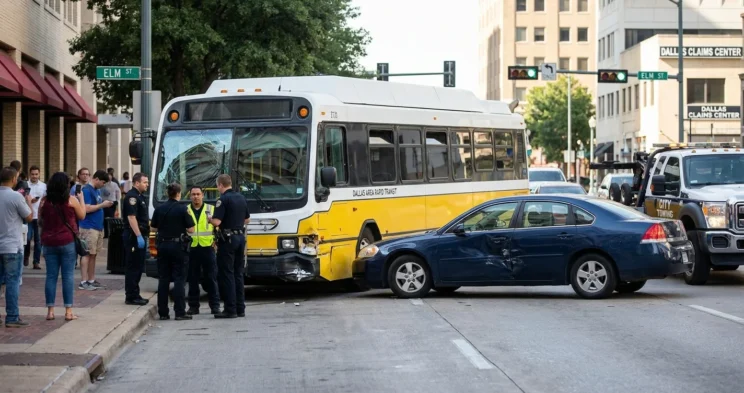
You were riding the DART bus home from your shift, somewhere near Deep Ellum, when it slammed into the car ahead and threw you into the seat rail. Your shoulder is throbbing, the medical bills are already stacking up, and you cannot afford to miss work. Filing a claim feels like the obvious next step. Then you learn that DART is not a private company, and the rules are different.
DART Bus Accidents Under Texas Law
DART is a government entity, not a private bus company, and that single fact reshapes your entire DART bus accident claim. Texas created the agency as a regional transportation authority under Texas Transportation Code Chapter 452, which governs how these transit systems run.
The law goes further. Texas Transportation Code § 452.0561 treats an authority like DART as a governmental unit. That puts your claim under the Texas Tort Claims Act, found in Chapter 101 of the Texas Civil Practice and Remedies Code (CPRC).
Because DART counts as a government body, you face requirements a private-driver claim never involves. You must send formal written notice within a fixed window, and state law caps what you can recover.
Both hurdles catch people off guard. Knowing how claims against public transit work before you begin helps you avoid an early misstep.
A claim against a government-run transit system follows its own path, and learning how to sue a government entity early protects your case.
Dallas DART Bus Accident Liability
More than one party can be responsible for a DART bus crash. The bus operator, DART itself, and other drivers on the road may each share the blame. Who is liable in a DART bus accident decides which rules govern your claim.
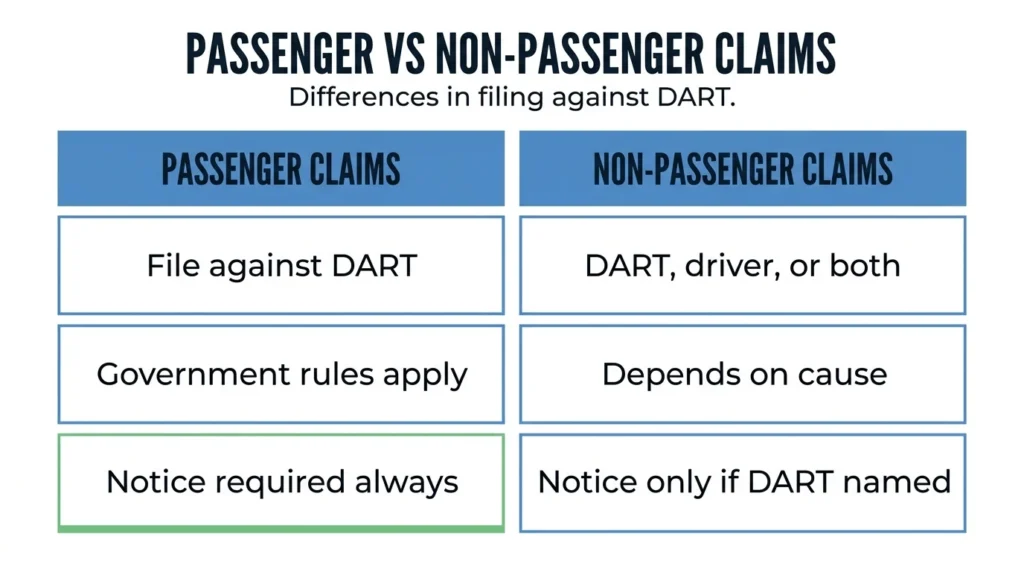
Passenger Injury Claims
If a DART bus injured you while you were riding it, you usually file directly against DART as the operator. This is where the government-claim steps in this article apply most directly. Operator negligence and equipment failure both fall under the notice and cap rules below, the same standards that shape most Dallas bus accident claims.
Non-Passenger Injury Claims
If a DART bus struck you as a pedestrian or another driver, your claim may run against DART, a third-party driver, or both. Which rules apply depends on who actually caused the crash.
A pedestrian pursuing DART directly still must meet the same six-month notice and deadline rules. That mirrors how other Dallas pedestrian accident claims proceed against a government defendant.
When a different driver caused the wreck, that part of your claim follows ordinary negligence rules instead of the government process. Our guide to filing a bus accident claim in Texas walks through how those standard claims work.
DART Notice of Claim Deadline
You must give DART written notice of your claim within six months of the crash. This notice is separate from any report taken at the scene, and missing it can end your claim before it starts.
The deadline comes from Texas Civil Practice and Remedies Code § 101.101, the notice rule for claims against government bodies.
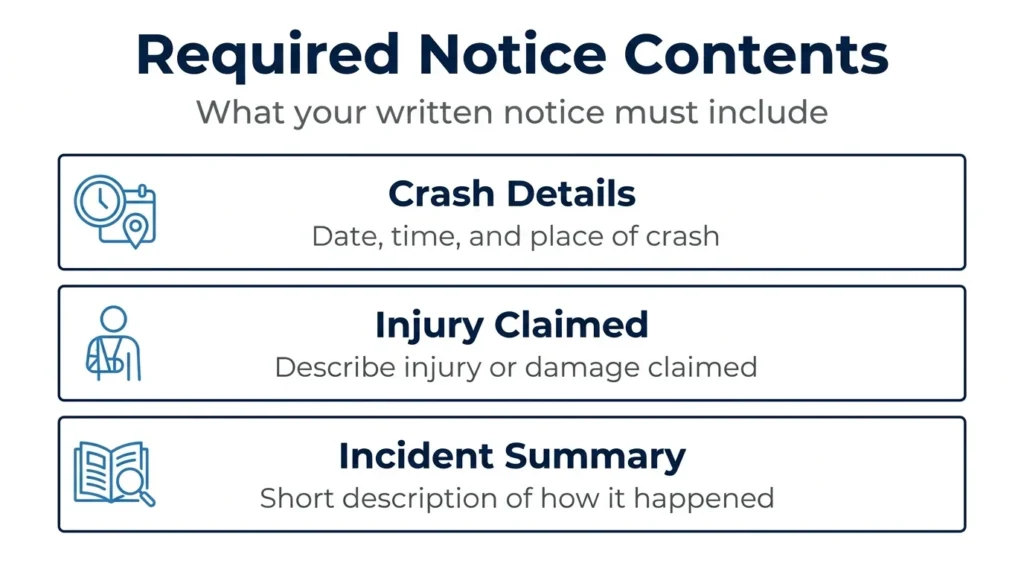
Your written notice does not need to be formal, but it must give DART enough to identify the claim. Include the core facts:
- The date, time, and place of the crash
- The injury or damage you are claiming
- A short description of how the incident happened
Do not assume the report a DART official completed at the scene protects you. Under the Texas Tort Claims Act, an on-scene or verbal report is not the same as the formal written notice Section 101.101 requires, so send your own written notice regardless of what was documented at the scene.
Courts treat this six-month deadline as strict, and factors like a minor’s age or a legal incapacity generally will not extend it the way they can extend a filing deadline. The only recognized exception applies when DART already has actual notice of your injury. Do not count on an exception applying to you, and treat the deadline as firm.
DART Bus Accident Recovery Caps
Even a strong DART claim will not pay unlimited damages. As a government body under the Texas Tort Claims Act, DART benefits from damage caps that limit what you can recover. CPRC § 101.023 sets those limits.
DART’s status as a regional transportation authority may place it at a different cap tier than a city or county, but the statute does not spell out exactly which tier applies to an authority like DART. That is a detail worth confirming with an attorney early in your case.
The exact dollar figures depend on that classification, so confirm them for your case. Our breakdown of Texas Tort Claims Act bus accident limits explains how these caps apply.
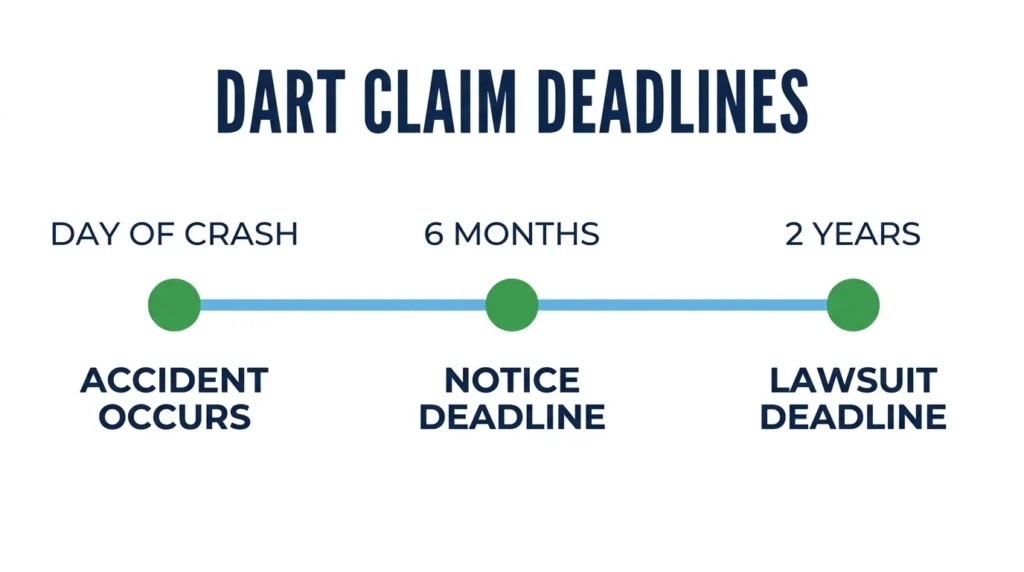
If you and DART do not resolve your claim during the notice period, you still have more time to sue. Texas generally gives you two years from the injury date to file that lawsuit. That deadline comes from CPRC § 16.003, the state’s general personal injury statute of limitations.
As a cap sets your ceiling, a closer look at how bus accident claims are valued helps you account for every loss.
Full documentation is what separates a capped claim that still pays well from one that leaves money behind. You can see how thorough records shape results in our client reviews and case outcomes.
Work with a Dallas DART Accident Attorney
A DART claim runs on a tighter clock and stricter rules than a claim against a private driver. You do not have to sort through it alone.
Angel Reyes & Associates has guided injured Texans for more than 30 years, and we know how DART claims move through Dallas County. We work from offices across Texas, including here in Dallas.
You can read our firm’s background to see how we handle cases like yours. Our record includes more than $1 billion recovered for clients.
You pay no fee unless we win, and we will explain any court costs and case expenses before we start. When you are ready, schedule a free consultation so you understand your options before the six-month notice window closes.
Past results do not guarantee future outcomes.
Frequently Asked Questions
What if I was partly at fault for the DART bus accident?
Texas law still lets you recover if you were 50% or less at fault, but your award shrinks by your share of the blame. If you were more than half at fault, you cannot recover anything.
Can I still use my own car insurance's PIP or MedPay while my DART claim is pending?
Yes, PIP and MedPay are your own coverage, so you can use them for medical bills while your DART claim moves forward. MedPay may later seek repayment from your settlement, but PIP usually does not.
Does DART On-Call, the paratransit service, follow the same claims process as a regular DART bus?
Yes, DART On-Call falls under the same government status as DART’s fixed-route buses, so the same notice deadline and damage caps generally apply.
Is there any way to meet DART's notice requirement without sending formal written notice?
In rare cases, Texas courts allow proof that DART already knew about the injury and its own fault, known as actual notice. This exception is hard to prove, so you should still send written notice inside the six-month window.
Do I still need a police crash report if DART already made an on-scene report?
Yes, Texas law requires an officer to file a separate written crash report for any collision that causes injury or over $1,000 in damage. That police report is different from both DART’s internal report and the written notice of claim you must send.
About the Authors

Angel Reyes
Writer
Angel L. Reyes, III is the Founder and Managing Partner of Angel Reyes & Associates. A nationally recognized trial attorney and business leader, Angel has helped over 70,000 injury victims recover more than $1 billion since founding the firm in 1993. Named to the Texas Super Lawyers list annually since 2008, Angel brings Wall Street experience, Ivy League education, and a deep commitment to client advocacy. He is a frequent legal commentator and published author with extensive contributions to legal scholarship, trial strategy, and consumer protection.

Graham Griffin
Editor
Graham Griffin is the Web & Content Manager at Angel Reyes & Associates, where he oversees content strategy, AI-powered workflows, a...

Angel Reyes
Reviewer
Angel L. Reyes, III is the Founder and Managing Partner of Angel Reyes & Associates. A nationally recognized trial attorney and business...