What Is the Common Fund Doctrine?


Every article on this site is researched by our internal team, reviewed for legal accuracy against current Texas law, and held to State Bar of Texas advertising standards before publication. We do not publish content that overstates outcomes or makes promises about results.
Learn more about our
editorial standards .
Key Takeaways
- Chapter 140 limits covered reimbursement and deducts allocated legal fees and costs.
- Court-awarded fees under Chapter 140 are capped at one-third of the payor's recovery.
- Check plan funding, reimbursement terms, and settlement costs before accepting a demand.

The common fund doctrine is the principle that parties who benefit from a recovery should share the legal costs of creating it. If your health plan demands repayment from your injury settlement, that principle can affect how much of the recovery goes back to the plan.
In Texas, covered health plan reimbursement claims fall under Chapter 140 of the Civil Practice and
Remedies Code. That statute caps what covered payors can collect and requires them to share in the attorney fees that produced the recovery. Whether it applies to you depends on the type of plan you have and where the money comes from.
What Does the Common Fund Doctrine Mean?

The common fund doctrine divides the legal costs of a recovery among the parties who benefit from it. When your lawyer’s work produces a settlement, a health plan seeking repayment from that settlement benefits from the same work.
Your lawyer may create the settlement fund through investigation, negotiation, and litigation. If the health plan seeks part of that money without contributing to the recovery costs, you would carry the full cost of collecting money that partly goes to the plan. Fee sharing addresses that problem.
The U.S. Supreme Court described this reasoning in U.S. Airways, Inc. v. McCutchen. The doctrine does not create a new claim against the person who hurt you. It addresses how recovery costs are split between you and the plan.
The principle alone does not decide your result. Texas statutory rules and federal ERISA rules follow different paths, so identifying the plan matters before calculating its reimbursement.
How Does Texas Chapter 140 Limit Reimbursement & Share Fees?
For a contractual reimbursement claim covered by Chapter 140, all payors together can recover no more than the lesser of one-half of your gross recovery or the cost of the injury-related benefits they paid. If you have a lawyer, both of those figures are reduced by the attorney fees and procurement costs assigned under § 140.007.
Chapter 140 covers contractual reimbursement for benefits paid because of injuries caused by someone else’s wrongful conduct, such as a careless driver on I-35. It reaches insured health plans, certain governmental arrangements, and some self-funded issuers. The policy or contract must be delivered, issued for delivery, or entered into in Texas, or it must entitle a person or group in Texas to benefits.
How the Payor’s Share of Attorney Fees Is Set
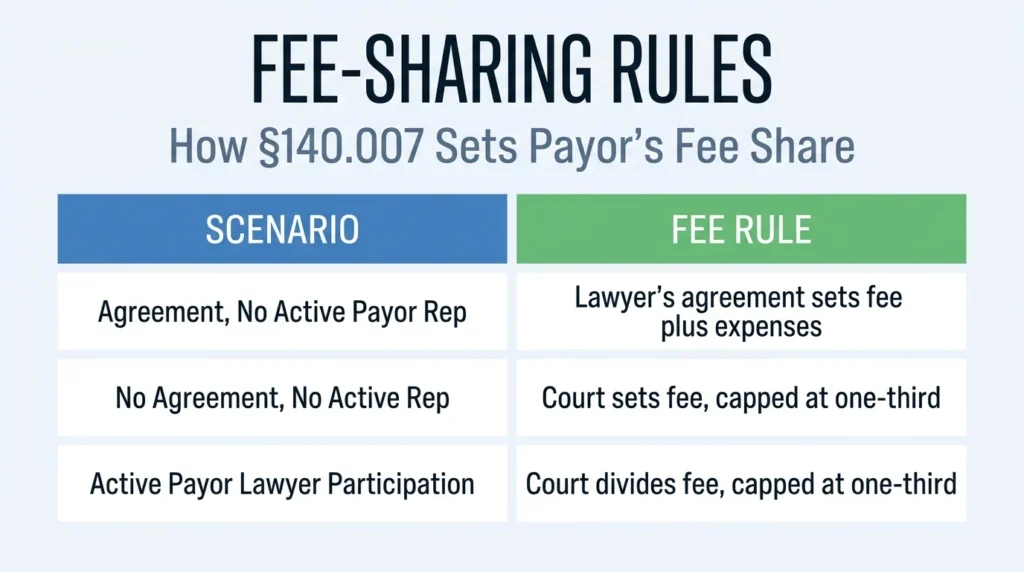
Section 140.007 determines how the payor contributes to the fees. The route depends on whether there is an agreement and whether the payor’s own lawyer actively worked on the recovery:
- Agreement without active payor representation: If the payor’s lawyer is not actively involved, the payor’s agreement with your lawyer sets the fee, plus a proportionate share of expenses.
- No agreement and no active payor representation: A court awards a reasonable fee, capped at one-third of the payor’s recovery, plus a proportionate share of expenses.
- Active participation by the payor’s lawyer: A court divides the fee based on how much each lawyer’s work benefited the payor, subject to the same one-third total fee cap.
These rules do not create a fixed, universal discount. The math turns on your recovery, the benefits paid, and the applicable fee-allocation rule.
Why an Incomplete Settlement Does Not Erase the Demand
Chapter 140 states that the made-whole doctrine does not apply. A settlement that falls short of your full losses does not, by itself, wipe out a covered payor’s reimbursement claim. The statutory cap and fee sharing limit what the payor may collect.
Which Plans & Proceeds Fall Outside Chapter 140?
Your plan type and the source of the money determine whether Chapter 140’s limits apply. Section 140.002(f) excludes these programs and plans:
- Workers’ compensation
- Medicare
- Medicaid and Medicaid managed care
- State child-health programs under Chapters 62 and 63
- Self-funded ERISA plans
These excluded programs and plans follow other reimbursement rules.
Why Self-Funding Alone Does Not Settle the Question
The exclusion covers self-funded ERISA plans, not every self-funded plan. Not every employer plan is an ERISA plan. Check the governing documents and the plan’s legal category before treating it as excluded.
How to Tell an Insured Plan From a Self-Funded Plan
The Texas Department of Insurance distinguishes plans where an insurance company pays the claims from plans where an employer pays them. A familiar insurer’s name on your card does not answer the question, because an insurer may only administer the plan. TDI points to “TDI” or “DOI” markings on the card and “ASO” language as useful clues.
TDI’s guide to employer self-funding explains that third-party administrators can manage claims using employer money. Some employers also buy stop-loss insurance to protect themselves against certain claim costs. Neither an administrator’s logo nor stop-loss coverage replaces checking who actually funds your benefits.
Money From Your Own Insurance Policies
Section 140.008 generally bars a covered payor from taking reimbursement out of your first-party recovery, meaning money recovered under insurance covering you. A payor may pursue uninsured or underinsured motorist coverage or medical payments coverage only if neither you nor your immediate family paid the premiums for that coverage.
What If the Health Plan Is Self-Funded & Governed by ERISA?
If your plan is a self-funded ERISA plan, Chapter 140 does not apply, but that exclusion does not decide the repayment amount or the fee share. Under McCutchen, when an ERISA plan sues to enforce an equitable lien by agreement, the plan’s written terms control over general fairness principles.
The same decision leaves room for the common fund doctrine. If the plan’s reimbursement language says nothing about how attorney fees are shared, common-fund principles can fill that gap. An ERISA plan is not automatically owed full repayment, and you are not automatically owed a reduction.
Reviewing the governing plan document is essential to determining the fee share. If you are still unsure how your plan is funded, TDI’s self-funded plan guidance directs you to your plan documents or your benefits administrator.
What Should You Gather Before Accepting a Reimbursement Demand?
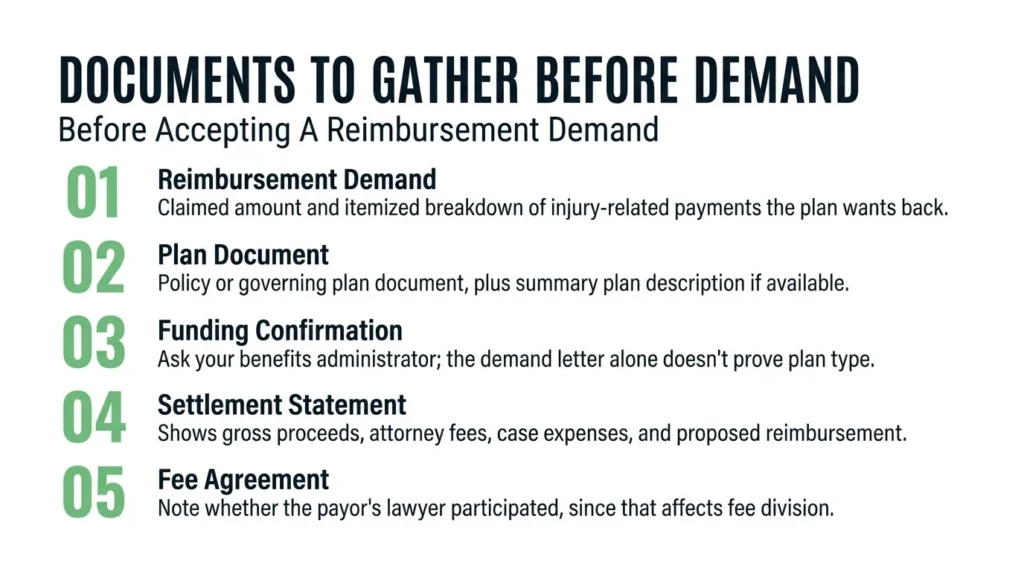
The right documents let a lawyer identify the payor, check the plan’s legal category and terms, and compare the demand with your settlement. Gather these before you accept any reimbursement figure:
- The reimbursement demand. Include the claimed amount and the itemized breakdown of injury-related payments so your lawyer can see which benefits the plan wants back.
- The policy or governing plan document. Add the summary plan description if you have one. These set out the reimbursement terms.
- Confirmation of who funds your benefits. Ask your benefits administrator. The demand letter alone does not prove whether a plan is insured or self-funded.
- The settlement statement. It should show gross proceeds, attorney fees, case expenses, and the proposed reimbursement.
- Any fee agreement with the payor. Note whether the plan’s own lawyer took part in the case, because that affects how fees are divided.
Collecting these documents does not guarantee a lower repayment. It gives you and your lawyer what you need to check whether the demand follows the rules that apply to your plan.
Speak With Angel Reyes & Associates About a Reimbursement Demand
A health plan’s repayment letter can feel final, but the amount it demands is not always the amount the law allows. Angel Reyes & Associates can review your situation in a free consultation.
Bring the reimbursement demand, your plan documents, and your settlement statement. We can walk you through which rules apply and what your options are. Contact Angel Reyes & Associates to schedule your free consultation.
Past results do not guarantee future outcomes.
Common Fund Doctrine FAQs
Can a health insurance company put a lien on my personal injury settlement in Texas?
A health plan may have contractual subrogation or reimbursement rights against a third-party recovery when applicable law permits them, but the scope of those rights depends on the plan and the governing statute. Chapter 140, for plans it covers, specifically regulates contractual subrogation and reimbursement claims.
What happens if a health plan refuses to reduce its reimbursement demand?
The demand should be compared with the plan documents, payment records, settlement amount, and applicable fee-sharing rules. Depending on the plan and governing law, those materials may provide grounds to dispute the amount being claimed.
What should I do if a health plan contacts my personal injury lawyer directly?
Provide the correspondence to your lawyer and avoid agreeing to a reimbursement amount before the claim is reviewed. The lawyer can determine whether the plan has enforceable rights and which reimbursement rules apply.
About the Authors

Angel Reyes
Writer
Angel L. Reyes, III is the Founder and Managing Partner of Angel Reyes & Associates. A nationally recognized trial attorney and business leader, Angel has helped over 70,000 injury victims recover more than $1 billion since founding the firm in 1993. Named to the Texas Super Lawyers list annually since 2008, Angel brings Wall Street experience, Ivy League education, and a deep commitment to client advocacy. He is a frequent legal commentator and published author with extensive contributions to legal scholarship, trial strategy, and consumer protection.

Graham Griffin
Editor
Graham Griffin is the Web & Content Manager at Angel Reyes & Associates, where he oversees content strategy, AI-powered workflows, a...

Angel Reyes
Reviewer
Angel L. Reyes, III is the Founder and Managing Partner of Angel Reyes & Associates. A nationally recognized trial attorney and business...