How a DUI by the Other Driver Affects Your Motorcycle Accident Case


Every article on this site is researched by our internal team, reviewed for legal accuracy against current Texas law, and held to State Bar of Texas advertising standards before publication. We do not publish content that overstates outcomes or makes promises about results.
Learn more about our
editorial standards .
Key Takeaways
- A DUI crash can qualify as gross negligence in Texas, adding exemplary damages to your claim.
- Texas law gives you two years to file a civil claim, independent of the criminal case timeline.
- Dram shop liability may extend your recovery to the bar that over-served the drunk driver.
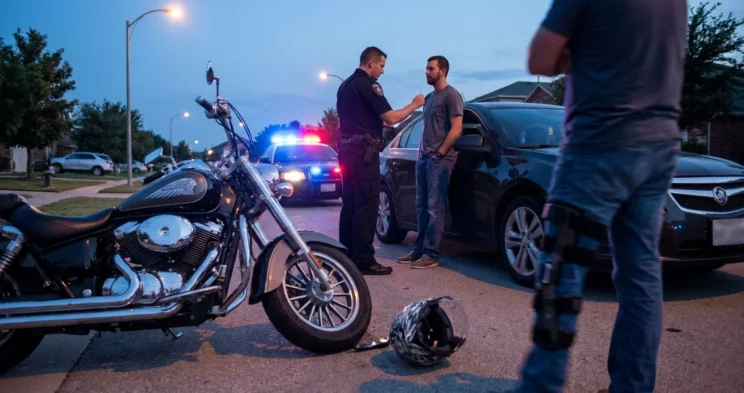
You were riding home on the I-35 corridor one night when a drunk driver blew a red light and slammed into your bike. The crash was not close. The other driver failed a roadside sobriety test at the scene, and you watched police place him in handcuffs.
Now you are dealing with hospital bills, a totaled motorcycle, and missed work. The other driver faces criminal charges, and you are trying to figure out what your civil claim is worth. Whether the DUI changes anything is the right question to be asking.
It does. Significantly.
Why a DUI Crash Is Not a Standard Negligence Case
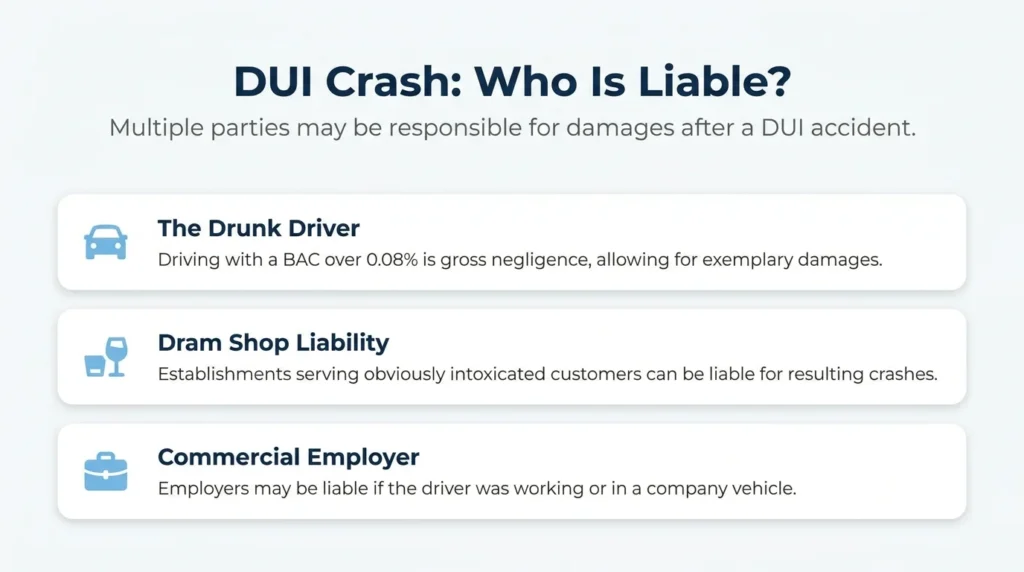
A drunk driver who hits your motorcycle does not just commit ordinary negligence. Under Texas law, driving while intoxicated is routinely classified as gross negligence, and that classification opens a damages category unavailable in typical crash cases.
Standard personal injury claims require proof that a driver owed you a duty, breached it, and caused your injuries. A DUI motorcycle accident claim proves those elements quickly. The harder question is whether the driver’s conduct rises to the level required for exemplary damages, and in drunk driving cases, it frequently does.
The Texas Civil Practice and Remedies Code (CPRC) § 41.003 allows exemplary damages when a plaintiff proves by clear and convincing evidence that the harm resulted from gross negligence, malice, or fraud.
Gross negligence requires showing that the defendant was aware of an extreme risk of harm and consciously disregarded that risk. A driver who gets behind the wheel with a blood alcohol content above 0.08 percent near other motorists has consciously disregarded the safety of everyone around them.
Texas Penal Code § 49.04 defines the DWI offense as operating a motor vehicle in a public place while intoxicated. The police report, the field sobriety test results, the breathalyzer reading, and the criminal charge together create a factual record your attorney can use in the civil case to establish gross negligence. You do not have to build that record from scratch.
For motorcycle riders, the gross-negligence argument is especially strong. Motorcycles offer no structural protection. A drunk driver who enters an intersection or drifts out of a lane near a rider creates an extreme risk of death or serious injury.
That exposure is exactly what the Texas motorcycle accident claims process is built around, and the DUI element takes it a significant step further.
What Exemplary Damages Add to Your Claim
Exemplary damages are not a bonus on top of your regular compensation. It is a legally distinct category that punishes conduct well above ordinary carelessness and can substantially increase the total value of your case.
Texas caps exemplary damages under CPRC § 41.008 at the greater of two amounts. The first option is two times your economic damages plus noneconomic damages up to $750,000. The second option is $200,000 if no economic damages were awarded.
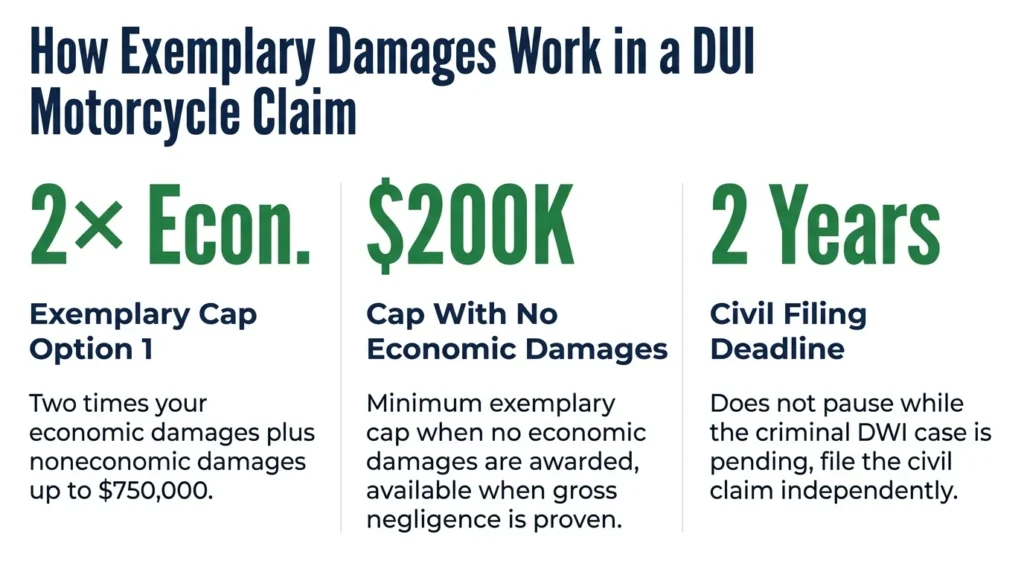
Economic damages include your medical bills, lost wages, and property damage. Noneconomic damages cover pain, suffering, and mental anguish.
To put that in concrete terms: if your economic damages total $150,000 and the jury awards $100,000 in noneconomic damages, the exemplary cap in your case would be $400,000. That is $300,000 (two times economic) plus $100,000 in noneconomic damages, a significant addition to your base compensation.
One practical reality affects settlement negotiations: standard auto liability insurance policies often do not cover punitive damages. When a drunk driver’s personal assets are in play for the exemplary portion, insurers and defense counsel recognize the increased exposure and tend to approach settlement conversations differently. Understanding the drunk driver hit motorcycle case value means accounting for both the compensatory and exemplary damages together.
Two Tracks Running at the Same Time
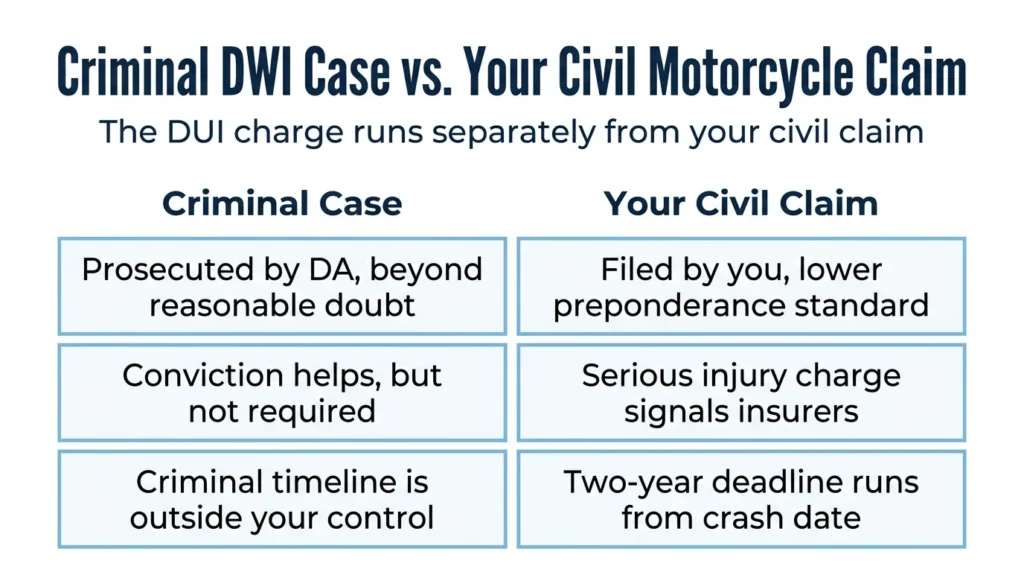
After a drunk driver hits your motorcycle, two separate legal proceedings begin. The state prosecutes the driver criminally. You pursue a civil claim for your damages. These tracks run at the same time and under different rules, but the facts underlying both are the same.
The criminal prosecution is handled by the district attorney. Your civil claim is yours to file and control. Texas law under CPRC § 16.003 gives you two years from the date of injury to file a civil lawsuit. That clock does not pause while the criminal case proceeds. Waiting for the DWI case to resolve before you act on the civil side is a risk you cannot afford.
If the driver is charged with Intoxication Assault under Texas Penal Code § 49.07, that means prosecutors have found that serious bodily injury resulted from the crash. A third-degree felony charge of that nature carries weight in settlement discussions and signals to insurers that the facts of your case are serious.
A guilty plea or conviction by the drunk driver can be introduced in your civil case as evidence. It does not automatically resolve the civil matter, but it substantially reduces the evidence-related issue you face when proving intoxication and recklessness.
The civil standard is the standard of proof of the evidence, or more likely than not, compared to the criminal standard of beyond a reasonable doubt. A conviction makes your civil case easier to establish.
For context on how drunk driving accident settlements in Texas are typically structured and what factors affect the final amount, the general settlement landscape is worth understanding alongside your DUI-specific claim strategy.
Other Defendants You May Not Have Considered
The drunk driver is not always the only party with legal exposure. If someone served that driver alcohol before the crash, Texas law may give you a claim against that establishment as well.
The Texas Alcoholic Beverage Code Chapter 2 allows a dram shop claim against a bar, restaurant, or other provider when two conditions are met: the person being served was obviously intoxicated to the degree of presenting a clear danger to others, and that intoxication was a proximate cause of your damages.
The bar cannot avoid liability by claiming ordinary service errors. The standard requires obvious intoxication that is visible to a reasonable observer.
This is important when the drunk driver carries only minimum liability coverage. A commercial establishment that over-served carries general liability insurance, which is often a larger and more accessible pool of compensation than a private driver’s personal policy. You can pursue the dram shop claim alongside your claim against the driver.
Evidence in a dram shop claim includes surveillance footage from the bar, receipts showing the quantity and timing of alcohol service, and witness accounts from staff and other patrons. Gathering that evidence quickly is important because surveillance footage is routinely overwritten within days.
You can review your rights as a drunk driving crash victim in Texas, including how dram shop claims interact with your insurance recovery; that additional context can help you understand the full landscape of what you may be owed.
Work with an Experienced Attorney
A DUI motorcycle accident claim involves criminal evidence, exemplary damages analysis, insurance coverage research, and potentially a dram shop claim. All of these elements run under tight deadlines, and most people cannot manage them alone while recovering from serious injuries.
Angel Reyes & Associates has handled motorcycle accident and drunk driving claims across Texas for over 30 years. Our team works on contingency, meaning no fee unless we win, and we offer free consultations available 24/7. If a drunk driver hit your motorcycle, contact us to review your options before the two-year window closes.
Past results do not guarantee future outcomes.
DUI Motorcycle Accident Claim FAQs
Can not wearing a helmet reduce my DUI motorcycle accident settlement?
Texas applies modified comparative fault, so an insurer may argue that the absence of a helmet contributed to your head and neck injuries and ask to reduce your recovery by a percentage. This argument applies only to injuries a helmet could have prevented, not to broken bones, internal injuries, or other trauma unrelated to head protection.
Does a DUI motorcycle accident claim settle faster than a regular crash claim?
Not always. The criminal proceedings against the drunk driver can run parallel to your civil case and sometimes influence how quickly the insurer is willing to negotiate. Cases involving serious injuries and exemplary damages tend to take longer to settle because both sides have more at stake.
What if the drunk driver was never convicted?
A criminal conviction strengthens your civil case but is not required. Texas civil courts use a preponderance of the evidence standard, meaning you can prevail if the evidence shows it is more likely than not that the driver was intoxicated and caused your injuries, even without a guilty verdict.
Can a passenger on my motorcycle make a DUI accident claim?
Yes. A passenger injured in a DUI motorcycle crash has an independent right to file a civil claim against the drunk driver and, where applicable, against a bar or restaurant that over-served that driver.
About the Authors

Spencer Browne
Writer
Spencer Browne is a partner at Angel Reyes & Associates and a Board Certified personal injury trial lawyer with nearly 100 jury trials across Texas. He focuses on car, truck, and wrongful death cases, with notable verdicts including a landmark win in the Choctaw Casino bus crash case. A recognized speaker and legal educator, Spencer is a member of the American Board of Trial Advocates and has been honored as a Texas Super Lawyer and one of D Magazine’s Best Lawyers in Dallas. He brings deep trial experience and relentless advocacy to every client he represents.

Kyle Nicolas
Editor
Kyle Nicolas is the Web Content & SEO Manager at Angel Reyes & Associates. He has more than 10 years of experience as a marketing co...

Angel Reyes
Reviewer
Angel L. Reyes, III is the Founder and Managing Partner of Angel Reyes & Associates. A nationally recognized trial attorney and business...