How Long Does a Car Accident Stay on Your Record in Texas?


Every article on this site is researched by our internal team, reviewed for legal accuracy against current Texas law, and held to State Bar of Texas advertising standards before publication. We do not publish content that overstates outcomes or makes promises about results.
Learn more about our
editorial standards .
Key Takeaways
- Texas repealed its driver's license point system effective September 1, 2019.
- A standard Texas driving record shows only the past three years of history.
- Four convictions in 12 months can trigger a Texas license suspension.
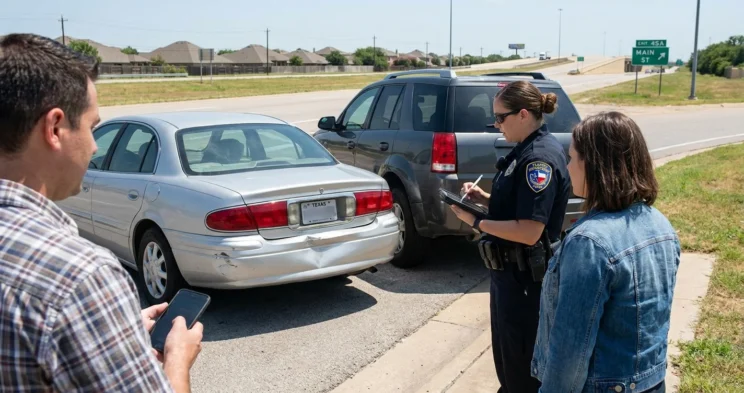
The crash seemed minor at first. Maybe it happened during a busy commute on I-35 near San Antonio, with only a few dents, exchanged insurance information, and the expectation that everything would be handled quickly.
Now, it’s months later, and a letter arrives in the mail from an insurance company that brings the accident back into your life. What happens next? You may be wondering whether the crash affects your driving record, whether you could be held responsible, or maybe you just want to know what information exists about the accident.
The answer depends on the type of Texas record you’re looking for, and what information you need from it.
What Does Your Texas Driving Record Show?
Texas documents accident information through two separate channels:
- TxDOT (Texas Department of Transportation) keeps the crash report for each specific incident.
- DPS (Texas Department of Public Safety) keeps your ongoing driving record as a licensed driver.
Your driving record lists everything about your history behind the wheel, including:
- Your driving history
- Complete documentation of all car accidents you’ve been involved in
- Your traffic violations
- Your license suspensions
- Your citations and tickets
- Your driving-related criminal offenses
How Long Does a Crash Stay on Your Record?
How long do accidents stay on your record in Texas? For the standard driving record, the answer is three years from the date of the crash or citation. This three-year window is what appears when someone searches the ordinary version of your record.
As the license holder, you can also order a certified complete version of your record that keeps every crash and violation on file. DPS does not publish a cutoff date for how long entries remain listed on your complete record. This is why the same accident can look like it disappeared after three years on your public record, while it remains in your history on your complete record.
A crash that was not your fault still ends up on both versions of your record. However, it carries far less weight than an at-fault crash, and it is not considered when determining whether suspension-related requirements apply.
If you believe you were incorrectly assigned fault on your report, then you can correct an inaccurate driving record entry by disputing that specific record.
How Repeat Violations Can Lead to Suspension
Texas does not use a driver’s license point system anymore. The state repealed the Driver Responsibility Program (including its points and surcharges) effective September 1, 2019, and DPS no longer adds points to a driver’s record for moving violations.
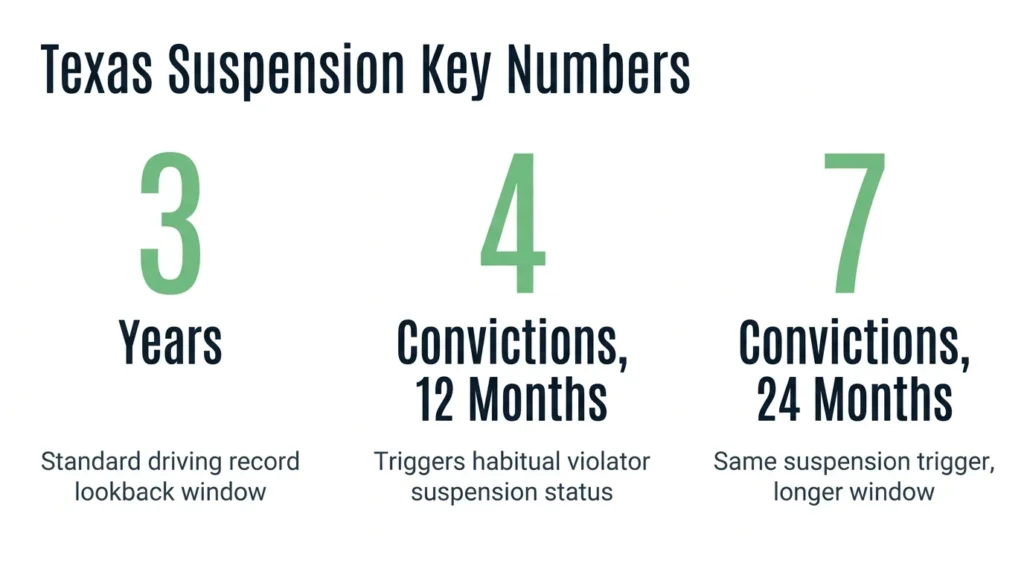
In place of points, Texas Transportation Code Section 521.292 allows the state to suspend a license once a driver becomes a “habitual violator.” This status kicks in after 4 or more moving violation convictions in 12 months (or 7 or more in 24 months).
A conviction may no longer count toward certain suspension thresholds once it falls outside the applicable 12-or-24-month window. This rolling window is sometimes called “falling off,” even though the conviction may still appear on the driver’s complete record.
If the driver who hit you was already suspended under this rule, then a crash caused by a suspended or unlicensed driver can raise additional issues that should be addressed while evaluating your claim.
How to Request Your Driving Record
You can request your own Texas driving record online or by mail. Ordering online through DPS is the fastest option. To do so, you will need your license or ID number, plus the audit number printed on your card.
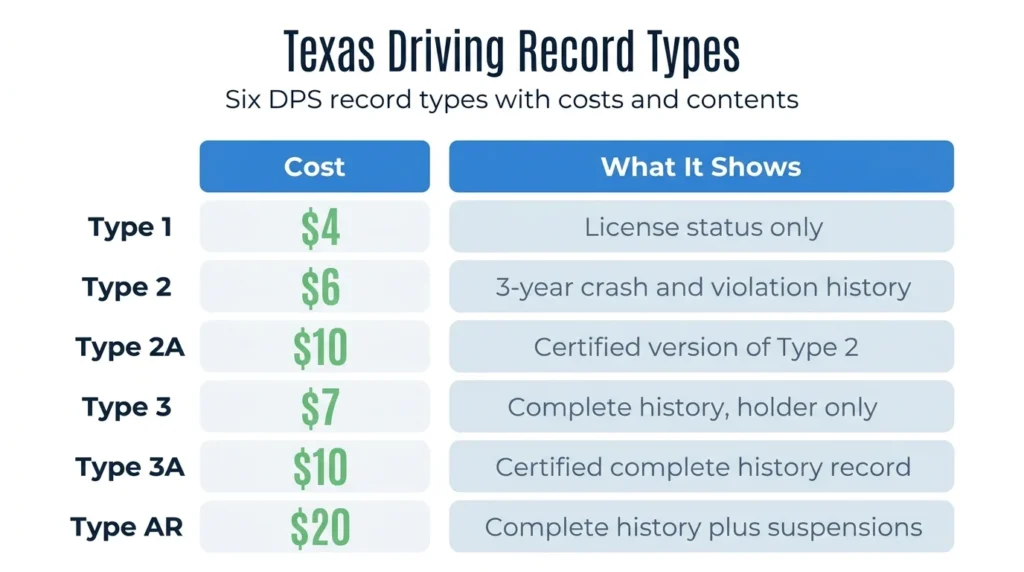
DPS offers several types of records, including:
- Type 1 (status only): This costs $4 and displays your license status and basic information.
- Type 2 (3-year history): This costs $6 and displays all crashes that resulted in a ticket and all moving violations from the past three years.
- Type 2A (certified 3-year history): This costs $10 and is a certified version of Type 2.
- Type 3 (complete history): This costs $7 and shows every crash and violation on file, but it is available only to the record holder.
- Type 3A (certified complete history): This costs $10, and it is the certified version required for defensive driving course credit.
- Type AR (certified complete abstract): This costs $20 and adds any suspensions to the Type 3 information.
Online orders can be printed or arrive by email right away. Mailed requests generally take a few weeks to process.
What Employers & Insurers Can See
Employers and insurers can both view a version of your Texas driving record, but usually not the same one you can pull for yourself.
Employers who request a pre-employment driving check generally receive the standard three-year record, since DPS reserves the complete history for the license holder alone.
Insurers can also pull your record as part of the underwriting process when evaluating risk and deciding on coverage terms. The length of time that an insurer considers depends on the company’s own policies and practices, rather than a single Texas rule.
Work with an Attorney on Your Injury Claim in Texas
Angel Reyes & Associates has represented Texas accident victims for more than 30 years. We know how driving records, crash reports, and fault determinations will affect your claim. We review the official record to uncover a repeat violator’s history or identify incorrect fault determinations that could affect your claim.
Our case results reflect more than $1 billion recovered for clients, and you pay nothing unless we win. Contact us for a free consultation today.
Driving Record FAQs
Will an out-of-state accident or ticket affect my Texas driving record?
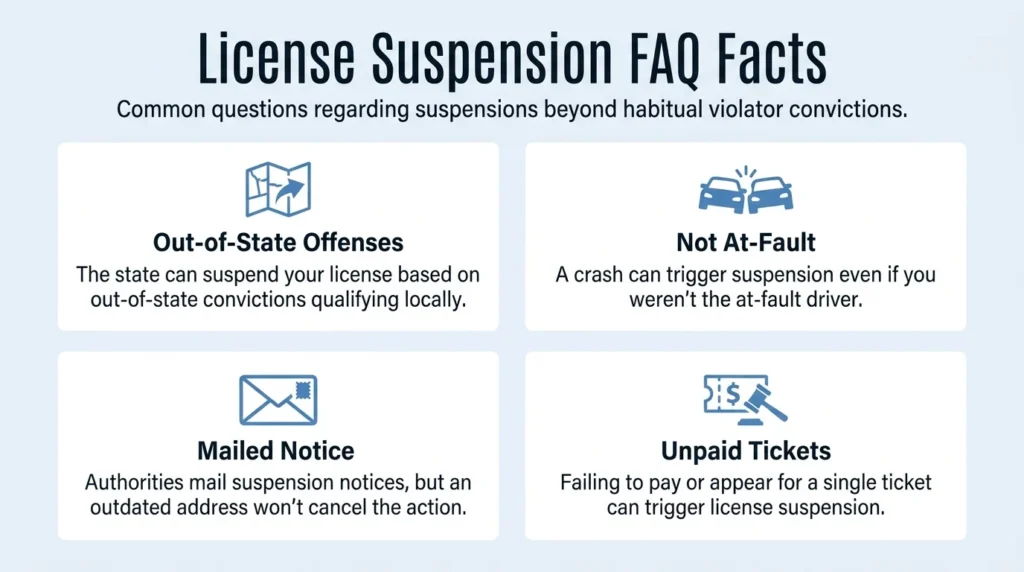
Yes. Texas DPS can suspend or take action on your Texas license based on an out-of-state conviction, provided that the same offense would have led to a suspension if it happened in Texas.
Can a crash cause my license to be suspended even if I’m not listed as the at-fault driver on my driving record?
Yes. A crash can lead to a license suspension no matter what appears on your driving record. If a court enters an unpaid judgment against you due to a crash, then DPS can suspend your license based on that judgment, in addition to what is reflected on your record.
Will Texas DPS notify me before suspending my license?
Yes. DPS mails a notice to the address it has on file. However, keep in mind that if the letter is sent to the wrong address, this does not cancel the suspension, so it’s important to keep your address current with DPS.
Can unpaid tickets cause my license to be suspended even if I don’t have enough convictions to count as a habitual violator?
Yes. Failing to appear in court or pay a citation can result in a separate license suspension in Texas, regardless of the number of convictions you have.
About the Authors

Spencer Browne
Writer
Spencer Browne is a partner at Angel Reyes & Associates and a Board Certified personal injury trial lawyer with nearly 100 jury trials across Texas. He focuses on car, truck, and wrongful death cases, with notable verdicts including a landmark win in the Choctaw Casino bus crash case. A recognized speaker and legal educator, Spencer is a member of the American Board of Trial Advocates and has been honored as a Texas Super Lawyer and one of D Magazine’s Best Lawyers in Dallas. He brings deep trial experience and relentless advocacy to every client he represents.

Kyle Nicolas
Editor
Kyle Nicolas is the Web Content & SEO Manager at Angel Reyes & Associates. He has more than 10 years of experience as a marketing co...

Angel Reyes
Reviewer
Angel L. Reyes, III is the Founder and Managing Partner of Angel Reyes & Associates. A nationally recognized trial attorney and business...