How Policy Exclusions Affect Texas Car Accident Claims


Every article on this site is researched by our internal team, reviewed for legal accuracy against current Texas law, and held to State Bar of Texas advertising standards before publication. We do not publish content that overstates outcomes or makes promises about results.
Learn more about our
editorial standards .
Key Takeaways
- Texas insurers must prove that a policy exclusion applies, and courts interpret unclear language against them.
- Named driver policies exclude household members not listed on the policy. They require oral and written disclosures and a signed written confirmation under Texas Insurance Code § 1952.0545. Named driver exclusions of specific individuals require written acceptance by the named insured under § 1952.353.
- Bad faith damages under Chapter 541 may apply when insurers misuse exclusions to deny valid claims made by their own policyholders.
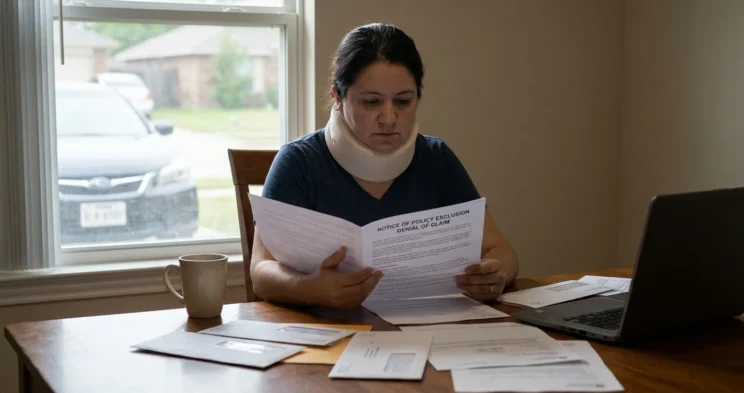
You were rear-ended on I-635 by a driver who ran a stop sign coming off the service road. Weeks later, a denial letter shows up saying the at-fault driver’s policy has an exclusion that blocks your claim. The medical bills are stacking up, your injuries are preventing you from working, and the one thing you counted on to make you whole is gone.
What are policy exclusions, and is there anything you can do about them?
What a Policy Exclusion Does to Your Coverage
A policy exclusion is a contract clause that removes specific people, vehicles, or conduct from coverage that would otherwise apply. Texas insurers list these in an “Exclusions” section of the policy. The insurer has to prove that an exclusion applies to the facts of your case. When the language is vague, Texas courts interpret it against the insurer.
Texas runs on a fault-based liability system. That means the at-fault driver’s insurer is the first source of compensation. If the insurer raises an exclusion, you lose access to the policy that pays your damages.
Exclusions must also be written clearly. Vague or contradictory exclusion language doesn’t hold up when challenged. The Texas Department of Insurance consumer guide to auto coverage is a useful place to start if you want to see how policies are structured before talking with a lawyer.
This is even more important because Texas treats car accident claims under fault rules, not no-fault rules. That means that if the insurer decides to use an exclusion, the full cost of the crash could be your responsibility, unless you push back.
Common Exclusions in Texas Auto Policies
Most exclusions fall into a handful of recognizable categories. Each one targets a different situation and has its own rules about when it legally applies. Understanding which exclusion the insurer is using is the first step to figuring out whether the denial will hold up in court.
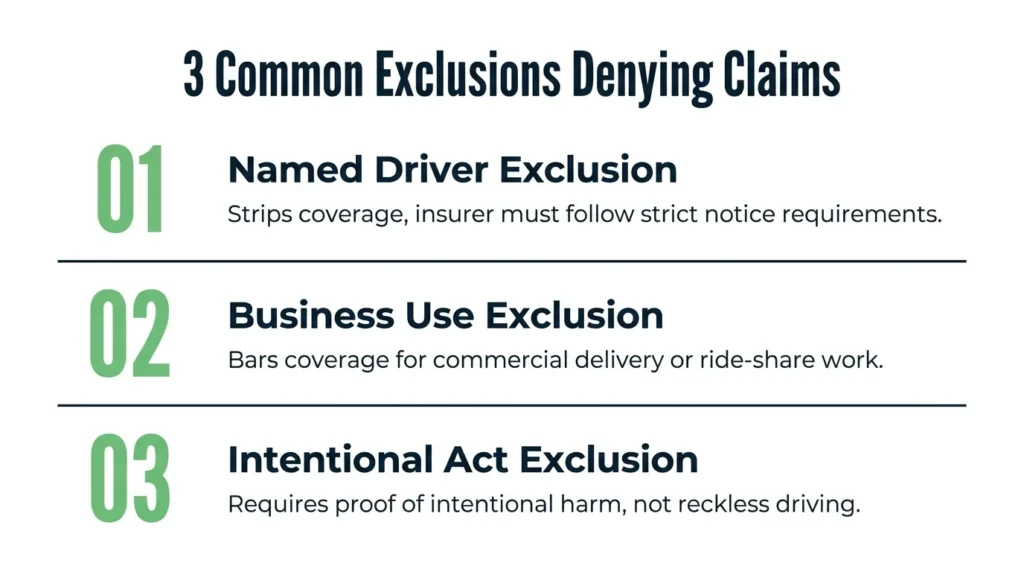
Here are a few common types of exclusions:
- Racing exclusion: Coverage does not apply to crashes during organized or informal races. In this situation, the insurer has to show that the crash actually happened in a racing context, not just on a public road.
- Business use exclusion: Personal auto policies do not cover commercial use. In this situation, the insurer will argue that the crash happened during ride-share driving or delivery work.
- Owned-but-unlisted vehicle exclusion: Some policies refuse coverage for vehicles that the insured driver owns but did not list on the policy at the time of the crash.
The Named Driver Exclusion
A named driver exclusion removes coverage for a specific person. If that person causes a crash while driving the insured vehicle, the policy will not pay. This exclusion is different from the others because it targets an individual, not a type of behavior.
Texas law sets a strict requirement before this exclusion can apply. Texas Insurance Code § 1952.0545 requires the insurer to provide both oral and written notice to the policyholder and obtain a signed written confirmation before issuing or renewing the policy. The confirmation must exclude all household members not listed on the policy. Texas Insurance Code § 1952.353 is a separate provision that requires the policyholder to sign a written confirmation that excludes a specific individual from coverage. If the insurer skipped either of those steps, the exclusion may not apply to you as the injured third party.
Insurers sometimes try to enforce these exclusions without the required paperwork, but a careful look at the policy file can change the outcome of a denial. For a deeper walkthrough, see what happens when an excluded driver causes a crash in Texas.
The Intentional Act Exclusion
The intentional act exclusion removes coverage when the policyholder deliberately causes harm. It exists to keep insurance from paying for criminal or willful conduct. Unlike the named driver exclusion, this exclusion depends on what the driver did, not on a procedural requirement that the insurer has to follow.
This makes it harder to challenge, but Texas courts require that the harm itself must be intentional, not just the action that caused it. In this case, reckless or careless driving does not apply. If the insurer is using this exclusion to avoid paying for negligent conduct, the denial may not hold up in court.
How Insurers Use Exclusions to Deny Claims
After you file a claim, the adjuster investigates the crash. They are not just looking for fault; they are checking the policy against the facts of your case to see whether any exclusion can apply. Most commonly, they look at whether the driver was actually listed on the policy, what the vehicle was being used for, and whether the conduct could be framed as intentional.
The denial letter has to identify the specific exclusion and explain why the insurer thinks it applies. A vague denial that just cites “policy exclusions” without naming one is a procedural problem that you may be able to challenge.
Texas also sets deadlines for how insurers must handle claims. Texas Insurance Code Chapter 542 sets deadlines for insurers to acknowledge claims, complete investigations, and decide on payment. These obligations apply to first-party claims, which are made by the insurer’s own policyholder. If you have first-party coverage on your own policy (such as uninsured motorist, MedPay, or PIP), those claims are subject to Chapter 542’s deadlines. Missing these deadlines can add penalty interest and attorney’s fees on top of the original claim.
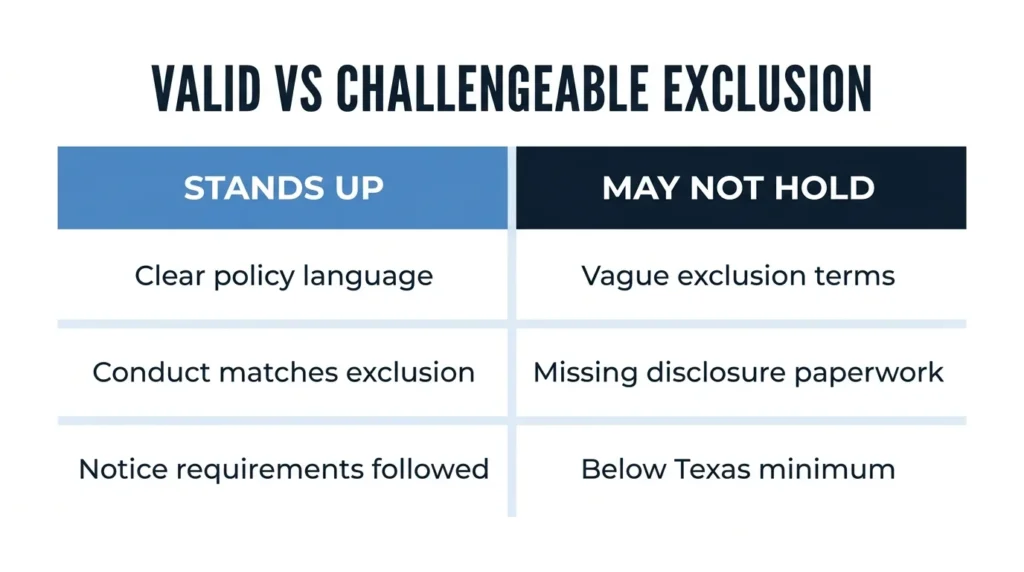
Adjusters sometimes apply the wrong exclusion to the claim. This is why it’s important to compare the denial letter to the actual policy language. If the facts of your crash do not match the exclusion’s conditions, then you may be able to challenge the denial. A close look at the insurance investigation process in Texas can help you spot where adjusters may have cut corners.
What Texas Law Requires of Insurers
You may have more options than a denial letter suggests. Texas law sets standards for how insurers must handle claims, and the Texas Insurance Code Chapter 541 prohibits unfair settlement practices, including misrepresenting policy language and denying claims without a reasonable investigation. These protections are primarily in favor of the insurer’s own policyholder, not a third-party claimant. If the at-fault driver’s insurer is misusing an exclusion, your strongest legal protection may come from your own insurer or a bad faith claim if you are pursuing coverage under your own policy.
The law places the burden on the insurer to prove that the exclusion applies. If they cannot produce evidence that every condition of the exclusion was met, then you may be able to challenge the denial.
Texas Transportation Code Chapter 601 sets the minimum liability coverage that every driver in Texas must have. An exclusion that would reduce a third-party claimant’s recovery below the minimum amount may conflict with the law and therefore may not be enforceable.
When the at-fault driver’s coverage is not available, other sources may still be an option, including:
- Your own uninsured or underinsured motorist coverage
- MedPay on your policy
- Your health insurance for medical bills
- A direct lawsuit against the at-fault driver
Filing a complaint with the Texas Department of Insurance also creates an official record of the denial. An attorney can review the denial and decide whether the exclusion holds up.
Talk to an Attorney in Texas About Policy Exclusions
A coverage denial is not always the end of the road. Angel Reyes & Associates has more than 30 years of experience handling Texas car accident claims, including disputes over policy exclusions, named driver denials, and bad faith conduct. We work on contingency, so there is no fee unless we win, and our team has recovered more than $1 billion recovered for clients.
If an insurer is using an exclusion to block your claim, we can review the policy, the denial, and your options under Texas law. Browse our frequently asked questions on Texas injury claims to learn more. When you are ready, contact us for a free consultation.
Past results do not guarantee future outcomes.
Policy Exclusion FAQs
Can a policy exclusion affect my own uninsured motorist claim, not just the at-fault driver's coverage?
Yes. If you file a UM or UIM claim under your own policy, your insurer can invoke exclusions that apply to your coverage, separate from anything the at-fault driver’s insurer does. Your own policy’s terms control that claim, so it is worth comparing both policies side by side after a denial.
Does Texas require insurers to send a reservation of rights letter before denying a claim based on an exclusion?
No, Texas does not legally require a specific reservation of rights letter, but insurers routinely send one anyway to preserve their right to deny coverage while they investigate the claim. If an insurer defends or handles a claim without sending a reservation of rights letter, they risk losing the ability to use certain coverage defenses later.
Can the business-use exclusion apply if I was only partially using my car for work at the time of the crash?
It depends. Texas courts look at the primary purpose of the trip at the moment of the accident, not the driver’s general occupation. If a personal errand was mixed in with a delivery run, the insurer still has to prove that the dominant use was commercial before the exclusion can hold.
Will a policy exclusion show up on the declarations page of my auto policy?
No. Exclusions are typically listed in the body of the policy, not on the declarations page. The declarations page summarizes coverage limits and named drivers, while the full exclusion language appears in a separate section, often labeled “Exclusions” or “What Is Not Covered.”
If the at-fault driver had no effective coverage due to an exclusion, does that count as being uninsured under Texas law?
Yes. Texas law treats a driver whose coverage has been voided or excluded as effectively uninsured for the purposes of your UM claim. This means your own uninsured motorist coverage can potentially step in to cover the remaining losses.
About the Authors

Angel Reyes
Writer
Angel L. Reyes, III is the Founder and Managing Partner of Angel Reyes & Associates. A nationally recognized trial attorney and business leader, Angel has helped over 70,000 injury victims recover more than $1 billion since founding the firm in 1993. Named to the Texas Super Lawyers list annually since 2008, Angel brings Wall Street experience, Ivy League education, and a deep commitment to client advocacy. He is a frequent legal commentator and published author with extensive contributions to legal scholarship, trial strategy, and consumer protection.

Kyle Nicolas
Editor
Kyle Nicolas is the Web Content & SEO Manager at Angel Reyes & Associates. He has more than 10 years of experience as a marketing co...

Angel Reyes
Reviewer
Angel L. Reyes, III is the Founder and Managing Partner of Angel Reyes & Associates. A nationally recognized trial attorney and business...