How Poor Visibility and Blind Spots Cause Bus Accidents


Every article on this site is researched by our internal team, reviewed for legal accuracy against current Texas law, and held to State Bar of Texas advertising standards before publication. We do not publish content that overstates outcomes or makes promises about results.
Learn more about our
editorial standards .
Key Takeaways
- A transit bus has four blind spots, and the curb-side right zone is the largest and deadliest.
- Right-turn squeeze crashes trap cyclists and pedestrians in the bus blind zone along the curb.
- Texas gives you two years to sue a private bus operator but as few as 45 days for public ones.
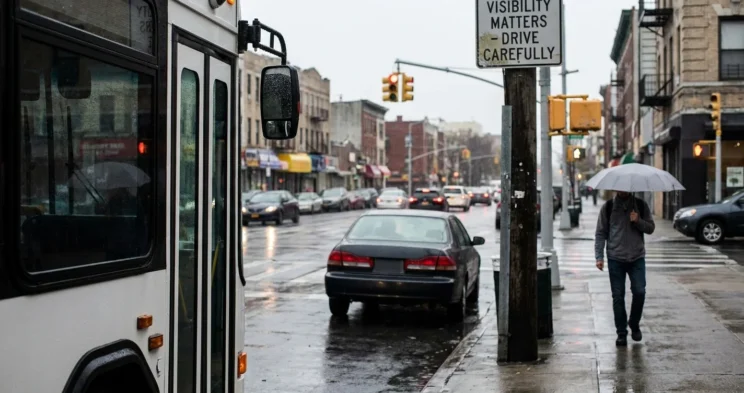
You stepped off the curb at a crosswalk near the Texas Medical Center as a city bus rolled toward the same corner. The driver started a slow right turn, and for a few seconds you were standing in a spot the driver simply could not see. Crashes like that happen because of how buses are built, not because the victim did anything wrong.
Bus Blind Spot Zones Pedestrians Must Know
A transit bus has four large blind spots, and the curb side is the most dangerous of them. Pedestrians and cyclists can stand in these zones and stay completely invisible to the driver, even when every mirror works perfectly.
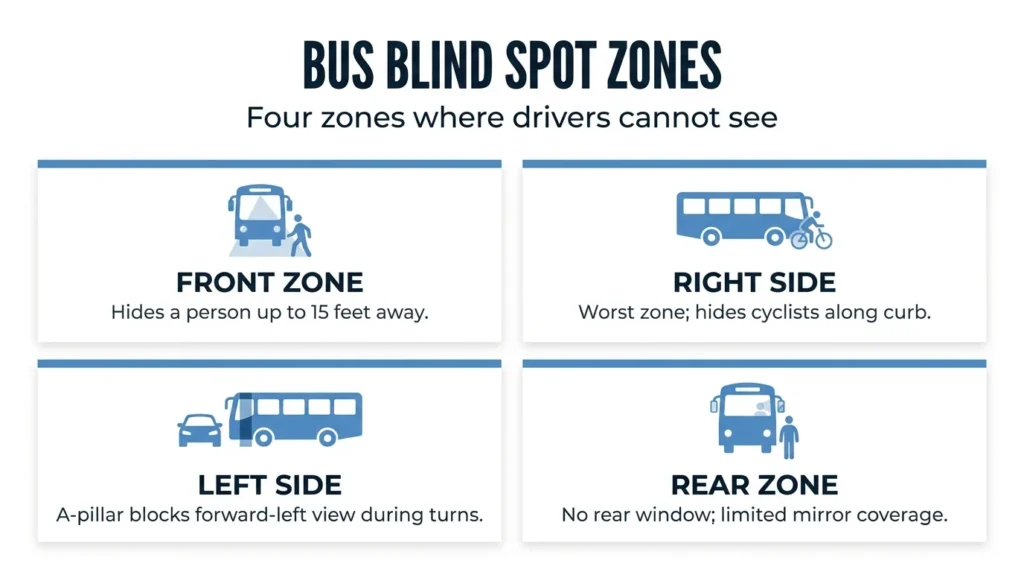
The front blind zone sits directly ahead of the bumper. A tall bus can hide a person standing up to 15 feet in front of it. That is why stepping into a crosswalk in front of a stopped bus is so risky.
The right-side zone is the worst one. It runs from the front right corner, down the entire passenger side, and curves under the rear wheels. A cyclist riding next to the bus here disappears from view entirely.
The left-side zone is smaller but still dangerous. It stretches along the driver’s side and overlaps with the thick A-pillar that blocks the driver’s forward-left view during turns.
The rear zone is the last one. Buses have no rear window and limited mirror coverage behind them. Anyone standing behind the back bumper is outside the driver’s sight lines.
Federal safety officials call these four areas the bus no-zone. They are the spots where collisions are most likely to happen. The same danger applies to large trucks. Federal data confirms the toll: the FTA reports on bus-to-person collisions that these crashes caused 537 deaths between 2008 and 2021.
Right-Turn Squeeze: The Deadliest Bus Blind Spot Crash
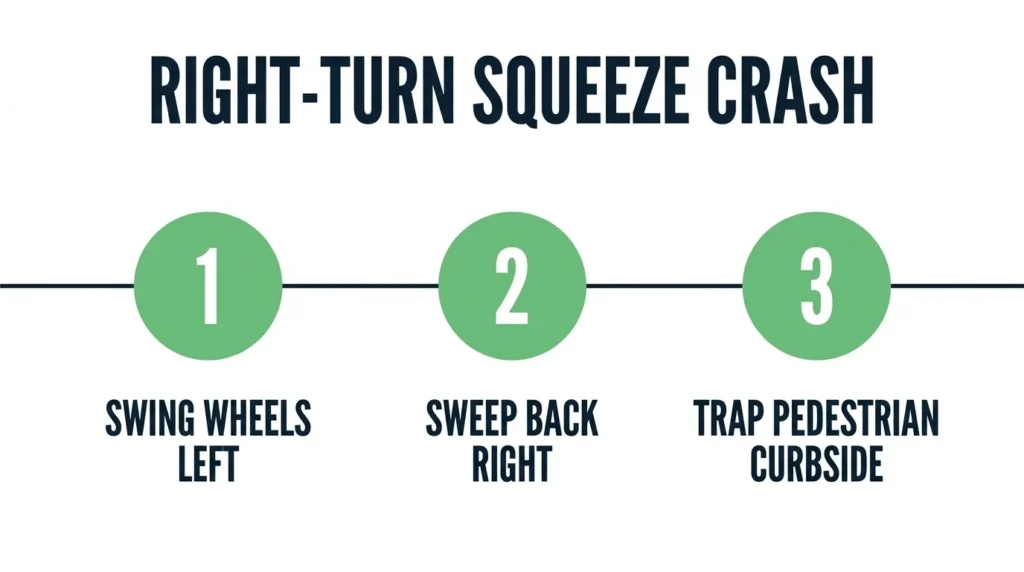
The right-turn squeeze is the single most lethal blind spot crash a bus can cause. It happens when the bus swings left to set up a right turn, then cuts sharply right and traps anyone in the gap along the curb.
To make a tight right turn, a bus driver first swings the front wheels left for clearance. The back of the bus then sweeps across the curb-side space as the vehicle pivots. A pedestrian or cyclist caught in that shrinking gap has nowhere to go.
The driver usually cannot see the danger at all. During the turn, the right front corner and the curb-side zone reach their largest size. The A-pillar and the mirror gaps leave the entire crush area hidden from view.
Cyclists in a bike lane and pedestrians stepping off the corner are the most common victims. The speed of the swing, a sharp curb, and a bus shelter blocking the view all make these crashes worse.
So does a driver who fails to check the mirrors before and during the turn.
Mirror Rules Buses Must Follow in Texas
Buses must carry specific mirrors under both federal and Texas law, and a missing or broken mirror is a regulatory violation. These rules set the safety baseline that every transit agency is required to meet.
Federal law sets the first standard. Under 49 CFR § 393.80, every bus must carry two exterior rear-vision mirrors that meet FMVSS No. 111 specifications. The rule fixes the minimum placement, angle, and field of view for those mirrors.
Texas adds its own requirement on top of that. Texas Transportation Code § 547.602 requires mirrors that give the driver a clear view of at least 200 feet behind the vehicle. This is the foundational state equipment rule for any bus on Texas roads.
Mirror type matters as much as mirror count. A bus should carry flat exterior mirrors plus convex or wide-angle mirrors to widen the curb-side view. An agency that skips the convex mirrors leaves a known gap in coverage.
Maintenance is the other half of the obligation. A mirror that is cracked, loose, or badly aimed when a crash happens counts as an equipment defect. That kind of defect can point back to the agency’s maintenance program, not just the driver. The same logic applies to passenger vehicles.
How Mirror Violations Become Legal Liability
A mirror violation can become direct proof of negligence through a rule called negligence per se. When a driver or agency breaks a safety statute and that violation causes your injury, the court may treat the broken rule as the negligence itself.
Under negligence per se, you may not have to prove the conduct was unreasonable. If an agency ran a bus that violated 49 CFR § 393.80 or the state mirror rule, and that failure caused your crash, the violation can stand in for that proof. The poor visibility crash that follows a mirror failure fits this framework directly.
More than one party can owe you money. Liability can reach the driver, the transit agency that failed to inspect the mirrors, the manufacturer that designed an unreasonable blind zone, and any contractor that repaired the mirrors incorrectly.
Evidence decides these cases. Dashcam footage, post-crash mirror inspection reports, fleet maintenance logs, FMCSA inspection records, and witness statements about mirror position all carry weight. Much of it disappears fast once a bus goes back into service.
Government-run buses add another layer. A claim against a city or county transit system triggers Texas Civil Practice and Remedies Code Chapter 101, the Texas Tort Claims Act. That law sets strict notice deadlines and limits the damages you can recover.
Filing a Claim After a Bus Blind Spot Accident
You usually have two years to file a bus injury claim against a private operator in Texas. Government-operated buses cut that window down to a matter of weeks, so the type of bus that hit you changes everything about your deadline.
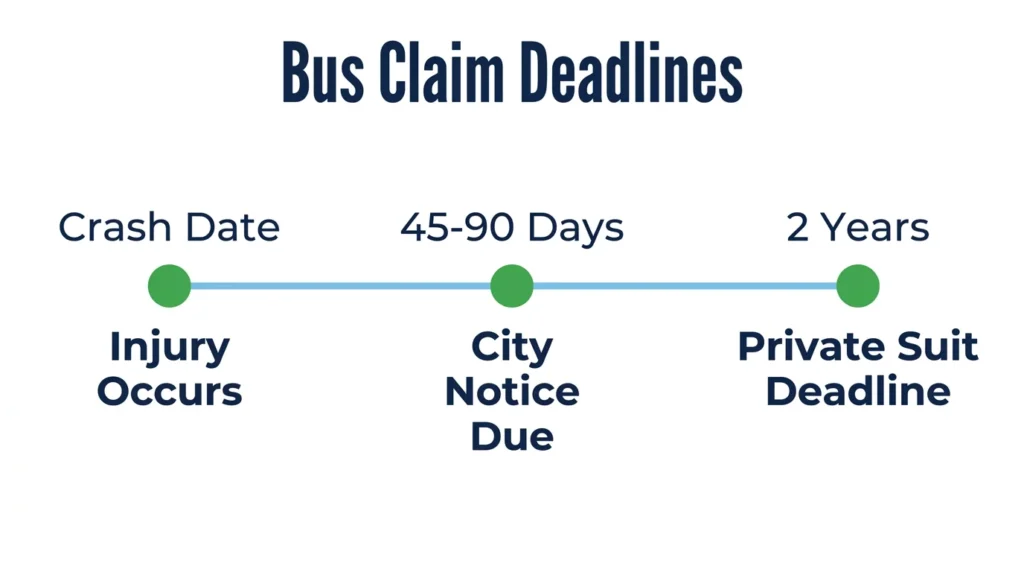
The general deadline comes from the Texas Civil Practice and Remedies Code (CPRC) § 16.003, which gives you two years from the date of injury. Miss it against a private bus company and your right to sue is almost certainly gone.
Public transit claims move much faster. A claim against a city or county bus system requires formal written notice within six months of the crash under the Texas Tort Claims Act, and some Texas cities shorten that window to as few as 45 to 90 days through their city charters, depending on the municipality.
Blow that notice deadline and the claim can be barred before you ever reach court.
The other driver may also try to blame you. Under Texas Civil Practice and Remedies Code (CPRC) § 33, Texas uses a proportionate responsibility rule, which is a fault-sharing system. If a defendant argues you stepped into the blind zone, you can still recover as long as you are 50 percent or less at fault.
A few steps in the first days protect your claim. Photograph the mirror positions and bus damage, collect witness contact information, and request the bus dashcam footage through public records before it is overwritten. See a doctor the same day so your injuries are documented.
The more you know about how to file a Texas bus accident claim, the easier the claim process will be.
Talk to an Experienced Lawyer
Many people hit by a bus never realize the crash was preventable or that someone can be held accountable. A hidden victim in a blind zone is rarely the one at fault. Angel Reyes & Associates has more than 30 years of experience, with more than $1 billion recovered for clients across Texas.
We handle bus accident cases on a contingency basis, which means no fee unless we win. You can review our bus and commercial vehicle case results and read what our clients say about us to see how we work.
If a bus blind spot crash hurt you or someone you love, schedule a free consultation and we will review your options at no cost.
Past results do not guarantee future outcomes.
FAQs About Poor Visibility/Blind Spot-Related Bus Accidents
Can a child be hit by a bus blind spot accident and still have a claim?
Yes. Texas law does not bar children from recovering compensation, and the statute of limitations is paused until a minor turns 18, giving them until their 20th birthday to file. A parent or guardian can also file on the child’s behalf while the child is still a minor.
Does it matter if the bus was privately operated or run by a school district?
School districts in Texas are government entities, so a claim against a school bus follows the Texas Tort Claims Act notice rules rather than the standard two-year private deadline. Notice requirements and damage caps for school districts differ from those for city transit systems, so the type of bus involved changes the claim process significantly.
Can a passenger inside the bus be injured because of a blind spot crash?
Yes. When a bus driver cannot see a hazard in a blind zone and brakes suddenly or swerves to avoid a collision, passengers standing or seated near the front can be thrown and injured. Those passengers can pursue a claim against the bus operator for the same underlying negligence that caused the crash.
What if the bus had a camera system but the footage was not saved?
Transit agencies have a duty to preserve evidence once a claim is reasonably foreseeable. If an agency failed to save dashcam footage that it routinely records, that failure can be argued as spoliation of evidence, which may allow a court to draw negative conclusions about what the footage would have shown.
Are school buses required to follow the same mirror rules as transit buses?
School buses must meet federal mirror standards under FMVSS No. 111, but they also follow additional Federal Motor Vehicle Safety Standards specific to school bus design, including requirements for crossview mirrors at the front that help drivers see children approaching from the front blind zone. These standards go beyond the baseline rules that apply to city transit buses.
About the Authors

Angel Reyes
Writer
Angel L. Reyes, III is the Founder and Managing Partner of Angel Reyes & Associates. A nationally recognized trial attorney and business leader, Angel has helped over 70,000 injury victims recover more than $1 billion since founding the firm in 1993. Named to the Texas Super Lawyers list annually since 2008, Angel brings Wall Street experience, Ivy League education, and a deep commitment to client advocacy. He is a frequent legal commentator and published author with extensive contributions to legal scholarship, trial strategy, and consumer protection.

Graham Griffin
Editor
Graham Griffin is the Web & Content Manager at Angel Reyes & Associates, where he oversees content strategy, AI-powered workflows, a...

Spencer Browne
Reviewer
Spencer Browne is a partner at Angel Reyes & Associates and a Board Certified personal injury trial lawyer with nearly 100 jury trials a...