How Texas Insurance Companies View Hands-Free Phone Use After a Car Accident


Every article on this site is researched by our internal team, reviewed for legal accuracy against current Texas law, and held to State Bar of Texas advertising standards before publication. We do not publish content that overstates outcomes or makes promises about results.
Learn more about our
editorial standards .
Key Takeaways
- Texas law permits most hands-free phone use, but insurers may still argue it contributed to distraction when assigning comparative fault percentages.
- Adjusters use recorded statements, phone records, and crash timelines to build distraction arguments that can reduce your recovery under Texas’s 51% bar rule.
- Preserving evidence, limiting early statements, and understanding insurer tactics helps protect your claim when hands-free use becomes an issue.
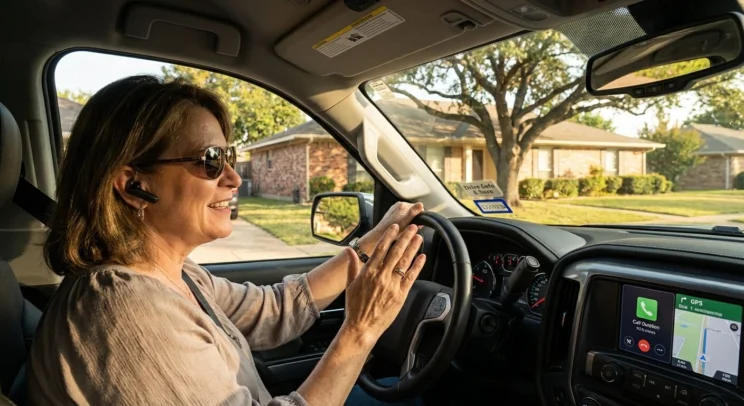
How Texas Insurance Companies View Hands-Free Phone Use After a Car Accident
You were rear-ended in rush hour traffic while driving on I-35 through Austin. You were on a call with your spouse when the crash happened. Now the other driver’s insurance adjuster is asking detailed questions about your phone use.
You thought hands-free phone use was legal in Texas, so why does it feel like they’re trying to blame you?
This is a common situation for Texas drivers: what’s legal and what insurers argue are two different things. Understanding how adjusters approach hands-free use can help you protect your claim from the start.
“Legal” Hands-Free Use Can Still Become an Insurance Problem
Texas isn’t a blanket hands-free state. The law prohibits texting while driving under Texas Transportation Code § 545.4251, but it doesn’t ban all phone use. Many drivers assume calls or voice commands can’t be used against them in a claim.
Insurers see it differently. Their goal is to resolve claims for the lowest possible payout. One way they do this is by arguing you share fault for the crash. Even if your hands-free use was perfectly legal, an adjuster may frame it as evidence that you weren’t paying full attention to the road.
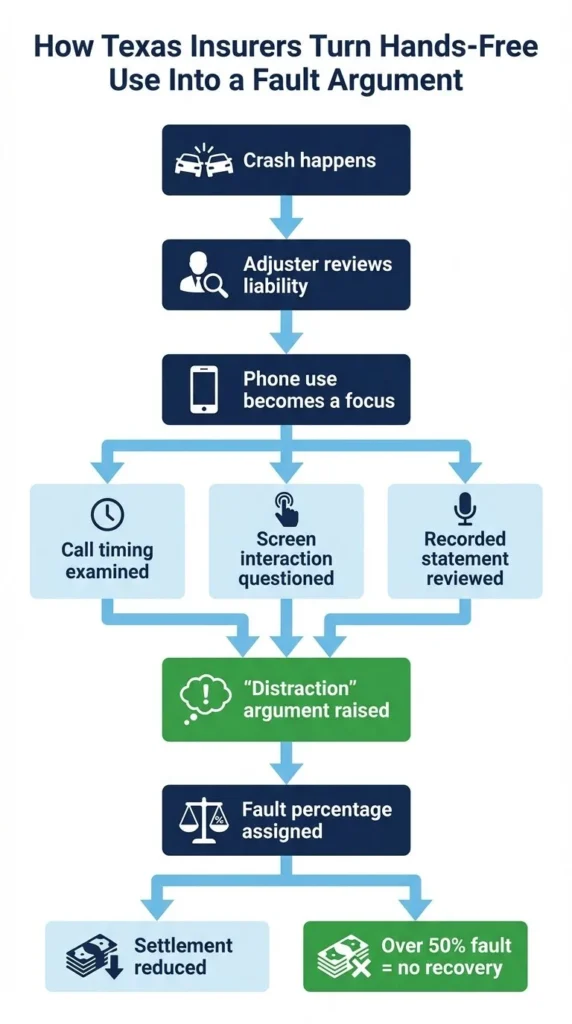
This is important because Texas uses a modified comparative fault system. Under Texas Civil Practice and Remedies Code § 33.001, your recovery is reduced by your percentage of fault. If you’re found more than 50% responsible, you recover nothing.
That’s why insurers look for any behavior they can use to shift blame your way. Understanding how insurance companies handle claims helps you recognize these tactics early.
What Counts as “Hands-Free” & What Still Looks Like Distraction?
Common hands-free technologies include Bluetooth phone connectivity as well as smartphone projection systems like Apple CarPlay and Android Auto. Some older vehicles also have proprietary voice-to-text messaging abilities. Many Texas drivers use at least one of these daily.
Adjusters may still scrutinize these activities. According to TxDOT’s distracted driving resources, distraction comes in three forms:
- Visual: taking your eyes off the road
- Manual: taking your hands off the wheel
- Cognitive: taking your mind off driving
Hands-free technology reduces manual distraction, but it doesn’t eliminate cognitive distraction. A conversation that requires concentration can still affect your reaction time. Insurers know this and may use it to argue negligence.
How Different Hands-Free Activities Are Treated
When a crash happens while you are on the phone, timing becomes an important issue. Adjusters look at whether the call coincided with the moment of impact. They may argue you were mentally engaged in conversation instead of watching traffic.
Voice-to-text can be treated almost like texting. While you might not be cited by a patrolling police officer for it, insurers can argue that glancing at your car’s dash display was a visual distraction. Some adjusters even frame voice-to-text as equivalent to manual messaging.
Navigation and infotainment raise attention-splitting arguments. Entering a destination, changing music, or checking a reroute all involve screen interaction. Vehicle telemetry systems may log these inputs.
The Insurer Playbook for Investigating Hands-Free Phone Use
Adjusters follow a structured process after any crash. When phone use is involved, they know almost immediately to look for evidence that supports shared blame.
The typical workflow includes:
- Initial intake and coverage verification
- Liability review based on police reports and statements
- Evidence collection (photos, witness accounts, device data)
- Evaluation and fault percentage assignment
- Settlement positioning
Early in this process, adjusters try to “lock in” your version of events. They ask about speed, following distance, what you saw, and what you were doing. Phone use questions often come up in the first call.
After they have gone through part of their process, they might resort to a few common pressure tactics to try to get you to settle for less than you might be entitled to. They might try to frame your phone use as a reason why you should take this offer (because you likely won’t receive any more).
However, these quick settlement offers, repeated document requests, and framing recorded statements as “just routine” are approaches designed to minimize their liability before you know your full medical situation.
What Evidence Insurers Look For
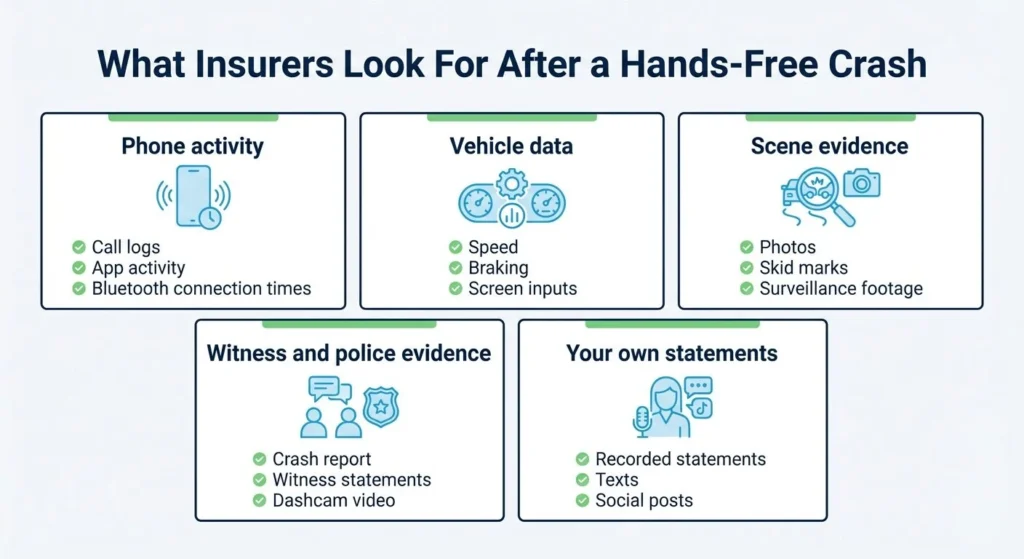
Phone and device activity is a primary target. Call logs show when calls started and ended. Data usage can indicate app activity. Bluetooth connection times may appear in vehicle systems. Adjusters may request this information or subpoena it later.
Vehicle and scene evidence includes crash report narratives, witness statements, dashcam footage, surveillance video, and tire skid marks. Some vehicles have event data recorders (or “black boxes”) that capture speed and braking data.
Your own words matter more than you might expect. Recorded statements, texts to family members, and social media posts can all become evidence. A casual comment like “I was on the phone, but it was hands-free” can be reframed as an admission of distraction.
Before giving any recorded statement, consider whether you should talk to the other driver’s insurance at all.
How Hands-Free Use Affects Fault Percentages
Texas’s proportionate responsibility rules mean fault percentages directly affect your recovery. If you’re 20% at fault for a crash with $100,000 in damages, you recover $80,000. If you’re 51% at fault, you recover nothing. Adjusters translate hands-free use into negligence theories. Common arguments include:
- Failure to keep a proper lookout
- Delayed reaction to traffic conditions
- Inattention to surrounding vehicles
- Unsafe following distance given the circumstances
Context like traffic density, weather conditions, sudden stops by other vehicles, and the other driver’s behavior, all affect how fault should be allocated. A hands-free call during light traffic on a clear day is different from one during heavy rain on Loop 1.
Realistic Scenarios Where Insurers Push Comparative Fault
Rear-end crashes: The insurer may argue you didn’t brake quickly enough because you were distracted by conversation, even if that conversation was being had via Bluetooth or some other hands-free technology. Counter-evidence includes traffic camera footage showing the lead vehicle stopped suddenly, witness accounts of erratic driving by the other party, or data showing you maintained safe following distance.
Left turn and failure-to-yield disputes: The insurer may claim you “didn’t see” the oncoming vehicle because you were focused on your call. Signal timing, sightlines, and speed estimates become critical evidence.
Commercial truck crashes: Trucking company insurers often argue distraction aggressively because the stakes are higher. These cases involve more complex evidence collection and larger potential damages. If a truck accident is involved, the investigation process is typically more intensive. It’s a good idea to have your case reviewed by an experienced attorney.
Recorded Statements & Phone Questions
When hands-free phone use is a factor in your accident, adjusters treat it as a potential liability lever. They ask detailed questions designed to establish a timeline and test consistency.
The purpose of a recorded statement is to lock in facts early. They also gather information that supports comparative fault arguments.
Some safe approaches when talking with an insurer include:
- Stick to basic facts you know for certain
- Don’t guess about speed, time, or distances
- Avoid absolute statements like “I never looked at my phone”
- If you misspeak, correct it in writing afterward
- Keep answers brief and factual
Common phone-related questions include:
- “Were you on Bluetooth at the time of the crash?”
- “Who called you, and when did the call start?”
- “Were you using voice-to-text?”
- “Were you looking at the screen for any reason?”
- “Can you send us screenshots of your call history?”
Each question serves a purpose. Timing questions anchor a distraction timeline. Screen-interaction questions reframe hands-free tech as visual distraction that played a role in the incident. Data requests expand the insurer’s access to your information.
Be cautious about broad authorizations. You may be able to provide relevant evidence in narrower ways without giving unlimited access to your device.
When to Talk to a Texas Car Accident Attorney
Some claims resolve without significant dispute. Others become fault-percentage battles where hands-free allegations affect your recovery.
Consider getting legal guidance from an attorney if:
- The insurer insists on a recorded statement
- They dispute liability or allege distraction
- They request broad phone or device access
- They undervalue your injuries
- The crash involved a commercial truck
An attorney can manage communications, gather supporting evidence, address comparative fault arguments, and negotiate from a stronger position. For car accident claims involving distraction allegations, professional guidance often changes or improves the outcome.
At Angel Reyes & Associates, we’ve helped more than 70,000 Texans recover more than $1 billion over our 30+ years of practice. We handle cases across the state from our 16 office locations, and there’s no fee unless we win. If you’re facing questions about hands-free use after a crash, reach out to us today before giving statements or signing releases; we offer free consultations with no obligation.
FAQs
Can you talk on the phone using hands-free technology while driving in Texas?
Generally, yes. Texas law does not ban phone use while driving statewide, though some local ordinances and driver categories may be restricted. For example, school zones are 100% phone-free (even hands-free), and commercial drivers may have different rules, depending on the nature of their work.
Is hands-free driving considered distracted driving?
It can be. Hands-free technology reduces manual distraction but doesn’t eliminate visual or cognitive distraction. Safety authorities and insurers may point to divided attention or screen interaction to argue negligence and comparative fault, even when the driver followed the law.
Do I have to give the other driver’s insurance company a recorded statement?
Often, no. You’re typically not required to give the other driver’s insurer a recorded statement. Doing so creates risk if you guess or misspeak. Understanding the purpose and getting legal guidance before agreeing is usually wise. (Note: You may be required to give your own insurer a statement, depending on your policy language.)
Will my settlement be reduced if I was using hands-free at the time of the crash?
Possibly. If the insurer persuades decision-makers that your phone use contributed to the crash, even if hands-free, they may assign you a percentage of fault. Under Texas proportionate responsibility rules, your recovery would be reduced by that percentage.
Can the insurance company demand my phone records after a crash?
They may request them, but broad access isn’t always necessary or appropriate. The right approach depends on what’s actually relevant to the dispute. An attorney can help evaluate requests before you sign releases that give more access than needed.
About the Authors

Angel Reyes
Writer
Angel L. Reyes, III is the Founder and Managing Partner of Angel Reyes & Associates. A nationally recognized trial attorney and business leader, Angel has helped over 70,000 injury victims recover more than $1 billion since founding the firm in 1993. Named to the Texas Super Lawyers list annually since 2008, Angel brings Wall Street experience, Ivy League education, and a deep commitment to client advocacy. He is a frequent legal commentator and published author with extensive contributions to legal scholarship, trial strategy, and consumer protection.

Kyle Nicolas
Editor
Kyle Nicolas is the Web Content & SEO Manager at Angel Reyes & Associates. He has more than 10 years of experience as a marketing co...

Spencer Browne
Reviewer
Spencer Browne is a partner at Angel Reyes & Associates and a Board Certified personal injury trial lawyer with nearly 100 jury trials a...