How Vehicle Blind Spots Cause Motorcycle Accidents


Every article on this site is researched by our internal team, reviewed for legal accuracy against current Texas law, and held to State Bar of Texas advertising standards before publication. We do not publish content that overstates outcomes or makes promises about results.
Learn more about our
editorial standards .
Key Takeaways
- Texas drivers must change lanes only when it is safe to do so according to Transportation Code § 545.060 rules.
- Riders under 51 percent at fault can still recover damages under Texas CPRC § 33.001.
- Semi-truck blind spots can hide a motorcycle across more than one neighboring highway lane.
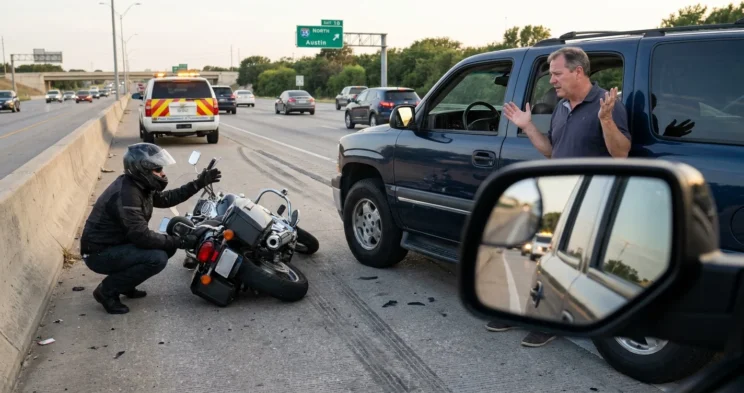
You were cruising north on I-35 outside Austin when an SUV in the next lane drifted into your space without turning on their signal. The driver never even turned their head. By the time you hit the brakes and swerved toward the shoulder, the impact had already happened, and the driver’s first words at the scene were “I didn’t see you.”
Why Motorcycles Disappear in Vehicle Blind Spots
Motorcycles are harder to see than cars because they take up much less space. A bike at the edge of a driver’s side mirror can be completely hidden from view. Most blind-spot motorcycle crashes happen in the area a driver can’t see with their mirrors or an over-the-shoulder check, and at highway speeds, a motorcycle can move through that hidden area in under a second.
Mirror design is the first issue. Side mirrors only show a narrow field of view, and even a properly adjusted mirror cannot show everything happening alongside a vehicle. A motorcycle trailing slightly behind and to the side of your vehicle may not be visible at all, making the road appear empty to the driver.
An over-the-shoulder check is supposed to help drivers see what their mirrors miss, but many drivers skip it or rush it, especially in heavy traffic. Data from the Texas Department of Transportation shows that motorcycle deaths in Texas have continued climbing, and lane-change crashes are a major cause of motorcycle rider injuries on Texas roads.
If you ride a motorcycle regularly, the risk is common in Texas motorcycle accident claims. This is because motorcycles are smaller than cars, they can approach your vehicle quickly, and drivers are conditioned to scan for cars, not bikes.
How Blind Spots Differ by Vehicle Type
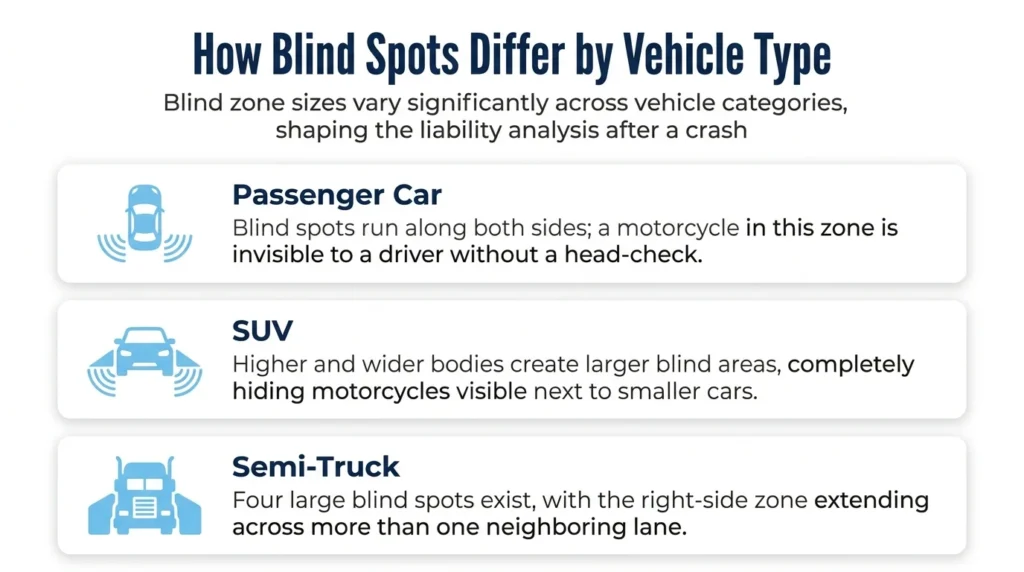
Blind spots can be very different, depending on what kind of vehicle is next to you. Sedans, SUVs, and commercial trucks each have their own blind spots. Understanding the type of vehicle that hit you is important because the size and shape of the blind spot often determines whether the driver was negligent.
Passenger Cars & SUVs
Passenger car blind spots are usually located along both sides of the vehicle, starting near the middle of the car and extending toward the rear. A motorcycle in this blind area during a lane change will not be visible to a driver who relies only on mirrors. The driver will have to physically turn their head to confirm that the lane is clear.
SUVs are worse. Their higher height and wider body makes the blind area bigger. A motorcycle that would be visible next to a sedan can be completely hidden next to a full-size SUV, even at the same following distance.
Federal rules do not require vehicles to have standard blind-spot detection. The driver is fully responsible for the over-the-shoulder check, which is why unsafe lane changes on Texas roads remain one of the most common causes of motorcycle rider injuries.
Semi Trucks & Commercial Vehicles
Commercial trucks have four distinct blind spots:
- Directly in front of the cab
- Directly behind the trailer
- The left side of the truck
- The right side of the truck (This blind spot is the largest; on a standard 18-wheeler, it can be wide enough to extend across more than one lane next to the truck. A motorcyclist who is riding lawfully to the right of a semi-truck may not be visible to the driver at all.)
The Federal Motor Carrier Safety Administration’s guidance on large truck blind spots formally names these blind spots and includes them in their national driver awareness program. This is critical information when a commercial carrier is the at-fault party, because it defines the safety standards and training that the truck driver was required to meet.
For an in-depth look at how these crashes are investigated, our coverage of blind spot truck accident claims explains the specific evidence that comes into play. Crashes involving 18-wheelers are also handled differently from passenger vehicle cases in Texas truck accident litigation.
Who’s Responsible in a Lane-Change Crash in Texas?
Texas law states that drivers are responsible for safe lane changes. The Texas Transportation Code § 545.060 requires drivers to stay in a marked lane and move between lanes safely. A driver who changes lanes into a motorcycle in their blind zone is breaking the law.
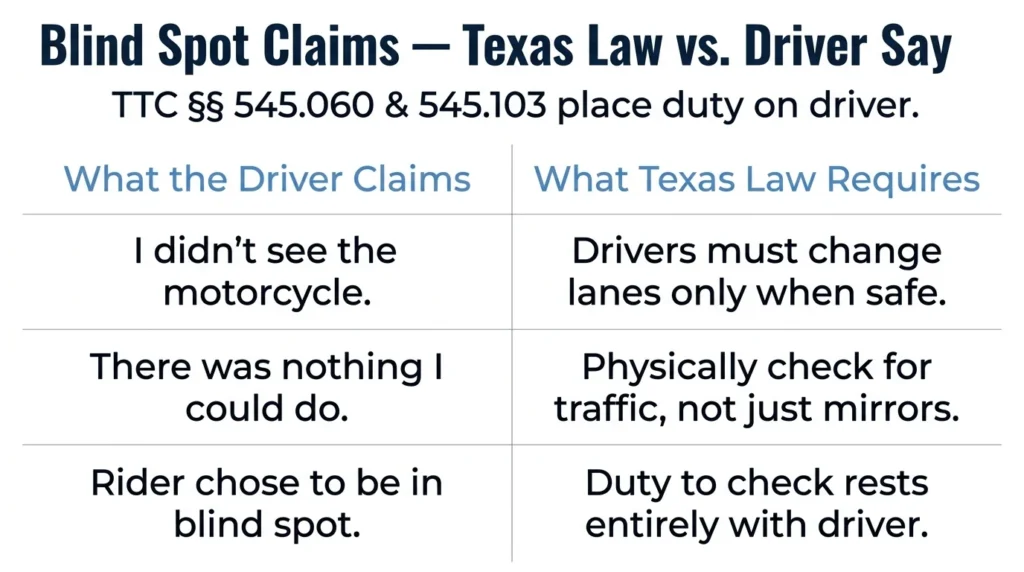
Similarly, Texas Transportation Code § 545.103 restricts sideways movement on a road unless it can be made safely. This includes sideswipes, forcing other vehicles out of their lane (also known as “squeeze-outs”), and partially merging without fully entering the new lane.
Breaking either of these laws can support a legal claim called negligence per se. This means that if a driver breaks a traffic law, they are automatically considered negligent, and the injured motorcycle rider does not have to prove what a “reasonable driver” would have done in the same situation, because the law has already set the standard for reasonable driving.
If the driver says, “I didn’t see the motorcycle,” that is not an acceptable defense because the driver is responsible for making a safe lane change, and that includes physically looking to ensure that the lane is clear. Riders trying to understand how fault is determined in Texas crashes will find that these traffic laws are central in almost every case.
Comparative Fault in Motorcycle Blind Spot Crashes
Insurance defense lawyers often argue that a motorcyclist “chose” to ride in a driver’s blind spot. Texas handles that argument through a rule called “proportionate responsibility” under the Texas Civil Practice and Remedies Code (CPRC) § 33.001. This means a rider who is found less than 51 percent responsible can still recover compensation, but their award will be reduced by their assigned share of fault.
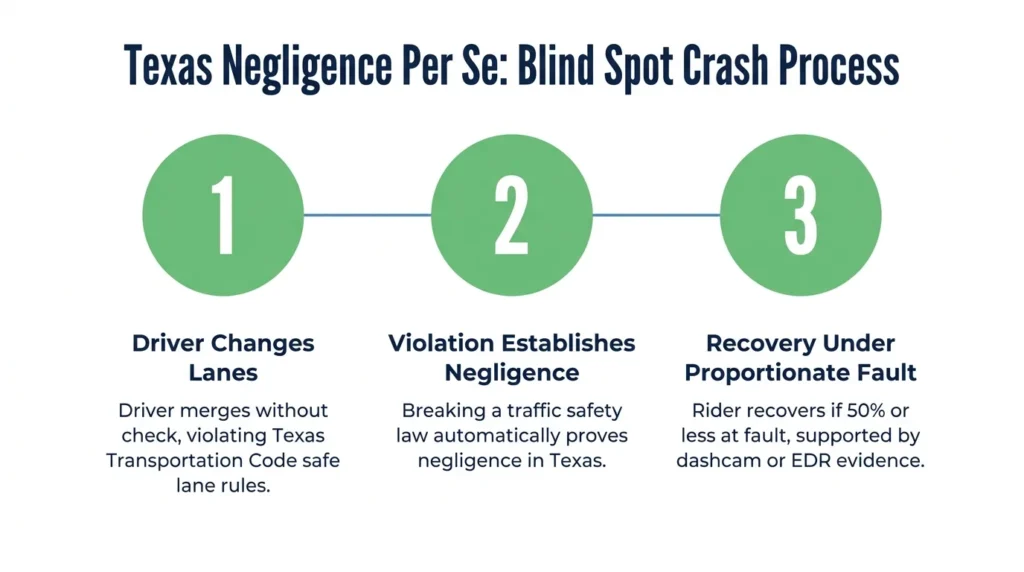
Riding in a vehicle’s blind spot does not excuse the driver from physically looking to make sure that the lane is clear. The driver’s legal responsibility to check for nearby traffic has nothing to do with where the motorcycle is positioned on the road.
Evidence is what wins these fault disputes. Useful proof typically includes dashcam and traffic camera footage, vehicle event data recorder output, accident reconstruction analysis, and witness accounts of whether the driver signaled. Dashcam clips can also show whether a driver did a mirror-only check and did not look over their shoulder, which helps show whether they properly checked their surroundings before changing lanes.
Riders who are worried about how a fault argument might reduce their recovery can review how Texas motorcycle accident settlements are structured before deciding their next steps. Our past motorcycle case results can give you a clearer picture of how this evidence can affect your claim. Past results do not guarantee future outcomes.
Talk to an Attorney About Blind Spot Crashes Involving Motorcycles in Texas
Blind spot crashes are usually more complicated than the insurance company is being told by the driver who hit you. Angel Reyes & Associates has represented motorcyclists across Texas in cases involving passenger cars, SUVs, and commercial trucks, with more than $1 billion recovered for clients.
We work on contingency, so there is no fee unless we win, and consultations are free. If you believe a driver’s failure to check their blind spot caused your crash, contact our team for a free case review to talk through what happened.
Past results do not guarantee future outcomes.
Blind Spot Accident FAQs
Can a driver be ticketed by police for a lane-change crash that injured a motorcyclist in Texas?
Yes, a driver who changes lanes without confirming that the path is clear can receive a ticket under Texas Transportation Code § 545.060. That ticket becomes part of the crash record and can be used as evidence in a civil negligence claim.
How long does a motorcyclist have to file a personal injury lawsuit in Texas after a blind spot crash?
Texas sets a two-year statute of limitations for most personal injury claims under Texas Civil Practice and Remedies Code § 16.003. This means the injured rider generally must file a lawsuit within two years of the crash date. Missing that deadline typically prevents you from filing a claim, regardless of how strong the evidence is.
If the truck driver's employer is a large trucking company, can the company be held liable, too?
Yes, under the legal rule of “respondeat superior,” an employer can be held liable for a driver’s negligent acts committed while they are on the job. Trucking companies may also face direct liability if they failed to properly train drivers on how to manage blind spots, or if they did not enforce the required mirror-check procedures under federal safety rules.
What happens if a motorcyclist was splitting lanes at the time of the blind spot crash?
Lane splitting is illegal in Texas, so a rider who was splitting lanes at the time of a crash could have a portion of fault assigned to them under the state’s proportionate responsibility rules. Whether the rider is still able to recover compensation depends on the facts of the case and whether their percentage of fault exceeds the 51 percent threshold.
About the Authors

Angel Reyes
Writer
Angel L. Reyes, III is the Founder and Managing Partner of Angel Reyes & Associates. A nationally recognized trial attorney and business leader, Angel has helped over 70,000 injury victims recover more than $1 billion since founding the firm in 1993. Named to the Texas Super Lawyers list annually since 2008, Angel brings Wall Street experience, Ivy League education, and a deep commitment to client advocacy. He is a frequent legal commentator and published author with extensive contributions to legal scholarship, trial strategy, and consumer protection.

Kyle Nicolas
Editor
Kyle Nicolas is the Web Content & SEO Manager at Angel Reyes & Associates. He has more than 10 years of experience as a marketing co...

Angel Reyes
Reviewer
Angel L. Reyes, III is the Founder and Managing Partner of Angel Reyes & Associates. A nationally recognized trial attorney and business...