Why Insurance Companies Request Independent Medical Exams in Texas Car Accident Claims


Every article on this site is researched by our internal team, reviewed for legal accuracy against current Texas law, and held to State Bar of Texas advertising standards before publication. We do not publish content that overstates outcomes or makes promises about results.
Learn more about our
editorial standards .
Key Takeaways
- An IME is an evaluation paid for by the insurance company to challenge your injury claims, not a treatment visit designed to help you recover.
- Before a lawsuit, IME requests are typically negotiable; after filing suit, Texas Rule of Civil Procedure 204.1 requires court approval with specific conditions and protections.
- Document everything about your IME appointment and review the report with an attorney to identify errors that can be challenged using your treating physicians' records.
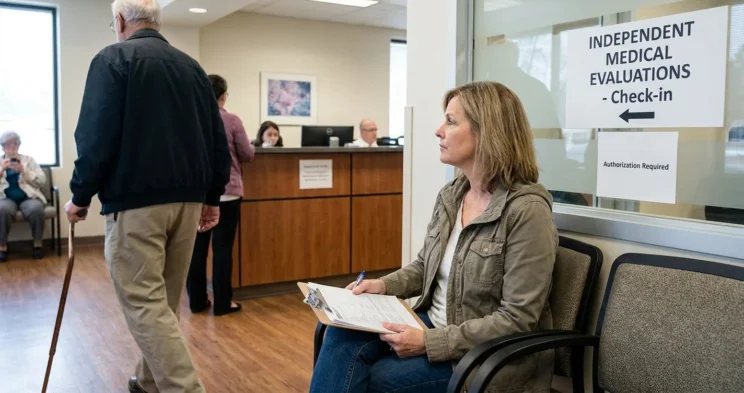
You were rear-ended in rush-hour traffic on I-35E last month. Your doctor has been treating your neck pain, and you’ve followed every recommendation. Now the insurance adjuster says you need to attend an Independent Medical Examination (IME) before they can move forward with your car accident claim. The letter makes it sound routine, but something feels off.
You’re right to pay attention. These exams can significantly affect your claim’s value, and understanding how they work in Texas gives you the power to protect yourself.
What an Independent Medical Examination Really Is
An IME is a medical evaluation requested by an insurance company or defense attorney to assess your injuries. The name suggests neutrality, but the reality is more complicated.
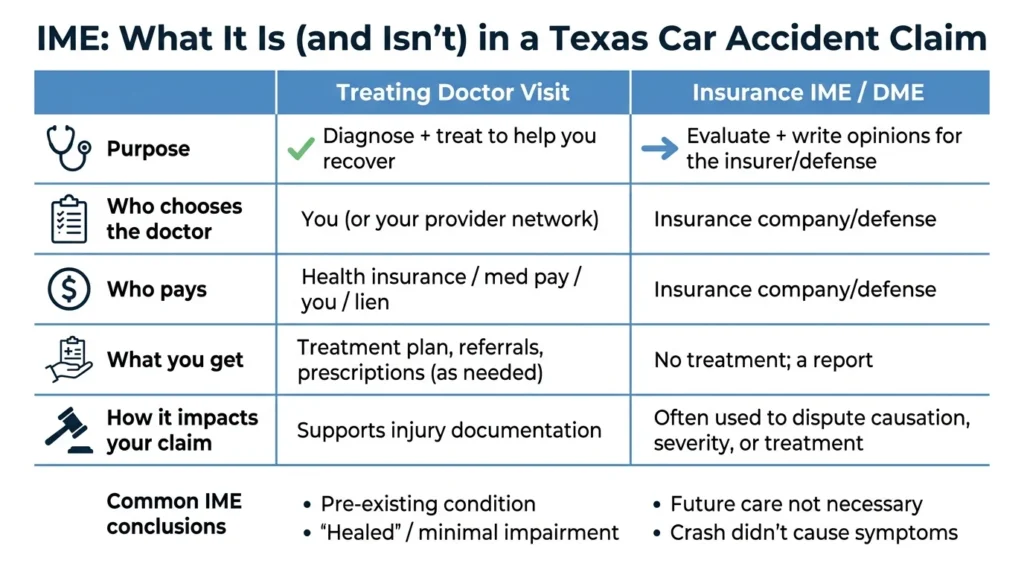
Unlike your treating doctor, the IME physician isn’t there to help you get better. Their job is to evaluate your condition and provide opinions about causation, severity, and whether your treatment is necessary. The insurance company selects the examiner, schedules the appointment, and pays for the evaluation.
This arrangement matters because the examiner’s conclusions often favor the party paying the bill.
Common findings in IME reports include:
- Your symptoms existed before the crash (pre-existing condition).
- Your injuries have fully healed (minimal impairment).
- Future treatment isn’t medically necessary.
- The accident didn’t cause your current complaints.
These conclusions can be used to reduce your settlement offer or deny coverage for ongoing care.
IME vs. DME
The distinction between an Independent Medical Examination (IME) and a Defense Medical Examination (DME) is often a matter of preference. DME is often considered to be the more accurate legal term in Texas personal injury litigation, as it acknowledges that the exam is a tactical tool used by the defense to challenge your evidence, dispute the severity of your injuries, or argue that your medical treatment was unnecessary.
Why Insurance Companies Request IMEs
Insurance companies are businesses. Their goal is to resolve claims for the lowest possible payout.
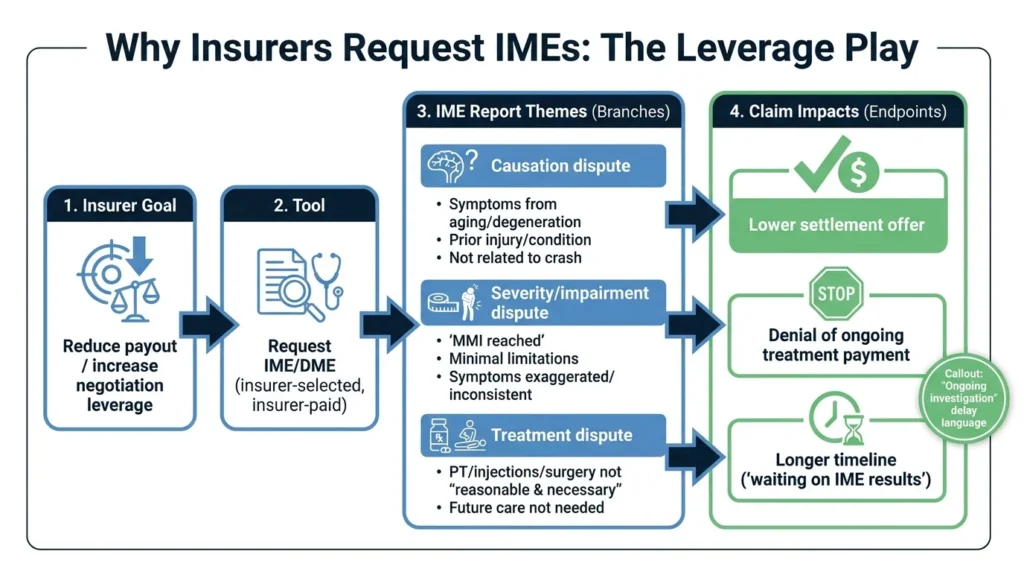
An IME gives them evidence they can use to challenge your claim in several ways, including:
- Causation disputes: The examiner may argue your symptoms stem from aging, prior injuries, or conditions unrelated to the crash. This is especially frequent with back and neck injuries, where imaging often shows some degenerative changes regardless of the accident.
- Severity and impairment disputes: Even if the examiner acknowledges an injury, they may conclude you’ve reached maximum medical improvement or that your limitations are minimal.
- Treatment disputes: The IME report might state that physical therapy, injections, or recommended surgery aren’t “reasonable and necessary.” This gives the insurer grounds to refuse payment for treatment.
Settlement leverage is the underlying goal of an IME. By creating a medical opinion that contradicts your treating doctors, the insurance company strengthens its negotiating position.
Under Texas Insurance Code § 542.056, insurers have deadlines for handling claims, but they often use “ongoing investigation” language to justify delays while waiting for IME results.
Do You Have to Attend an IME in Texas?
While you’re generally not legally required to attend an IME before a lawsuit is filed, outright refusal might complicate settlement discussions or result in your claim being denied. Proceeding without legal advice can put you at a disadvantage.
After a lawsuit is filed, the rules change. Under Texas Rule of Civil Procedure 204.1, the defense can file a motion asking the court to order you to submit to an examination. However, they must demonstrate that your physical or mental condition is “in controversy” and show good cause for the exam. Courts don’t grant these requests automatically.
Negotiating the terms often produces the best outcome. Refusing a reasonable request might make you look uncooperative, but attending without conditions might expose you to an overly broad or unfair examination.
Red Flags to Watch Out for in IME Request Letters
Many requests are framed as “routine” or “required” without explaining your actual rights.

Watch for these warning signs:
- Vague scope with no specific body parts or conditions listed.
- No information about the examiner’s specialty.
- Requests for overly broad medical authorizations.
- Excessive travel demands or unreasonable scheduling pressure.
Don’t sign new authorizations or releases at the IME without legal advice. Some forms grant access to your entire medical history, which can be used to find unrelated conditions to blame for your symptoms.
Your attorney can request conditions that prevent overreach. The exam scope should be limited to body parts and conditions actually in dispute. If you injured your neck and back in a crash near Deep Ellum, the examiner shouldn’t be conducting a full psychiatric evaluation.
Reasonable time limits, an appropriate examiner specialty, and clarity about what testing will occur can all be negotiated or ordered by the court.
What Happens at an IME Appointment
Knowing what to expect reduces anxiety and helps you better prepare. A typical IME follows a predictable pattern.
Intake
This portion of your appointment involves identification verification, questionnaires about your injury history, and questions about prior medical conditions, work activities, and daily functioning. Answer honestly, but don’t volunteer information beyond what’s asked.
Examination
The examiner typically reviews your medical records, imaging reports, and sometimes surveillance footage or social media posts either before or during your appointment.
The examination itself usually includes range-of-motion testing, orthopedic or neurological assessments, and questions about your current symptoms. The examiner may ask you to perform specific movements or tasks.
During this appointment, you will not receive treatment, prescriptions, or a care plan. This isn’t a doctor’s visit designed to help you. Understanding this distinction helps you approach the appointment with appropriate expectations.
How to Prepare for Your IME
Preparation is about accuracy and documentation, not performance.
Before the appointment, review your injury timeline, current symptoms, medications, and what your treating doctors have recommended.
Plan your travel time, arrive early, and keep receipts and time logs. Don’t skip your regular treatment appointments to accommodate the IME schedule. Gaps in treatment can be used to argue your injuries aren’t serious.
Here are things you need to keep in mind and prepare for during your appointment:
- Be consistent: Inconsistencies between your IME statements and medical records can be used against you. The examiner may ask the same questions in different ways to test you.
- Don’t guess at answers: If you don’t remember something, say so.
- Avoid minimizing your symptoms: Do not try to seem tough or worry that the examiner may believe you are exaggerating to make a point.
- Watch what you say: Casual conversation about your activities can appear in the report. Mentioning that you went to the Texas State Fair last weekend might become “patient reports no limitations on recreational activities” in the write-up.
- Stay on track: Don’t volunteer unrelated medical history unless directly asked.
- Be mindful of your actions: Your demeanor is being observed throughout. How you sit, stand, walk, and move can be interpreted as evidence of your functional capacity. Be yourself, but be aware that everything is being evaluated.
During the exam, be truthful and precise. Describe your limitations with specific examples. “I can’t lift my daughter anymore” is more concrete than “my back hurts.”
Keep Careful Documentation to Protect Your Claim
Keep proof of the appointment details: date, time, address, examiner’s name, and duration. If the report claims a thorough 45-minute examination but you were only in the room for 12 minutes, that discrepancy matters.
Preserve all communications about the IME, including request letters, scheduling emails, and any claims about what was “required.”
What to Do If an IME Is Wrong or Unfair
Insurers have legal duties they must uphold when they investigate and handle claims. Texas Insurance Code § 541.060 prohibits unfair settlement practices, including failing to conduct reasonable investigations or refusing to explain claim denials.
If an IME is being used to justify an unreasonable delay or denial, you have options. The Texas Department of Insurance accepts complaints about improper claim handling, and TDI Bulletin B-0006-22 summarizes insurer duties regarding good faith and prompt payment.
Compare the IME conclusions to your treating physician’s records. If the examiner says your range of motion was normal, but your physical therapist documented significant restrictions the same week, your attorney can use that inconsistency to strengthen your claim.
When to Talk to a Texas Car Accident Lawyer
An IME can significantly impact your claim’s value. Knowing when to hire a car accident lawyer can make all the difference in your case.
Consider contacting an attorney if:
- The insurer insists the IME is “mandatory” or threatens denial for noncompliance.
- You’re asked to sign broad medical releases.
- Your IME report contradicts your treating doctors or is being used to lowball your settlement.
At Angel Reyes & Associates, we’ve spent over 30 years helping Texas injury victims protect their claims. We have extensive experience working with victims of car accidents, premises liability claims, pedestrian accidents, and other personal injury cases.
We offer free consultations, and you pay nothing unless we win. Our team can review IME requests, negotiate appropriate conditions, and challenge biased reports that don’t reflect your real injuries.
If you’ve been asked to attend an independent medical exam or received a report that doesn’t match your experience, reach out to us today. We’re available 24/7 and serve clients throughout Texas from our more than 20 office locations.
Independent Medical Examination FAQs
Can I bring someone with me to an IME in Texas?
Maybe, but it depends on whether the exam is voluntary or controlled by a court order in a lawsuit. This issue is often negotiated in advance.
Will the IME doctor order an MRI, prescribe medication, or give me treatment advice?
No. An IME is generally for evaluation only, not treatment, so most people should not expect prescriptions, referrals, or a long-term care plan from that doctor.
How long does an independent medical exam usually take?
Many IMEs are fairly short, sometimes much shorter than a regular visit with your treating doctor. The exact length varies, which is why it helps to note your arrival time, exam start time, and when the appointment ended.
Can an IME include mental health or cognitive testing after a car accident?
Sometimes, but not automatically. In a lawsuit, the requested testing should match the condition actually in dispute, and broader exams may require a stronger showing and clearer limits.
What if the IME report leaves out symptoms I told the doctor about?
Make a written timeline of what you reported and what testing was done as soon as you get home. Those notes can help show factual mistakes if the report later misstates your history or complaints.
About the Authors

Angel Reyes
Writer
Angel L. Reyes, III is the Founder and Managing Partner of Angel Reyes & Associates. A nationally recognized trial attorney and business leader, Angel has helped over 70,000 injury victims recover more than $1 billion since founding the firm in 1993. Named to the Texas Super Lawyers list annually since 2008, Angel brings Wall Street experience, Ivy League education, and a deep commitment to client advocacy. He is a frequent legal commentator and published author with extensive contributions to legal scholarship, trial strategy, and consumer protection.

Kyle Nicolas
Editor
Kyle Nicolas is the Web Content & SEO Manager at Angel Reyes & Associates. He has more than 10 years of experience as a marketing co...

Angel Reyes
Reviewer
Angel L. Reyes, III is the Founder and Managing Partner of Angel Reyes & Associates. A nationally recognized trial attorney and business...