Injured in a Commuter Vanpool Crash?


Every article on this site is researched by our internal team, reviewed for legal accuracy against current Texas law, and held to State Bar of Texas advertising standards before publication. We do not publish content that overstates outcomes or makes promises about results.
Learn more about our
editorial standards .
Key Takeaways
- Save your vanpool agreement and identify the program sponsor and the vehicle provider.
- Driver status and trip purpose shape whether a claim against a public sponsor can proceed.
- Review the actual insurance policies and possible notice rules with a lawyer promptly.
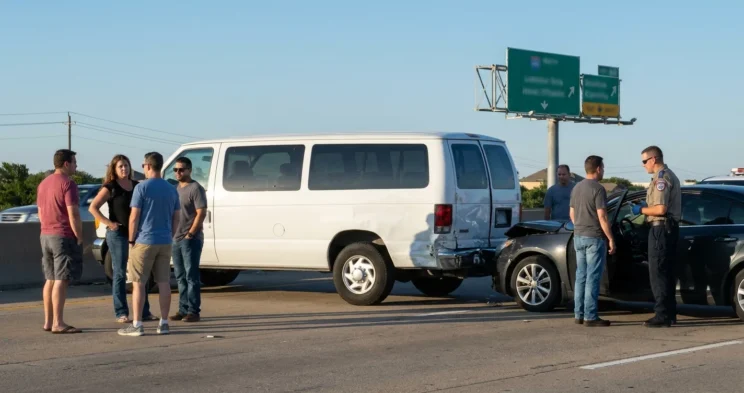
After a vanpool accident in Texas, your claim depends on the sponsor, the driver’s status, the vanpool agreement, and the insurance policies. A public sponsor may have legal protection from a lawsuit, and an unpaid driver may not qualify as its employee. Neither fact automatically settles every claim or insurance question.
When injuries interrupt your commute and leave you missing work, begin with the records that identify the sponsor, vehicle provider, and driver. Those roles can belong to different people or organizations.
Identify the Sponsor & the Vanpool Agreement
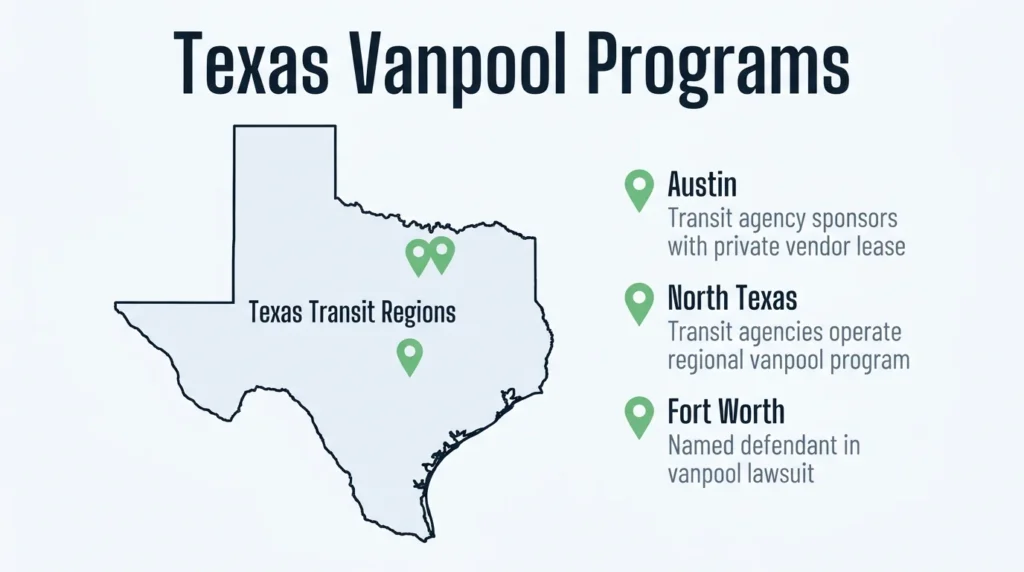
Start by identifying four things, which are the program sponsor, the company that provides the van, the driver, and the agreement everyone signed. A transit logo on the van or a fare subsidy does not, by itself, show who is legally responsible or whose insurance applies.
Texas commuter programs can involve regional transportation authorities. Texas Transportation Code Chapter 452 establishes the governmental character of these authorities. Under §§ 452.052 and 452.056, it also authorizes them to operate public transportation or contract with others to provide it. The chapter expressly recognizes coordinated carpool and vanpool activities.
Chapter 452 does not govern every vanpool in Texas. Some programs run through a different entity with its own enabling law. The first job is to name the actual sponsor and confirm the law behind it.
Each role can carry different legal consequences. The sponsor may be a public authority, and the vehicle provider may be a private company. Your employer may encourage participation without running the program. Joining the vanpool through work does not, on its own, answer whether an employment-based claim exists.
Current programs show how these roles split apart. CapMetro describes a sponsor arrangement with Commute with Enterprise and a lease that includes insurance. In North Texas, the regional vanpool program identifies Trinity Metro and DCTA as operators. A program webpage illustrates the structure. It is not your signed agreement or the policy in force on the day of your crash.
Driver Status Shapes Claims Against a Public Sponsor
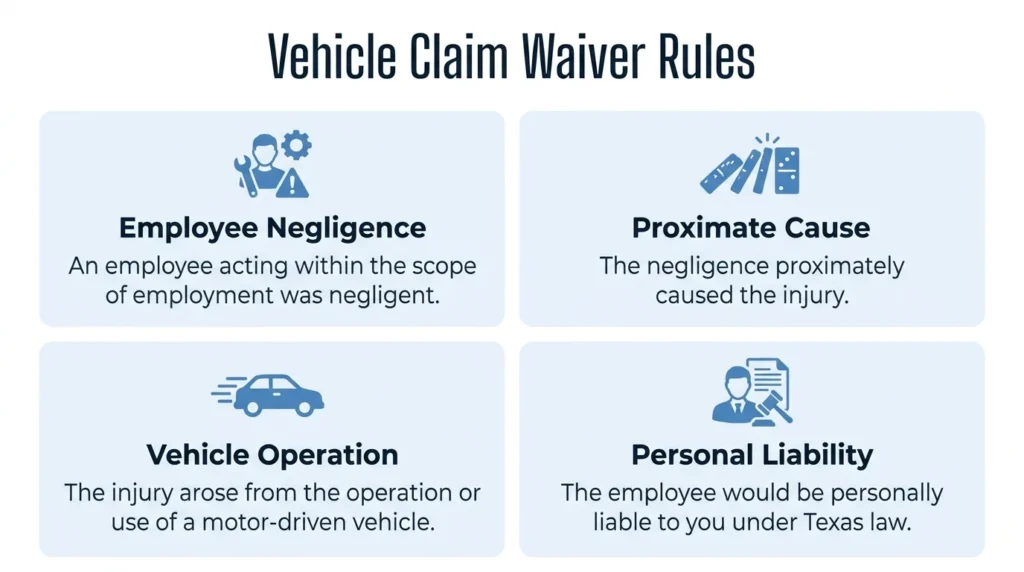
When a public authority sponsors the vanpool, the driver’s status often decides whether a claim against that authority can move forward. A genuinely unpaid volunteer driver may not meet the legal definition of an employee. That can bar a vehicle claim against a governmental sponsor even when the driver caused the crash.
Texas governmental units generally have immunity. That means they cannot be sued unless the Legislature waives that protection. The Texas Tort Claims Act provides a limited waiver for motor vehicle injuries. Under Texas Civil Practice and Remedies Code §101.021(1), the waiver applies only when all of these are true:
- An employee acting within the scope of employment was negligent.
- The negligence proximately caused the injury.
- The injury arose from the operation or use of a motor-driven vehicle.
- The employee would be personally liable to you under Texas law.
Employee & Volunteer Status
The Act’s definition of employee carries real weight here. Section 101.001(2) requires a person in the paid service of a governmental unit. It excludes independent contractors, their employees, and anyone whose task details the government has no legal right to control.
The question goes beyond who sat behind the wheel or what the paperwork called the driver. Compensation, benefits, the actual working relationship, and the sponsor’s legal right to control the driving all count.
If a volunteer participant fails the employee test, a vehicle waiver claim based only on that participant’s negligence can fail. Other employee involvement, legal theories, and defendants require separate analysis.
Contractor Protection & Trip Purpose
A Fort Worth appellate decision involving a commuter vanpool shows how much the facts drive the result. In Bell v. VPSI, Inc., a passenger sued the van provider and the Fort Worth Transportation Authority. The court affirmed judgment for those defendants on the appealed vicarious liability claims.
On that record, the driver was an independent contractor, and the crash followed personal weekend errands rather than the commuting service.
The decision has limits. The claims against the driver had been dropped, the direct negligence ruling was not appealed, and the court never reached the notice issue. Bell shows why the agreement and the actual trip matter. It does not mean every vanpool driver is immune or that every weekday commute ends the same way.
A private provider does not automatically face unlimited liability either. Section 452.056(d) limits a qualifying contractor’s exposure to what the authority would face for performing the same function. In Fort Worth Transportation Authority v. Rodriguez, the Texas Supreme Court applied that limit to outsourced bus operations. The court distinguished liability limits from a general grant of governmental immunity from suit.
In 2026, the Texas Supreme Court decided MV Transportation, Inc. v. GDS Transport, LLC. The decision confirmed that this protection can eliminate liability within a delegated transit function, not merely cap damages. That case involved a fraud claim arising within a contractor’s delegated transit management function, not a passenger injury. Neither decision predicts how a vanpool injury claim will turn out.
Insurance Coverage Depends on the Actual Policies
Insurance answers come from the policies themselves, reviewed one at a time. If a claim against a public sponsor fails, the volunteer driver’s personal insurer does not automatically step in to pay. Ask the insurer to identify the policy terms supporting its coverage decision.
Start with the program. A vanpool lease may include insurance, as CapMetro’s program describes. A program summary still does not prove what coverage existed on your crash date.
Under §452.062, authorities may also buy insurance or self insure for their own liability and their contractors’ liability. That permission does not establish coverage for any particular loss.
Next, look at the driver’s coverage and your own. The Texas Department of Insurance says ordinary carpools are generally covered but tells consumers to check their policies. TDI also notes that paid driving can be treated differently. That guidance addresses everyday carpools, not a leased commuter van.
A careful review of the driver’s policy covers several parts. These include the declarations page, endorsements, and authorized driver terms. The review also covers provisions for hired, non-owned, or regularly furnished vehicles and any coverage position the insurer has taken.
TDI’s guidance also discusses personal injury protection (PIP) and medical payments coverage, including when you ride in someone else’s vehicle. Your own policy may deserve a close look. If another motorist caused the crash, that driver’s policy is a separate source to review. Coverages do not automatically stack.
Section 101.104 restricts discovery and trial use of a governmental unit’s insurance information, so you may not be able to demand every authority policy.
Shared expense vanpools also have a different regulatory classification from app-based rideshare trips. The Texas Department of Licensing and Regulation excludes shared expense carpool and vanpool arrangements from transportation network companies. Uber and Lyft insurance rules do not carry over.
Preserve Records & Get Prompt Advice After the Crash
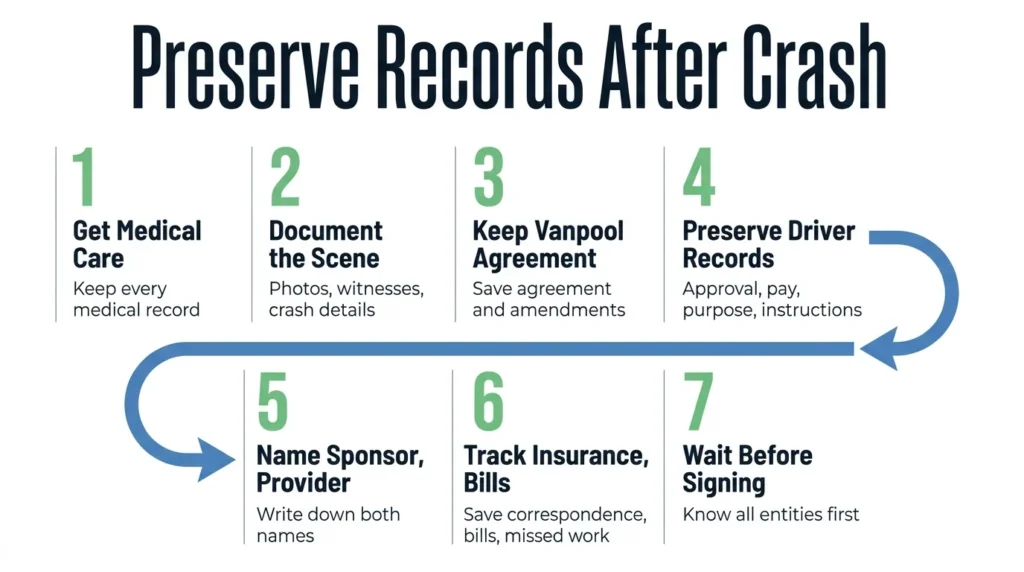
After a vanpool accident, your health comes first. The paper trail comes next. These steps protect the evidence that shows who answers for your injuries:
- Get the medical care you need and keep every record.
- Save photos, witness names and phone numbers, crash details, and messages with other participants.
- Keep your signed vanpool agreement and any amendments.
- Preserve records of driver approval, any driver compensation or benefits, program instructions, and the purpose of the trip.
- Write down the sponsor and the vehicle provider by name.
- Save insurance correspondence and track your medical bills and missed work.
- Wait to sign any release until you know every entity involved.
If the vanpool connects to a governmental sponsor, timing matters. Section 101.101 generally requires notice of a claim to a governmental unit within six months. That rule is subject to the statute’s provisions on actual notice and any valid municipal notice requirements. A police crash report does not necessarily satisfy that notice rule.
Six months is also not a universal deadline to file a lawsuit. Which rules apply depends on the entity and the facts, so prompt legal review matters.
Review Your Vanpool Crash Options With Angel Reyes & Associates
Angel Reyes & Associates has guided injured Texans for over 30 years. A consultation can help you review the sponsor’s identity, the driver’s relationship to the program, and the available insurance information.
Bring your vanpool agreement, trip records, medical documentation, and any insurance correspondence. Request a free consultation to review your options. You can reach the firm 24/7.
Past results do not guarantee future outcomes.
Commuter Vanpool Injury Claim FAQs
Does workers' compensation cover injuries sustained in an employer-sponsored vanpool?
Workers’ compensation may apply if the commute qualifies as work-related under Texas law, including circumstances involving employer-required transportation or other recognized exceptions to the general commuting rule. Whether coverage exists depends on the employment relationship and the purpose and conditions of the trip.
What if a vanpool accident aggravates an injury I already had?
A preexisting condition does not automatically prevent an injured passenger from pursuing compensation if another party’s negligence worsened it. Medical evidence can help distinguish the prior condition from the additional harm caused by the crash.
Can a vanpool accident claim include lost wages and future medical expenses?
An injury claim may include documented lost income, reasonable medical expenses, and certain future losses when supported by evidence. The amount recoverable depends on the injuries, proof of damages, and applicable liability rules.
Does Texas require vanpool passengers to wear seat belts, and can that affect an injury claim?
Texas law generally requires occupants to wear seat belts in vehicles equipped with them, subject to statutory exceptions. A failure to wear a seat belt may become relevant to certain injury-related defenses, depending on the circumstances.
About the Authors

Angel Reyes
Writer
Angel L. Reyes, III is the Founder and Managing Partner of Angel Reyes & Associates. A nationally recognized trial attorney and business leader, Angel founded the firm in 1993, which has gone on to help over 70,000 injury victims recover more than $1 billion. Named to the Texas Super Lawyers list annually since 2008, Angel brings Wall Street experience, Ivy League education, and a deep commitment to client advocacy. He is a frequent legal commentator and published author with extensive contributions to legal scholarship, trial strategy, and consumer protection.

Kyle Nicolas
Editor
Kyle Nicolas is the Web Content & SEO Manager at Angel Reyes & Associates. He has more than 10 years of experience as a marketing co...

Spencer Browne
Reviewer
Spencer Browne is a partner at Angel Reyes & Associates and a Board Certified personal injury trial lawyer with nearly 100 jury trials a...