Involved in an Austin Toll Road Crash?


Every article on this site is researched by our internal team, reviewed for legal accuracy against current Texas law, and held to State Bar of Texas advertising standards before publication. We do not publish content that overstates outcomes or makes promises about results.
Learn more about our
editorial standards .
Key Takeaways
- Record the road, segment, direction, nearest exit, and lane type after a toll road crash.
- Request police evidence from the investigator and road records from the correct operator.
- Confirm injury-notice rules separately for governmental units and private operators.
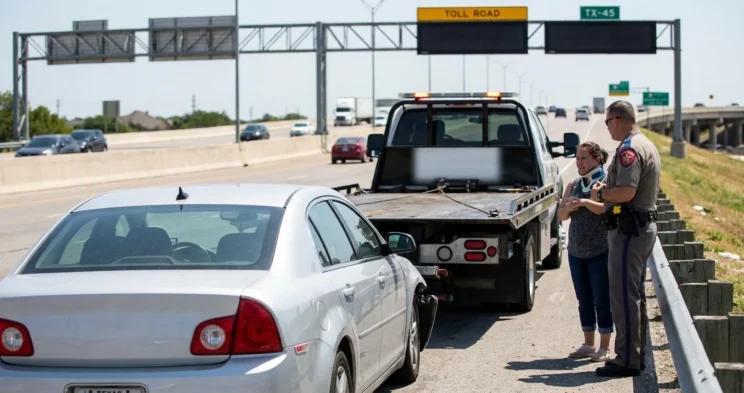
You were injured in a crash on Loop 1, but the company listed on your toll statement may not operate the road, investigate the collision, or handle injury claims.
Call 911 for injuries or immediate danger. Record the exact road, segment, direction, and lane where the crash happened. Keep the incident number, crash report, towing papers, and toll records so you can identify the correct agencies and companies.
What to Do After a Crash on an Austin Toll Road
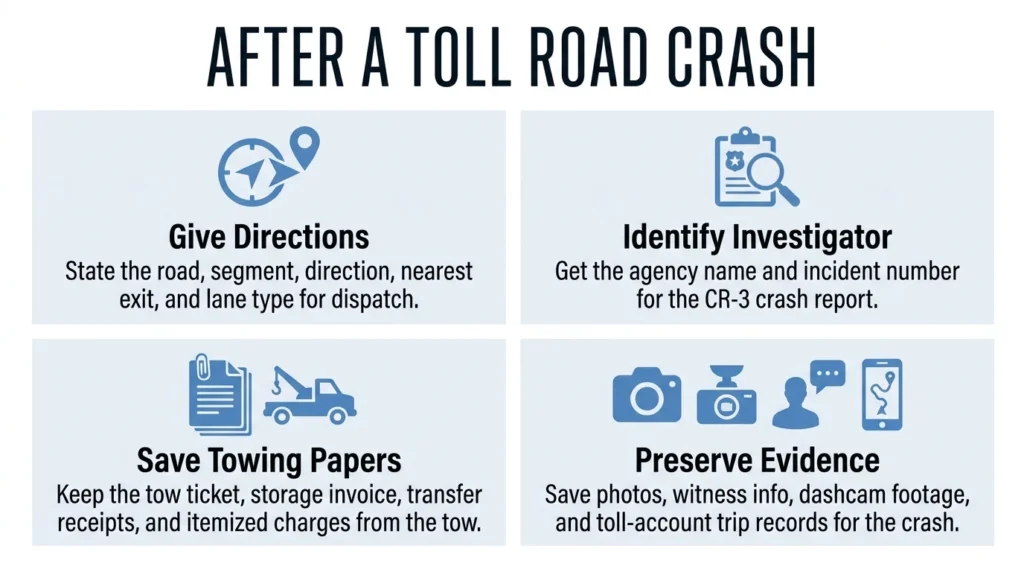
1. Give dispatch precise directions. Record the road number and facility name, segment, direction, nearest exit or marker, and tolled, express, general, ramp, or frontage lane. Note any entry or exit transition.
2. Identify the investigator. Ask the responding officer for the investigating agency and incident number. That agency submits the CR-3 crash report. Eligible requesters can obtain it through TxDOT’s crash report system. Request scene photos, field notes, and dashcam evidence from the investigating agency. Keep the local number and TxDOT crash ID.
3. Save towing paperwork. Keep the tow ticket, storage invoice, transfer receipts, and itemized charges. Record the towing company, who authorized the tow, where the vehicle was picked up, and where it was taken. Texas towing guidance explains accident-tow tickets. Keep these documents because who pays towing costs after a Texas crash may depend on who ordered the tow and the available insurance coverage.
4. Preserve other evidence. Save photos, witness information, dashcam footage, and toll-account trip records. Ask the road operator to preserve any existing incident logs, maintenance records, work-zone records, and video for the crash location and time. Some cameras do not record or retain footage.
These records can help establish what happened in a car accident injury investigation.
CTRMA Toll Roads & Express Lanes Around Austin
The Central Texas Regional Mobility Authority (CTRMA) operates under Transportation Code Chapter 370 as a governmental unit. Its facility inventory identifies the following roads as CTRMA-owned, operated, and maintained. CTRMA uses ViaPlus to process Pay By Mail bills. Your tag provider provides electronic toll charges.
Use the official project maps and current road pages to locate the facility. The agency responsible may differ for nearby frontage roads, ramps, connectors, and regular traffic lanes.
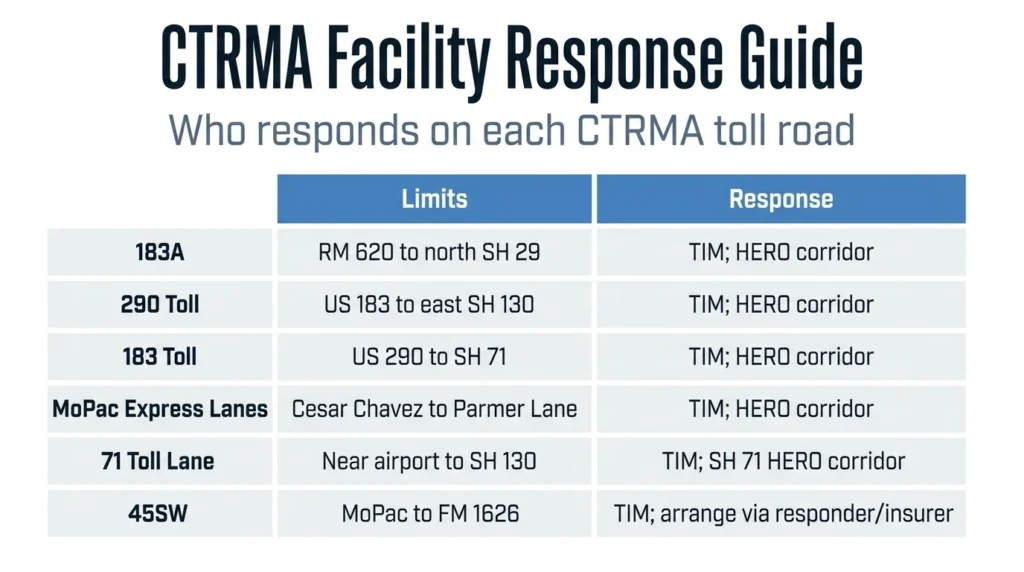
CTRMA also operates the 183 Express Lanes along US 183 between SH 45 North/RM 620 and MoPac. Do not confuse them with 183A Toll or 183 Toll in East Austin.
For a crash on one of these facilities, use CTRMA contacts. Confirm separately who controls any nearby ramp, frontage road, connector, or regular traffic lane. Check the crash report to identify the investigating police agency.
CTRMA’s TIM Center coordinates incident response on its facilities. TxDOT’s HERO service provides free roadside assistance on covered Austin corridors. HERO may move a disabled vehicle to a safer location, but it does not guarantee a free tow to a repair shop. Call 512-974-4376 to confirm coverage.
TxDOT’s SH 45 North, Loop 1 & Northern SH 130 Toll Sections
The state owns these Central Texas Turnpike System (CTTS) facilities, TxDOT operates them, and Harris County Toll Road Authority (HCTRA) bills tolls. CTTS roadside assistance is 512-874-9102.
| Facility | Limits and evidence |
| SH 45 North | US 183 to SH 130, connecting Loop 1 and I-35; record east/west direction, exit and mainlane/frontage/connector |
| Tolled Loop 1 | Parmer Lane north to SH 45 North; record position relative to Parmer |
| SH 130 segments 1–4 | I-35 at Georgetown to US 183 southeast of Austin; record segment, north/south direction and exit near the US 183/SH 45 Southeast transition |
For crashes on these roads, check the crash report to identify the investigating police agency. Use TxDOT contacts to request road records or submit a claim inquiry. The Austin toll map can help identify the facility, although responsibility for nearby ramps and connectors may differ.
Tolled Loop 1 runs north of Parmer Lane. South of Parmer, CTRMA operates the separate MoPac Express Lane.
Southern SH 130 Near Seguin Has a Private Operator
SH 130 segments 5–6 run from SH 45 Southeast near Mustang Ridge to I-10 in Seguin. The State of Texas owns the road, SH 130 Concession Company operates and maintains it, and HCTRA handles toll billing.
Record your direction of travel, nearest exit, and position relative to the US 183 and SH 45 Southeast interchange. Call 911 for an emergency. Company roadside assistance is available at 1-877-741-3089 and can arrange towing, although the tow may not be free. Check the crash report to identify the investigating agency.
Where to Request Records & Send a Potential Injury Claim
Police evidence, operator records, preservation requests, insurance reports, claim notices, and lawsuits are separate steps. Billing contacts and records requests do not automatically provide legal injury notice.
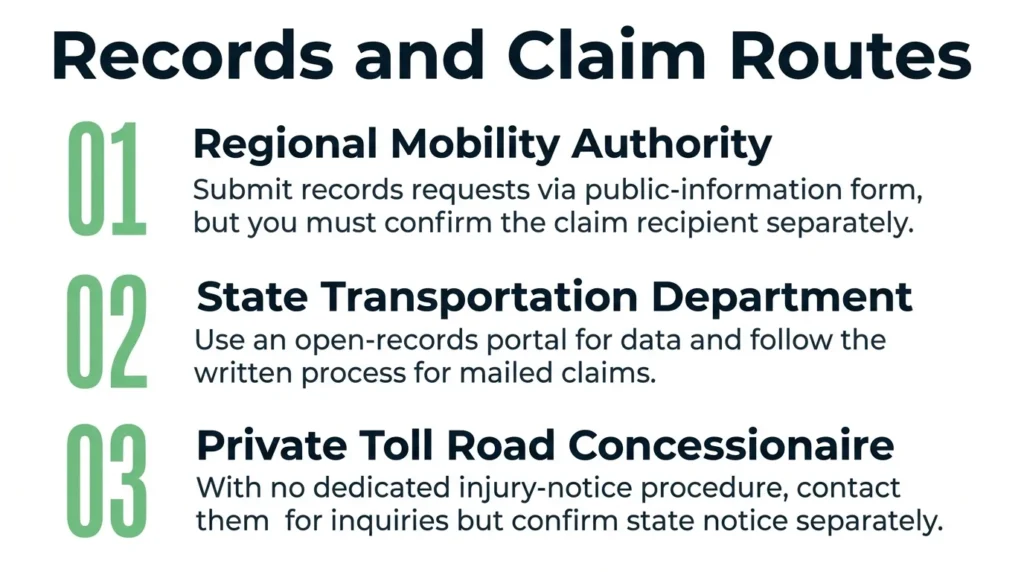
Contacting SH 130 Concession Company does not notify TxDOT about a possible claim. Confirm whether you also need to send notice to the state.
TxDOT asks for the crash location, mile marker or exit, county, type of damage, and your contact information. Its instructions say not to include photos, estimates, or other documents with an initial mailed claim. Keep those materials in your own file. Sending a claim does not mean TxDOT accepts responsibility.
The Texas Tort Claims Act generally requires you to notify a governmental unit within six months. The notice must describe the incident, when and where it happened, and the claimed injuries or property damage. A crash report or records request may not provide the required notice.
SH 130 Concession Company is privately operated, so different notice requirements may apply. Confirm where notice should be sent for your specific claim.
Get Help After an Austin Toll Road Crash
Bring your incident number, tow papers, and toll records to a free consultation. Contact Angel Reyes & Associates to discuss responsible parties, evidence, and applicable notice.
Past results do not guarantee future outcomes.
Austin Toll Road Crash FAQs
Can a toll road operator be responsible for a crash caused by a dangerous road condition?
Potentially. Under Texas law, liability for a dangerous roadway condition can depend on who controlled the location, the type of defect involved, what the responsible entity knew, and whether it waived governmental immunity.
Who may be responsible for an Austin toll road crash involving road construction or a work zone?
Depending on the facts, potentially responsible parties may include another driver, a construction contractor, a maintenance company, or the governmental or private entity responsible for the roadway. Identifying who controlled the specific work zone and activity involved can be important.
Does paying a toll mean the tolling company is responsible for an accident?
No. The company that processes or collects a toll may be different from the entity that owns, operates, or maintains the roadway, so a toll statement alone does not establish responsibility for a crash.
Can I make an injury claim if debris or an obstruction caused my toll road accident in Texas?
Possibly, but claims involving a governmental roadway can raise special rules under the Texas Tort Claims Act, including rules concerning premises defects and certain roadway “,How long do I have to file a lawsuit after an Austin toll road accident?,
The deadline depends on the defendant and type of claim
and a separate notice requirement can expire before the applicable lawsuit deadline. Claims against governmental entities are particularly time-sensitive because Texas law generally requires notice within six months
while valid local notice provisions may impose different requirements.
“
About the Authors

Spencer Browne
Writer
Spencer Browne is a partner at Angel Reyes & Associates and a Board Certified personal injury trial lawyer with nearly 100 jury trials across Texas. He focuses on car, truck, and wrongful death cases, with notable verdicts including a landmark win in the Choctaw Casino bus crash case. A recognized speaker and legal educator, Spencer is a member of the American Board of Trial Advocates and has been honored as a Texas Super Lawyer and one of D Magazine’s Best Lawyers in Dallas. He brings deep trial experience and relentless advocacy to every client he represents.

Kyle Nicolas
Editor
Kyle Nicolas is the Web Content & SEO Manager at Angel Reyes & Associates. He has more than 10 years of experience as a marketing co...

Angel Reyes
Reviewer
Angel L. Reyes, III is the Founder and Managing Partner of Angel Reyes & Associates. A nationally recognized trial attorney and business...