Lane Filtering vs. Lane Splitting: Texas Motorcycle Laws


Every article on this site is researched by our internal team, reviewed for legal accuracy against current Texas law, and held to State Bar of Texas advertising standards before publication. We do not publish content that overstates outcomes or makes promises about results.
Learn more about our
editorial standards .
Key Takeaways
- Lane filtering in Texas is now legal under specific conditions starting September 1, 2025.
- If you were filtering outside the legal conditions, that violation can reduce your injury claim.
- Texas's 51% bar means riders more than half at fault recover nothing from a crash.
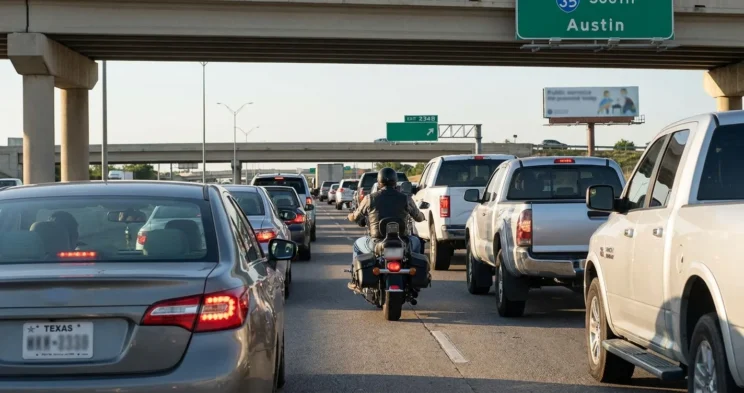
You pull up to a red light on I-35 near downtown Austin, traffic backed up ahead of you. A rider in front of you eases between the stopped cars and rolls to the front of the line. You have heard other riders call this “filtering.” You wonder whether it is legal, and what would happen to you legally if someone hit you while you were doing it.
Texas law on this exact question has shifted more than once in recent years. Knowing where things stand right now could make a real difference to your claim if you are ever in a crash.
Lane Filtering vs. Lane Splitting: The Core Difference
These two terms describe different things, and Texas law now treats them differently.
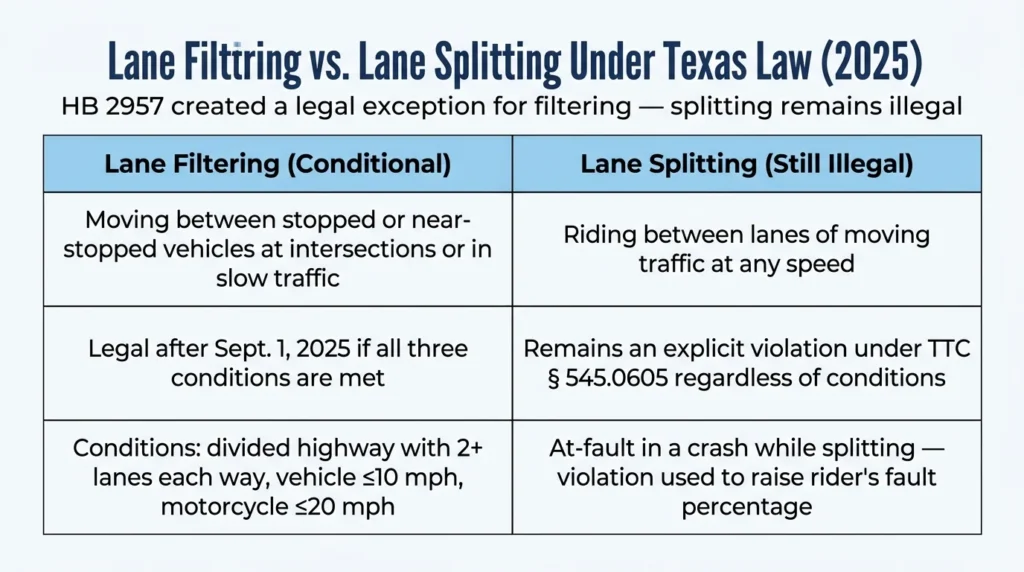
Lane splitting means riding between two lanes of traffic that are moving in the same direction, at any speed. The motorcycle moves along the gap between two parallel lanes while cars around it are traveling at road speed.
Lane filtering means moving between stopped or nearly stopped vehicles, typically at intersections or in slow traffic, at low speed. The motorcycle is not keeping pace with flowing traffic; it is working through vehicles that are sitting still or barely crawling.
The distinction matters because the legal exposure attached to each practice has diverged. Texas Transportation Code § 545.0605 now treats them under the same statute, but with different rules depending on the conditions.
Texas Law on Lane Filtering & Splitting
Before September 2023, Texas had no statute that explicitly addressed lane splitting or lane filtering. Riders who were cited for these maneuvers were typically cited under § 545.060, the general lane discipline rule requiring operators to stay within a single lane. That created some questions about whether filtering was technically prohibited at all.
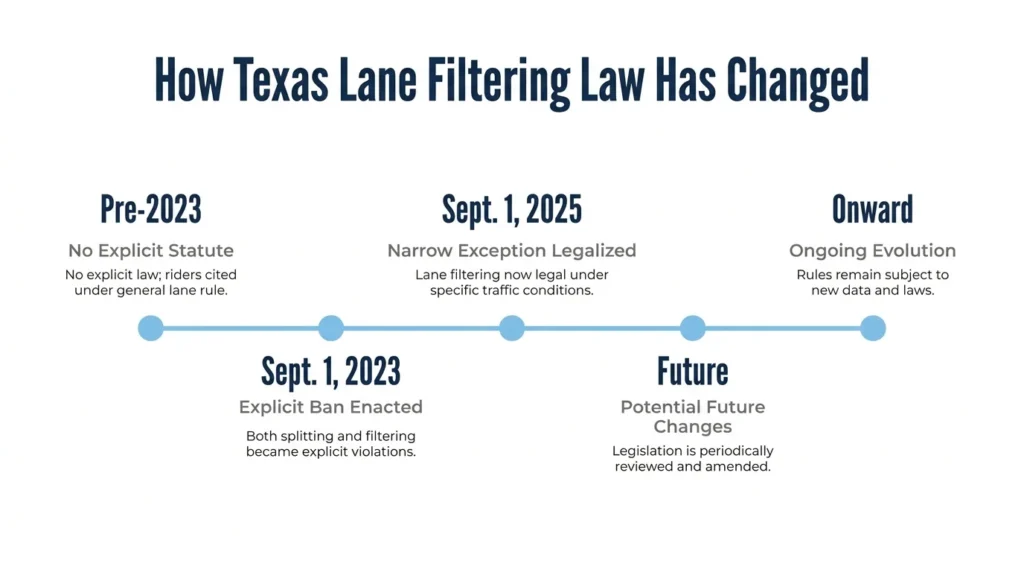
That ambiguity ended on September 1, 2023, when § 545.0605 was added to the Transportation Code. The new section stated that a motorcycle operator may not ride between lanes of traffic moving in the same direction or pass a motor vehicle while in the same lane as the vehicle being passed.
Both lane splitting and lane filtering became explicit violations under Texas law. Penalties ranged from $175 to $300 in fines depending on the county, with the additional possibility of a reckless driving misdemeanor charge if an officer considered the behavior dangerous.
Then the law shifted again. The 89th Legislature passed HB 2957, which was signed into law and took effect September 1, 2025. HB 2957 amends § 545.0605 to create a narrow exception.
Under the new provision, a rider may filter through traffic if three conditions are all met: the road is a divided highway with at least two lanes in each direction; the vehicle being passed is stopped or moving at 10 mph or less; and the motorcycle itself is traveling at no more than 20 mph. If any condition is not met, the maneuver is a violation under Texas motorcycle accident claims law.
How Filtering Affects Your Injury Claim
Whether filtering was legal or not at the moment of your crash, it does not automatically end your right to compensation.
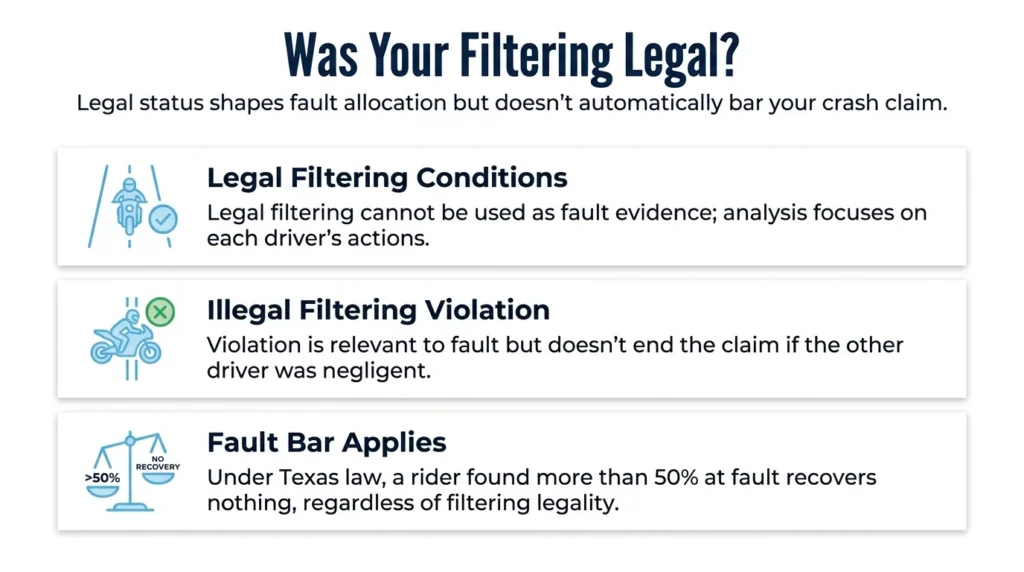
Texas uses proportionate responsibility under Texas Civil Practice and Remedies Code Chapter 33. Under that framework, each party involved in a crash is assigned a percentage of fault. Your compensation is reduced by your own fault percentage. If your share of fault is 51% or more, you cannot win anything. If it is 50% or below, you can still receive compensation, though the amount is reduced.
Before September 1, 2025, a rider who was filtering when a crash occurred faced a harder argument. The filtering itself was a statutory violation of § 545.0605. Insurance adjusters and defense attorneys could point to that violation as evidence the rider was acting outside the law, which made it easier to assign a larger share of fault onto the rider.
However, that did not mean automatic loss of the claim; a driver who changed lanes without signaling into the path of the filtering rider was still doing something wrong. But the rider’s violation gave the other side a clear target.
After September 1, 2025, the analysis gets more fact-specific. If the rider met the three conditions under the new law, filtering was legal, and the maneuver itself cannot be used as automatic fault evidence. If the rider was filtering outside those conditions, the violation is still relevant to fault but does not end the claim on its own.
The surrounding facts are still important: the speed of both vehicles, what the other driver did, whether signals were used, and what witnesses saw. You can learn more about lane splitting in Texas and what it means for a claim.
The Legislative History Behind These Laws
The current law did not arrive in a straight line.
Texas had no statute on lane splitting for most of its history. Riders operated under general traffic rules, and law enforcement handled filtering and splitting on a case-by-case basis under the lane discipline statute. A 2016 Texas Senate bill proposed legalizing lane splitting under specific conditions. It did not pass.
SB 273, filed late in 2018 and considered by the 86th Legislature in 2019, tried again. That bill also died in committee.
In 2023, the legislature moved in the opposite direction. Rather than legalizing the practice, the 88th Legislature passed HB 4122, adding an explicit ban as § 545.0605. The law took effect September 1, 2023, and made both filtering and splitting clear violations for the first time.
By 2025, the pendulum swung back. HB 2957 passed the 89th Legislature and was signed into law, creating the narrow filtering exception described above. Texas went from no explicit rule, to a flat ban, to a partial legalization, all within roughly three years.
The practical consequence is that any rider relying on information from before September 2025 may be operating under assumptions that no longer match current law. The question of whether filtering was legal also depends on when and where the crash happened, because the answer has changed.
You can check out how Texas motorcycle accident settlements work and learn how these fault determinations affect real-world compensation.
Talk to an Attorney After a Texas Motorcycle Crash
If you were in a crash involving filtering or splitting, getting a legal review of your specific circumstances before talking to an insurance adjuster can help you understand how fault is likely to be allocated. You can review how comparative negligence works in Texas for the full framework.
Angel Reyes & Associates has helped injured Texas riders work through exactly these situations for over 30 years. We offer free initial consultations, and you owe us nothing unless we recover for you.
If you were in a crash and have questions about whether your riding behavior affects your claim, reach out to us to review your options.
Past results do not guarantee future outcomes.
Lane Filtering vs. Lane Splitting FAQs
Does legal lane filtering under the 2025 law protect me from any fault if I get hit?
Not automatically. Meeting the legal conditions under the 2025 amendment means the filtering itself is not a traffic violation, so it cannot be used as automatic fault evidence against you. A jury or adjuster will still examine all the other circumstances, including your speed, your lane position, and what the other driver did.
Will a lane-splitting or lane-filtering ticket raise my motorcycle insurance rates?
Yes, a moving violation for illegal lane splitting or filtering can increase your motorcycle insurance premiums, sometimes for several years. If the violation contributed to a crash, the insurer may also use it to reduce or deny your claim, making it doubly costly.
What should I document at the scene if I was involved in a crash while filtering?
Photograph the road type, lane markings, surrounding traffic positions, and any skid marks or debris. Note the speed of surrounding vehicles and whether the road qualifies as a divided highway. These details directly determine whether the 2025 legal exception applies to your situation and how fault is likely to be assigned.
About the Authors

Angel Reyes
Writer
Angel L. Reyes, III is the Founder and Managing Partner of Angel Reyes & Associates. A nationally recognized trial attorney and business leader, Angel has helped over 70,000 injury victims recover more than $1 billion since founding the firm in 1993. Named to the Texas Super Lawyers list annually since 2008, Angel brings Wall Street experience, Ivy League education, and a deep commitment to client advocacy. He is a frequent legal commentator and published author with extensive contributions to legal scholarship, trial strategy, and consumer protection.

Kyle Nicolas
Editor
Kyle Nicolas is the Web Content & SEO Manager at Angel Reyes & Associates. He has more than 10 years of experience as a marketing co...

Angel Reyes
Reviewer
Angel L. Reyes, III is the Founder and Managing Partner of Angel Reyes & Associates. A nationally recognized trial attorney and business...