Lost Wages After an Uber Accident in Texas


Every article on this site is researched by our internal team, reviewed for legal accuracy against current Texas law, and held to State Bar of Texas advertising standards before publication. We do not publish content that overstates outcomes or makes promises about results.
Learn more about our
editorial standards .
Key Takeaways
- Texas gives you two years to file a lost-wages claim after an Uber accident.
- Uber's $1 million policy covers lost wages during an accepted ride or active trip.
- Gig workers can prove lost income with tax returns, 1099s, and bank statements.
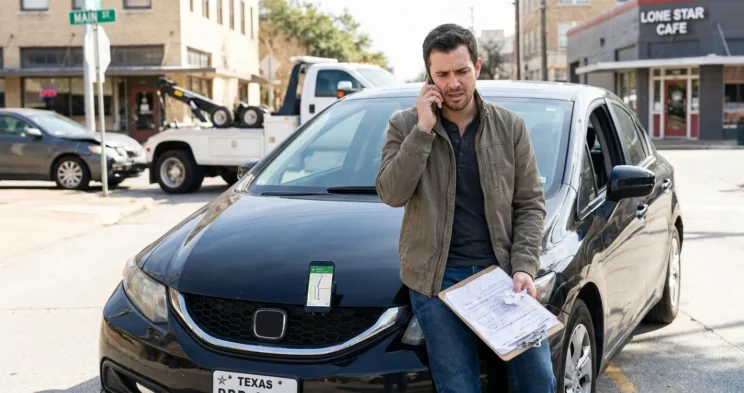
You were riding home from The Heights one evening when your Uber driver got T-boned at a Houston intersection. Now you are out of work, the medical bills are stacking up, and every missed shift is money you needed. Can you get that lost income back?
Lost Wages Are Recoverable After an Uber Accident
Yes. Texas treats lost income as an economic damage you can recover in a personal injury claim. That covers the money you would have earned but could not because of the crash, including hourly pay, salary, self-employment earnings, freelance income, and gig-platform pay.
If the accident kept you from working, the income you lost counts. A rideshare accident lost income claim follows the same core rule whether you drive for a living or sit in the back seat.
Both passengers and drivers can pursue lost wages. If you were a passenger, you can recover compensation. If you were a driver hit by another negligent vehicle, you can recover compensation.
Your role only decides which insurance policy pays, not whether the loss is recoverable.
There is also a difference between lost wages and lost earning capacity. Lost wages are the income you have already missed. Lost earning capacity is the long-term hit to your future earning ability when an injury is lasting or permanent.
You do not have unlimited time to act. Texas sets a two-year deadline on personal injury claims under Texas Civil Practice and Remedies Code (CPRC) § 16.003. Wait too long and you lose the right to recover anything at all.
Which Insurance Pays Lost Wages Depends on the Period
The insurance source for your lost wages depends on what the Uber driver was doing when the crash happened. Texas law splits rideshare coverage into three periods based on the driver’s app status.
The period active at the moment of the crash sets both the coverage limits and the insurer on the hook. Texas Insurance Code Chapter 1954 lays out this framework, and the Texas Department of Licensing and Regulation rideshare rules confirm how the periods work.
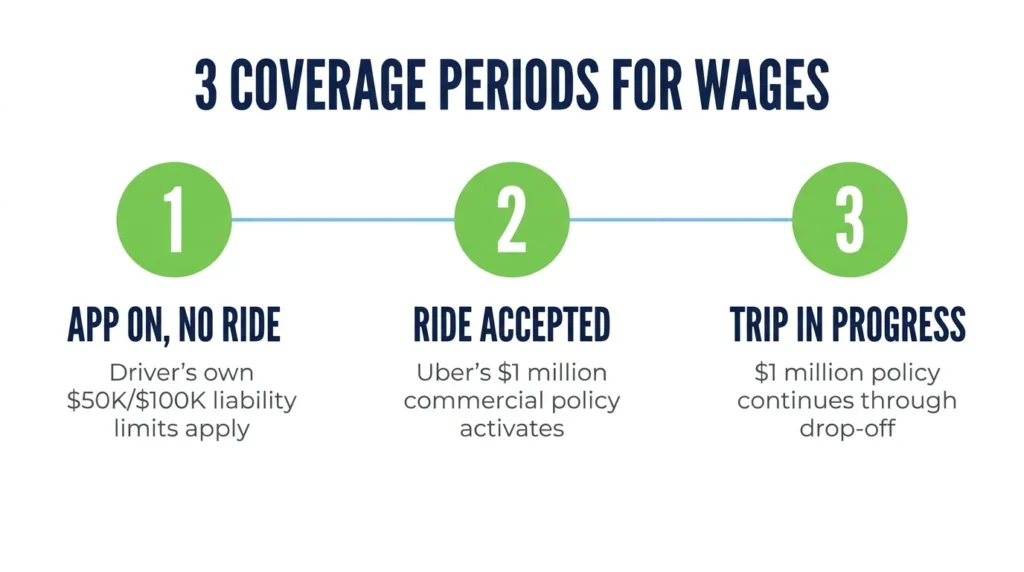
During Period 1, the app is on but the driver has not accepted a ride. Uber carries liability coverage with minimums of $50,000 per person and $100,000 per accident for bodily injury under Texas Insurance Code § 1954.052. This layer applies directly and does not require the driver’s personal insurer to deny a claim first.
Periods 2 and 3 run from the moment a ride is accepted through passenger dropoff. Here, Uber’s $1,000,000 policy applies under Texas Insurance Code § 1954.053. For most passenger injury claims, this is the primary coverage and the policy most likely to fully fund a lost-wages award.
The period also shapes the process. Period 2 and 3 claims run against Uber’s commercial carrier, which means a formal claims process and adjusters trained to keep payouts low.
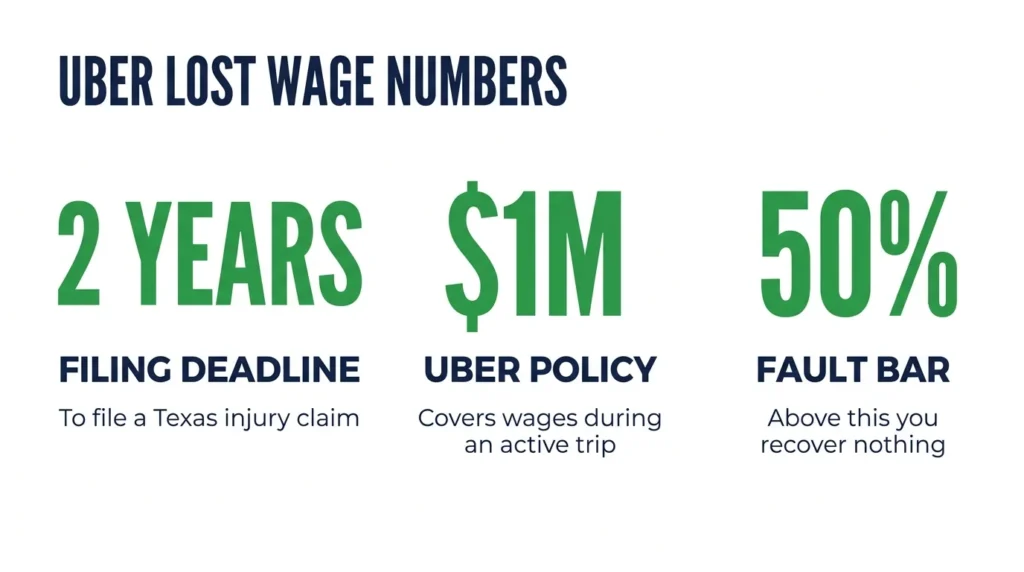
Fault matters too. Texas uses a proportionate responsibility rule under Texas Civil Practice and Remedies Code (CPRC) Chapter 33. If you are found more than 50 percent at fault, you recover no compensation. If your share is lower, your award drops by your percentage of fault.
Documenting Lost Wages: Employees vs. Gig Workers
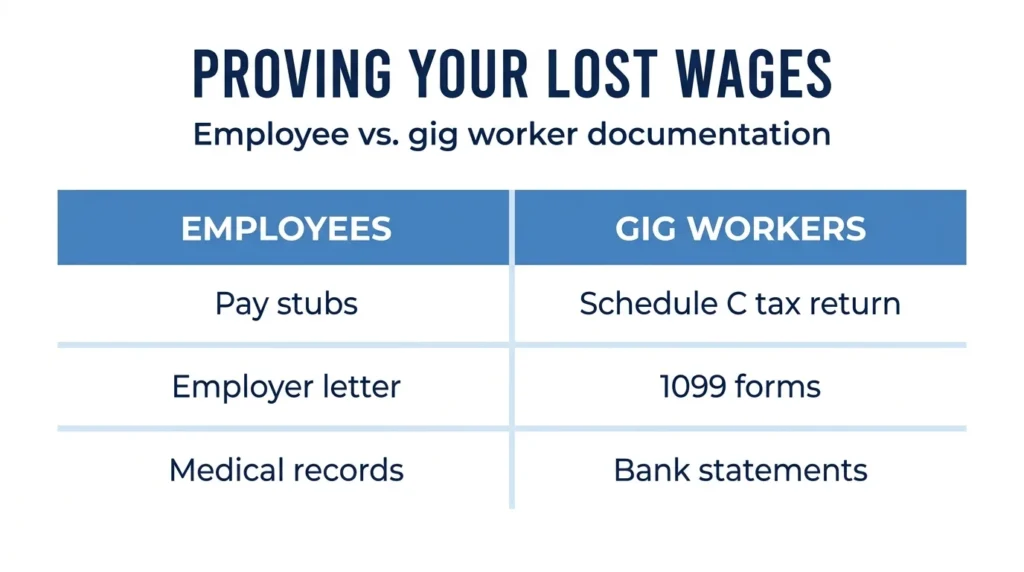
What you need to prove your lost income depends on how you get paid. Traditional employees have pay stubs and employer records. Gig workers and the self-employed need different proof, but the law recognizes that proof.
Traditional Employees
If you work a standard job, your documentation path is the clearest. Pay stubs, an employer letter, and tax returns establish your wage rate and the days you missed.
- Pay stubs: The stubs from the weeks before the accident set the baseline wage rate used to calculate your per-day or per-hour loss.
- Employer letter: A letter from a supervisor or HR confirming the hours or days you missed is your primary proof of absence.
- Medical records: Records linking the injury to your time off are required, since an adjuster can dispute the connection without a physician’s note.
This is also where many rideshare passenger lost wages claims in Texas come together, because passengers usually have standard employment records to draw on.
Gig Workers & Self-Employed Claimants
If you are self-employed or earn through gig platforms, you lack traditional pay stubs. You can still prove your income with records that Texas adjusters and courts accept.
- Schedule C: Your most recent federal return shows net self-employment income, and two or three years of consistent filings strengthen the baseline.
- 1099 forms: Forms from Uber Eats, DoorDash, or other apps document platform income and back up your tax return.
- Bank statements: Regular deposits from clients or platforms show your income rhythm and fill the gaps between annual tax records.
- Partner dashboard statements: Your Uber partner dashboard shows historical weekly and monthly earnings and is accepted proof for driver claimants.
For an injured Uber driver proving lost income, the math is the gap between your average weekly earnings before the crash and the zero you earned while recovering. The same approach that supports claiming lost wages after a car accident in Texas applies to gig-worker lost wages from an accident.
PIP Coverage as a Bridge While the Claim Resolves
Personal injury protection can put money in your pocket fast. PIP under Texas Insurance Code Chapter 1952 replaces a portion of your lost wages regardless of fault, and it pays before a liability claim resolves.
That speed makes it a real bridge when bills are piling up. You can see the coverage framework in the Texas Insurance Code Chapter 1952.
PIP is optional in Texas, though. Drivers can reject it in writing, so check whether the driver carried it before you count on it as a source.
When PIP is available, using it does not block a separate claim against the at-fault party. The two run at the same time, and PIP can ease the immediate pressure while the larger claim plays out.
Accepting a quick settlement before you understand your full losses is one of the most common ways injured workers leave money behind. Lost earning capacity from a lasting injury can far exceed the wages you have already missed.
Injured in a Texas Uber Accident? Talk to an Attorney
The bills do not pause while you sort out which insurance period applies and how to prove income you earn through an app. Rideshare lost-wages claims get complicated fast, and you should not have to untangle them alone. Angel Reyes & Associates has spent more than 30 years handling Texas injury claims, and we know how these cases work.
We work on a no fee unless we win basis, so cost is not a barrier to getting answers. Our team has recovered more than $1 billion for clients across the state. If you want help knowing what to do after a rideshare accident, or you want your situation reviewed by our Texas injury attorneys, reach out for a free consultation.
Past results do not guarantee future outcomes.
FAQs About Lost Wages After an Uber Accident
Can an Uber driver who was injured while driving collect workers' compensation in Texas?
No. Uber classifies its drivers as independent contractors, not employees, so they are not covered by workers’ compensation in Texas. An injured Uber driver must pursue a fault-based personal injury claim against the at-fault party instead.
Is the lost-wages portion of a Texas Uber accident settlement taxable?
Lost wages recovered as part of a personal physical injury claim are generally not taxable under federal law, as long as the wage loss stems directly from the physical injury. Texas has no state income tax, so the recovered amount is not taxed at the state level either.
What happens if the driver who caused the accident had no insurance or too little coverage?
You may still recover lost wages through uninsured or underinsured motorist (UM/UIM) coverage. During an active Uber trip, Uber’s commercial policy includes up to $1,000,000 in UM/UIM protection; if you carry UM/UIM on your own personal auto policy, that coverage can also step in to fill the gap.
Can a pedestrian or cyclist hit by an Uber driver claim lost wages in Texas?
Yes. Anyone injured by an Uber driver, including pedestrians, cyclists, and occupants of other vehicles, can pursue lost wages and other economic damages under Texas personal injury law. The same coverage periods that apply to passengers also determine which policy pays the claim.
What if the insurance company disputes which coverage period was active when the crash happened?
Period disputes are common, especially in Period 1 cases where Uber’s insurer and the driver’s personal insurer may each deny the claim. Trip records and app data from Uber can be used to establish the driver’s status at the exact time of the crash and resolve the dispute.
About the Authors

Angel Reyes
Writer
Angel L. Reyes, III is the Founder and Managing Partner of Angel Reyes & Associates. A nationally recognized trial attorney and business leader, Angel has helped over 70,000 injury victims recover more than $1 billion since founding the firm in 1993. Named to the Texas Super Lawyers list annually since 2008, Angel brings Wall Street experience, Ivy League education, and a deep commitment to client advocacy. He is a frequent legal commentator and published author with extensive contributions to legal scholarship, trial strategy, and consumer protection.

Kyle Nicolas
Editor
Kyle Nicolas is the Web Content & SEO Manager at Angel Reyes & Associates. He has more than 10 years of experience as a marketing co...

Angel Reyes
Reviewer
Angel L. Reyes, III is the Founder and Managing Partner of Angel Reyes & Associates. A nationally recognized trial attorney and business...