Motorcycle Accident Spinal Cord Injuries


Every article on this site is researched by our internal team, reviewed for legal accuracy against current Texas law, and held to State Bar of Texas advertising standards before publication. We do not publish content that overstates outcomes or makes promises about results.
Learn more about our
editorial standards .
Key Takeaways
- A complete spinal cord injury means there's no movement or feeling below where the injury happened.
- High cervical injuries can carry lifetime care costs of more than $5 million.
- Texas gives you two years from the injury date to file your motorcycle claim.
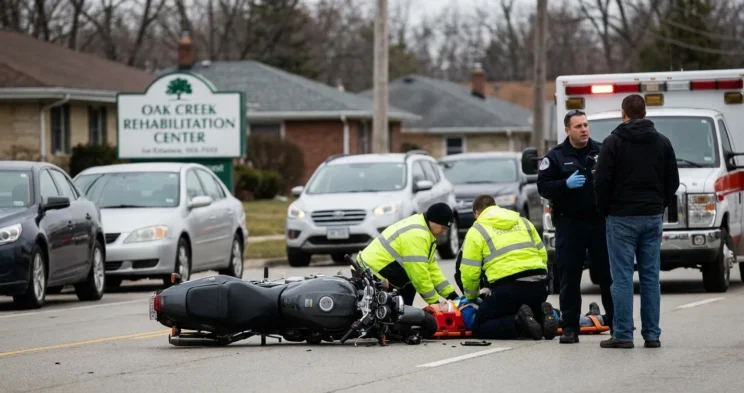
You were riding home through Deep Ellum when a driver turned left across your lane and clipped your front wheel. Now you’re in a hospital bed, and a doctor is using words like “incomplete” and “ASIA grade” that you’ve never heard before.
A couple weeks later, the bills are already coming in, and the other driver’s insurer has called twice. They seem dead-set on getting you to sign an offer sheet and close your case. If something seems suspicious, you might be right.
How Motorcycle Crashes Cause Spinal Cord Injuries
Motorcycle crashes are a leading cause of new spinal cord injuries in the United States, according to the National Spinal Cord Injury Statistical Center.
A motorcycle crash can damage the spinal cord through forces that car crashes rarely produce. When you’re thrown from a bike, your spine absorbs hyperflexion, twisting, and the crushing weight of axial loading all at once. These forces explain why motorcycle accident spinal cord injuries are far more common than standard car accidents, and why those injuries are more likely to be severe.
Three regions of the spine take the brunt of crash forces:
- Your cervical spine in your neck
- Your thoracic spine in your mid-back
- Your lumbar spine in your lower back
Each section carries a different outlook for whether you retain movement and feeling.
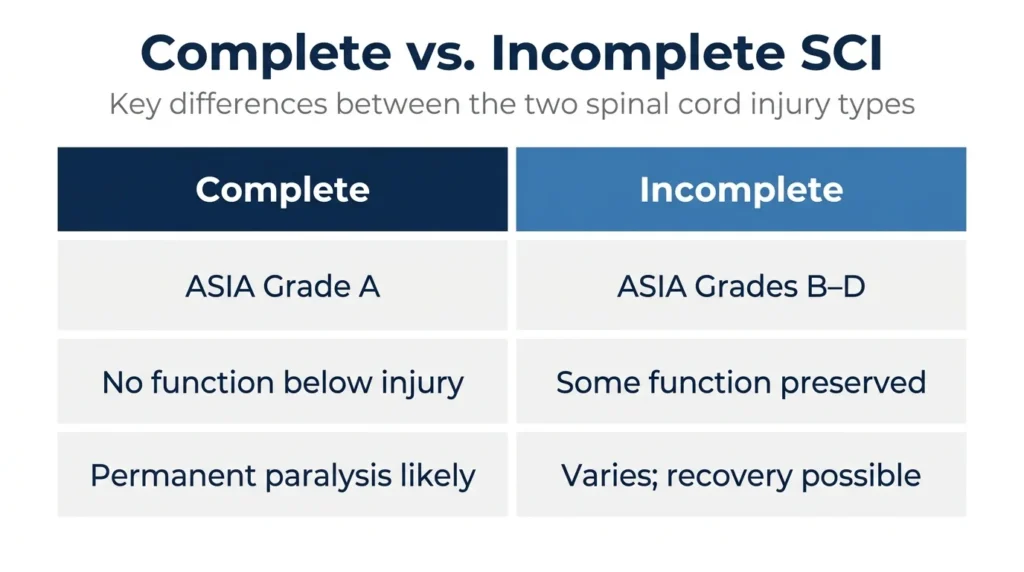
Doctors describe how severe your injury is using the ASIA Impairment Scale. It runs from Grade A, indicating there’s no movement or feeling below the injury, through Grade E, indicating there’s normal function. The grade your doctors assign in those first days after a crash shapes both your medical prognosis and the value of any claim you bring.
Complete vs. Incomplete Spinal Cord Injuries
Your injury falls into one of two categories, and which one matters enormously. The line between a complete and an incomplete injury might seem small, but it changes your prognosis and the way your future damages are calculated.
Complete Spinal Cord Injuries
A complete injury, ASIA Grade A, means no movement or feeling survives below where the injury happened. The two most common forms are paraplegia, when the injury sits at the thoracic level, and quadriplegia, when it sits at the cervical level.
Paraplegia takes away the use of your legs, and at higher thoracic levels, some or all of your trunk control. Quadriplegia also takes the use of your arms and hands in addition to the lower body.
The cost of this care is staggering. First-year medical costs for a high cervical injury affecting C1 through C4 can surpass $1 million. Published life care planning data from the Christopher & Dana Reeve Foundation estimates that the lifetime costs for a 25-year-old with a high cervical complete injury can exceed $5 million when living with a spinal cord injury.
Incomplete Spinal Cord Injuries
An incomplete injury, ASIA Grades B through D, means some movement or feeling survives below where the injury happened. Your path to recovery can vary widely. Some people regain real function with hard rehabilitation. Others reach a plateau and live with permanent limits.
That uncertainty creates a tricky valuation problem for your claim. Retained function may lower your projected lifetime care costs compared to a complete injury. It also hands the insurer an argument that your remaining ability undercuts what you can claim for lost earning power.
Incomplete injuries show up in several patterns after a crash. Central cord syndrome affects the arms more than the legs. Anterior cord syndrome causes motor loss with some feeling preserved.
Brown-Sequard syndrome results from a one-sided injury to the spinal cord. It causes weakness and loss of proprioception on the same side as the injury, along with loss of pain and temperature sensation on the opposite side.
Life Care Planners & Future Medical Costs
A life care planner is the expert who puts a real number on your future. This is a certified medical professional, often a nurse or rehabilitation physician, who builds a structured plan projecting your lifetime medical needs and their costs. The plan rests on your current diagnosis, your expected progression, and the going rates for care in your area.

That plan covers the full arc of what catastrophic injury demands over a lifetime.
- Acute and surgical care: Hospitalization and the initial surgeries right after the crash.
- Inpatient rehabilitation: The weeks or months of intensive therapy that follow.
- Attendant care: Daily hours of personal assistance, priced out by year.
- Home and equipment needs: Adaptive home modifications, wheelchairs, ventilators, and other durable medical equipment.
- Ongoing medical care: Specialist visits and prescription medications for life.
- Vocational rehabilitation: Retraining for work when some capacity remains.
A vocational rehabilitation expert often works alongside the life care planner at trial. This expert measures the income you have lost across your statistical work-life expectancy, or the years you would have spent earning.
You should expect a fight over these numbers. The insurer’s own experts will attack the life care planner’s methods, cost figures, and regional rate assumptions, often invoking the expert testimony standard under Texas Rule of Evidence 702.
Preparing your experts to hold up under that cross-examination is a key task in a spinal cord injury case. You can learn more about how damages are calculated in our breakdown of how motorcycle accident settlements work in Texas.
Why These Cases Go to Trial
These cases reach a courtroom because the early money never matches the real loss. An insurer for the at-fault driver has every reason to push a low settlement before your life care plan is even finished. Those early offers routinely leave out your future medical costs, your lost earning power, and the full weight of what you’ve suffered.
Texas fault rules give insurers another lever to pull. Under the Texas Civil Practice and Remedies Code (CPRC) § 33.001, the state follows proportionate responsibility.
If the insurer pins any percentage of fault on you, your award drops by that share. Cross the line to 51% or more at fault, and you recover nothing.
Then there’s the problem of thin coverage. Texas requires only $30,000 per person in liability coverage under Texas Transportation Code § 601.072, which rarely touches a multimillion-dollar spinal cord injury.
When the at-fault driver’s limits fall short, your own uninsured and underinsured motorist coverage, governed by Texas Insurance Code § 1952.101, becomes your main path to recovery. Our guide to handling an uninsured motorist accident walks through how that coverage works.
A drunk or recklessly indifferent driver can owe more than ordinary damages. When the at-fault driver’s conduct shows conscious indifference, such as driving while intoxicated, CPRC § 41.003 allows exemplary damages under a clear-and-convincing-evidence standard. That added exposure can change how an insurer calculates a settlement.
One deadline covers all this information. You have two years from the date of your injury to file a motorcycle spinal cord injury claim under CPRC § 16.003. But miss it, and your claim is gone for good, no matter how strong it was.
Contact Angel Reyes & Associates
A spinal cord injury reshapes both your life and finances, and the legal fight that follows is rarely simple. Angel Reyes & Associates has represented catastrophically injured Texas riders for more than 30 years, so we understand what these cases demand. You can see how we’ve handled serious injury claims through our client reviews and testimonials.
We offer free initial consultations to reveiw the facts of your crash, and we charge no fees unless we win. Our work has recovered more than $1 billion for clients across Texas. Reach out to us for a free consultation so you understand your options before the insurer’s deadline passes.
Past results do not guarantee future outcomes.
Spinal Cord Injury FAQs
Can I still recover damages if I wasn't wearing a helmet at the time of the crash?
Yes, but the insurer may argue that your injuries were made worse by the lack of a helmet and ask the jury to assign you a share of fault. Under Texas’s proportionate responsibility rules, your damages are reduced by whatever fault percentage a jury assigns to you, so using a helmet can affect how much you actually recover even when someone else caused the crash.
Can a motorcycle passenger file a spinal cord injury claim?
Yes, a passenger has the same right to pursue compensation as the rider, and because passengers don’t control the motorcycle, they are rarely assigned any share of fault. They can file claims against the at-fault driver, the motorcycle operator, or both, depending who caused the crash.
What is maximum medical improvement, and why does it matter before settling?
Maximum medical improvement, or MMI, is the point at which your doctors determine your condition has stabilized and is unlikely to improve further. Settling before you reach MMI in a spinal cord injury case is risky because the full scope of your future medical needs and earning losses may not yet be known, and accepting a settlement ends your right to seek more money later.
If the injured rider dies from their injuries, can the family still pursue a claim?
Yes. When a spinal cord injury proves fatal, the rider’s spouse, children, or parents can bring a wrongful death claim under Texas law. They can recover damages for lost financial support, loss of companionship, and mental anguish. The same two-year deadline also applies, running from the date of death.
How long does it typically take to resolve a motorcycle spinal cord injury case in Texas?
Most catastrophic SCI cases take between 1.5 to 2.5 years or more from injury to final resolution. The injured person must first reach MMI before the full value of future damages can be established. Cases involving disputed liability or a hard-fought life care plan often take longer than cases where fault is clear.
About the Authors

Alex Ivanov
Writer
Alex Ivanov is a personal injury attorney at Angel Reyes & Associates, focused on car, truck, and motorcycle accident cases. Licensed in Texas and multiple federal districts, Alex brings international legal experience and a global education to his practice. He earned his LL.M. from Texas A&M University School of Law after graduating from Belarussian State University in 2016. Alex is fluent in Russian, English, Ukrainian, and Belarussian, and is recognized by multiple national trial lawyer associations for his results and leadership under 40.

Kyle Nicolas
Editor
Kyle Nicolas is the Web Content & SEO Manager at Angel Reyes & Associates. He has more than 10 years of experience as a marketing co...

Angel Reyes
Reviewer
Angel L. Reyes, III is the Founder and Managing Partner of Angel Reyes & Associates. A nationally recognized trial attorney and business...