Motorcycle Accident in Texas as an Uninsured Rider


Every article on this site is researched by our internal team, reviewed for legal accuracy against current Texas law, and held to State Bar of Texas advertising standards before publication. We do not publish content that overstates outcomes or makes promises about results.
Learn more about our
editorial standards .
Key Takeaways
- Texas riders without insurance can still sue an at-fault driver for crash injuries and damages.
- Uninsured riders face fines from $175 to $1,000, but penalties do not bar a civil claim.
- A rider found 51% or more at fault recovers nothing under Texas's comparative fault law.
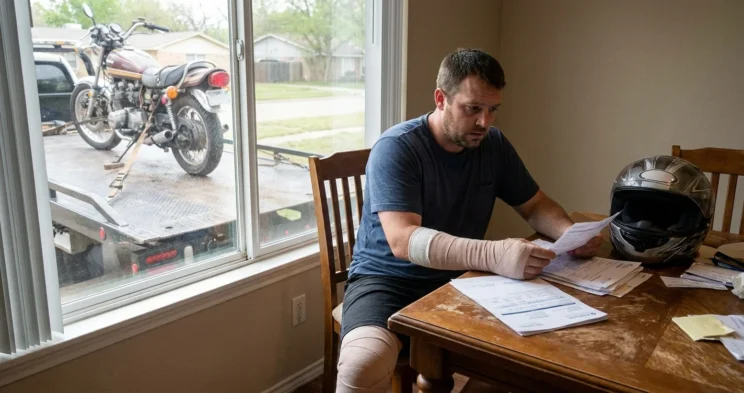
You were riding home from a late shift on I-35 when a driver drifted out of their lane and clipped your bike. You went down hard, and now you’re sitting with a hospital bill, time off work, and one nagging worry: you weren’t carrying insurance that day. Does that one fact erase everything else about the crash?
Texas Insurance Requirements for Motorcyclists
Texas treats motorcycles like any other motor vehicle under its financial responsibility law. As a rider, you must carry liability coverage with minimum limits of 30/60/25: $30,000 per injured person, $60,000 per occurrence, and $25,000 for property damage. The requirement applies regardless of how often you ride or what the bike is worth.
The baseline rule comes from the Texas Transportation Code § 601.051, which sets the financial responsibility requirement for every motor vehicle operated on a public road in Texas. The minimum dollar limits are set separately under Transportation Code § 601.072.
Many riders skip coverage because of cost. The legal requirement still applies. And the stakes are real: TxDOT reported 599 motorcyclist fatalities and more than 2,400 serious injuries on Texas roads in 2023.
Penalties for Riding Uninsured in Texas
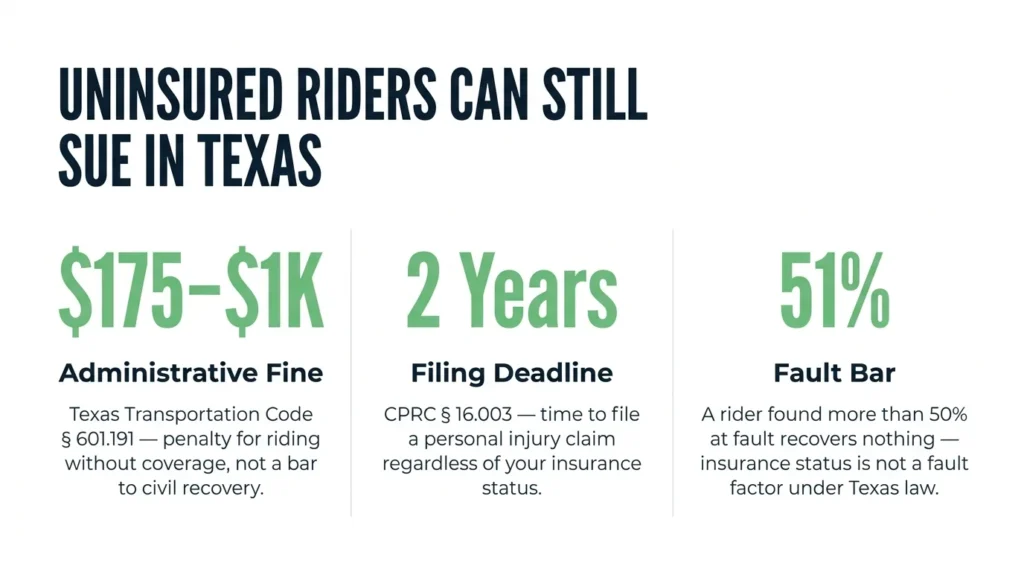
Riding without insurance in Texas carries real penalties. A first offense runs $175 to $350, and repeat violations can reach $1,000. You may also face vehicle impoundment, license suspension, and an SR-22 filing requirement before reinstatement. These are administrative and criminal consequences, not civil ones.
Transportation Code § 601.191 defines the misdemeanor offense of operating a motor vehicle without financial responsibility and sets the applicable fine ranges.
The penalty track and the civil claim track run on separate rails. Paying a fine for riding uninsured does not eliminate your right to seek compensation from the driver who hit you. They are two different proceedings handled by two different processes.
Can an Uninsured Rider Still Sue the At-Fault Driver?
Yes. Under Texas personal injury law, you can file a claim against the at-fault driver even if you don’t have insurance. Your lack of coverage is a penalty issue, not a bar to civil recovery. To win, you still have to prove the other driver’s negligence caused the crash. Their liability insurance (or the driver personally) is the source of compensation.
The deadline is firm. Under the Texas Civil Practice and Remedies Code (CPRC) § 16.003, you have two years from the date of the crash to file a lawsuit. Miss that window, and even the strongest case is gone.
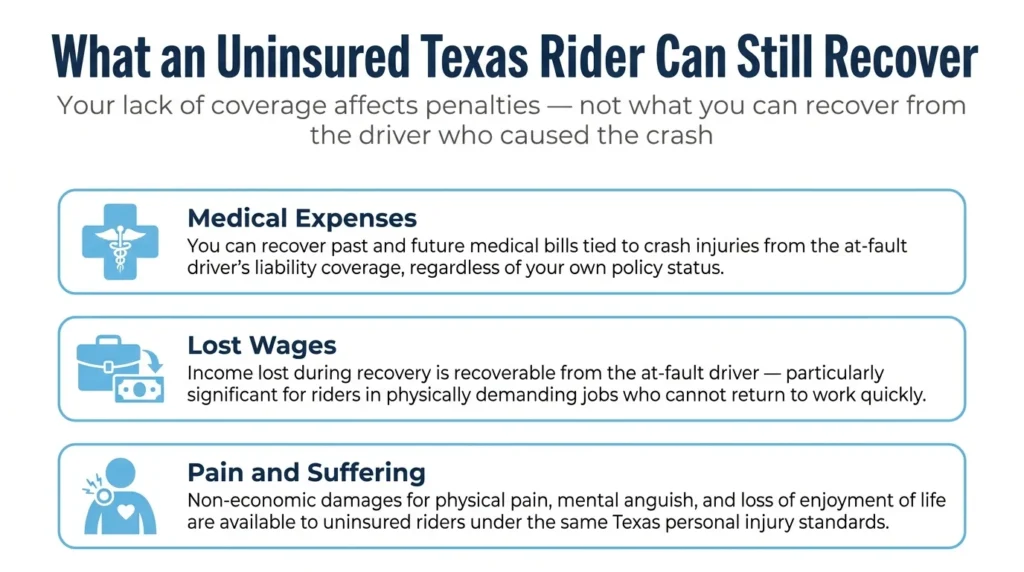
With a successful claim, you can recover medical expenses, lost wages, pain and suffering, and other damages tied to the crash. Lost wages often matter most if you work a physical job and cannot return immediately after your injury.
Speaking with a motorcycle accident attorney about the specific facts of your crash can clarify whether you have a viable claim and what legal strategies after a Texas motorcycle accident are available to you.
How Comparative Fault Affects an Uninsured Rider’s Recovery
Texas uses a modified comparative fault system called proportionate responsibility. Your recovery depends on the percentage of fault assigned to you. If your share crosses a specific threshold, you recover nothing. Below that line, you can still recover, but the award is reduced by your fault percentage. Your insurance status does not factor into the fault calculation.
The 51% Bar Rule
Under Texas CPRC § 33.001 (Proportionate Responsibility), a plaintiff found more than 50% at fault is barred from any recovery. The rule applies to every plaintiff in Texas, not just riders, and it does not treat uninsured riders differently.
If you’re found exactly 50% at fault, you may still recover; the bar doesn’t apply until fault exceeds that threshold.
Partial Fault and Reduced Recovery
If you are assigned some fault below the 51% comparative negligence threshold, your damages are reduced by that percentage. For example, if you’re found 30% at fault, you’d recover 70% of the total award. The math is simple, but the fault dispute often isn’t.
Fault disputes in motorcycle crashes can be complex, but the bottom line is you can often still pursue a claim if you were partially at fault for the accident. Fault can turn on speed, lane position, helmet use, and road conditions. Each factor depends on the facts of the specific incident. Your uninsured status is not one of those factors under Texas law.
Talk to a Texas Motorcycle Accident Attorney
Angel Reyes & Associates handles Texas motorcycle accident claims on a contingency basis, which means no fee unless we win your case. Our firm has recovered more than $1 billion for clients across Texas. You can learn more about us and our past case results before deciding to move forward. If you were hurt while riding, even without insurance, contact us for a free consultation to talk through your options.
Past results do not guarantee future outcomes.
Uninsured Motorcycle Accident FAQs
Can the other driver's insurance company use my lack of coverage against me during settlement negotiations?
An insurer may try to pressure you into accepting a lower settlement, but your coverage status has no legal bearing on what damages you are owed under Texas law. The at-fault driver’s liability and your provable losses are what determine the value of the claim.
Does Texas require an uninsured rider to repay their medical provider or a government program before collecting a settlement?
If a government program like Medicaid paid your medical bills after the crash, Texas law may require reimbursement from any settlement you receive. The amount you owe depends on which program paid and the specific costs covered.
What happens if the at-fault driver also had no insurance?
If the other driver carried no liability insurance, your ability to collect depends on whether they have personal assets to pay a judgment, or whether you carried uninsured motorist coverage on any other vehicle that might apply. Collecting directly from an uninsured individual is often difficult, even after winning a lawsuit.
Does Texas require a motorcycle rider to wear a helmet, and could skipping one reduce a settlement?
Texas law allows riders 21 and older who have completed an approved safety course to ride without a helmet. However, if a jury finds that not wearing a helmet contributed to your head or neck injuries, that finding could increase your assigned fault percentage and reduce your recovery under the proportionate responsibility rules.
Can an uninsured rider file a claim for damage to their motorcycle, or only for personal injuries?
Property damage to your bike is a separate recoverable item from personal injury damages, and an uninsured rider can pursue it against the at-fault driver’s liability policy. The at-fault driver’s property damage coverage is what Texas law holds responsible for those losses, not your own policy.
About the Authors

Angel Reyes
Writer
Angel L. Reyes, III is the Founder and Managing Partner of Angel Reyes & Associates. A nationally recognized trial attorney and business leader, Angel has helped over 70,000 injury victims recover more than $1 billion since founding the firm in 1993. Named to the Texas Super Lawyers list annually since 2008, Angel brings Wall Street experience, Ivy League education, and a deep commitment to client advocacy. He is a frequent legal commentator and published author with extensive contributions to legal scholarship, trial strategy, and consumer protection.

Kyle Nicolas
Editor
Kyle Nicolas is the Web Content & SEO Manager at Angel Reyes & Associates. He has more than 10 years of experience as a marketing co...

Angel Reyes
Reviewer
Angel L. Reyes, III is the Founder and Managing Partner of Angel Reyes & Associates. A nationally recognized trial attorney and business...