Motorcycle Accident Turning: Right-of-Way Rules in Texas


Every article on this site is researched by our internal team, reviewed for legal accuracy against current Texas law, and held to State Bar of Texas advertising standards before publication. We do not publish content that overstates outcomes or makes promises about results.
Learn more about our
editorial standards .
Key Takeaways
- Texas § 545.152 requires left-turning drivers to yield to oncoming riders at intersections.
- A wide-turn or U-turn violation follows different statutes but creates the same liability exposure.
- Riders more than 50% at fault under Texas Chapter 33 cannot recover any damages.
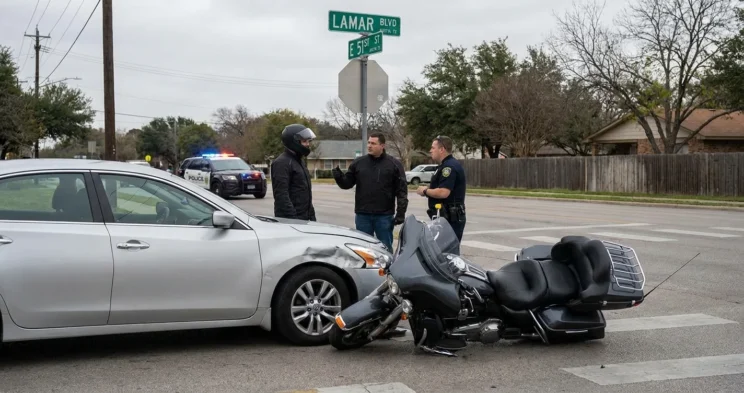
You were heading home on the I-35 corridor when a car cut left across your lane without warning. The driver swore they checked. You know they didn’t. Now you’re dealing with a broken collarbone, a destroyed bike, and an insurance adjuster who keeps asking whether you were speeding.
Turning crashes are the most dangerous intersection scenario motorcycle riders face in Texas. Knowing which right-of-way rules apply to your fact pattern is the first step toward protecting your claim.
Texas Turning Rules at Intersections
Texas spells out how vehicles must make turns, and those rules apply equally to cars and motorcycles. Texas Transportation Code § 545.101 sets the lane-positioning requirements. A driver making a right turn must approach and complete the turn as close to the right-hand curb as possible.
A driver making a left turn must approach in the far-left lane available for traffic moving in that direction, enter the intersection from that lane, and arrive in the correct lane on the road being entered.
These positioning rules are essential because departing from them is a statutory violation. A car that swings wide on a right turn and enters your lane has broken the law, not just made a poor driving choice. The same principle applies when a vehicle making a left turn overshoots into the wrong lane on exit.
Motorcycles hold the same rights under Texas law as any other vehicle. Under Texas motorcycle accident law, a rider is entitled to full use of a lane, and no driver may execute a turn that deprives a rider of lawful lane space. That right is not diminished because the vehicle is smaller or less visible.
Who Has the Right of Way in a Left-Turn Crash?
The left-turn crash is the single most deadly intersection scenario for motorcycle riders. Texas Transportation Code § 545.152 places the duty solely on the left-turning driver: they must yield the right of way to any vehicle approaching from the opposite direction that is in the intersection or close enough to be an immediate hazard.
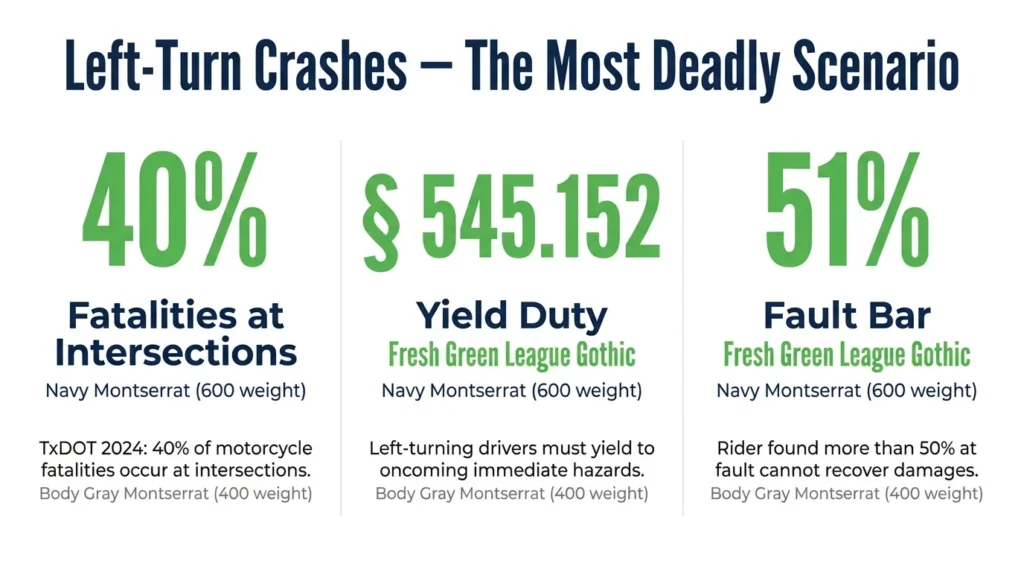
When a driver turns left and strikes a motorcycle, that statutory duty creates a strong presumption that the turning driver failed to yield. It is not an automatic fault, but it is a significant legal issue for the other driver to overcome.
That presumption can be challenged. If the rider was traveling well above the speed limit, or entered the intersection after the signal had already turned red, the other driver may argue the rider was not an “immediate hazard” at the moment the turn began. Texas uses proportionate responsibility, so fault for the accident does not have to be all-or-nothing.
Under Texas’s proportionate responsibility system, a rider found 20% at fault for speeding can still recover 80% of their total damages. Texas comparative negligence rules reduce compensation by the plaintiff’s own fault percentage, but do not eliminate it unless that percentage exceeds 50%.
TxDOT data shows that 40 percent of Texas motorcycle fatalities in 2024 occurred at or near an intersection, which reflects just how dangerous these turning scenarios are for riders.
Intersection motorcycle accident data in Texas consistently shows that the left-turn collision is the leading cause of rider deaths at intersections. That data is necessary when an insurer tries to minimize a claim by blaming the rider.
Wide-Turn & U-Turn Crashes: Different Rules Apply
Not every turning crash fits the standard left-turn scenario. Wide-turn and U-turn collisions involve different statutory rules and produce different fault analyses.
Wide-Turn Collisions
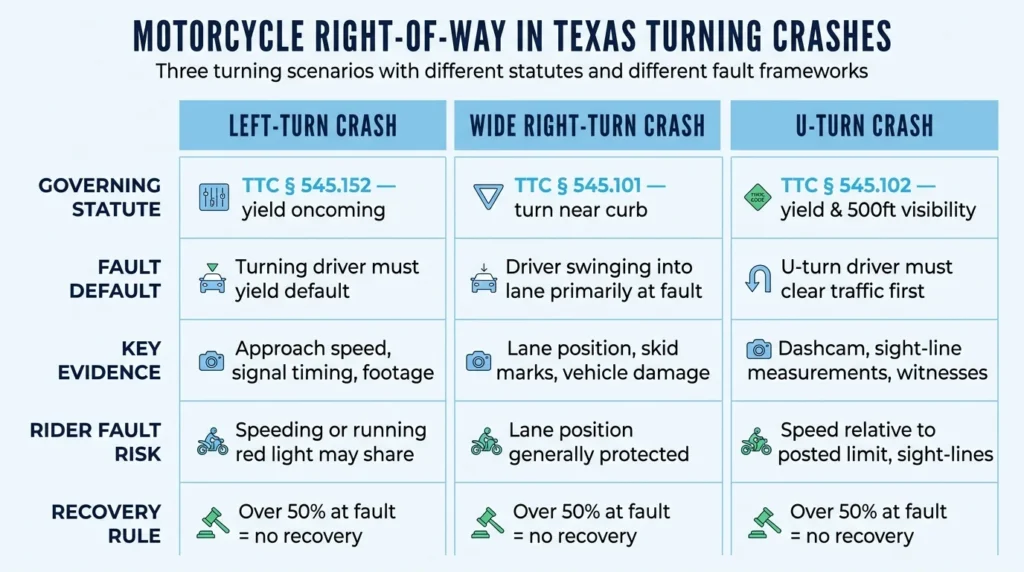
A wide-turn crash happens when a vehicle making a right turn swings left before or during the maneuver, crossing into an adjacent lane and striking a motorcycle lawfully traveling there. The violation here is § 545.101, which requires the right-turning driver to stay as close as practicable to the right-hand curb throughout both the approach and the turn.
Departing from that path into adjacent lanes is a direct statutory violation. A rider in the lane next to a vehicle making a wide right turn holds the right of way. The turning driver’s failure to maintain proper lane positioning means they are the proximate cause of any resulting collision.
Wide-turn crashes are sometimes underestimated because right turns feel safer than left turns. The physics are different, but the legal analysis is the same: a driver who violates the positioning rules and enters a lane they were not permitted in is mainly at fault.
U-Turn Collisions
U-turn crashes introduce a separate Texas statute. Texas Transportation Code § 545.102 prohibits a driver from making a U-turn on a curve or at the crest of a grade when their vehicle is not visible to approaching drivers within 500 feet. Executing a U-turn from a blind curve directly into a motorcycle’s path violates that visibility rule and establishes negligence.
Beyond the 500-foot rule, a driver making a U-turn must yield to all oncoming traffic before completing the maneuver. The § 545.152 yield duty applies here just as it does in left-turn crashes. A driver who begins a U-turn without clearing oncoming traffic has failed that duty.
Evidence is especially important in U-turn cases. Because these crashes often happen in locations where visibility is limited, dashcam footage, witness accounts, and skid-mark measurements become critical in reconstructing who had the right of way.
Legal strategies after a motorcycle accident for riders in U-turn crashes should include preserving this evidence as early as possible.
How Fault Is Split When Both Parties Were Turning
The hardest cases arise when both vehicles are in motion and maneuvering simultaneously, such as a rider turning left and a vehicle also entering the intersection from a cross street. Texas law handles these situations through Texas Civil Practice and Remedies Code Chapter 33, which governs proportionate responsibility.
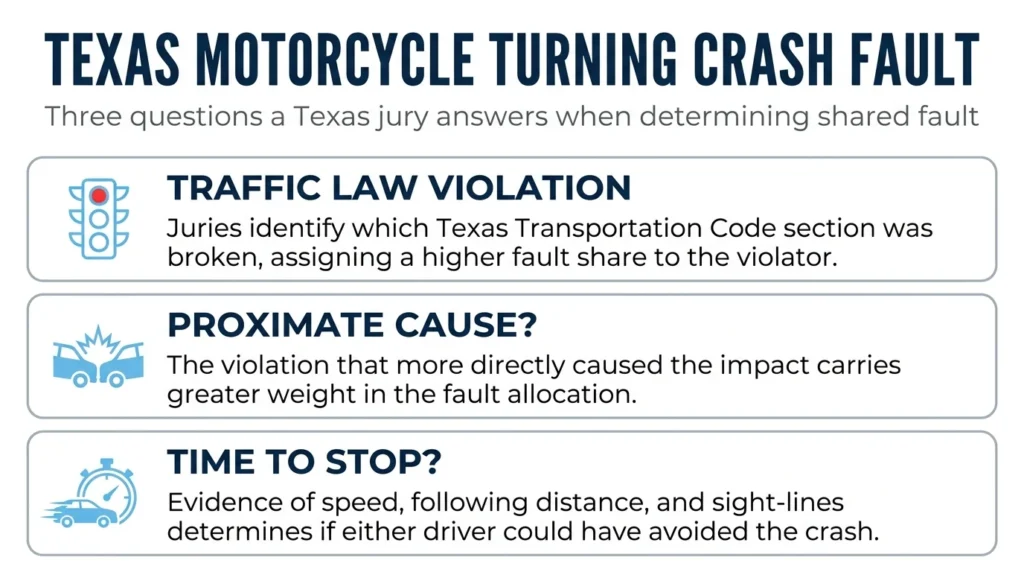
Under Chapter 33, a jury assigns a fault percentage to each party. Every percentage point of fault assigned to the rider reduces their compensation by that amount. The 50% bar is what counts: a rider found more than 50% at fault receives no compensation. A rider found exactly 50% at fault recovers half their requested compensation, or damages.
When two vehicles are both turning, juries evaluate three questions. First, which party violated a specific traffic rule under the Texas Transportation Code? Second, whose violation was the more direct cause of the impact? Third, did either party have enough time and space to stop before the collision occurred?
Evidence shapes every one of those questions. Lane position at the moment of impact, vehicle speed relative to posted limits, compliance with traffic signal timing, dashcam or intersection camera footage, and the location of physical damage on each vehicle all feed into how fault is determined in Texas injury cases. Riders who face shared-fault arguments after a turning crash often benefit from having an attorney evaluate the evidence before accepting any fault assignment from an insurer.
Get Legal Help After a Turning Motorcycle Crash in Texas
Turning crashes are rarely straightforward. The right-of-way rules under the Texas Transportation Code establish a clear framework, but insurers often contest that framework aggressively, especially when shared fault is possible. Having the evidence preserved, organized, and presented correctly makes a measurable difference in how a claim resolves.
Angel Reyes & Associates has spent over 30 years helping injured motorcycle riders across Texas recover compensation after turning crashes and intersection collisions. We work on contingency, meaning you pay nothing unless we win. With more than $1 billion recovered, we have seen and successfully handled a wide range of claims over our history.
If a turning driver violated Texas right-of-way rules and injured you, reach out for a free consultation to review your options. Our team has handled cases like yours across Texas and can walk you through what the evidence shows.
Past results do not guarantee future outcomes.
Motorcycle Right-of-Way Accident FAQs
What if the driver who turned in front of me had a green light?
A green light allows a vehicle to proceed, but it does not override the duty to yield to oncoming traffic that is an immediate hazard under § 545.152. A turning driver with a green arrow has a protected left turn and the right of way, but a driver on a standard green light still must clear the intersection of oncoming riders before completing the turn.
Does wearing a helmet affect my right to recover damages in Texas?
Texas law does not reduce your compensation simply because you were not wearing a helmet. Helmet use may become relevant if the defense argues it contributed to your specific head injuries, but it does not affect the right-of-way analysis or your baseline eligibility to file a claim.
Can I still recover if the turning driver had no insurance?
Yes. If you carry uninsured motorist coverage on your own motorcycle policy, you can file a claim with your insurer to cover medical bills, lost wages, and other damages when the at-fault driver has no coverage. Texas requires insurers to offer this coverage, and you have it unless you declined it in writing.
How long do I have to file a lawsuit after a motorcycle turning crash in Texas?
Texas gives injured riders two years from the date of the crash to file a personal injury lawsuit under Texas Civil Practice and Remedies Code § 16.003. Missing that deadline almost always ends any chance of recovery through the courts.
What types of damages can I recover after a turning motorcycle crash?
Texas allows injured riders to seek economic damages such as medical bills, future treatment costs, lost wages, and property damage, as well as non-economic damages including pain and suffering, mental anguish, and loss of enjoyment of life. Your recovery is reduced by your own percentage of fault if you shared any responsibility for the crash.
About the Authors

Angel Reyes
Writer
Angel L. Reyes, III is the Founder and Managing Partner of Angel Reyes & Associates. A nationally recognized trial attorney and business leader, Angel has helped over 70,000 injury victims recover more than $1 billion since founding the firm in 1993. Named to the Texas Super Lawyers list annually since 2008, Angel brings Wall Street experience, Ivy League education, and a deep commitment to client advocacy. He is a frequent legal commentator and published author with extensive contributions to legal scholarship, trial strategy, and consumer protection.

Kyle Nicolas
Editor
Kyle Nicolas is the Web Content & SEO Manager at Angel Reyes & Associates. He has more than 10 years of experience as a marketing co...

Angel Reyes
Reviewer
Angel L. Reyes, III is the Founder and Managing Partner of Angel Reyes & Associates. A nationally recognized trial attorney and business...