Motorcycle Accident Wrongful Death Claims in Texas


Every article on this site is researched by our internal team, reviewed for legal accuracy against current Texas law, and held to State Bar of Texas advertising standards before publication. We do not publish content that overstates outcomes or makes promises about results.
Learn more about our
editorial standards .
Key Takeaways
- Only a spouse, children, or parents can file a Texas wrongful death claim.
- Texas families have two years from the date of death to file the lawsuit.
- A rider found more than 50 percent at fault bars all family recovery.
You got the call no family ever expects: a rider you love left the house on a clear morning, headed up I-35W toward Keller, and never made it home because another driver turned across their path.
Now the funeral home is asking for money, the hospital bills are already arriving, and you have no idea whether the law gives you any right to fight back. Good news: you do have options, including potentially pursuing a wrongful death claim.
Who Can File Motorcycle Accident Wrongful Death Claims in Texas?
Texas law allows only three people to file a wrongful death claim: the surviving spouse, the children, and the parents of the person who died. Adopted children count the same as biological children. No one else qualifies, no matter how close they were to the rider.
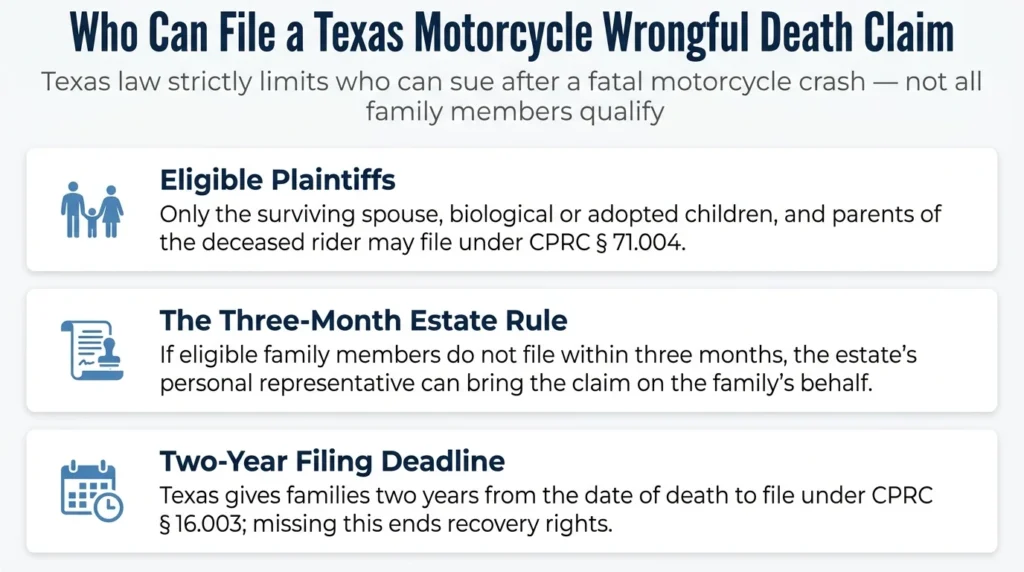
This rule surprises many grieving families. Siblings, grandchildren, fiancés, and longtime partners cannot sue under the Texas Civil Practice and Remedies Code (CPRC) § 71.004. Their financial dependence on the rider does not change that.
Your right to file is set at the moment of death. You do not lose it by grieving, by waiting a few weeks, or by living in another state. The clock on filing still runs, but your standing as a beneficiary stays intact.
There is one exception worth knowing. If none of the eligible family members files within three months of the death, the personal representative of the estate can bring the claim on the family’s behalf. That keeps the case alive when a grieving family needs more time to act.
These claims are far from rare. Nearly 600 motorcyclists died on Texas roads in 2023, a 7 percent jump over the year before, according to reported motorcyclist fatality figures from TxDOT.
Damages Texas Wrongful Death Families Can Recover
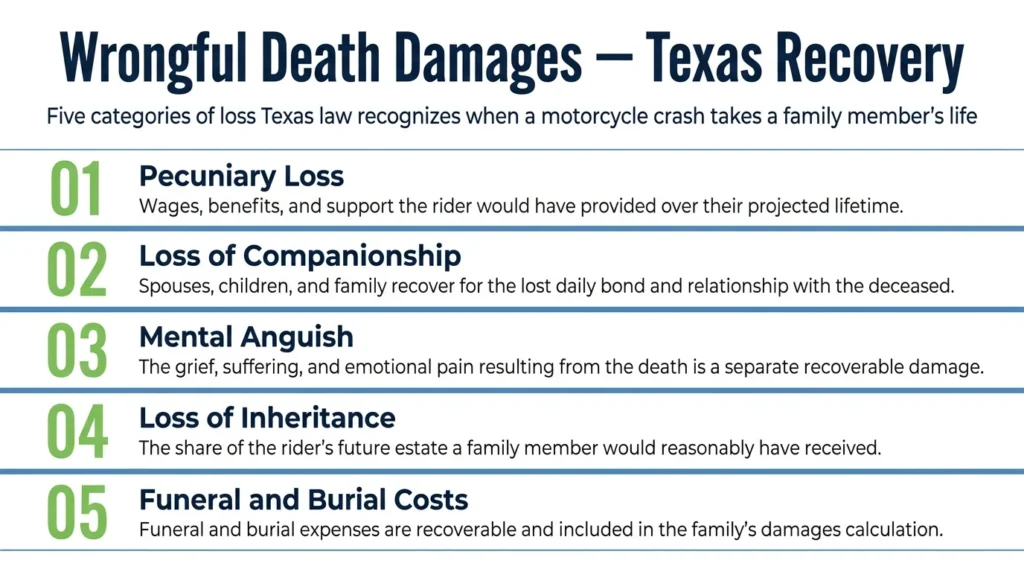
Texas law allows surviving family members to recover both financial and emotional losses in a wrongful death case. The law recognizes that losing a loved one costs a family far more than funeral expenses and tries to account for everything you lost when that person was taken.
Pecuniary loss is the financial backbone of the claim. It covers the wages, benefits, and household services the rider would have provided. It also includes the value of the guidance, care, and support your family will no longer receive.
Loss of companionship compensates spouses and children for the relationship itself. This is the shared life, the daily presence, and the emotional bond you lost. For a surviving spouse, loss of consortium, or loss of companionship, support, and affection, covers the same ground within the marriage.
Mental anguish is a separate issue. It accounts for the grief, suffering, and emotional pain you carry because of the death. You do not have to choose between this and loss of companionship. The law treats them as distinct losses.
Loss of inheritance covers the share of the rider’s future estate you reasonably would have received. Proving it usually takes financial or actuarial (risk assessment) evidence showing what the estate would have grown to over time.
Funeral and burial costs are recoverable too. For many families, these bills appear first, long before any settlement arrives. That pressure is real, and the law lets you claim those expenses back.
Insurance companies know these claims are worth far more than the first offer they float. You can review a breakdown of recoverable wrongful death damages for more clarity.
Wrongful Death vs. Survival Action in Texas
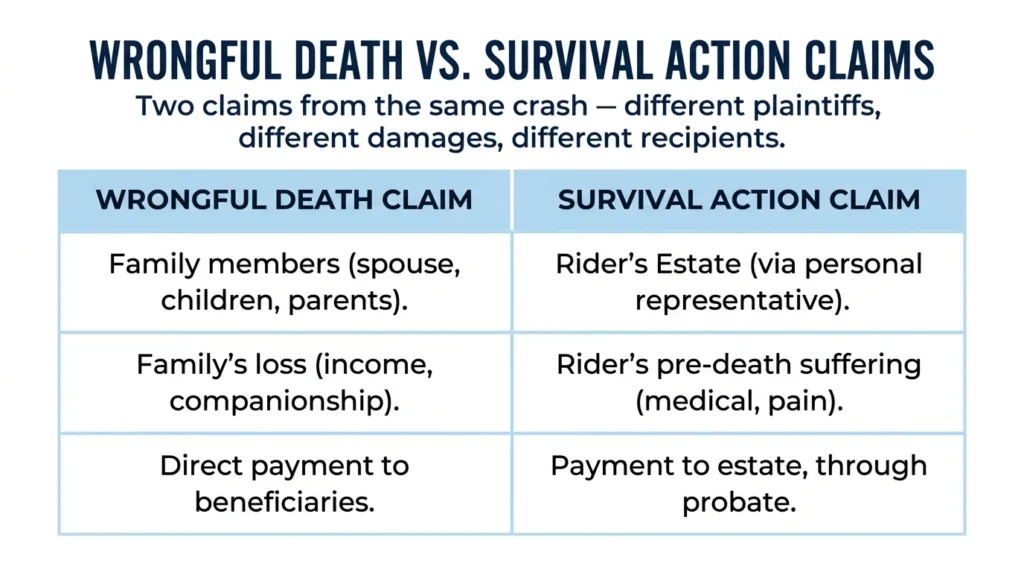
Two separate claims can come out of the same crash, and families often confuse them. A wrongful death claim and a survival action both arise from the death, but they belong to different people, cover different losses, and pay out to different recipients. Filing both at once is common.
Wrongful Death Claim
A wrongful death claim belongs to you, the eligible family members, personally. It compensates you for what the death cost you directly.
The plaintiffs are the surviving spouse, children, or parents. The claim is theirs, not the estate’s. Compensation covers future income, companionship, mental anguish, and loss of inheritance, and it flows straight to the beneficiaries without passing through probate court.
Survival Action
A survival action belongs to the rider’s estate. It steps into the legal shoes of the person who died and recovers what they personally suffered between the crash and the moment of death.
Recoverable losses include pre-death medical expenses, the physical pain and suffering the rider endured before dying, and lost earning capacity up to the date of death. This claim exists under CPRC § 71.021.
Money from a survival action goes to the estate, not directly to you. From there, it passes according to the will or, if there is none, under Texas intestacy rules. Both claims can run together in a single lawsuit, since they cover different ground rather than competing, much like the parallel claims described in fatal crash and wrongful death cases.
Fault, Deadlines & Exemplary Damages
Three legal rules determine how much your family can recover, and two of them catch families off guard. Texas proportionate responsibility law reduces your compensation by the rider’s share of fault. If the rider is found more than 50 percent at fault, your family recovers nothing under CPRC § 33.001.
This is why the defense fights so hard over fault. Insurers and their lawyers routinely argue the rider was speeding, lane-splitting, or riding without a helmet to push that percentage higher. Preserving evidence from the moment of the crash is the best way to answer those arguments in light of how motorcycle accident settlements work.
The deadline is just as unforgiving. You have two years from the date of death to file a wrongful death or survival action under CPRC § 16.003. Miss it, and the claim is gone for good, no matter how strong it was. The Texas wrongful death filing deadline covers narrow exceptions.
There is one more rule that often applies in fatal motorcycle crashes. When the at-fault driver acted with gross negligence or malice, including drunk driving, the court can award exemplary damages on top of everything else. These punish the driver and require clear and convincing evidence under CPRC § 41.003.
You can learn more about how Texas courts calculate punitive damages. Families who move quickly to lock down crash evidence are far better positioned to fight the fault arguments that can shrink or erase a recovery.
Work with an Experienced Attorney
Losing a rider to someone else’s choices is a wound no settlement can heal, but the right legal support can lift the financial weight off your family while you grieve. Angel Reyes & Associates has spent over 30 years helping injured Texans and grieving families across the state hold negligent drivers accountable.
We work on contingency, so there is no upfront cost and no fee unless we win your case. Our team has achieved more than $1 billion recovered for clients, and we are available 24/7, with service in Spanish for families who need it.
You should not have to figure out deadlines, fault rules, and insurance tactics alone in the worst weeks of your life. Schedule a free consultation and let us review what your family is owed.
Past results do not guarantee future outcomes.
Motorcycle Accident Wrongful Death FAQs
What if the driver who killed my family member had no insurance?
You may still have options. If the deceased rider carried uninsured motorist (UM) coverage on the motorcycle policy, that coverage can pay wrongful death damages when the at-fault driver has no insurance or flees the scene. An attorney can also investigate whether other parties, such as a bar that overserved the driver or a trucking company, share liability.
Does Texas tax a wrongful death settlement?
Compensatory wrongful death damages, such as lost income, loss of companionship, and funeral costs, are generally excluded from federal income tax under IRS rules for physical injury and death claims. Exemplary (punitive) damages are taxable income, so if the court awards both, the family will owe taxes on the punitive portion only.
Does the at-fault driver have to be convicted of a crime before we can file a civil wrongful death claim?
No. A civil wrongful death lawsuit is separate from any criminal case, and you do not need to wait for a conviction or guilty plea. The civil burden of proof is lower than the criminal standard, so families can pursue and sometimes resolve a civil claim before the criminal case concludes.
What if some eligible family members want to file but others do not?
In Texas, any one eligible beneficiary can bring the wrongful death claim without the others joining in. If one beneficiary files, the others may join, but they are not required to do so. A court can require all eligible beneficiaries to be named as parties if requested, but disagreement alone does not block the case.
Can a wrongful death claim be filed if a road defect contributed to the crash?
Yes, but claims against a government entity follow different rules. Texas law requires written notice to the responsible agency within six months of the incident as a condition of filing suit under the Texas Tort Claims Act. Missing that shorter deadline can bar the claim against the government even if the two-year wrongful death deadline has not passed.
About the Authors

Angel Reyes
Writer
Angel L. Reyes, III is the Founder and Managing Partner of Angel Reyes & Associates. A nationally recognized trial attorney and business leader, Angel has helped over 70,000 injury victims recover more than $1 billion since founding the firm in 1993. Named to the Texas Super Lawyers list annually since 2008, Angel brings Wall Street experience, Ivy League education, and a deep commitment to client advocacy. He is a frequent legal commentator and published author with extensive contributions to legal scholarship, trial strategy, and consumer protection.

Kyle Nicolas
Editor
Kyle Nicolas is the Web Content & SEO Manager at Angel Reyes & Associates. He has more than 10 years of experience as a marketing co...

Angel Reyes
Reviewer
Angel L. Reyes, III is the Founder and Managing Partner of Angel Reyes & Associates. A nationally recognized trial attorney and business...