Motorcycle Accidents Caused by Distracted Drivers in Texas


Every article on this site is researched by our internal team, reviewed for legal accuracy against current Texas law, and held to State Bar of Texas advertising standards before publication. We do not publish content that overstates outcomes or makes promises about results.
Learn more about our
editorial standards .
Key Takeaways
- Texas bans handheld phone use while driving under Transportation Code 545.4251.
- Subpoenaed phone records and dashcam footage can prove a driver was distracted.
- You have two years to file a Texas motorcycle injury lawsuit before the right is lost.
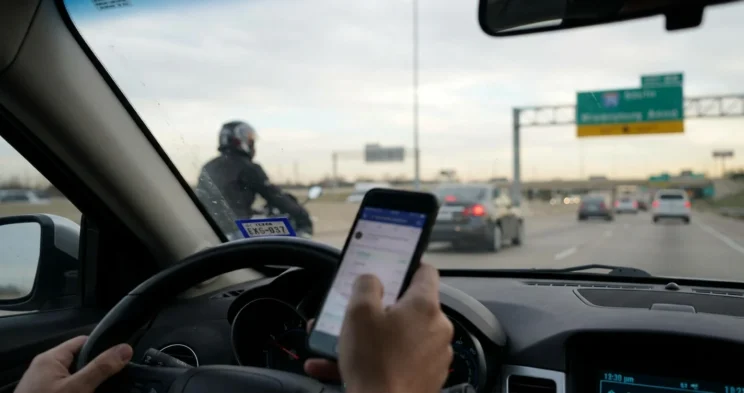
You were riding home through Midtown on Westheimer when a driver drifted into your lane and clipped your bike. You went down hard. The driver swears they were paying attention, and now their insurer is acting like the crash was your fault. You believe that the driver was looking at a phone. The question is whether you can prove it.
Texas Law on Distracted Driving
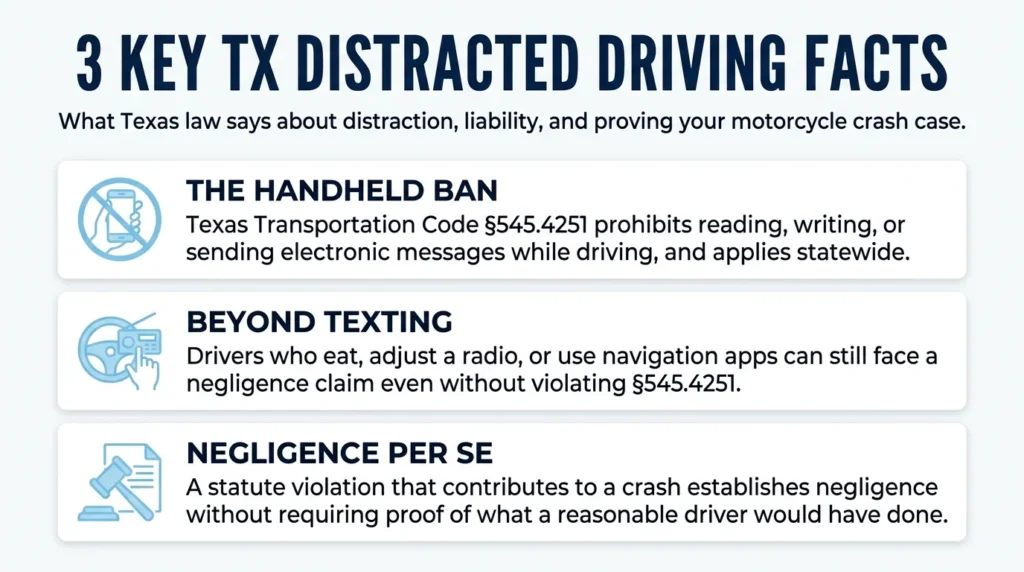
Texas Transportation Code § 545.4251 prohibits drivers from reading, writing, or sending electronic messages while operating a motor vehicle. The law applies statewide and establishes a clear standard of conduct for distracted driving cases.
Distracted driving goes beyond texting. Eating, adjusting the radio, using a navigation app, or turning to talk to passengers can all take a driver’s attention away from the road. Even when the conduct does not violate § 545.4251, it may still support a negligence claim. The statute only covers handheld devices, but careless behavior of any kind can still count as negligence.
When Distracted Driving Violates Texas Law
When a driver violates a safety law and that violation contributes to a crash, Texas courts may treat that violation as evidence of negligence. This rule is called negligence per se, and it can make your claim stronger.
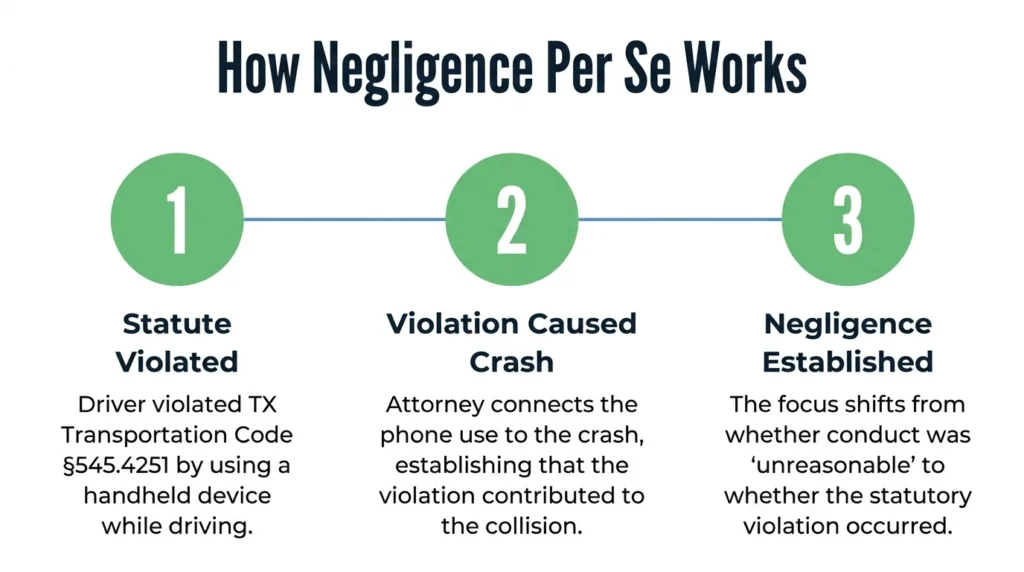
In most motorcycle accident cases, you must prove that the driver owed you a duty to operate their vehicle safely, breached that duty, caused the crash, and caused your injuries. Normally, there can be disagreement about whether the driver’s conduct was unreasonable under the circumstances.
If the evidence shows the driver violated § 545.4251, your attorney can point to a specific safety law the driver may have broken. Instead of debating what a reasonably careful driver would have done, the focus shifts to whether the violation occurred and whether it contributed to the crash. This does not automatically hand you the case. Your attorney still has to connect the phone use to the crash.
Texas also uses a fault-sharing rule under Chapter 33 of the Texas Civil Practice and Remedies Code. If a jury finds you 51% or more at fault, you recover nothing. Riders often face unfair assumptions about speed and lane position, so a strong negligence per se argument helps push back against them.
Proving Phone Use After a Motorcycle Crash
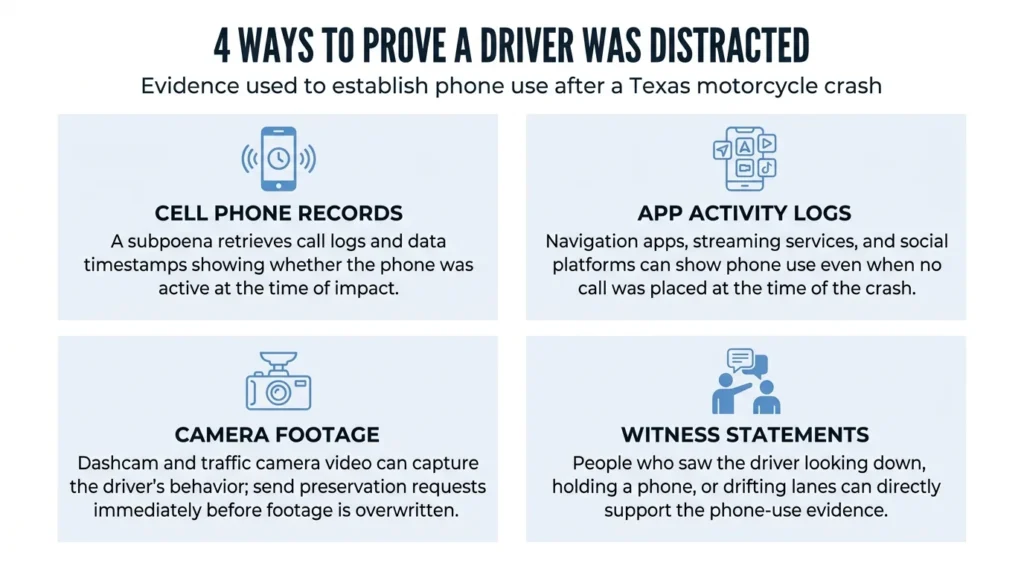
Distracted drivers rarely admit they were on their phone. Several types of evidence can help establish what the driver was doing in the moments before impact:
- Cell phone records. A cell phone records subpoena can retrieve call logs and data timestamps to show whether the phone was active at the time of impact. Carriers usually keep this data for a limited time, so try to get it quickly.
- Social media and app activity. Logs from navigation apps, streaming services, and social platforms can show the phone was in use even when the driver didn’t place a call.
- Dashcam and traffic camera footage. Video from your bike, the other vehicle, or nearby cameras can capture the crash. Some video systems automatically overwrite older footage if it is not saved. Footage like this helps your case because you can use dash-cam videos as evidence.
- Witness statements. People who saw the driver looking down, holding a phone, or drifting lanes can back up the physical proof.
The Two-Year Deadline & What Riders Should Do Now
Texas gives you two years from the date of the crash to file a personal injury lawsuit under Texas Civil Practice and Remedies Code (CPRC) § 16.003. Miss that window and you lose the right to sue, no matter how strong your evidence is.
Your legal strategy after a motorcycle accident should begin in the hours or days after your crash. Document the scene with photos and video if you are able. Get the other driver’s name, insurance, and plate number, and speak with witnesses before they leave. Seek medical care right away and follow through on your treatment. Gaps in care give the insurer room to argue that your injuries were not serious.
One more step protects your recovery. Do not give a recorded statement to the other driver’s insurer before you talk with an attorney. Adjusters use early statements to pin part of the blame on you and shrink what they owe.
Talk to an Attorney About Your Case
Proving a distracted driving claim often comes down to the evidence available after the crash. Angel Reyes & Associates has more than 30 years of experience guiding injured Texans, including riders in cases where a driver’s phone use had to be proven through subpoenaed records and preserved footage. We have recovered more than $1 billion for clients across Texas.
Your consultation is free, and there is no fee unless we win. Riders across Texas can reach us 24/7, and we can handle most, if not all, of your case remotely. Schedule a free consultation to find out what your claim is worth. You can also see how we have handled cases like yours through our client reviews.
Past results do not guarantee future outcomes.
Motorcycle Distracted Driving FAQs
Does hands-free phone use while driving count as distracted driving in Texas?
Texas Transportation Code Section 545.4251 bans only handheld device use, so talking through a Bluetooth earpiece or a speakerphone mounted to the dash is technically legal. A driver who causes a crash while using a hands-free device can still be sued for negligence, but negligence per se does not apply.
Can a rider still recover damages if they were not wearing a helmet at the time of the crash?
Yes. Texas law allows riders 21 and older to ride without a helmet if they have completed an approved safety course or carry a certain amount in medical insurance. If a jury finds that not wearing a helmet contributed to specific injuries, the award for those injuries may be reduced by the rider’s share of fault, but the crash claim itself is not barred.
If the distracted driver was working at the time of the crash, can their employer be held liable?
Possibly. Texas recognizes respondeat superior, which holds employers liable for an employee’s negligence when the employee was acting within the scope of their job at the time of the crash. A driver who was making deliveries, running a work errand, or driving a company vehicle on duty would generally satisfy that standard; someone commuting or on a personal errand typically would not.
Can the police crash report be used to show the driver was distracted?
Texas peace officers complete a CR-3 crash report that includes a contributing factors field where they can note phone use or inattention. A police report noting phone use, inattention, or other contributing factors can support a distracted driving claim, although it is rarely the only evidence needed.
Can deleted text messages still be recovered after a motorcycle accident?
Sometimes. Depending on the circumstances, phone records, cloud backups, app data, and other digital evidence may still exist even if a driver deletes messages after a crash. The availability of that information depends on the device, service provider, and how quickly evidence preservation efforts begin.
About the Authors

Angel Reyes
Writer
Angel L. Reyes, III is the Founder and Managing Partner of Angel Reyes & Associates. A nationally recognized trial attorney and business leader, Angel has helped over 70,000 injury victims recover more than $1 billion since founding the firm in 1993. Named to the Texas Super Lawyers list annually since 2008, Angel brings Wall Street experience, Ivy League education, and a deep commitment to client advocacy. He is a frequent legal commentator and published author with extensive contributions to legal scholarship, trial strategy, and consumer protection.

Kyle Nicolas
Editor
Kyle Nicolas is the Web Content & SEO Manager at Angel Reyes & Associates. He has more than 10 years of experience as a marketing co...

Angel Reyes
Reviewer
Angel L. Reyes, III is the Founder and Managing Partner of Angel Reyes & Associates. A nationally recognized trial attorney and business...