Where Do Most Motorcycle Accidents Occur?


Every article on this site is researched by our internal team, reviewed for legal accuracy against current Texas law, and held to State Bar of Texas advertising standards before publication. We do not publish content that overstates outcomes or makes promises about results.
Learn more about our
editorial standards .
Key Takeaways
- Most Texas motorcycle crashes happen in cities, with intersections the deadliest spot.
- Left-turn drivers who fail to yield cause many serious intersection motorcycle crashes.
- Crash location shapes liability by setting the traffic duties and evidence in play.
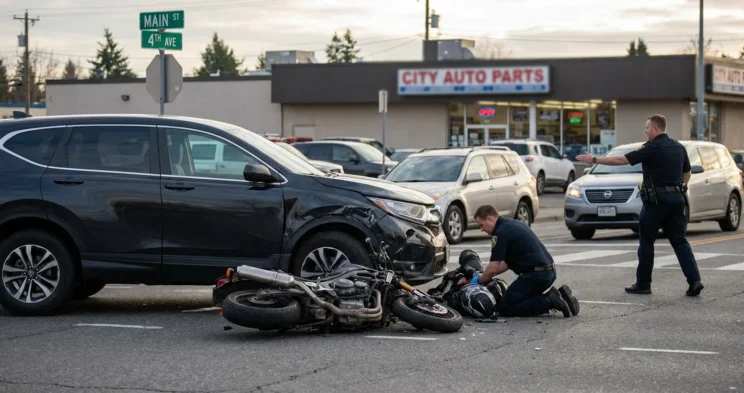
You were riding home through Deep Ellum one evening when a car waiting to turn left rolled into your lane without ever seeing you. One second the intersection was clear, the next you were on the pavement. Crashes like that are not random, and where they happen tells you a lot about who was at fault.
The Short Answer on Crash Locations
Most motorcycle crashes happen in cities, and intersections are the single most dangerous spot for multi-vehicle collisions. TxDOT reports that a large share of Texas motorcycle fatalities happen at or near an intersection.
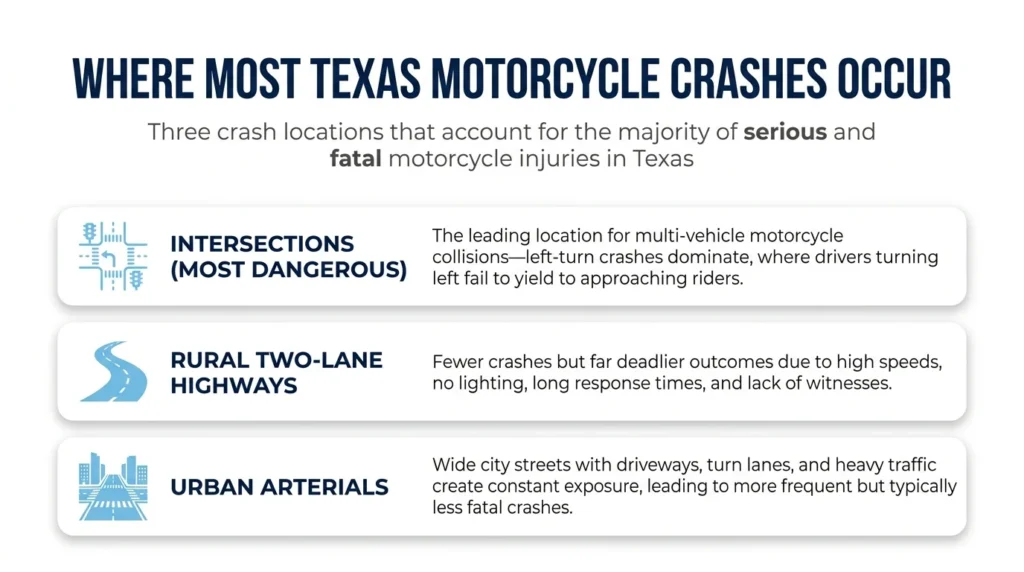
That pattern holds across the state. In 2024, motorcycle crashes killed roughly 580 riders on Texas roads, and TxDOT reports that a large share of motorcycle fatalities happen at or near an intersection, as covered in its reporting on rising motorcyclist deaths.
Three location patterns drive most of the risk. Intersections lead the list, followed by rural two-lane highways and busy urban arterials.
The differences between these places are not just trivia. They shape how a crash happens and how fault gets decided.
Why Intersections Are So Dangerous
Intersections are the leading location for multi-vehicle motorcycle crashes because they pack turning cars, crossing traffic, and split-second decisions into one small space. TxDOT’s crash data shows intersections contribute to many serious motorcycle collisions, and you can review the figures through the agency’s crash data analysis tools.
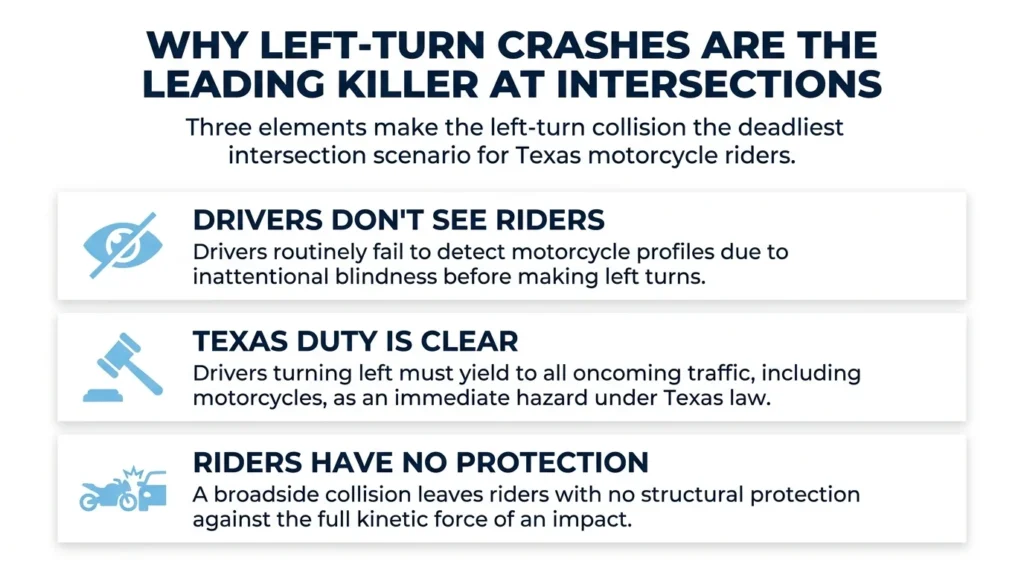
The most common pattern is the left-turn collision. A driver turns left across your path, often swearing later that they never saw you coming.
That is not just an excuse. NHTSA points to driver failure to detect motorcycles as a leading factor in these crashes, a problem its motorcycle safety research explains in detail.
A motorcycle is narrow and easy to lose against traffic. Drivers also misjudge how fast a bike is closing, so they pull out thinking they have room when they do not.
When a driver turns left in front of you, the law usually sides with the rider. A driver turning left must yield to oncoming traffic under Texas Transportation Code § 545.152. Breaking that duty is strong evidence the other driver caused the crash.
Rural Highways & Urban Arterials
Rural two-lane highways and urban arterials, or through-roads, are the other two major crash settings, and each carries its own kind of danger. Rural roads produce fewer crashes but far deadlier ones.
On a rural highway, speeds run high and help is usually far away. A crash that you might survive in the city can turn fatal when the nearest hospital is forty minutes off and no one witnessed the wreck.
Limited lighting and long sightless curves add to the risk. The injuries tend to be severe.
Urban arterials carry the opposite problem. These are the wide, busy city streets lined with driveways, turn lanes, and traffic signals.
The danger here is volume. More cars, more turns, and more chances for a driver to miss you mean steady day-to-day risk, even if each crash is less likely to be fatal than a rural one.
How Crash Location Affects Liability
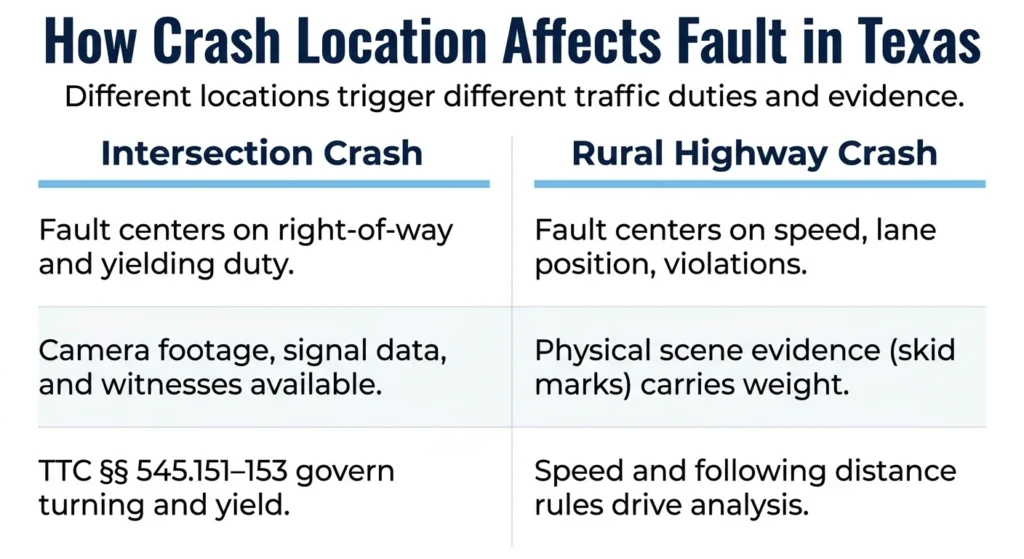
Where your crash happened shapes who pays, because location determines the traffic duties in play and the evidence available. Texas uses a fault-sharing system that can reduce or erase your recovery.
Under Texas proportionate responsibility, your compensation drops by your share of the blame. If you are found more than 50 percent at fault, you recover nothing, a rule set out in the Texas Civil Practice and Remedies Code (CPRC) Chapter 33.
At an intersection, the fight usually centers on who had the right of way. Stop-and-yield duties under the Texas Transportation Code § 545.151 often decide whether the driver who hit you was at fault.
On a rural highway, the questions shift to speed, lane position, and whether either rider or driver crossed the center line. The physical evidence at the scene carries more weight when there are no cameras and few witnesses.
Once fault is clear, the next question is what you can recover. Understanding how motorcycle accident settlements work in Texas helps you see the path from a crash to compensation.
Getting a clear read on fault before you talk to an insurer can protect your claim, and reviewing how motorcycle accident cases develop is a good first step.
Talk with an Experienced Attorney
Knowing where your crash happened is the start. Proving who caused it is where the real work begins. Angel Reyes & Associates has spent over 30 years helping injured Texans understand their options after a crash.
We work on a contingency basis, so there is no fee unless we win, and we have recovered more than $1 billion for clients across the state.
You should know that court costs and other case expenses may still apply even if we do not collect an attorney fee. We will walk you through exactly how that works before you decide anything. If another driver left you hurt at an intersection or on the highway, reach out to us for a free consultation.
Past results do not guarantee future outcomes.
Motorcycle Accident Location FAQs
What time of day do most motorcycle accidents happen?
Crashes cluster in the late afternoon and evening when traffic is heaviest, and weekends carry a large share of fatal crashes. Riders face more risk during these high-volume, social-driving hours.
Are single-vehicle motorcycle crashes common too?
Yes. A large portion of motorcycle deaths involve only the rider, often from running wide on a curve or losing control, which is separate from the multi-vehicle intersection crashes.
Does weather cause most motorcycle accidents?
No. Most fatal motorcycle crashes happen in clear or cloudy conditions, not rain or storms, because more riders are on the road when the weather is good.
What evidence should I gather after a crash at an intersection?
Photos of the signals, skid marks, and vehicle positions help show who had the right of way. Witness contact information and the police report also support your account of what happened.
How does Texas compare to other states for motorcycle deaths?
Texas consistently ranks among the states with the highest motorcycle fatality counts each year. Its large population, long highways, and year-round riding season all add to the total.
About the Authors

Alex Ivanov
Writer
Alex Ivanov is a personal injury attorney at Angel Reyes & Associates, focused on car, truck, and motorcycle accident cases. Licensed in Texas and multiple federal districts, Alex brings international legal experience and a global education to his practice. He earned his LL.M. from Texas A&M University School of Law after graduating from Belarussian State University in 2016. Alex is fluent in Russian, English, Ukrainian, and Belarussian, and is recognized by multiple national trial lawyer associations for his results and leadership under 40.

Kyle Nicolas
Editor
Kyle Nicolas is the Web Content & SEO Manager at Angel Reyes & Associates. He has more than 10 years of experience as a marketing co...

Angel Reyes
Reviewer
Angel L. Reyes, III is the Founder and Managing Partner of Angel Reyes & Associates. A nationally recognized trial attorney and business...