Motorcycle Accidents Involving Teenage Riders in Texas


Every article on this site is researched by our internal team, reviewed for legal accuracy against current Texas law, and held to State Bar of Texas advertising standards before publication. We do not publish content that overstates outcomes or makes promises about results.
Learn more about our
editorial standards .
Key Takeaways
- Teen drivers ages 16-17 have the highest crash rate per mile of any age group in the U.S.
- Texas parents can be held liable for motorcycle crashes under the negligent entrustment doctrine.
- Texas gives you two years from the crash date to file a personal injury claim under CPRC 16.003.
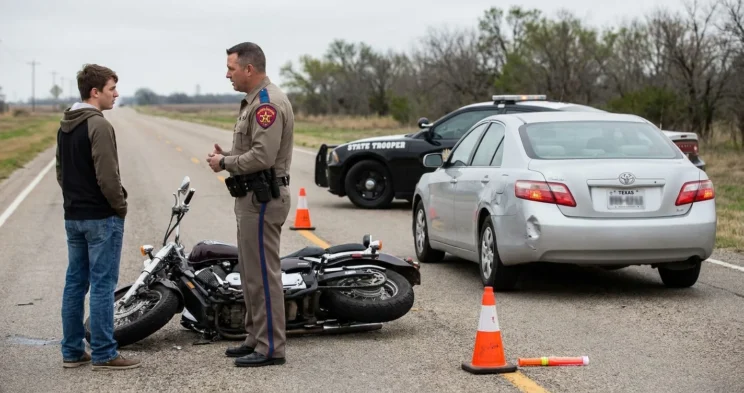
You were riding home on the I-35 corridor when a teenager pulled out of a side street and hit you broadside. The teen walked away from the crash. You did not. Now your motorcycle is wrecked, the medical bills are arriving, and the insurance claim has already started.
You have the growing realization that the teenager who hit you probably has no money, no job, and no assets. You want to know if there is actually a way to recover what you lost. Texas law gives you several legal paths to pursue.
Why Teen Drivers Are Dangerous to Motorcyclists
Drivers ages 16 and 17 have the highest crash rate of any age group in the country. The CDC reports that the fatal crash rate for this age group runs nearly three times higher per mile driven than for drivers 20 and older. Teen drivers are more likely to make mistakes at intersections, miss motorcycles when changing lanes, or become distracted behind the wheel.
Motorcycle crash injuries are categorically different from car crash injuries. Road rash, broken bones, traumatic brain injury, and spinal damage are common outcomes even at moderate speeds. When a teen driver misjudges a turn or checks their phone at the wrong moment, the motorcyclist absorbs the full cost.
Who Is Legally Responsible for the Crash?
The teen driver is personally liable for the accident. The next question is whether anyone else may also be legally responsible for your injuries and losses. There can be parental liability in car accident cases. However, parents are not automatically liable because their child caused a motorcycle accident. Texas law recognizes situations where a parent or vehicle owner may share responsibility.
Negligent Entrustment
A vehicle owner may be held responsible if they allow someone they know, or should know, is an unsafe driver to use their vehicle.
Texas courts generally require proof that the owner entrusted the vehicle to an unlicensed, incompetent, or reckless driver, knew or should have known the driver was unfit to drive, and that the driver’s negligence caused the crash. Prior crashes, traffic violations, distracted driving incidents, or other evidence of unsafe driving may become important when evaluating this type of claim.
License Co-Signature Liability
Texas Transportation Code § 521.145 requires a parent or other qualified adult to sign a minor’s driver’s license application. While that signature alone does not automatically create liability for a motorcycle crash, it may become relevant when evaluating the parent’s role in supervising the teen driver and the circumstances surrounding the vehicle’s use.
Texas Family Code Chapter 41
Texas Family Code Chapter 41 allows parents to be held responsible for certain property damage caused by a minor’s conduct when that damage results from a failure to exercise reasonable discipline and control. Because the statute focuses on property damage, motorcycle injury claims are more commonly pursued through negligent entrustment and other negligence-based theories.
You must establish one of these legal theories based on the specific facts of your crash. Determining which theory applies and what evidence supports it is where a legal analysis of your case begins. Under Texas Civil Practice and Remedies Code § 16.003, you generally have two years from the date of the crash to file a personal injury lawsuit.
Insurance Coverage When the At-Fault Driver Is a Minor
Teen drivers are sometimes covered on a parent’s auto insurance policy. If the teen was driving a family vehicle covered by that policy, the policy’s liability limits are the first source of compensation.
Texas minimum liability coverage is $30,000 per person and $60,000 per accident. A serious accident caused by a teen driver can exceed that in emergency room costs alone before any surgery or rehabilitation. When that happens, the teen’s policy limits are exhausted, and your losses still are not covered.
Your own Underinsured Motorist (UIM) coverage is your next layer of coverage. If you carry UIM coverage on your motorcycle accident policy, it pays the difference between what the teen’s insurance covers and your actual damages, up to your own policy limit.
If you were hit by an uninsured driver, your Uninsured Motorist (UM) coverage steps in the same way. Texas requires insurers to offer UM/UIM coverage, though you may have rejected it in writing.
Collecting Compensation When the Teen Has No Assets
In many cases, the focus shifts to available insurance coverage and any legal claims that may exist against other responsible parties. If negligent entrustment applies, the claim may extend beyond the teen driver. Additional insurance coverage may also be available through a parent’s auto policy, umbrella policy, or other applicable coverage.
A successful lawsuit is only valuable if there is a way to collect compensation. That can be difficult when the at-fault driver is a teenager with no income, savings, or significant assets.
You can potentially help your case by collecting the following evidence:
- The teen’s driving record, including prior citations, crashes, or license suspensions
- Dashcam footage, phone records, or other evidence showing distracted driving
- Witness statements from people who observed the collision
- Evidence showing what the parents knew about the teen’s driving history and habits
Work with an Attorney After a Teen-Rider Motorcycle Crash
Parental liability claims require gathering the right evidence early, identifying all available insurance layers, and filing within a strict deadline. Angel Reyes & Associates has handled motorcycle accident claims across Texas for over 30 years.
Our past case results show what early, prepared representation can do in a case like yours. We work on a contingency basis, which means you pay nothing unless we recover compensation for you. If a teenage driver hit you and you are trying to figure out your options, contact us for a free consultation.
Past results do not guarantee future outcomes.
Teen Driver Motorcycle Accident FAQs
Does Texas law prohibit teen drivers from driving at night or with passengers?
Texas provisional license holders under the Graduated Driver License (GDL) program cannot drive between midnight and 5 a.m. without a work, school, or medical reason. It cannot carry more than one non-family passenger under 21 during the first 12 months of the provisional license. If the teen who hit you was violating these restrictions at the time of the crash, that fact may be relevant to your claim.
What if the teen was driving a car that did not belong to their family?
Negligent entrustment applies to whoever entrusted the vehicle, not just parents. If a friend, employer, or neighbor allowed the teen to drive their vehicle knowing the teen was inexperienced or reckless, that person or entity may also be liable.
Will a motorcycle accident claim be handled differently because the at-fault driver is a minor?
The claim process generally works the same way, but issues involving parental responsibility, insurance coverage, and the minor’s legal status can create additional complications.
What if the teen driver was using a phone when the crash happened?
Phone use can become important evidence in a motorcycle accident claim. Cell phone records, witness testimony, surveillance footage, and admissions made after the crash may help establish that distracted driving contributed to the collision.
What if the teen driver received a traffic ticket after the accident?
A traffic citation does not automatically establish liability, but it can be useful evidence in a personal injury claim. The insurance company, attorneys, and ultimately a jury may consider the facts that led to the citation when evaluating fault for the crash.
About the Authors

Angel Reyes
Writer
Angel L. Reyes, III is the Founder and Managing Partner of Angel Reyes & Associates. A nationally recognized trial attorney and business leader, Angel has helped over 70,000 injury victims recover more than $1 billion since founding the firm in 1993. Named to the Texas Super Lawyers list annually since 2008, Angel brings Wall Street experience, Ivy League education, and a deep commitment to client advocacy. He is a frequent legal commentator and published author with extensive contributions to legal scholarship, trial strategy, and consumer protection.

Kyle Nicolas
Editor
Kyle Nicolas is the Web Content & SEO Manager at Angel Reyes & Associates. He has more than 10 years of experience as a marketing co...

Angel Reyes
Reviewer
Angel L. Reyes, III is the Founder and Managing Partner of Angel Reyes & Associates. A nationally recognized trial attorney and business...