Texas’s No-Pay-No-Play Law & Motorcycle Accident Claims


Every article on this site is researched by our internal team, reviewed for legal accuracy against current Texas law, and held to State Bar of Texas advertising standards before publication. We do not publish content that overstates outcomes or makes promises about results.
Learn more about our
editorial standards .
Key Takeaways
- Texas law requires all motorcycle riders to carry 30/60/25 minimum liability coverage.
- Uninsured riders can still sue an at-fault driver but face weaker leverage and no UM/UIM fallback.
- A crash while uninsured brings license suspension, SR-22 filing, and higher premiums for two years.
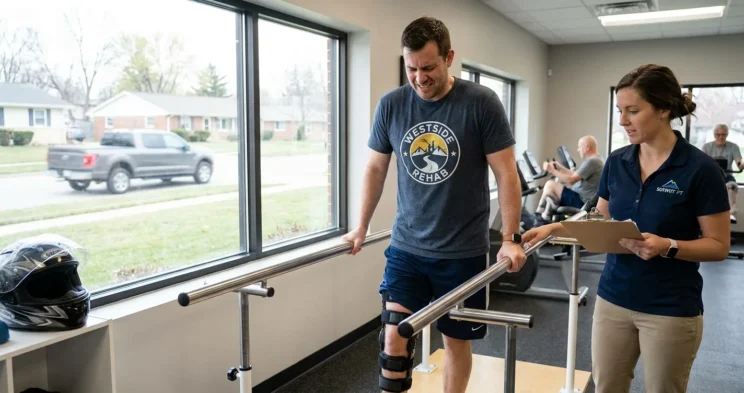
You got hit on the way home from work. The driver who sideswiped you on I-35 ran a red light. The crash was clearly not your fault. Your bike is totaled, your shoulder is injured, and now you find out the at-fault driver is fully insured.
There is just one problem. You have been riding without insurance, and you are not sure what that means for your ability to collect anything.
Texas Requires Motorcycle Insurance
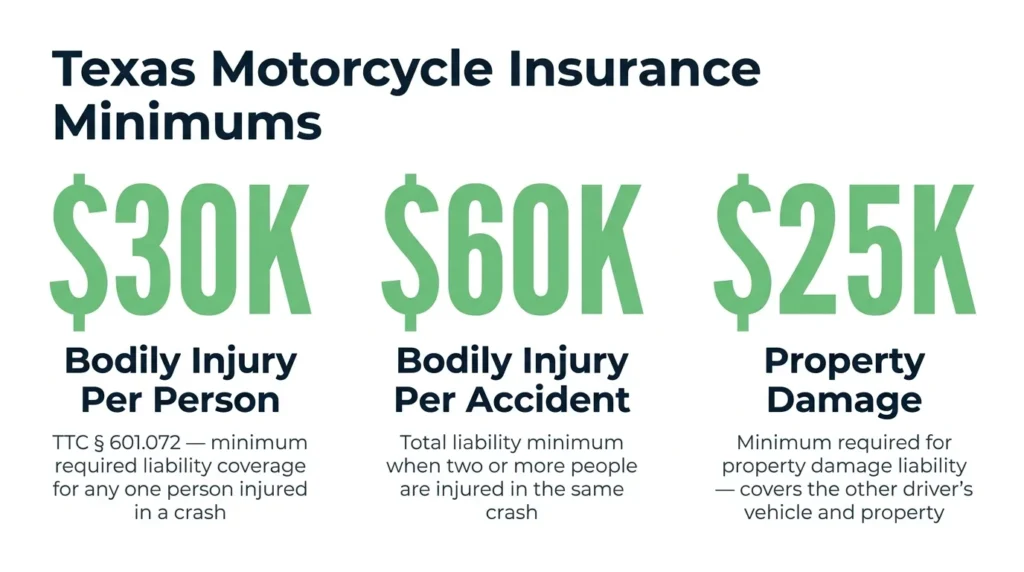
Texas law leaves no room for confusion here. Every motorcycle rider operating on public roads must carry minimum liability coverage under Texas Transportation Code (Transportation Code) § 601.072.
The minimums are $30,000 per person and $60,000 per accident in bodily injury liability, plus $25,000 in property damage liability. This is often called “30/60/25” coverage.
Motorcycles fall squarely under the Motor Vehicle Safety Responsibility Act, Transportation Code § 601.051. There is no exemption for smaller bikes, older models, or occasional riders. The law applies the same way it does to car and truck drivers.
You must carry proof of insurance every time you ride. If a law enforcement officer stops you, or if you are involved in a crash, you are required to show it. Not having proof of insurance at a crash scene sets a chain of consequences in motion that extends well beyond the cost of the crash itself.
What “No Pay, No Play” Means for Texas Riders
Texas has not passed a statute formally titled “no pay, no play,” but the phrase captures something real: if you did not pay for insurance, you may not play the same compensation game as riders who did.
You can still sue the at-fault driver. Texas does not bar uninsured riders from filing a civil lawsuit. But your ability to actually collect depends on several things working in your favor at the same time:
- The at-fault driver must have attachable assets beyond the policy limits.
- Your fault share under Texas’s proportionate responsibility rules must stay below 51 percent.
- You must be prepared to litigate, because the at-fault driver’s insurer knows you have no policy of your own.
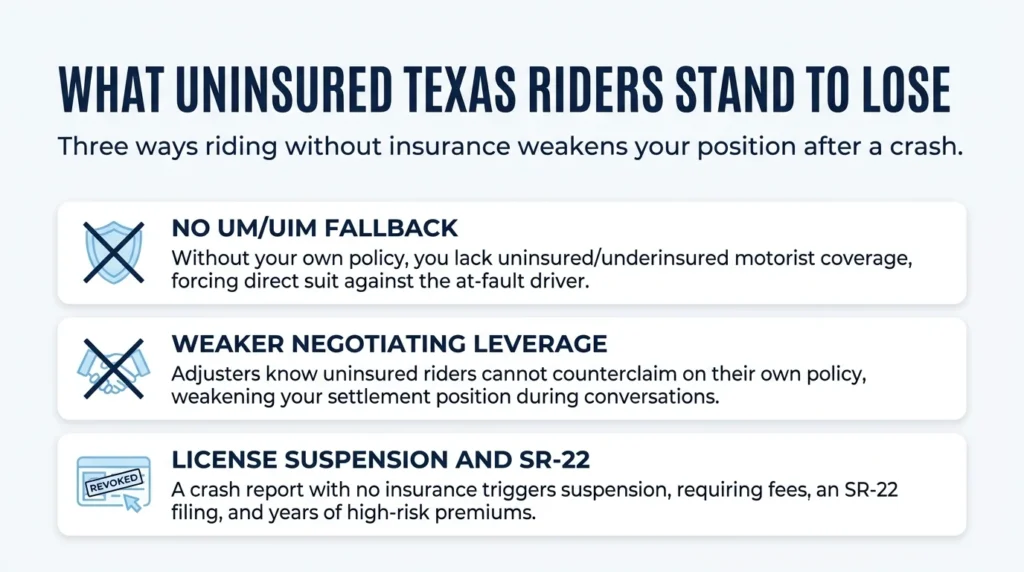
That last point shapes every conversation you will have with the other driver’s insurance company. Adjusters know that an uninsured rider is in a weaker negotiating position. You cannot make a claim on your own policy because you do not have one. You have no UM/UIM coverage to invoke as a fallback.
The only compensation path available to you is the lawsuit route, and insurance companies know that uninsured plaintiffs often cannot afford to wait out a lengthy legal battle.
Even without a policy of your own, you may have legal options worth pursuing.
The License, Fine & SR-22 Consequences
The civil recovery problem is serious. The immediate legal consequences are just as real and hit faster.
When a crash report reaches the Texas Department of Public Safety showing that a rider had no insurance at the time of the accident, DPS initiates a crash suspension process. Your driver’s license could be suspended. Getting it reinstated requires showing proof of insurance, paying reinstatement fees, and in most cases filing an SR-22 certificate.
First-offense fines for riding without insurance run from $175 to $350. Subsequent violations can reach $1,000. Those fines are separate from reinstatement fees and any civil liability you carry from the crash itself.
The SR-22 requirement means your insurer must certify your coverage directly to DPS for two years. During that period, you are classified as a high-risk driver, and premiums reflect that.
Riders who come off a crash suspension typically pay substantially more for coverage than they would have paid had they simply maintained a basic policy from the start. The cheapest policy you never bought turns into one of the most expensive situations you will ever face.
You can learn more about how insurance dynamics shape a motorcycle accident claim to understand how coverage gaps affect what riders actually collect.
UM/UIM Coverage: Your Protection Against Uninsured Drivers
This is the coverage that fills the gap when the at-fault driver does not have enough insurance, or any insurance at all.
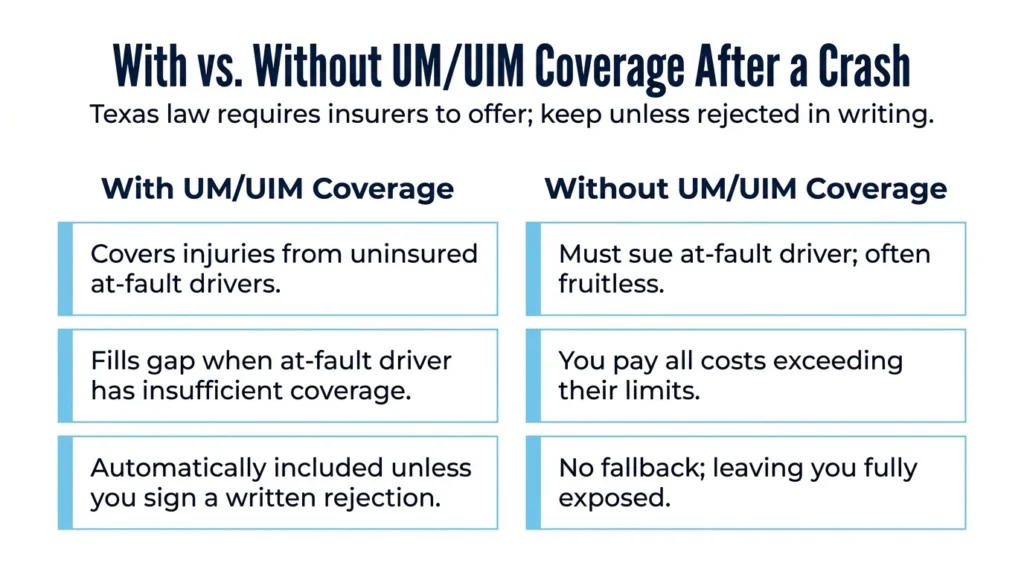
Texas Insurance Code (Insurance Code) § 1952.101 requires every insurer that sells auto liability coverage in Texas to offer uninsured and underinsured motorist coverage. You can reject it, but the rejection must be in writing. If you bought a motorcycle policy without signing a rejection form, you likely have UM/UIM coverage already.
UM coverage pays your medical bills, lost wages, and other damages when the at-fault driver has no insurance. UIM coverage handles the scenario where they have some insurance but not enough. For a motorcycle rider, where crash costs frequently exceed the other driver’s minimum limits, UM/UIM coverage is often the difference between a partial recovery and a full one.
If you have no policy at all, you have no UM/UIM coverage. The protection that Texas requires insurers to offer you only works if you are actually insured. An uninsured rider who gets hit by another uninsured driver is left with a lawsuit against a defendant who may have nothing to collect.
You can learn more about the differences between UM, UIM, and PIP coverage.
Work with an Experienced Attorney
If you were riding without insurance and got hurt in a crash that was not your fault, you are in a complicated situation. You have fewer options than an insured rider, but you are not necessarily out of options.
Angel Reyes & Associates has handled motorcycle injury claims across Texas for over 30 years. We offer free consultations so you can understand your situation before committing to anything. Our team works on a contingency basis, which means there is no fee unless we recover compensation for you.
Reach out to us to talk through what happened and what your options look like.
Past results do not guarantee future outcomes.
Uninsured Motorcycle Rider FAQs
What happens to my driver's license if I crash without motorcycle insurance in Texas?
The Texas Department of Public Safety initiates a crash suspension when it receives a crash report showing no insurance. Your license is suspended until you pay reinstatement fees and file proof of financial responsibility, typically in the form of an SR-22 certificate.
Can an uninsured motorcycle rider use health insurance after a Texas crash?
Yes. Health insurance may help pay injury-related treatment even when the rider did not have motorcycle insurance, though deductibles, copays, provider liens, and later reimbursement claims can affect the final recovery.
Does a Texas motorcycle accident claim change if the rider was on a borrowed bike?
It can. The motorcycle owner’s policy, permissive-use rules, household exclusions, and the rider’s own coverage history may all affect whether any insurance applies.
Can an uninsured rider still recover if the crash happened while commuting for work?
Possibly. If the rider was within the course and scope of employment, workers’ compensation or a non-subscriber workplace injury claim may become relevant in addition to any claim against the at-fault driver.
Can an uninsured motorcycle rider make a claim against a bar, business, or government entity after a crash?
Sometimes. A dram shop claim, negligent road-design claim, vehicle-defect claim, or claim against another responsible party may apply, but these cases often have strict notice rules and fact-specific requirements.
About the Authors

Angel Reyes
Writer
Angel L. Reyes, III is the Founder and Managing Partner of Angel Reyes & Associates. A nationally recognized trial attorney and business leader, Angel has helped over 70,000 injury victims recover more than $1 billion since founding the firm in 1993. Named to the Texas Super Lawyers list annually since 2008, Angel brings Wall Street experience, Ivy League education, and a deep commitment to client advocacy. He is a frequent legal commentator and published author with extensive contributions to legal scholarship, trial strategy, and consumer protection.

Kyle Nicolas
Editor
Kyle Nicolas is the Web Content & SEO Manager at Angel Reyes & Associates. He has more than 10 years of experience as a marketing co...

Angel Reyes
Reviewer
Angel L. Reyes, III is the Founder and Managing Partner of Angel Reyes & Associates. A nationally recognized trial attorney and business...