What Happens When Multiple Parties Are at Fault in a Rideshare Accident?


Every article on this site is researched by our internal team, reviewed for legal accuracy against current Texas law, and held to State Bar of Texas advertising standards before publication. We do not publish content that overstates outcomes or makes promises about results.
Learn more about our
editorial standards .
Key Takeaways
- You can sue the rideshare driver, the third-party driver, and pursue the company's policy at once.
- Each defendant's insurer pays only its assigned percentage of fault under Texas law.
- A defendant found 51% or more at fault can be held liable for your entire judgment.
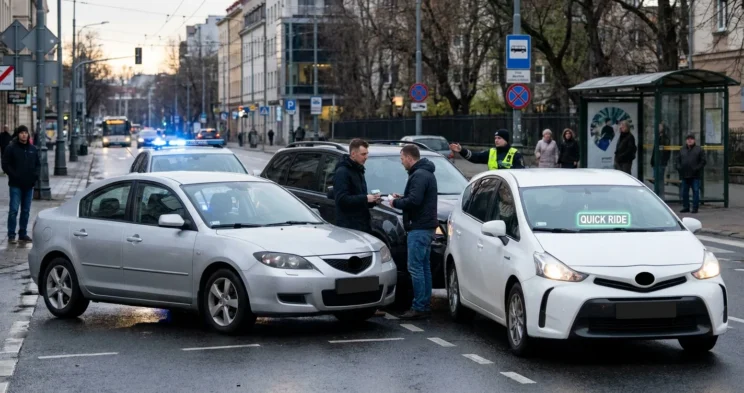
You were riding in an Uber home from a late dinner in Montrose when another driver ran a stop sign and clipped your side of the car. Now two insurance adjusters are calling you, and each one blames the other driver. You did nothing wrong, yet you are the one stuck wondering who actually pays for your injuries.
Who Can Be at Fault in a Rideshare Accident?
Three separate parties can carry legal responsibility after a rideshare crash: the rideshare driver, a third-party driver, and the rideshare company through its insurance. Texas lets you pursue all of them at once, so you’re never forced to pick a single target.
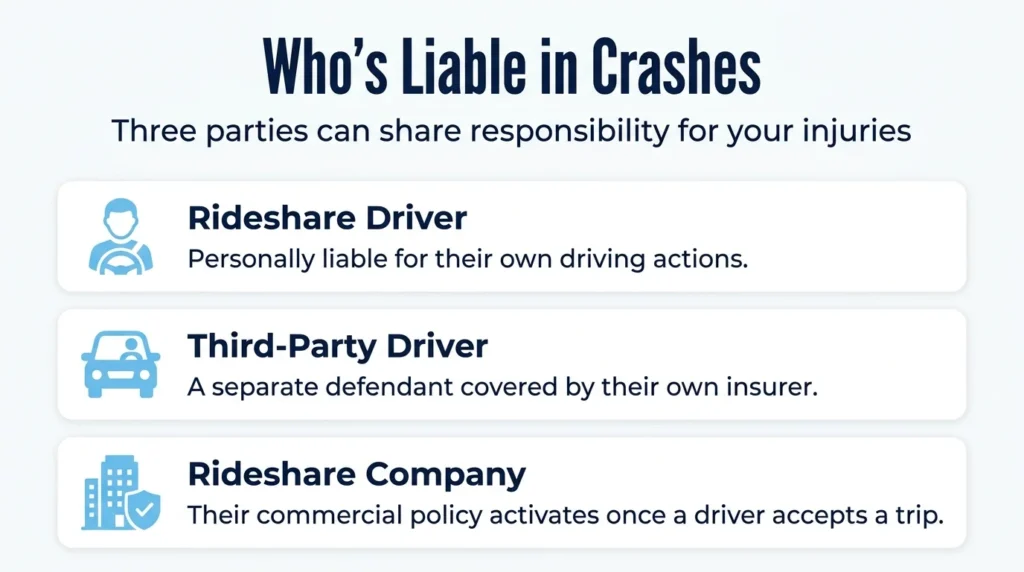
The rideshare driver is personally responsible for how they operated the vehicle. Their classification as an independent contractor does not erase that responsibility.
A third-party driver who helped cause the crash is a separate defendant with their own coverage. If they ran a light or rear-ended your car, their insurer answers for their share.
The rideshare company is a different story. Uber and Lyft are usually not liable as your driver’s employer in Texas, but their commercial policy still activates once the driver accepts a trip. That makes the company’s coverage a real source of recovery no matter which driver was careless.
You can name all three in one rideshare accident claim.
How Texas Proportionate Responsibility Splits the Fault
Texas assigns each at-fault party a percentage of the blame, and that percentage decides how much their insurer owes you. This rule comes from the Texas Civil Practice and Remedies Code (CPRC) Chapter 33, which governs multi-defendant rideshare cases.
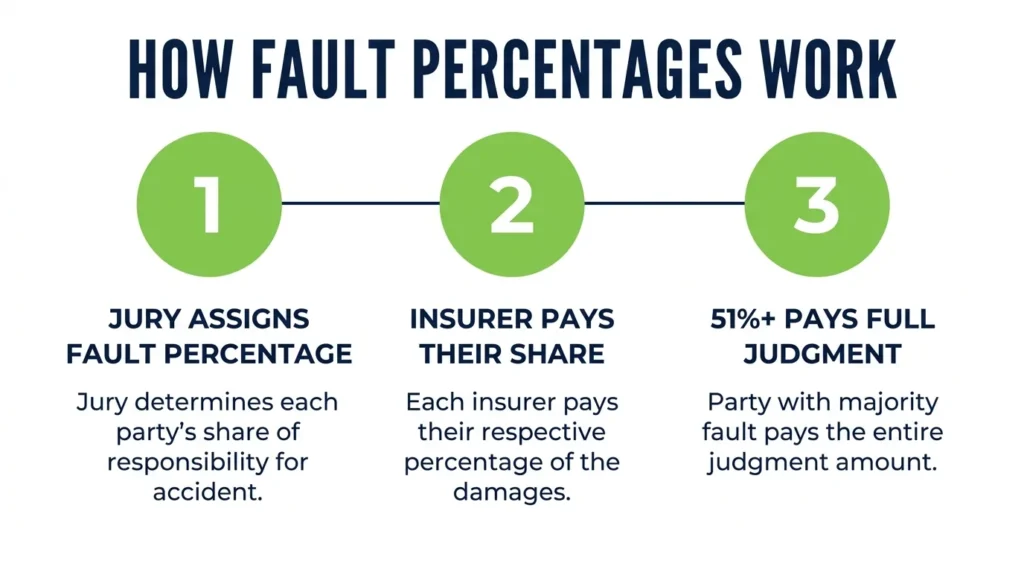
A jury or judge looks at the facts and gives each party a number. The rideshare driver might land at 45%, the third-party driver at 40%, and so on until the shares add up to 100%.
Each insurer then pays only that party’s slice of your total damages. Under CPRC § 33.013, a defendant found 40% at fault pays 40% of the judgment, not the whole thing.
This is why pursuing every responsible party matters to your bottom line. Leave one out, and you may never collect their share.
When Joint & Several Liability Changes the Math
One exception can shift the entire calculation in your favor. When a single defendant is found 51% or more responsible, that defendant becomes liable for the full judgment.
This happens often in rideshare crashes where one driver clearly caused most of the wreck. The majority-fault driver cannot cap their payment at just their percentage, which protects you if another defendant cannot pay.
The 51% Bar Rule for Injured Victims
Your own conduct affects your settlement amount, too. A victim assigned more than 50% of the fault recovers nothing, a rule known as the 51% bar.
In a multi-defendant case, that bar looks only at your percentage, not the combined total of the defendants. If you’re found 20% at fault, you still recover 80% of your damages, divided among the defendants by their shares.
If you think your own actions may have played a part in the crash, it helps to understand how partial fault affects rideshare claims before you talk to any adjuster.
Which Insurance Policy Pays in a Multi-Party Crash
The driver’s app status at the moment of impact controls which policy applies. The Texas Insurance Code Chapter 1954 creates three coverage periods for rideshare companies, and each one opens a different layer of insurance.
Period 1 covers the time the app is on, but no ride is accepted. The company provides contingent coverage of $50,000 per person and $100,000 per accident for bodily injury, plus $25,000 for property damage, while the third-party driver’s own policy stays primary if that driver caused the crash.
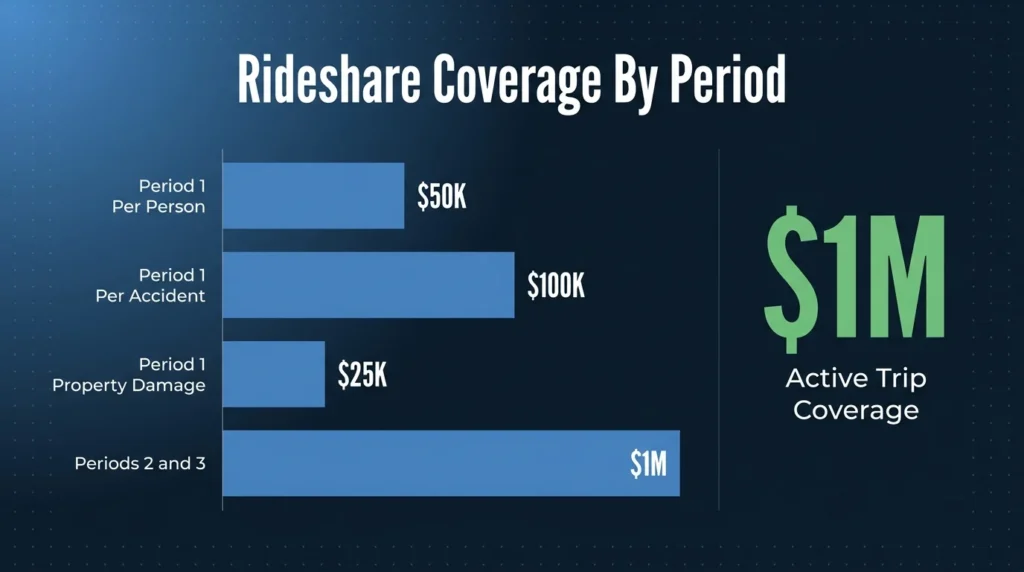
Periods 2 and 3 run from the accepted ride through your drop-off. During these periods, Uber or Lyft’s $1 million commercial policy becomes the primary coverage.
When a third-party driver shares fault during an active trip, both the company’s $1 million policy and that driver’s personal policy are in play at the same time. You can pursue both insurers.
Your total available coverage is not capped at one policy limit. Each policy pays its portion based on the fault percentages, and it helps to learn more about how the three coverage periods work before filing.
What Happens When Insurers Dispute Fault Percentages
Every insurer in the case has a financial reason to push fault onto someone else’s client. The rideshare company’s insurer may blame the third-party driver, while the third-party insurer blames the rideshare driver, and neither agrees.
This is where solid evidence decides your outcome. App data from the platform records the driver’s speed, route, and trip status at impact, but that data is time-sensitive and can be overwritten without a formal preservation request.
The proof that fixes each party’s percentage includes police reports, dashcam footage, eyewitness accounts, the driver’s app logs, and the other driver’s phone and traffic records. Knowing what to do after a rideshare accident helps you protect that evidence early.
Be careful with fast settlement offers. Accepting a quick check from one insurer can release every defendant, not just the one paying you, depending on the release language you sign.
An attorney can send preservation letters to the rideshare company and pursue all defendants before the two-year deadline under CPRC § 16.003 runs out. That deadline applies to all defendants at once, and it starts on the date of your crash.
Work with an Attorney on Multi-Party Rideshare Claims
Sorting out multiple defendants and competing insurers is hard to do alone while you’re healing and watching the bills pile up. Angel Reyes & Associates has guided injured Texans through complex rideshare claims for more than 30 years.
Our team includes investigators and accident reconstruction specialists who can establish each party’s fault percentage and pursue every available insurance layer at once. We work on contingency, so you pay nothing unless we recover compensation for you, part of more than $1 billion recovered for clients.
You can contact us for a free consultation to review your options, and you are welcome to read more about our work for injured Texans. We serve the entire state and can handle most, if not all, of your case remotely.
Past results do not guarantee future outcomes.
Rideshare Accident Fault FAQs
What if one of the at-fault drivers in my rideshare accident has no insurance?
The rideshare company is required under Texas Insurance Code Chapter 1954 to carry uninsured and underinsured motorist coverage during Periods 2 and 3. That coverage can pay for the uninsured driver’s share of your damages if they cannot cover it themselves.
How long do I have to file a claim against all the at-fault parties in Texas?
Texas Civil Practice and Remedies Code Section 16.003 gives you two years from the date of your crash to file against every defendant. The clock runs at the same time for all of them, so waiting to resolve one claim before pursuing another can cost you the right to sue the others.
Can accepting a quick settlement from one insurer affect my claims against the other parties?
It can, depending on the release language in the agreement you sign. Some releases are written broadly enough to extinguish your rights against every party, not just the one paying you, which is why you should review any settlement document with an attorney before signing it.
Does Uber or Lyft's $1 million policy cover me if the third-party driver caused the crash?
Yes, during an active trip (Periods 2 and 3), the $1 million commercial policy is primary coverage regardless of which driver was at fault. If the third-party driver is uninsured or underinsured, the TNC’s uninsured motorist coverage can also fill that gap.
What evidence is most important in a multi-party rideshare accident case?
The rideshare driver’s app data, including speed, route, and trip status at the moment of impact, is often the most time-sensitive piece of evidence because it can be overwritten. Police reports, dashcam footage, and the other driver’s phone records round out the proof used to set each party’s fault percentage.
About the Authors

Angel Reyes
Writer
Angel L. Reyes, III is the Founder and Managing Partner of Angel Reyes & Associates. A nationally recognized trial attorney and business leader, Angel has helped over 70,000 injury victims recover more than $1 billion since founding the firm in 1993. Named to the Texas Super Lawyers list annually since 2008, Angel brings Wall Street experience, Ivy League education, and a deep commitment to client advocacy. He is a frequent legal commentator and published author with extensive contributions to legal scholarship, trial strategy, and consumer protection.

Kyle Nicolas
Editor
Kyle Nicolas is the Web Content & SEO Manager at Angel Reyes & Associates. He has more than 10 years of experience as a marketing co...

Angel Reyes
Reviewer
Angel L. Reyes, III is the Founder and Managing Partner of Angel Reyes & Associates. A nationally recognized trial attorney and business...