Rideshare Accidents Involving DUI Drivers in Texas


Every article on this site is researched by our internal team, reviewed for legal accuracy against current Texas law, and held to State Bar of Texas advertising standards before publication. We do not publish content that overstates outcomes or makes promises about results.
Learn more about our
editorial standards .
Key Takeaways
- Who you can sue depends on whether your driver or a third party was the drunk one.
- A passenger in the vehicle activates the rideshare company's $1 million liability policy.
- Texas gives you two years from the crash date to file a rideshare DUI injury claim.
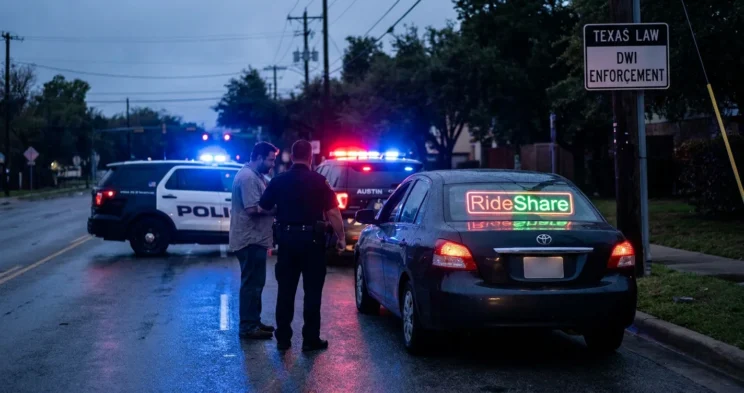
You took an Uber home from a night out in Deep Ellum to avoid driving impaired yourself. Then the trip ended in a crash, and you learned the person behind the wheel had been drinking too. Now you are hurt, the bills are stacking up, and you have no idea who actually owes you money.
Two Scenarios, Two Liability Paths
Who you can sue depends entirely on which driver was drunk. A rideshare DUI crash takes one of two forms, and each one means a different set of defendants.
In the first scenario, your Uber or Lyft driver is the impaired one. That driver is both the at-fault party and a company-approved worker. So you can pursue a claim against the driver directly and against the company itself for approving someone who should never have been driving.
The second scenario flips the roles. A drunk third-party driver slams into the rideshare vehicle you were riding in. Here the impaired stranger faces the same liability as in any drunk driving injury claim, while the rideshare company’s insurance still has a role to play because you were its passenger.
Sorting out which scenario you are dealing with is the first real step. It decides who the defendants are, which insurance policies respond, and whether you can even receive punitive damages, or damages caused by gross negligence, from the company.
TNC Insurance Periods & What They Cover
The single biggest factor in how much insurance is available is what the driver was doing on the app when the crash happened. Texas law splits a rideshare driver’s time into three coverage periods, and each one has a different type of insurance.
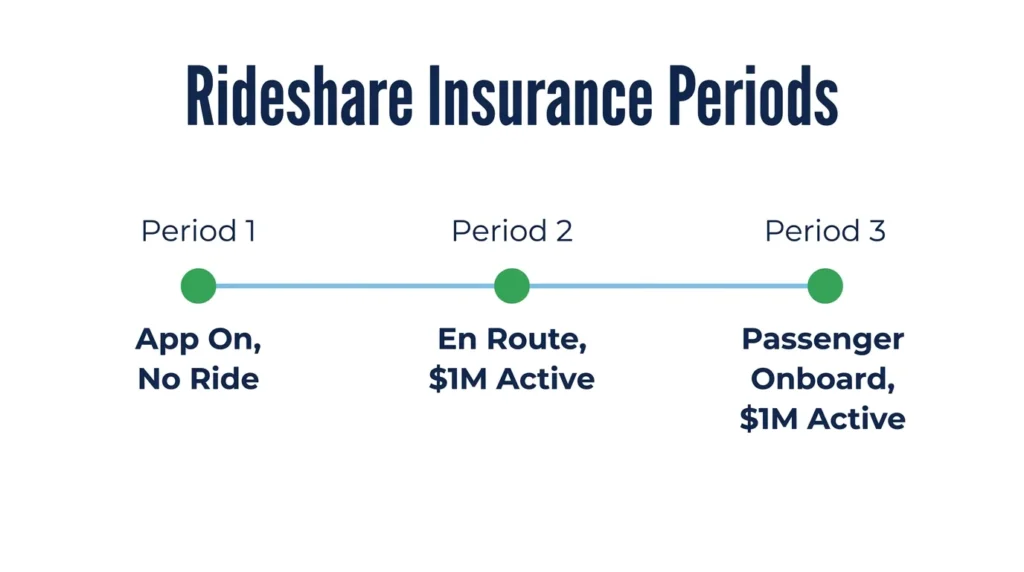
Period 1 covers the time when the app is on but the driver has not accepted a ride. During this window, the company carries only contingent liability coverage, and the driver’s personal auto policy is the primary coverage layer. The minimums for this period are set under the Texas Insurance Code Chapter 1954.
Period 2 begins the moment the driver accepts your ride and heads to pick you up. Period 3 starts when you climb into the vehicle and lasts until you are dropped off. In both of these periods, the company’s $1 million liability policy is active. That policy is the operative coverage for most serious injury claims.
This matters directly for the second scenario. If a drunk third party hit your rideshare while you were a passenger in Period 3, that $1 million policy is available to cover your injuries. A separate claim runs at the same time against the impaired driver who caused the wreck.
The practical takeaway is simple. The moment you enter the vehicle as a passenger, the largest available insurance layer switches on.
Negligent Hiring & Background Check Failures
When your driver was the drunk one, you may have a claim against Uber or Lyft directly, separate from anything the driver did. This is a negligent hiring claim, and it survives even though drivers are technically independent contractors.
The contractor label does not protect the company here. Uber and Lyft control who gets approved to drive, and that approval decision is the company’s own act. If they cleared a driver with a disqualifying drunk driving record, the failure is theirs to answer for.
Texas Occupations Code Chapter 2402 sets the ground rules. It requires a background check before a driver is approved, lists the criminal history that disqualifies an applicant, and imposes an ongoing duty to keep monitoring drivers after approval.
To win this kind of claim, you have to show two things. First, that the company knew or should have known the driver posed a risk. Second, that approving or keeping that driver is what led to your injury.
The state agency behind these rules is the Texas Department of Licensing and Regulation, which enforces the driver requirements for rideshare companies under Chapter 2402. If you suspect a company approved a driver with a known drunk driving history, you may have a direct claim worth exploring, and the question of whether you can sue Lyft after a crash is a good place to start.
Exemplary Damages, Dram Shop & What DUI Changes
The alcohol does more than make the crash worse. It opens the door to exemplary damages, the punitive money meant to punish a defendant rather than simply repay your losses.
Under Texas law, driving at or above the 0.08 limit set in the Texas Penal Code § 49.04 shows a conscious disregard for everyone else on the road. That disregard satisfies the gross negligence element you need to reach exemplary damages.
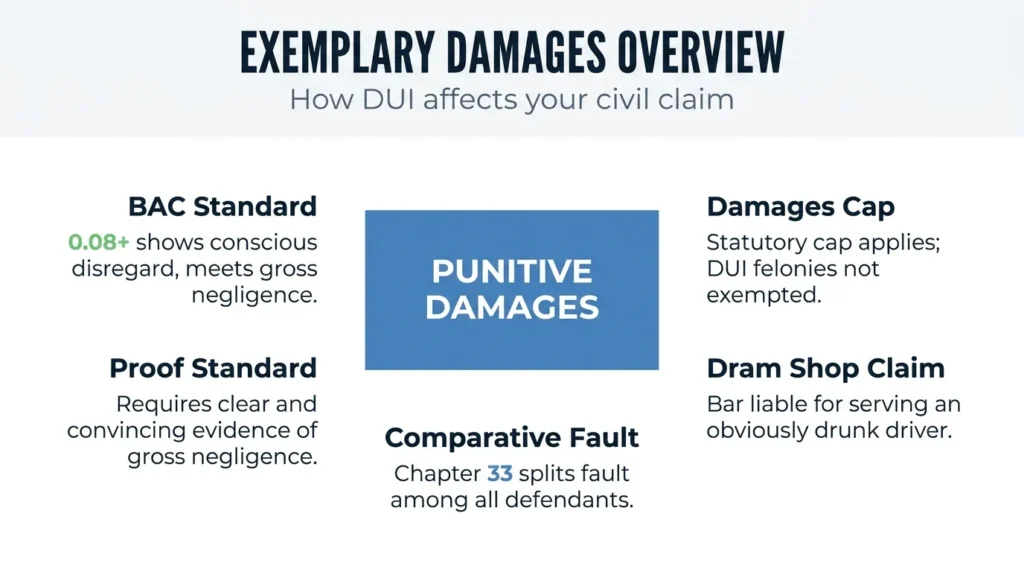
Proving it takes more than the usual burden. The Texas Civil Practice and Remedies Code (CPRC) § 41.003 requires clear and convincing evidence and limits recovery to three grounds: fraud, malice, or gross negligence. A documented DUI usually points straight at the gross negligence path.
There is a catch most people do not expect. The statutory cap under Texas Civil Practice and Remedies Code (CPRC) § 41.008 limits exemplary damages, and the law lifts that cap only for certain felonies. Intoxication assault and intoxication manslaughter are left off that list. So in most rideshare DUI civil claims, the cap still applies even though the conduct was criminal.
A third defendant may also be in play. Under Texas Alcoholic Beverage Code § 2.02, a bar or restaurant that serves alcohol to an obviously drunk person can be liable for the harm that person later causes. This dram shop theory can add the establishment that overserved the driver to your case.
When more than one defendant shares the blame, Texas splits the responsibility. The state’s modified comparative fault rules under Texas Civil Practice and Remedies Code (CPRC) Chapter 33 decide how much of the fault each party carries.
Steps to Take After a Rideshare DUI Crash
Your first job after a rideshare DUI crash is to protect your health and lock down the evidence before it disappears. The steps below do both, and they preserve your legal claims while the trail is still fresh.
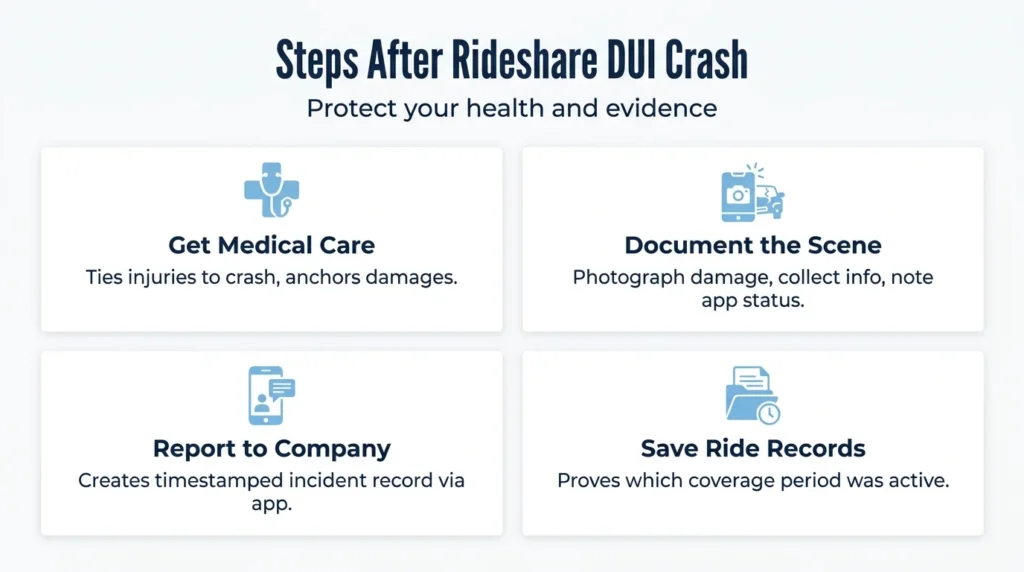
- Step 1: Get emergency medical care right away. A record from the scene or the ER ties your injuries to the crash and anchors any damages claim you later bring.
- Step 2: Document the scene. Photograph the vehicle damage, collect the driver’s rideshare and insurance information, and note whether the app was active when the crash happened.
- Step 3: Report the crash to the rideshare company through the app. This creates a timestamped incident record at the company level that you cannot easily recreate later.
- Step 4: Save your electronic ride records. Your trip receipt and in-app history prove which coverage period was active, which decides which insurance responds.
You also have a hard deadline. Texas Civil Practice and Remedies Code (CPRC) § 16.003 gives you two years from the date of the crash to file a suit, and that clock runs against the driver, the company, and any dram shop defendant alike. Miss it and your right to recover almost certainly disappears.
Talk to an Experienced Attorney Today
A rideshare DUI crash rarely involves just one party, and untangling the driver, the company, the insurance periods, and a possible dram shop claim is not something you should have to do while you are healing. Angel Reyes & Associates has spent over 30 years helping injured Texans hold drunk drivers and the companies behind them accountable.
We work on a no-fee-unless-we-win basis, with more than $1 billion recovered for clients across the state.
Your first consultation is free, and we can walk you through who owes you and what your claim may be worth. You can also see our team of Texas personal injury attorneys before you decide. Reach out to us for a free consultation.
Past results do not guarantee future outcomes.
FAQs About Rideshare Accidents Involving Drunk Drivers
Can I still recover compensation if I was partly at fault for the crash?
Texas modified comparative fault bars recovery only if you are more than 50% responsible for the crash. As a rideshare passenger, you would rarely be assigned any fault in a DUI-caused wreck, but the rule applies to all Texas personal injury claims.
Does a criminal DWI conviction help my civil injury case?
A conviction or guilty plea can be introduced as evidence in the civil case because it establishes what the driver did. The civil burden of proof is lower than the criminal standard, so a conviction does not automatically win your claim, but it significantly strengthens the gross negligence argument.
What if the rideshare driver had no personal auto insurance?
If the crash happened in Period 1, the driver’s personal policy is the primary coverage layer, but Texas Insurance Code Chapter 1954 requires the company to carry contingent coverage that fills the gap if that policy does not apply. In Periods 2 and 3, the company’s $1 million policy is the operative layer, so a lapse in the driver’s personal coverage does not reduce what is available to you.
Does my own uninsured or underinsured motorist coverage apply to a rideshare crash?
If you carry UM/UIM coverage on your own auto policy, it can provide an additional layer of compensation when the at-fault driver’s coverage falls short of your total losses. In a serious rideshare DUI crash, your own policy may be worth checking even when the company’s $1 million policy is available.
About the Authors

Angel Reyes
Writer
Angel L. Reyes, III is the Founder and Managing Partner of Angel Reyes & Associates. A nationally recognized trial attorney and business leader, Angel has helped over 70,000 injury victims recover more than $1 billion since founding the firm in 1993. Named to the Texas Super Lawyers list annually since 2008, Angel brings Wall Street experience, Ivy League education, and a deep commitment to client advocacy. He is a frequent legal commentator and published author with extensive contributions to legal scholarship, trial strategy, and consumer protection.

Kyle Nicolas
Editor
Kyle Nicolas is the Web Content & SEO Manager at Angel Reyes & Associates. He has more than 10 years of experience as a marketing co...

Angel Reyes
Reviewer
Angel L. Reyes, III is the Founder and Managing Partner of Angel Reyes & Associates. A nationally recognized trial attorney and business...