Rural Road Motorcycle Accidents in Texas


Every article on this site is researched by our internal team, reviewed for legal accuracy against current Texas law, and held to State Bar of Texas advertising standards before publication. We do not publish content that overstates outcomes or makes promises about results.
Learn more about our
editorial standards .
Key Takeaways
- Rural Texas roads have unique hazards: loose caliche, livestock, no lighting, and no cameras to document a crash.
- TxDOT maintains FM roads; county commissioners maintain county roads, and each has separate liability rules.
- Texas law gives you two years to file and only 180 days to notify TxDOT or a county of a road defect claim.
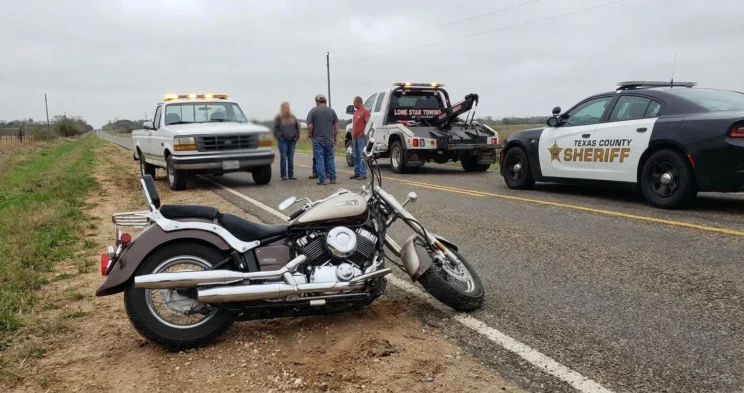
You were heading out past Bastrop on a Saturday morning, riding an FM road you’ve taken a hundred times, when a patch of loose gravel pulled the front wheel sideways. Or maybe a cow wandered across an unmarked county road outside of Stephenville just as you came around a blind curve.
There were no cameras. There were no witnesses. And the nearest hospital was 40 minutes away. Rural road motorcycle accidents are not just physically more dangerous than city crashes; they are legally harder, too.
Why Rural Roads Are Dangerous for Motorcycles
Rural Texas roads create hazards that city riders never encounter. The surface under your tires is the first problem. FM roads and county roads across Texas often feature loose gravel on the shoulder, unpaved sections, and road edges that crumble when a tire drifts even slightly. A bump that rattles a pickup truck can send a motorcycle into a slide.
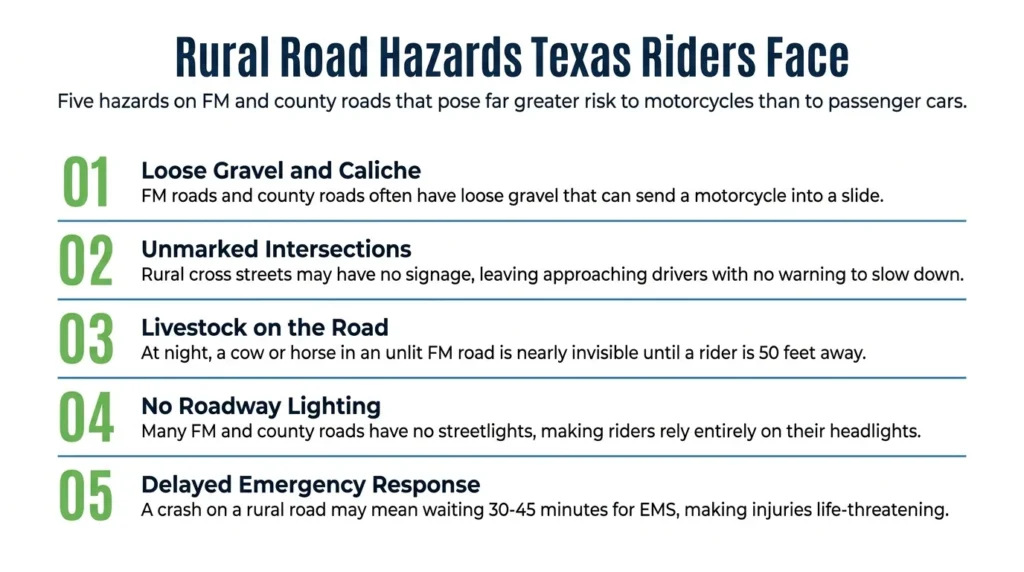
Unmarked intersections are the second problem. In cities, you expect traffic signals, stop signs, and yield markings. On a rural FM road or county road, a cross street may have no signage at all. Other drivers approaching that intersection may not slow down because they have never had to before.
The result is a crash that neither party saw coming.
Open-range conditions and livestock on the road are a Texas-specific hazard with no urban equivalent. At night, a cow or horse standing in an unlit FM road is nearly invisible until you are 50 feet away. The same is true of deer, hogs, and other animals that cross rural roads without warning.
Poor or absent roadway lighting compounds every other hazard after dark. Many FM and county roads have no streetlights at all. Riders rely entirely on their headlights, which cover a shorter distance than most riders assume at highway speeds.
The final factor is emergency response time. A crash on I-35 in San Antonio draws EMS within minutes. A crash on a county road in Jim Wells or Frio County may mean waiting 30 to 45 minutes for help to arrive. Injuries that are survivable with fast treatment become life-threatening in that time window.
Those common injuries in motorcycle accidents hit harder when the nearest trauma center is an hour away.
Proving Fault When There Are No Witnesses or Cameras
In most Texas cities, traffic cameras, security footage from nearby businesses, and dashcam video from passing drivers fill in the gaps that police reports leave out. On a rural road, none of those tools exist. The crash happens, and the only record is the physical evidence left on the pavement.
That physical evidence is your starting point. Skid marks tell investigators how fast each vehicle was traveling and when braking began. Gouge marks in the road show the point of impact.
Debris scatter patterns indicate the direction of force. Road surface conditions at the scene, documented in photographs taken immediately after the crash, establish whether a defect contributed to the collision. Every hour that passes without documentation is evidence you cannot get back.
Texas motorcycle accident data consistently shows that rural crashes produce more severe outcomes precisely because of delayed response and the absence of bystanders who detail what happened. Gathering and documenting evidence quickly is the first step toward building a case without eyewitnesses.
Cell phone records can show whether the other driver was on the phone before impact. Event data recorders in newer vehicles capture speed, braking, and steering inputs in the seconds before a crash. Accident reconstruction specialists can work from physical evidence alone, without a single witness, to produce a credible and defensible account of how the crash happened.
FM Roads vs. County Roads: Who Is Responsible?
Not every rural road in Texas is the same, and that distinction determines who you can file a claim against when a road defect caused or contributed to your crash. The road type controls which government entity is responsible and what rules govern your claim.
Suing TxDOT for an FM Road Defect
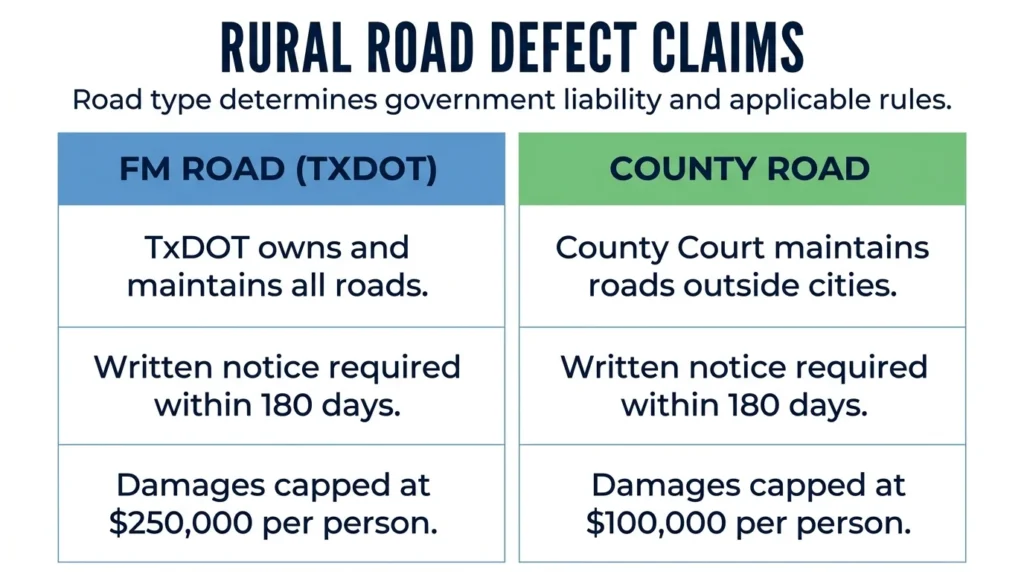
TxDOT owns and maintains every Farm-to-Market road in Texas. If a defect on an FM road contributed to your crash, your claim is against a state agency. The Texas Tort Claims Act allows injured people to bring claims against TxDOT when it had actual or constructive notice of a road defect and failed to correct it within a reasonable time.
Two rules shape every TxDOT claim. First, damages are capped by statute at $250,000 per person and $500,000 per incident. Second, you are required to give TxDOT written notice of your claim within 180 days of the crash. The notice must describe your injuries, the date of the incident, and the specific road condition involved.
Miss that deadline and your right to sue TxDOT is gone, regardless of how strong your evidence is.
Suing a County for a County Road Defect
County roads are a different category. Texas law places county road maintenance under the County Commissioners Court, not TxDOT. If your crash happened on a road with a county road number, your claim goes to the county.
The Texas Transportation Code Chapter 251 establishes the county’s authority and responsibility over its road network. Counties, like TxDOT, are protected by governmental immunity but subject to the same Tort Claims Act waiver when they had notice of a defect. The same 180-day notice requirement applies to county claims.
Building a county road defect case means documenting what the county knew and when it knew it. Prior complaints submitted to the county, maintenance request records, and inspection logs become the foundation of your claim. An attorney can request those records quickly, before they are deleted.
Understanding Texas’s comparative negligence 51 percent rule is also important, because counties and their insurers will often argue that the rider’s speed or behavior caused the crash, not the road condition.
Your Legal Options After a Rural Motorcycle Crash
Texas gives you two years from the date of your crash to file a personal injury lawsuit. That clock runs whether you are recovering in a hospital, dealing with insurance adjusters, or waiting for a settlement offer that never comes.
Texas uses proportionate responsibility, or shared fault responsibility. If your share of fault is 50% or less, you can still recover damages, but your recovery is reduced by your fault percentage. If a jury finds you more than 50% at fault, you recover nothing.
On rural roads where evidence is limited and the crash scene has not been preserved, insurance companies will push hard to assign fault to the rider. Countering that narrative with strong physical evidence and expert reconstruction is not optional. It is the difference between a full recovery and no recovery at all.
Compensation in a rural motorcycle crash case can cover medical bills, future medical costs, lost income, reduced earning capacity, and pain and suffering. When a road defect contributed to the crash, government liability claims under the Tort Claims Act open a second source of recovery.
Understanding how motorcycle accident settlements work in Texas gives you a clearer picture of what your case may be worth.
Get Help from an Experienced Attorney
Rural crashes leave victims with two problems at once: serious injuries and a legal path that is harder to navigate than most city crash cases. Evidence disappears fast. Government notice deadlines run quickly. And insurance adjusters start building a fault narrative against you from the moment you file a claim.
Angel Reyes & Associates has handled motorcycle accident cases across Texas for over 30 years, including crashes on FM roads, county roads, and remote highways where evidence is scarce and witnesses do not exist.
Our motorcycle accident practice covers the entire state of Texas. Whether your crash happened on an FM road maintained by TxDOT, a county road maintained by the Commissioners Court, or a remote highway where you were the only rider for miles, we are here for you.
Our team includes investigators and accident reconstruction specialists who know how to build a case when the scene has gone cold and the cameras were never there. We work on a contingency basis, meaning no upfront cost and no fee unless we win. For a free consultation, reach out to us today.
See what we have recovered for injured Texans and decide whether we are the right fit for your case.
Past results do not guarantee future outcomes.
Rural Road Motorcycle Accident FAQs
Can a livestock owner be held liable for a motorcycle crash on a Texas rural road?
It depends on the county and road type. Texas state and federal highways are closed range, so livestock owners can be held liable for animals that stray onto those roads. On other rural roads, liability depends on whether the county has passed a local stock law making it closed range; in open-range areas without such a law, the livestock owner may not be legally responsible.
What happens if the other driver in my rural crash had no insurance?
If you carry uninsured motorist (UM) coverage on your own policy, that coverage can step in to pay your medical bills, lost wages, and pain and suffering when the at-fault driver has no insurance. Texas auto policies include UM/UIM coverage by default unless you decline it in writing.
What should I do at the scene of a rural motorcycle crash when no one else is around?
Call 911 first, then photograph everything you can before vehicles are moved: skid marks, road surface conditions, debris, and your injuries. If you can safely do so, note the road name or number, the nearest mile marker, and the direction each vehicle was traveling. That documentation becomes your primary evidence when no witnesses or cameras exist.
About the Authors

Angel Reyes
Writer
Angel L. Reyes, III is the Founder and Managing Partner of Angel Reyes & Associates. A nationally recognized trial attorney and business leader, Angel has helped over 70,000 injury victims recover more than $1 billion since founding the firm in 1993. Named to the Texas Super Lawyers list annually since 2008, Angel brings Wall Street experience, Ivy League education, and a deep commitment to client advocacy. He is a frequent legal commentator and published author with extensive contributions to legal scholarship, trial strategy, and consumer protection.

Kyle Nicolas
Editor
Kyle Nicolas is the Web Content & SEO Manager at Angel Reyes & Associates. He has more than 10 years of experience as a marketing co...

Angel Reyes
Reviewer
Angel L. Reyes, III is the Founder and Managing Partner of Angel Reyes & Associates. A nationally recognized trial attorney and business...