School Bus Accident Statistics in Texas


Every article on this site is researched by our internal team, reviewed for legal accuracy against current Texas law, and held to State Bar of Texas advertising standards before publication. We do not publish content that overstates outcomes or makes promises about results.
Learn more about our
editorial standards .
Key Takeaways
- TxDOT recorded 2,480 crashes involving Texas school buses in 2024, with 11 people killed.
- School buses average 0.2 deaths per 100 million miles, which makes them far safer than passenger vehicles.
- The biggest risk happens while boarding and unboarding the school bus, not during the ride itself.
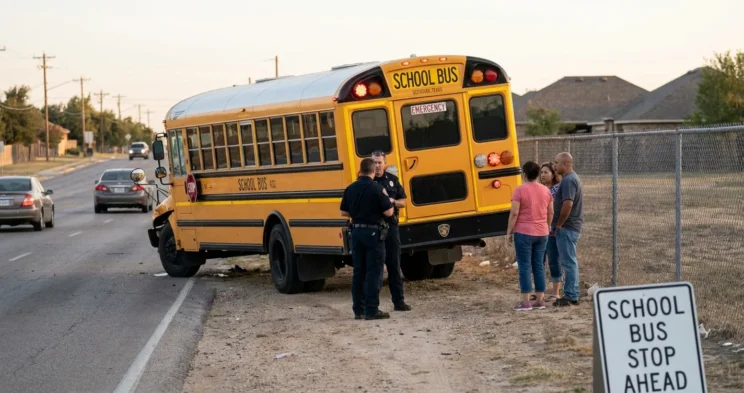
As the school bus pulls away from the corner near your house in Round Rock, you remember a news alert from last week. A school bus rolled over with dozens of kids on board. How worried should you be that this might happen to your child?
The best answer can be found in the data from Texas and federal agencies, not the headlines.
How Safe Are School Buses in Texas?
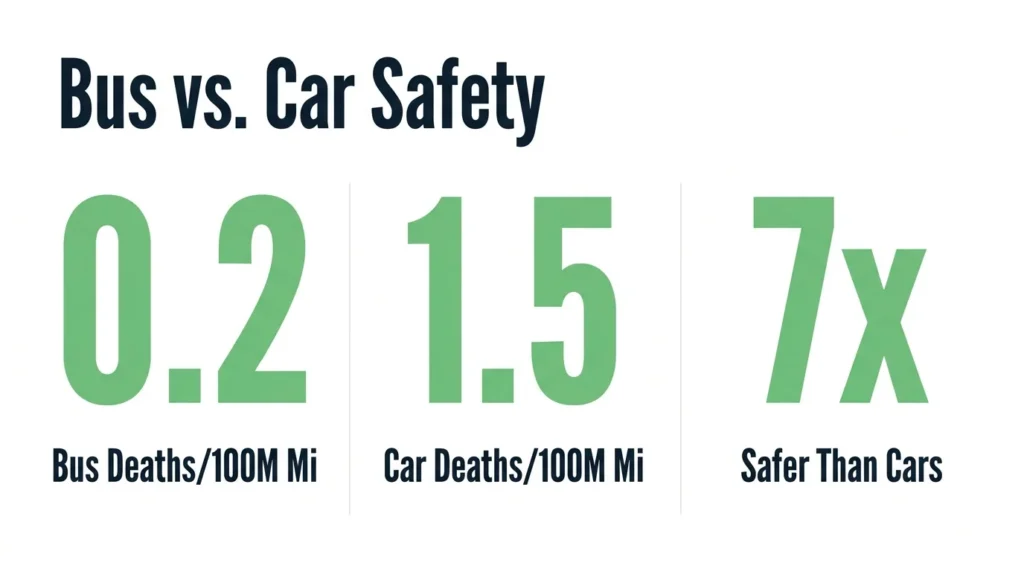
School buses are one of the safest ways to get your child to school. According to NHTSA school bus safety data, school buses average about 0.2 deaths per 100 million miles traveled. In comparison, passenger vehicles average 1.5 deaths per 100 million miles traveled. That means a school bus is more than seven times safer per mile than a regular vehicle.
Buses are built to be big, tall, and heavy on purpose. Their size and padded seats with high backs protect kids in ways a family car cannot. This is why a serious crash becomes statewide news. It’s not supposed to happen.
However, a single school bus crash is not a pattern, especially when you take into consideration how many car accidents happen daily in Texas. In comparison, school buses are remarkably safe.
Texas School Bus Crash Data from TxDOT
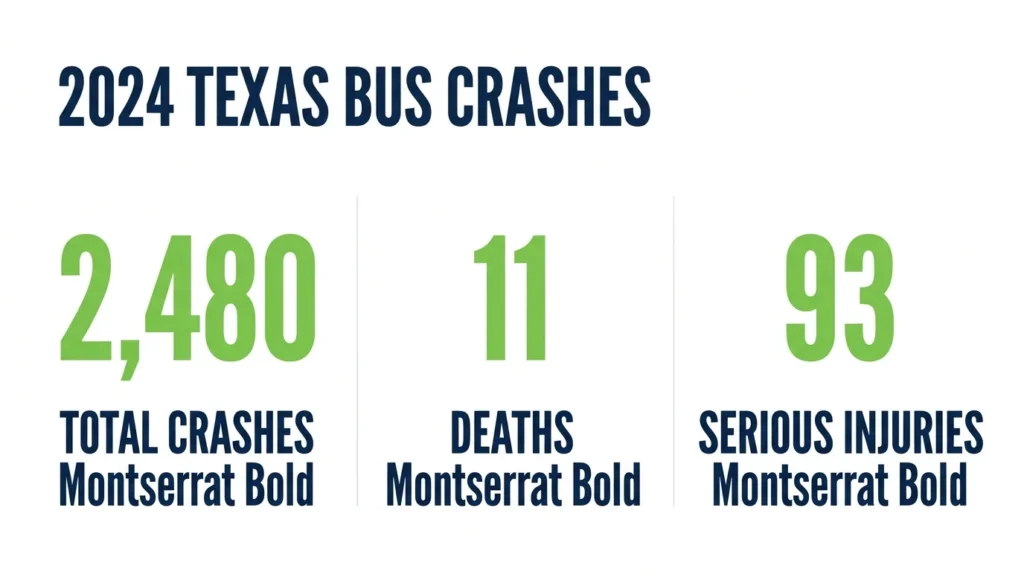
According to TxDOT school bus crash data, in 2024, 2,480 crashes involved school buses in Texas. Of these 2,480 crashes, 11 people were killed, and 93 were seriously injured. That means the vast majority of those 2,480 crashes were minor collisions, with no deaths or serious injuries at all.
TxDOT points to two leading causes behind these crashes:
- Driver inattention
- Excessive speed
Both causes are usually the fault of the other driver on the road, not the school bus driver. A distracted commuter who drifts into a bus or speeds through a stop sign creates far more risk than a school bus itself ever does.
Another thing to remember is that TxDOT refreshes its crash data every year, so the numbers change from one year to the next. You can track the current figures through the TxDOT crash statistics reports, which the agency updates annually. It’s important to remember that when you are reading a statistic online, a number from three years ago may not match a number from the current year, so make sure to check the year attached to any figure you see.
Who Gets Hurt in School Bus Crashes?
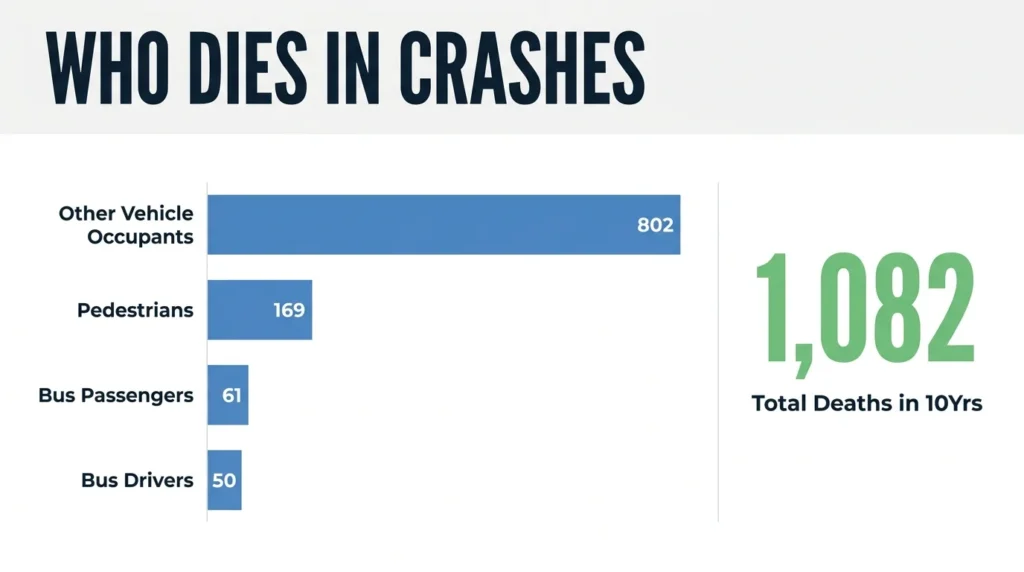
Most people who die in school bus crashes were never on the bus. According to NHTSA’s school transportation crash data, there were 976 fatal crashes and 1,082 deaths nationwide from 2013 through 2022, which equals about 108 deaths a year. Most of those deaths were occupants of other vehicles. Of the 1,082 total deaths in school bus crashes, 169 were pedestrians.
Comparatively, school bus passengers made up only a small fraction, as 111 people were inside the school bus at the time of the crash, and of those 111, 50 were drivers, and 61 were passengers. Spread across ten years and the entire country, 61 is a small number of student passenger deaths per year.
Of the 1,082 total deaths in school bus crashes from 2013 through 2022, 198 were school-age children, but only 35 of those children were riding in the bus at the time of the crash. The remaining 163 were in other vehicles, on bicycles, or pedestrians.
Many of these pedestrians were children who were trying to board or unboard the bus itself. This proves that riding the school bus itself isn’t the most dangerous part of the trip; it’s the seconds a child spends crossing the street to reach the bus or stepping off it. This is because the area around a stopped bus is where a driver’s view of a small child is the most obscured.
Texas law treats this blind spot seriously. Under Texas Transportation Code § 545.066, you must stop for a school bus loading or unloading children when its red lights flash. The only exception is if you are on the opposite side of a divided highway. A driver who ignores this rule puts children at risk.
What the Statistics Mean for Parents
Your child is statistically safer on a school bus than the backseat of your own car. That means a school bus ride itself is low risk, but the trip to and from the bus stop is where the real danger happens.
Teach your child bus stop safety by telling them to:
- Wait several steps back from the curb
- Make eye contact with the driver before crossing the street
- Never walk behind a bus
Pay attention to the drivers around the bus stop, too. The biggest threat is a driver who ignores the bus stop and keeps going. It’s your job as a parent to watch your child and make sure they get on and off the bus safely.
If the worst does happen, and your child is injured in a school bus crash, who is liable? Determining who is at fault gets complicated fast, as a school district, transit agency, private contractor, or another driver may all share the blame.
Another thing to remember is that the deadline to file a claim against government-operated school buses can be short. Our overview of how to file a Texas bus accident claim explains the applicable deadlines in detail.
Talk with an Attorney About Your School Bus Accident in Texas
If your child was hurt in a school bus crash, you deserve answers about what happened and who is responsible. Angel Reyes & Associates has spent over 30 years helping injured Texans understand their options after a school bus crash.
We work on a contingency basis, which means you pay no fee unless we win. We are available 24/7, and we serve families across the entire state. We have recovered more than $1 billion for clients. Review our case results to see the kind of outcomes we have secured. Reach out for a free consultation to discuss your options today.
Past results do not guarantee future outcomes.
Frequently Asked Questions
Do school buses in Texas have seat belts?
Usually, yes. Texas law requires three-point seat belts on most public school buses bought after September 2018, though districts can seek an exemption if funding is not available.
What is the fine for passing a stopped school bus in Texas?
A first offense carries a fine of up to $1,250, and the penalty rises for repeat offenses within five years.
Does the Texas Tort Claims Act limit what I can recover from a school district after a school bus crash?
Yes. As a unit of local government, a school district is generally capped at $100,000 per person and $300,000 per accident, which is lower than the amount you can recover from a private defendant.
How quickly must I report a claim against a public school district?
Government claims require formal written notice within a short window (often six months). Some local entities set deadlines as short as 45 days, so taking legal action early is critical.
Are charter and private school buses held to the same safety rules as public ones?
Generally, yes. Private and contractor-operated buses follow the same federal motor carrier safety standards, but claims against them usually follow standard injury law, rather than the tighter government notice rules.
About the Authors

Angel Reyes
Writer
Angel L. Reyes, III is the Founder and Managing Partner of Angel Reyes & Associates. A nationally recognized trial attorney and business leader, Angel has helped over 70,000 injury victims recover more than $1 billion since founding the firm in 1993. Named to the Texas Super Lawyers list annually since 2008, Angel brings Wall Street experience, Ivy League education, and a deep commitment to client advocacy. He is a frequent legal commentator and published author with extensive contributions to legal scholarship, trial strategy, and consumer protection.

Kyle Nicolas
Editor
Kyle Nicolas is the Web Content & SEO Manager at Angel Reyes & Associates. He has more than 10 years of experience as a marketing co...

Angel Reyes
Reviewer
Angel L. Reyes, III is the Founder and Managing Partner of Angel Reyes & Associates. A nationally recognized trial attorney and business...