School Field Trip Bus Accident Liability


Every article on this site is researched by our internal team, reviewed for legal accuracy against current Texas law, and held to State Bar of Texas advertising standards before publication. We do not publish content that overstates outcomes or makes promises about results.
Learn more about our
editorial standards .
Key Takeaways
- A field trip bus crash can make the school district, a charter company, and the driver liable.
- Texas caps school district recovery at $100,000 per person and $300,000 per occurrence.
- You must give a school district written notice within six months or you lose the claim.
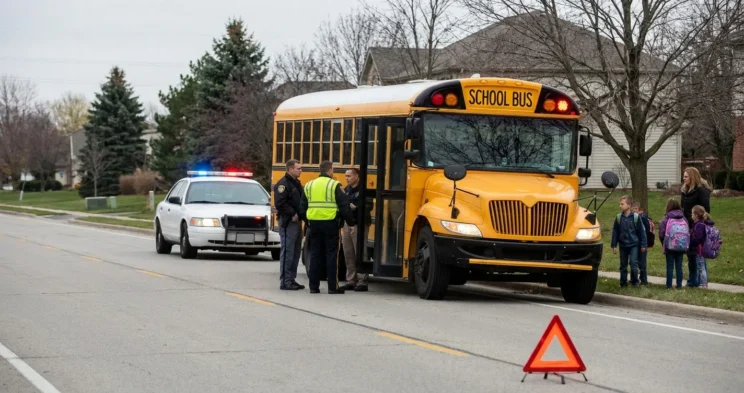
Your child left for a museum field trip that morning, excited and waving from the bus window. Hours later, you got the call that the bus had crashed on the way back. Now you are sitting in a hospital hallway, scared for your child and unsure who is even responsible for what happened.
Who Can Be Liable for a Field Trip Bus Crash?
Three parties can share legal responsibility for a field trip bus crash: the school district, a private charter company, and the bus driver. Which ones apply depends on who owned the bus and who employed the person behind the wheel.
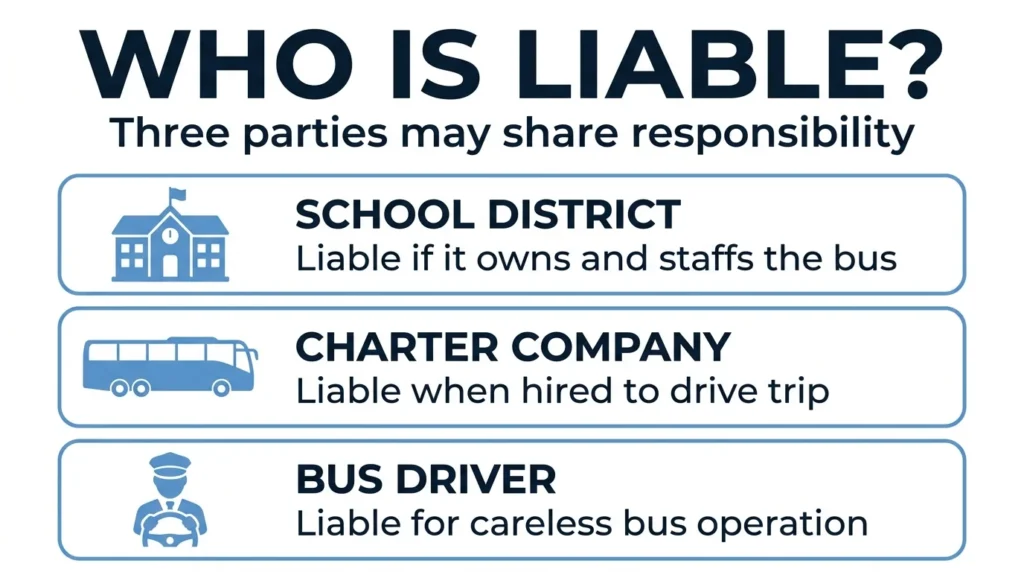
When a district-employed driver operates a district-owned bus, the school district can be liable. Because a district is a governmental unit, immunity rules limit what you can recover. Texas law still creates a partial waiver for motor vehicle crashes.
When the school hires an outside carrier to drive the trip, the charter company can be liable instead. That company is a private business, not a government entity. As a common carrier, it owes student passengers the highest duty of care under Texas law.
The driver can also be personally liable for careless operation of the bus. The driver’s employer, whether the district or the charter company, may share that liability under a rule called respondeat superior. That rule holds an employer responsible when its employee causes harm while doing the job.
Who operated the bus changes everything about your claim. When the district owns and staffs the bus, you face governmental immunity limits. When a private charter company runs the trip, those limits do not apply to that company, which often makes the carrier your strongest source of compensation.
Texas Tort Claims Act & School District Claims
The Texas Tort Claims Act waives a school district’s immunity for crashes caused by an employee driving a government vehicle on the job. That waiver appears in Texas Civil Practice and Remedies Code (CPRC) § 101.021, and it is the door that lets you sue a district at all.
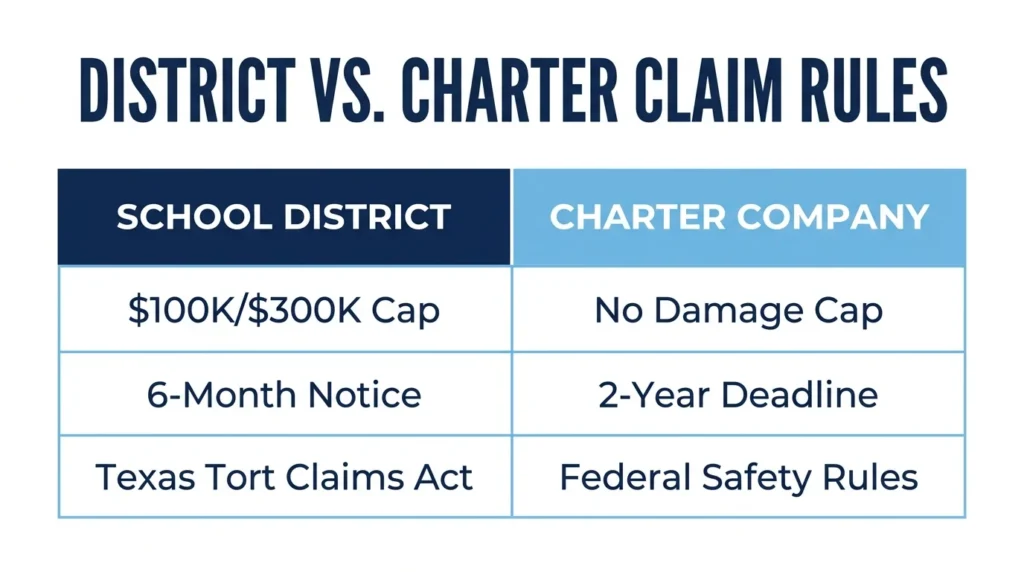
That door only opens so far. Recovery against a school district is capped at $100,000 per person and $300,000 per occurrence for a single crash involving a government vehicle. Those limits come from Texas Civil Practice and Remedies Code (CPRC) § 101.023, and punitive damages are off the table against a governmental unit.
The cap matters most when your child’s injuries are severe. Medical bills for a serious injury can climb well past $100,000, and the district’s cap does not move to match them. When a private charter company operated the bus, those caps do not apply to your claim against that company.
If a student dies in a field trip crash, the family can bring a wrongful death claim under Texas Civil Practice and Remedies Code (CPRC) Chapter 71. The same district caps still apply when the defendant is the school district.
The Six-Month Notice Requirement
You have only six months to put a school district on formal written notice of your claim. Miss that window and you almost always lose the right to recover from the district, even with a strong case. This rule lives in Texas Civil Practice and Remedies Code (CPRC) § 101.101.
The notice cannot be a phone call or a hallway conversation with a principal. It must be in writing. It has to state the time, place, and circumstances of the injury, your child’s name, age, and address, and a description of the damages you are claiming.
The six-month clock starts on the date of the crash. It does not wait until you hire a lawyer or until you learn how badly your child was hurt. Acting fast protects your claim before the deadline quietly closes it. If you are unsure whether notice has been given correctly, an attorney who handles government entity claims can review how to file a bus accident claim with you.
Claims against a private charter company follow a different clock. Those claims fall under the standard two-year deadline for injury cases in Texas Civil Practice and Remedies Code (CPRC) § 16.003, not the six-month government notice rule.
Charter Bus Companies & Federal Safety Rules
A private charter company driving a field trip answers to federal safety law, not just Texas negligence rules. The Federal Motor Carrier Safety Administration rules govern driver qualifications, hours of service, vehicle inspections, and carrier insurance requirements under 49 CFR Parts 390–391.
A private charter company driving a field trip in interstate commerce must meet federal minimum insurance requirements under 49 CFR Part 387, including up to $5,000,000 for vehicles carrying 16 or more passengers.
For trips that stay within Texas, and for school-district-contracted trips that qualify for the federal exemption under 49 CFR § 387.27(b)(4), state law and the carrier’s own policy limits determine the available coverage.
Either way, a private charter company is not bound by the school district’s damage caps, and its insurance limits are set to cover commercial passenger operations, often far exceeding what a capped district claim can yield.
A charter company owes your child the highest duty of care as a common carrier. When the company breaks a federal safety rule, that violation can serve as evidence of negligence. An expired driver certification, an overdue inspection, or an hours-of-service violation can all support your case.
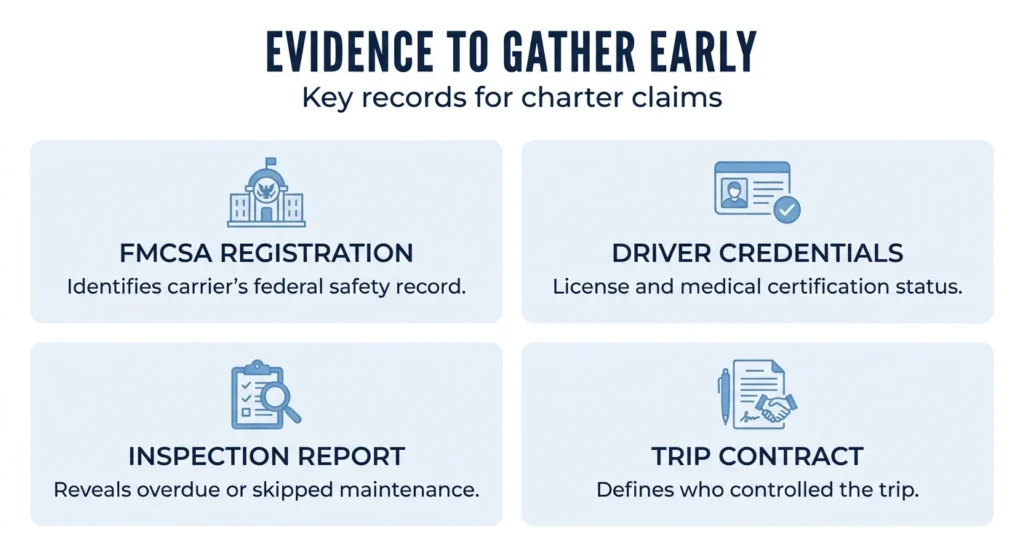
Preserving the right evidence early can decide a charter company case. Gather these records as soon as you can:
- FMCSA registration number: Identifies the carrier and ties it to its federal safety record.
- Driver credentials: The commercial license and medical certification status in effect on the trip date.
- Inspection report: The vehicle’s most recent inspection, which can reveal overdue or skipped maintenance.
- Trip contract: The agreement between the school district and the charter company that defines who controlled the trip.
What Damages Can Parents Recover?
Against a private charter company, your recoverable damages are not capped. You can pursue past and future medical expenses, income you lost while caring for your child, pain and suffering, and disfigurement.
Against the school district, the per-person limit controls your compensation. Those damages still cover real losses, but punitive damages are not available.
When both a district and a charter company are defendants, the two claims often move on separate tracks with different damage limits. Coordinating those claims takes someone comfortable with both government claim procedure and commercial carrier cases. That coordination is where many parents need experienced help.
The two-year deadline governs your claims against non-government defendants. For the school district, the six-month notice rule is the earlier deadline that controls in practice.
Talk to an Experienced Attorney in Texas
When your child is hurt on a field trip, sorting out a district, a charter company, and a driver at once is a heavy load to carry alone. Angel Reyes & Associates has guided Texas families through bus accident and government entity claims for more than 30 years. We have more than $1 billion recovered for clients across Texas.
We work on a contingency fee basis, which means no fee unless we win, and we can review most of your case remotely. Our consultations are free and available 24/7, so cost is never the reason to wait. You can see results from past clients and meet the attorneys who handle these claims before you decide.
Contact us for a free consultation and we will walk you through your options.
Past results do not guarantee future outcomes.
School Bus Accident Liability FAQs
Does signing a field trip permission slip prevent my child's injury claim in Texas?
Texas courts have held that a parent cannot sign away a minor child’s personal injury rights, so pre-injury waivers on permission slips are generally unenforceable for the child’s claim. The waiver may acknowledge certain risks but does not bar a negligence case against the bus operator or school district.
How long does a minor child have to file a bus accident claim in Texas?
Under Texas Civil Practice and Remedies Code Section 16.001, the two-year personal injury deadline stops while the injured person is a minor, meaning the clock typically does not start until the child turns 18. That extension applies to claims against private defendants; the six-month written notice rule for school district claims is a separate, earlier deadline that does not stop.
Do Texas school districts carry student accident insurance that covers field trip injuries?
Many Texas school districts offer optional student accident insurance that can pay medical bills when a student is hurt on a field trip, but this coverage is secondary to any other health insurance the family carries and is separate from a negligence claim against the district or a bus company. Accepting a payout from student accident insurance does not waive the right to pursue a personal injury claim.
If both the school district and a charter company share fault, how does Texas split the damages?
Texas uses proportionate responsibility under Civil Practice and Remedies Code Chapter 33, so a jury assigns a fault percentage to each defendant and each party pays its share of the damages. The school district’s portion of any judgment is still subject to the TTCA per-person cap even when a private charter company is also a defendant in the same case.
Can a bus defect make the vehicle manufacturer liable for a field trip crash?
If a defective part, such as faulty brakes, tires, or safety equipment, contributed to the crash, the manufacturer or distributor of that component may be strictly liable under Texas products liability law. A strict liability claim does not require proof of carelessness, only that the product was defective and that the defect caused the injury.
About the Authors

Alex Ivanov
Writer
Alex Ivanov is a personal injury attorney at Angel Reyes & Associates, focused on car, truck, and motorcycle accident cases. Licensed in Texas and multiple federal districts, Alex brings international legal experience and a global education to his practice. He earned his LL.M. from Texas A&M University School of Law after graduating from Belarussian State University in 2016. Alex is fluent in Russian, English, Ukrainian, and Belarussian, and is recognized by multiple national trial lawyer associations for his results and leadership under 40.

Kyle Nicolas
Editor
Kyle Nicolas is the Web Content & SEO Manager at Angel Reyes & Associates. He has more than 10 years of experience as a marketing co...

Angel Reyes
Reviewer
Angel L. Reyes, III is the Founder and Managing Partner of Angel Reyes & Associates. A nationally recognized trial attorney and business...