Statute of Limitations for Motorcycle Accidents in Texas


Every article on this site is researched by our internal team, reviewed for legal accuracy against current Texas law, and held to State Bar of Texas advertising standards before publication. We do not publish content that overstates outcomes or makes promises about results.
Learn more about our
editorial standards .
Key Takeaways
- Texas gives motorcycle crash victims two years to file a lawsuit under CPRC 16.003.
- Missing the two-year deadline almost always ends a claim before it can begin.
- Government claims can require formal notice within six months, far sooner than two years.
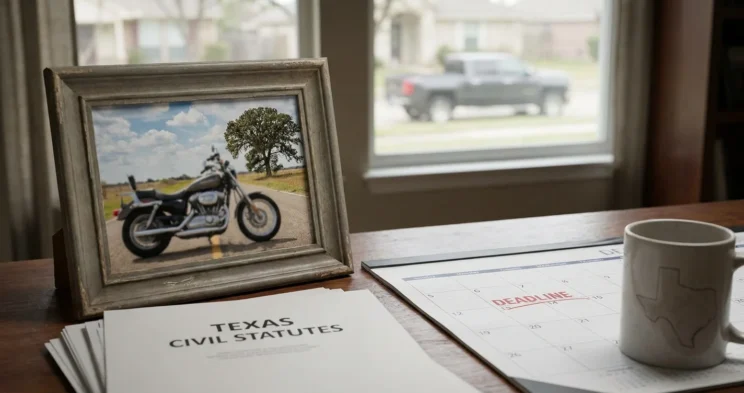
You were riding home on I-35 near downtown Dallas when a driver changed lanes without looking and clipped your bike. Months have passed since the crash, and the medical bills are still coming. Now you’re wondering if it is too late to do anything about it.
The Two-Year Deadline in Texas
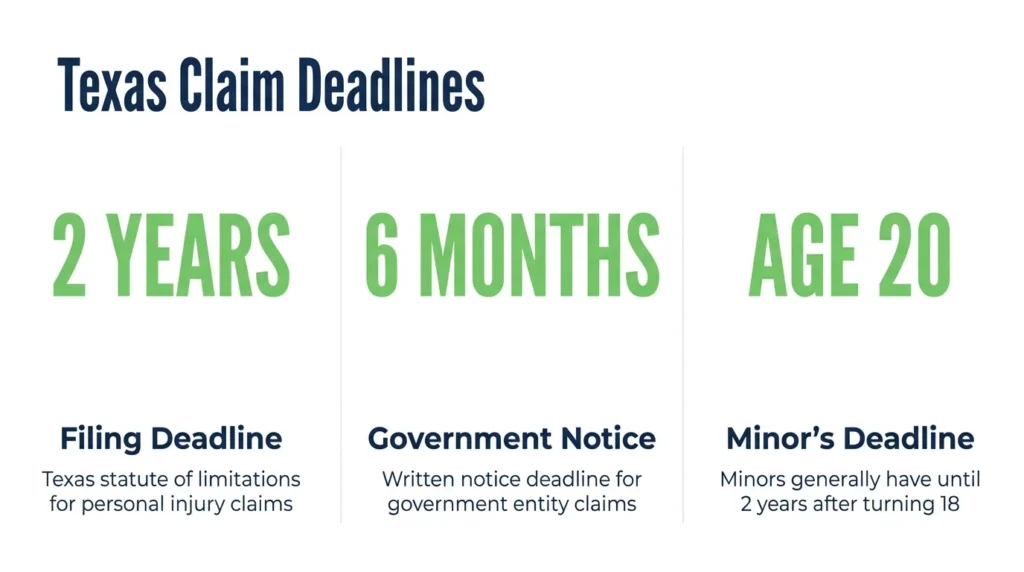
Texas gives you two years from the date of your motorcycle crash to file a lawsuit. This deadline comes from the Texas Civil Practice and Remedies Code § 16.003, which sets the limit for most personal injury claims.
The clock usually starts the day the crash happens. From that moment, you have two years to act, and the window doesn’t pause just because you are still recovering.
Filing means starting an actual lawsuit in court. It does not mean calling the insurance company or opening a claim with an adjuster.
That distinction trips up a lot of injured riders. You can spend months talking with an insurer and still blow past your deadline to sue. This is a hard cutoff, not a guideline.
What Happens If You Miss the Deadline
Miss the two-year window and the court will almost certainly throw out your case. It doesn’t matter how badly you were hurt or how clearly the other driver was at fault.
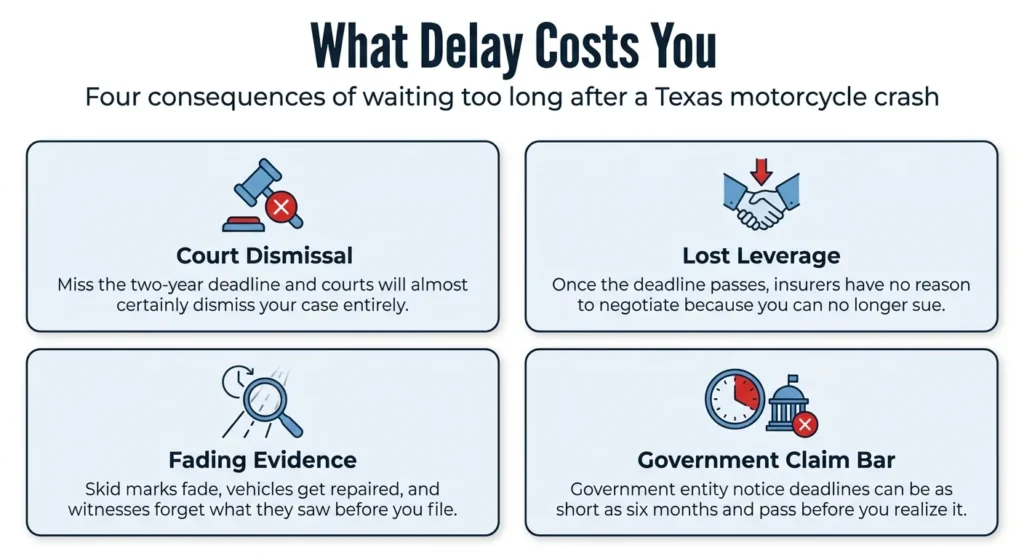
Once the deadline passes, the insurance company has no reason to negotiate. They know you can no longer take them to court, so any leverage you had disappears.
Waiting hurts your case long before the two years are up. Skid marks fade, vehicles get repaired or scrapped, and witnesses forget what they saw.
The sooner you talk to an attorney, the more evidence you can lock down. An attorney can also explain how motorcycle settlements work in Texas.
Delay is the single most common and most damaging mistake injured riders make. It is also the one you can never undo.
Exceptions That Can Change the Deadline
A few narrow exceptions can pause or shift the two-year clock. Texas courts apply them strictly, so don’t assume one fits your situation without legal advice.
The Discovery Rule
The discovery rule can delay the start of the clock when an injury was not reasonably discoverable right away. In those cases, the clock may start when you discover the injury or reasonably should have.
This exception rarely helps after a motorcycle crash. Most crash injuries are obvious the same day, so courts expect the clock to start at the wreck.
Tolling for Minors
If the injured rider was under 18 at the time of the crash, the deadline pauses. Being younger than 18 counts as a legal disability under the Texas Civil Practice and Remedies Code § 16.001, which stops the limitations clock from running.
A minor generally has until two years after turning 18 to file. In practice, that often means a deadline around their 20th birthday.
The rules change again when a rider dies in a crash. The wrongful death statute of limitations in Texas runs two years from the date of death under the Texas Civil Practice and Remedies Code Chapter 71, not the date of the accident.
The Shorter Deadline for Government Claims
If a city, county, or state entity may share blame for your crash, you face a much shorter deadline. The Texas Tort Claims Act requires formal written notice, often within six months, under the Texas Civil Practice and Remedies Code § 101.101.
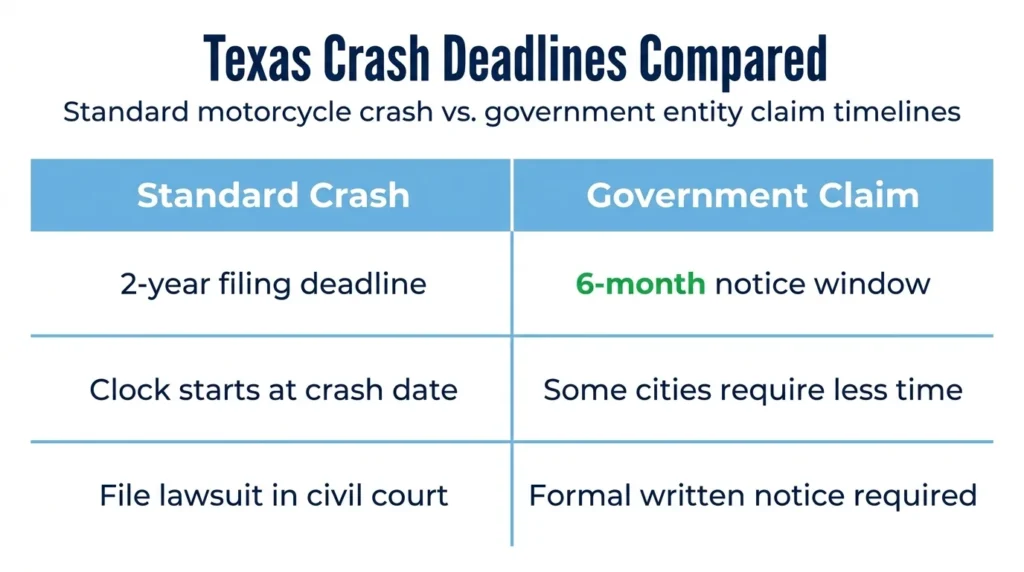
Many Texas cities set even tighter windows through their own charters. Some require notice within just a few months of the crash.
A government entity might be involved in more crashes than you would expect, due to issues like:
- Bad road design
- A broken traffic signal
- A collision with a government vehicle
Miss that notice deadline and your claim could be barred even though the two-year period has not run. If you suspect a public road or vehicle played a role, it’s worth confirming early which deadlines apply to your situation.
Talk to an Experienced Motorcycle Accident Attorney
The safest move after a motorcycle crash is to seek advice well before any deadline gets close. Angel Reyes & Associates has spent over 30 years helping injured Texans understand their options and protect their right to file motorcycle accident claims.
We work on a no fee unless we win basis, though you may still be responsible for court costs and case expenses. Our consultations are free, we are available 24/7, and we have more than $1 billion recovered for clients across Texas.
You can see how we approach cases like yours and get to know our team on our attorney profiles. When you’re ready, reach out for a free consultation so you understand your timeline before it runs out.
Past results do not guarantee future outcomes.
Motorcycle Accident Statute of Limitations FAQs
Is the deadline to report a crash to my insurer the same as the deadline to sue?
No. Your policy sets a separate, usually much shorter window to notify your insurer, and most policies require prompt notice well before the two-year lawsuit deadline.
Can a judge extend the two-year deadline once it has passed?
Generally no. Outside of narrow tolling rules like those for minors or an unknown driver, courts have little power to revive a claim after the limitations period runs out.
Does the two-year clock still run if the rider who hit me fled the scene?
Often the clock may be paused until the at-fault driver is identified, but you should still pursue uninsured motorist coverage and report the crash quickly to protect your options.
Which state's deadline applies if my motorcycle crash happened outside Texas?
The deadline of the state where the crash happened usually controls, so a wreck in another state may follow that state’s filing rules instead of Texas’s two-year period.
What can I do now to keep my claim within the deadline?
Save crash photos, the police report, medical records, and any insurer communications, then get legal advice early so nothing critical lapses before you file.
About the Authors

Angel Reyes
Writer
Angel L. Reyes, III is the Founder and Managing Partner of Angel Reyes & Associates. A nationally recognized trial attorney and business leader, Angel has helped over 70,000 injury victims recover more than $1 billion since founding the firm in 1993. Named to the Texas Super Lawyers list annually since 2008, Angel brings Wall Street experience, Ivy League education, and a deep commitment to client advocacy. He is a frequent legal commentator and published author with extensive contributions to legal scholarship, trial strategy, and consumer protection.

Kyle Nicolas
Editor
Kyle Nicolas is the Web Content & SEO Manager at Angel Reyes & Associates. He has more than 10 years of experience as a marketing co...

Angel Reyes
Reviewer
Angel L. Reyes, III is the Founder and Managing Partner of Angel Reyes & Associates. A nationally recognized trial attorney and business...