How Long Does It Take to Get an Insurance Settlement In Texas?


Every article on this site is researched by our internal team, reviewed for legal accuracy against current Texas law, and held to State Bar of Texas advertising standards before publication. We do not publish content that overstates outcomes or makes promises about results.
Learn more about our
editorial standards .
Key Takeaways
- Texas insurers must acknowledge a claim within 15 business days, but settlement timing depends on injury severity, fault clarity, and insurer cooperation.
- Claims move faster when treatment ends quickly and documentation is organized, while disputed liability, ongoing care, multiple parties, and low limits can extend timelines.
- Most cases settle before trial, but litigation can take 12 to 24 months or more, and the two-year filing deadline affects negotiation leverage.
How Long Does It Take to Get an Insurance Settlement In Texas?
Insurance claims are not always an expedient process. Texas insurers must acknowledge your claim within 15 business days, but that’s just the start of a process that can stretch for weeks or even years.
The timeline for your claim depends on several factors: your injuries, how clearly fault can be shown, and whether the insurer cooperates. A fender-bender with minor whiplash might wrap up in a couple of months, but a serious crash on I-35 with disputed liability could take a year or more.
If you’re juggling work, medical appointments, and bills piling up, you need a realistic picture of what’s ahead. This guide breaks down the factors that speed things up or slow things down, so you can plan accordingly.
Understanding the Settlement Timeline in Texas
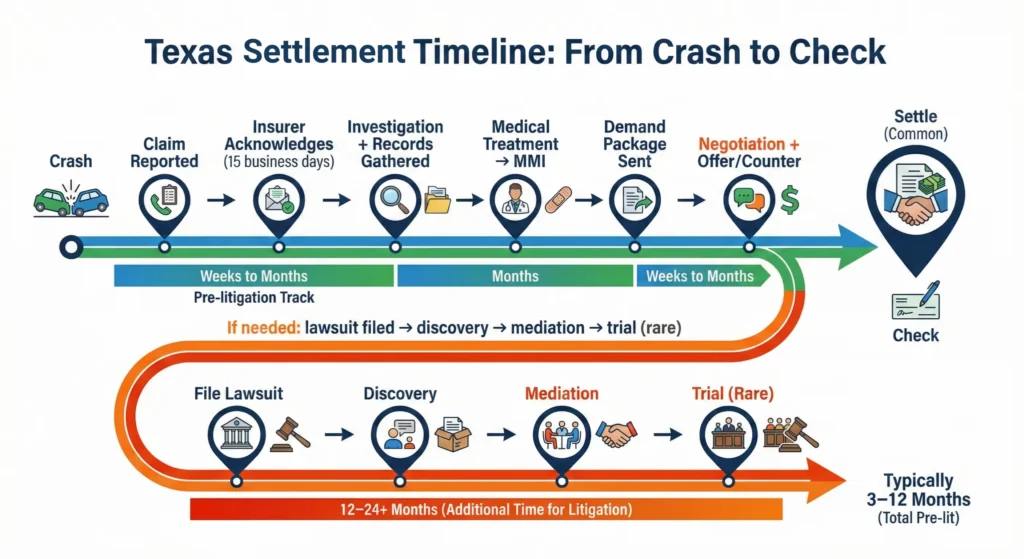
Most Texas car accident claims follow a predictable path: you report the crash, gather evidence, complete medical treatment, then negotiate with the insurer. How long each step takes depends on your specific situation.
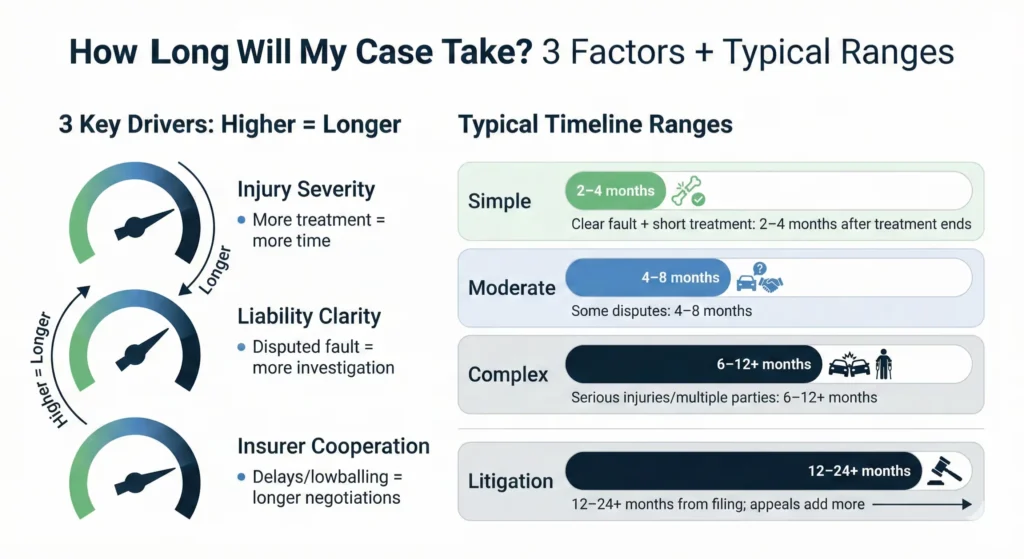
Three main factors shape your timeline:
- Injury severity. Minor soft-tissue injuries heal faster, which means quicker settlements. Broken bones, surgeries, or traumatic brain injuries require longer treatment and more documentation.
- Liability clarity. If fault is obvious, such as a rear-end collision with a police report confirming the other driver ran a red light, negotiations move faster. Disputed fault means more investigation.
- Insurer cooperation. Some adjusters respond promptly and make reasonable offers. Others delay, request unnecessary documentation, or lowball initial offers, hoping you’ll accept out of frustration.
You might settle in 60 to 90 days after finishing treatment if everything lines up. Or you might spend six months to a year negotiating before deciding whether to file a lawsuit.
When Settlements Happen Quickly
Quick settlements typically share a few characteristics: clear liability, complete documentation, and injuries that resolve within a defined treatment period.
What “quick” looks like in practice:
- Treatment wraps up within a few weeks or months
- Medical records clearly connect your injuries to the crash
- The at-fault driver’s insurance accepts responsibility
- You have organized documentation ready when the adjuster asks
If you were rear-ended at a stoplight near the Dallas North Tollway and finished physical therapy eight weeks later, you might receive a settlement offer within 30 to 60 days of submitting your demand package.
Steps that support a faster outcome:
- Take photos of vehicle damage, the scene, and visible injuries immediately after the crash
- Get a copy of the police report within a few days
- Keep all medical records, bills, and receipts organized in one folder
- Follow your doctor’s treatment plan without gaps that insurers might question
- Respond promptly when the adjuster requests information
The goal is to leave no room for the insurer to claim they need more time to investigate.
When Settlements Take Longer
Some claims hit roadblocks that extend the timeline by months or even years. Knowing what causes delays helps you take proactive steps that may help minimize delays.
Common factors that slow things down:
- Disputed liability. If both drivers blame each other, the insurer may conduct a lengthy investigation, review traffic camera footage, or hire accident reconstruction experts.
- Ongoing medical treatment. You shouldn’t settle until you reach maximum medical improvement—the point where your condition stabilizes. Settling too early means you can’t recover costs for future treatment.
- Serious or permanent injuries. Claims involving surgery, long-term rehabilitation, or permanent disability require more documentation and higher settlement amounts, which insurers scrutinize more carefully.
- Multiple parties. Crashes involving commercial trucks, rideshare vehicles, or multiple at-fault drivers add complexity because several insurance policies may apply.
- Low policy limits. If the at-fault driver has minimal coverage, you may need to pursue underinsured motorist claims or other sources of recovery.
A crash on the 610 Loop in Houston involving a commercial truck and disputed fault could easily take 12 to 18 months to resolve, and even longer if litigation becomes necessary. An attorney can help by handling communications with adjusters, organizing medical evidence, and pushing back when insurers stall without legitimate reasons.
Pre-Litigation vs. Litigation Timelines
Understanding the difference between settling a claim before pursuing a lawsuit and taking liable parties to court helps you set realistic expectations.
Pre-litigation covers everything from the crash until a lawsuit is filed: reporting the accident, gathering evidence, completing treatment, and negotiating with the insurer. Most claims resolve here.
Litigation begins when negotiations fail and you file a lawsuit. This triggers formal legal procedures, including discovery, depositions, motions, and potentially a trial.
These paths are considerably different in terms of time, cost, and stress. Pre-litigation is generally faster and less adversarial, while litigation gives you more leverage but requires patience.
Typical Timeframes by Pathway
Pre-litigation settlements:
- Simple claims with clear liability: 2 to 4 months after treatment ends
- Moderate claims with some disputes: 4 to 8 months
- Complex claims with significant injuries: 6 to 12 months or more
These ranges assume the insurer engages in good-faith negotiations. If they don’t, litigation may become necessary.
Litigation:
- Filing through initial discovery: 3 to 6 months
- Full discovery and depositions: 6 to 12 months
- Mediation or settlement conference: often scheduled 9 to 15 months after filing
- Trial (if no settlement): 12 to 24 months or longer from filing date
- Appeals (if either side challenges the verdict): can add another 1 to 2 years
A straightforward lawsuit might resolve in 12 to 18 months. A complex case with multiple defendants, extensive medical evidence, and a contested trial could take 2 to 3 years.
Just because you have chosen to file for litigation doesn’t mean that your case needs to proceed all the way through the process. Most cases settle before trial. Negotiations continue after the suit is filed, and both parties may reach a settlement before it concludes. Many claims resolve at mediation, where a neutral third party helps both sides reach an agreement.
Texas-Specific Deadlines and Legal Context
Texas law gives you two years from the date of injury to file a personal injury lawsuit. If you miss this deadline, you lose your right to sue, no matter how strong your case. This statute of limitations affects settlement negotiations too. Insurers know the deadline. If you wait until month 23 to get serious about your claim, you have almost no leverage. They can delay, knowing you’re running out of time.
How to Prepare for Your Case:
- Start documenting your claim immediately after the crash
- Don’t assume negotiations will wrap up quickly
- If you’re approaching the 18-month mark without a fair offer, consult an attorney about filing suit to preserve your rights
Special situations with different deadlines:
- Claims against government entities (city buses, state vehicles): You typically must file a formal notice within 6 months, and the lawsuit deadline may be shorter.
- Claims involving minors: The two-year clock generally doesn’t start until the child turns 18, but acting sooner preserves evidence and witness memories.
- Wrongful death claims: The two-year period usually runs from the date of death, not the date of the accident.
If your situation involves any of these factors, get legal advice early. Missing a deadline can’t be fixed later.
Can Hiring an Attorney Speed Up the Settlement Process?
While hiring a lawyer doesn’t guarantee a faster outcome, it often removes obstacles that slow things down. An attorney can help by organizing evidence, handling communications with adjusters, and pushing back against delay tactics. They know what documentation insurers need and can anticipate objections. If negotiations stall, they can file suit to force the insurer to take your claim seriously.
At Angel Reyes & Associates, we have guided Texans through insurance claims for over 30 years. If you’re unsure where your claim stands or how long it might take, a free consultation can give you a clearer picture of your options. Every case is different. Past results do not guarantee future outcomes.
About the Authors

Angel Reyes
Writer
Angel L. Reyes, III is the Founder and Managing Partner of Angel Reyes & Associates. A nationally recognized trial attorney and business leader, Angel has helped over 70,000 injury victims recover more than $1 billion since founding the firm in 1993. Named to the Texas Super Lawyers list annually since 2008, Angel brings Wall Street experience, Ivy League education, and a deep commitment to client advocacy. He is a frequent legal commentator and published author with extensive contributions to legal scholarship, trial strategy, and consumer protection.

Graham Griffin
Editor
Graham Griffin is the Web & Content Manager at Angel Reyes & Associates, where he oversees content strategy, AI-powered workflows, a...

Spencer Browne
Reviewer
Spencer Browne is a partner at Angel Reyes & Associates and a Board Certified personal injury trial lawyer with nearly 100 jury trials a...