The Texas Wrongful Death Act (Chapter 71), Explained


Every article on this site is researched by our internal team, reviewed for legal accuracy against current Texas law, and held to State Bar of Texas advertising standards before publication. We do not publish content that overstates outcomes or makes promises about results.
Learn more about our
editorial standards .
Key Takeaways
- Texas Chapter 71 lets a spouse, children, or parents sue for a loved one's wrongful death.
- A wrongful death claim pays the surviving family; a survival claim pays the estate.
- You generally have two years from the date of death to file under Texas CPRC § 16.003.

You got the call no one is ever ready for. There was a crash on I-820 near Camp Bowie that took your husband, and the police report says another driver caused it. Now you are trying to understand what rights you have and whether Texas law allows you to hold the other driver accountable.
Texas Wrongful Death Act Overview
The Texas Wrongful Death Act is Chapter 71 of the Texas Civil Practice and Remedies Code (CPRC). It creates a legal claim for a family whose loved one dies because of someone else’s wrongful act, neglect, carelessness, unskillfulness, or default.
This is a standalone cause of action. It gives certain surviving family members the right to sue for their own losses after a preventable death.
The Act covers deaths from crashes, workplace incidents, and other preventable causes, and it is the foundation for any Texas wrongful death claim.
CPRC § 71.001 sets the terms the rest of the chapter relies on, including how the law defines a corporation for wrongful death purposes. Liability extends to the wrongful conduct of a company’s agents and employees when their actions cause a death.
CPRC § 71.002 establishes the cause of action itself. Liability attaches when the wrongful act would have let your loved one sue had they lived.
Who Can File Wrongful Death Lawsuits in Texas?
Texas limits who can file to three groups of close family. Under CPRC § 71.004, only the surviving spouse, children, and parents of the person who died may bring the claim.
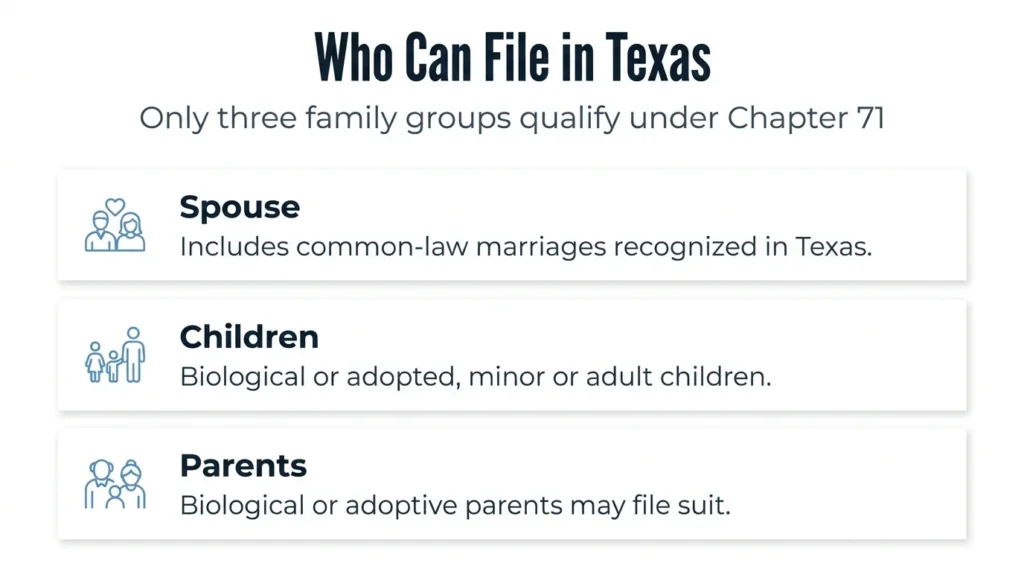
- Surviving spouse: A husband or wife can file, including a spouse in a common-law marriage Texas recognizes.
- Children: Biological and legally adopted children can file, whether they are minors or adults.
- Parents: Biological and adoptive parents can file, but grandparents, siblings, and other relatives cannot.
One eligible family member can file for everyone, or several can file together. The court names any eligible relative who does not join as a defendant, so that it can settle every share in one case.
If no eligible family member files within three months of the death, the estate’s personal representative may step in. They can file for the family unless a beneficiary asks them not to.
The narrower question of who exactly qualifies is covered in our guide on who can sue in a Texas wrongful death lawsuit.
What a Wrongful Death Claim Must Prove
To win, you must prove the defendant’s wrongful act, neglect, carelessness, or default caused your loved one’s death. This mirrors the standard in § 71.002: if your loved one could have sued for the injury, you can sue for the death.
The wrongful act looks different depending on how the death happened. If a crash caused your loss, seeing how Texas car accident claims prove fault can show you what evidence your case needs.
If a dangerous property condition caused the death, the same proof applies in Texas premises liability cases.
When a jury awards damages, CPRC § 71.010 directs them to split the award among all of the eligible family members. Each share reflects the loss that person suffered.
Your recovery can also include exemplary damages. CPRC § 71.009 allows them on top of actual damages when the death resulted from a willful act or gross negligence.
Actual damages can include lost companionship, lost financial support, and the mental anguish of losing your family member. Our overview of wrongful death damages in Texas breaks down each category.
Wrongful Death vs. Survival Claims
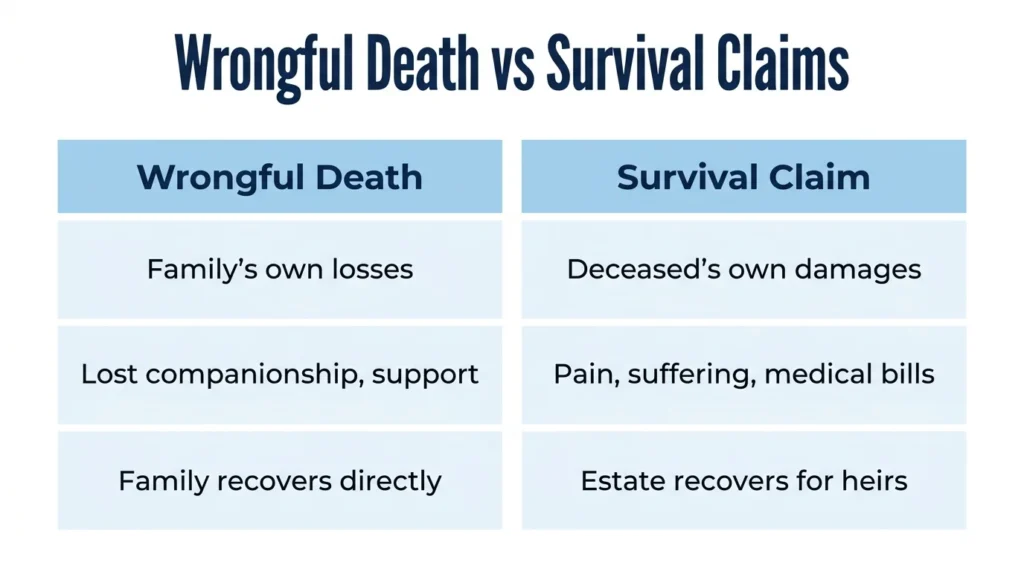
These two claims often get confused, but they compensate different people for different losses. A wrongful death claim belongs to the surviving family. A survival claim belongs to the estate of the person who died.
Wrongful Death Claims
A wrongful death claim under the Texas Wrongful Death Act compensates the surviving spouse, children, and parents for their own losses. That covers the companionship they lost, the financial support the family depended on, and their own mental anguish.
The Texas Survival Statute
A survival claim is different. CPRC § 71.021, the Texas survival statute, lets your loved one’s own injury claim survive their death and pass to the estate.
Instead of paying the family for their loss, it recovers what your loved one endured before dying. That means their physical pain, mental suffering, and medical bills from the injury that caused the death.
The estate brings the survival claim, and any recovery passes through the estate to the heirs. The two claims often move forward together after the same event.
Texas Wrongful Death Statute of Limitations
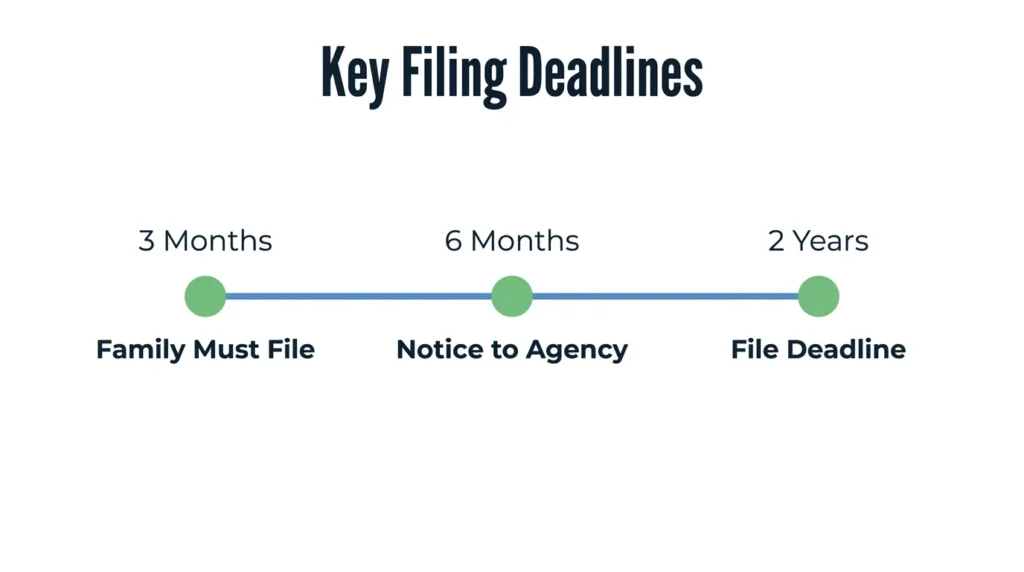
You generally have two years from the date of death to file a wrongful death claim in Texas. That deadline comes from the Texas Civil Practice and Remedies Code § 16.003, and missing it usually ends your claim for good.
A few narrow exceptions can change that deadline. If you are unsure how close you are, our guide to the wrongful death statute of limitations in Texas explains how it applies.
Once you know you are within the deadline, the next question is usually value. Our breakdown of wrongful death settlement maximums and damage caps covers what these claims can be worth.
Work with a Texas Wrongful Death Attorney
Losing someone to another party’s negligence leaves you with grief and a legal deadline at the same time, but you do not have to work through Chapter 71 alone.
Angel Reyes & Associates has guided Texas families through wrongful death claims for over 30 years. You can learn more about our firm and our history. We keep over 20 offices across Texas, so help stays close to home.
Families we have represented share their experiences in our client reviews and testimonials. Your first consultation is free, and we serve Texas families in English and Spanish.
We work on contingency. We advance the costs of your case, and you pay no attorney fee unless we win. Our work includes more than $1 billion recovered for clients.
When you are ready, schedule a free consultation, and we will review your options together.
Past results do not guarantee future outcomes.
Texas Wrongful Death Act FAQs
Can a wrongful death claim be reduced if the person who died was partly at fault?
Yes. Texas law can reduce the family’s award by the deceased person’s share of fault, and the family recovers nothing if that share is more than 50 percent.
Can you sue a government agency for a wrongful death in Texas?
You can, but Texas law requires written notice to the agency, usually within six months of the death, before you can file suit. Some cities set an even shorter notice deadline in their own rules, so this should be confirmed quickly with the specific agency involved.
Is there a cap on wrongful death damages in Texas?
Actual damages such as lost income and loss of companionship have no set dollar cap. Punitive damages are limited by law to about twice the economic damages plus up to $750,000 in noneconomic damages, whichever amount is greater.
Does the wrongful death filing deadline change if a surviving child is a minor?
Texas law allows some pause in the deadline for minors, but courts do not agree on how far that pause reaches in wrongful death cases. A minor’s claim should not be delayed on the assumption that the deadline is automatically paused.
Do you have to pay taxes on a wrongful death settlement?
Money paid for pain, suffering, and loss of companionship is usually not taxable. Money paid for lost wages or as punitive damages is treated as taxable income.
About the Authors

Angel Reyes
Writer
Angel L. Reyes, III is the Founder and Managing Partner of Angel Reyes & Associates. A nationally recognized trial attorney and business leader, Angel has helped over 70,000 injury victims recover more than $1 billion since founding the firm in 1993. Named to the Texas Super Lawyers list annually since 2008, Angel brings Wall Street experience, Ivy League education, and a deep commitment to client advocacy. He is a frequent legal commentator and published author with extensive contributions to legal scholarship, trial strategy, and consumer protection.

Kyle Nicolas
Editor
Kyle Nicolas is the Web Content & SEO Manager at Angel Reyes & Associates. He has more than 10 years of experience as a marketing co...

Angel Reyes
Reviewer
Angel L. Reyes, III is the Founder and Managing Partner of Angel Reyes & Associates. A nationally recognized trial attorney and business...