Truck Accident Statute of Limitations in Texas


Every article on this site is researched by our internal team, reviewed for legal accuracy against current Texas law, and held to State Bar of Texas advertising standards before publication. We do not publish content that overstates outcomes or makes promises about results.
Learn more about our
editorial standards .
Key Takeaways
- Texas Civil Practice and Remedies Code Section 16.003 sets a two-year filing deadline.
- Federal rules require truck logs be kept only six months, far short of two years.
- Government vehicle crashes require written notice within six months, not two years.
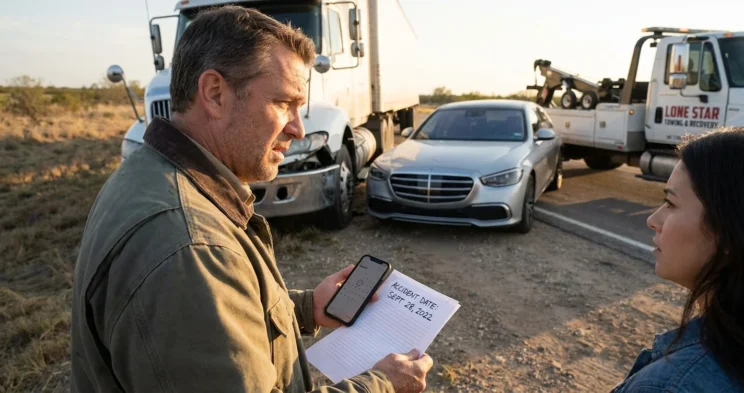
You have spent weeks recovering from a truck crash on I-35 outside San Antonio, but settlement negotiations have gone nowhere. Medical bills keep arriving, and you are beginning to wonder whether you have already run out of time to sue. Texas gives you a limited amount of time to file a truck accident lawsuit.
Truck Accident Statute of Limitations in Texas
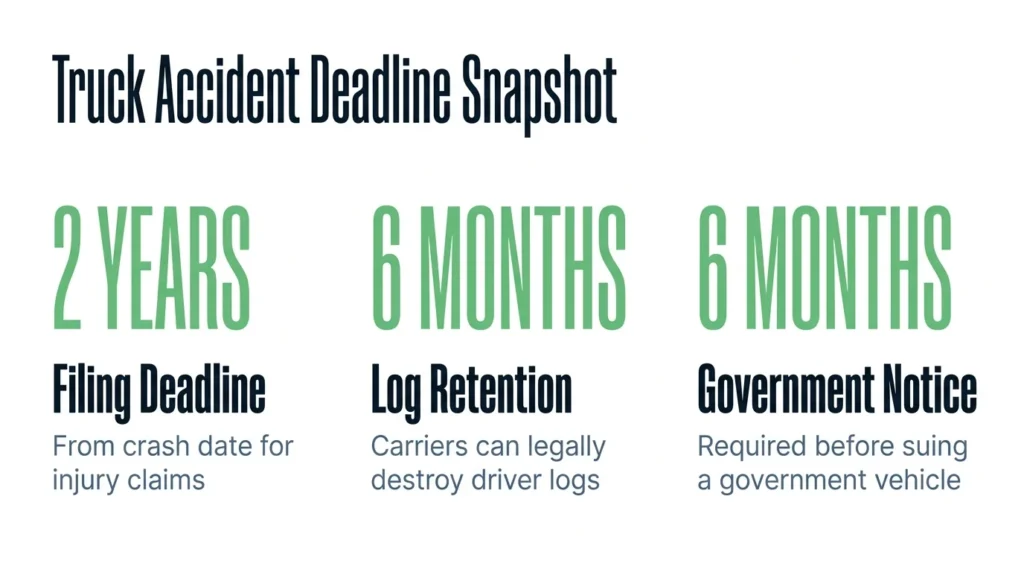
Under Texas Civil Practice and Remedies Code Section 16.003, you generally have two years from the crash date to file a truck accident lawsuit. This deadline covers personal injury and property damage claims, while wrongful death claims follow their own two-year clock from the date of death.
If your crash happened on April 14, 2023, you would generally have until April 14, 2025, to file your lawsuit. Miss that date, and the court will almost certainly refuse to hear your case.
Lawmakers set this window partly because evidence and memories fade over time. Witnesses relocate, and details blur. That fading evidence problem hits trucking crashes even harder than most car crashes.
Truck Accident Evidence Preservation Deadlines
Trucking companies must keep driver logs for less time than you have to file a lawsuit. Under 49 CFR Section 395.8, motor carriers only need to retain logs and related records for six months.
That is one-fourth of your two-year filing window. Once six months pass, a carrier can legally destroy the logs that might prove the driver violated hours-of-service rules.
Event data recorder information, often called black box data, faces a similar risk. Dashcam footage and maintenance or inspection records can also be lost, purged, or overwritten long before your lawsuit deadline arrives.
Exceptions That Pause the Filing Deadline
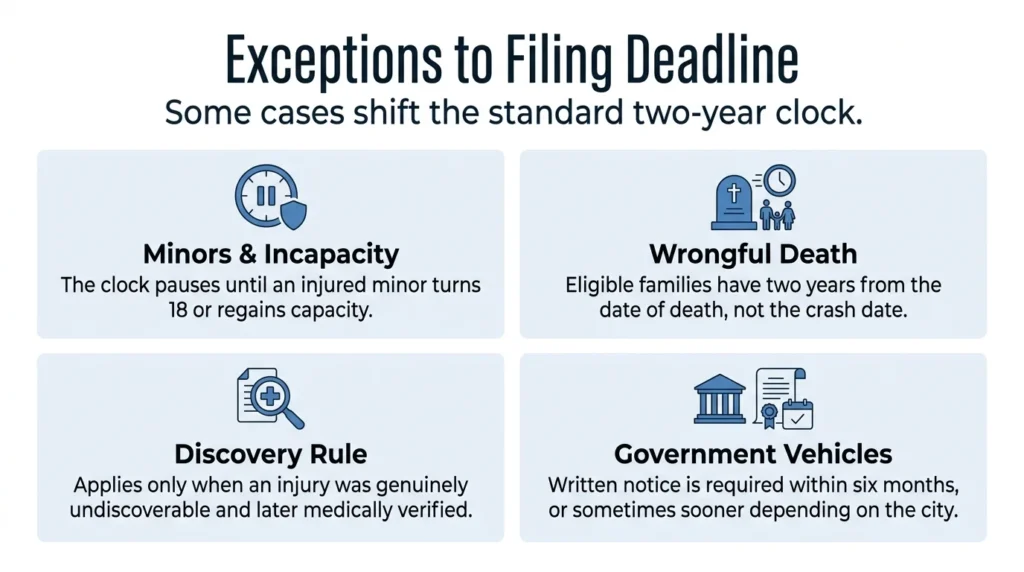
Texas’s standard two-year deadline may change in cases involving injured minors, mental incapacity, wrongful death, or a government vehicle. The exceptions to the Texas statute of limitations do not apply automatically, and each situation follows its own timeline.
Legal Disability Tolling
Under Texas Civil Practice and Remedies Code Section 16.001, the two-year clock is paused when the injured person cannot legally act for themselves.
For a minor injured in a truck accident, the two-year clock generally does not begin until they turn 18. The deadline may also be paused while an injured person is considered legally of unsound mind.
Wrongful Death Claim Deadlines
Family members generally have two years from the date of death, rather than the date of the crash, to file a wrongful death claim under Texas Civil Practice and Remedies Code § 16.003(b).
If the victim survives the crash but later dies from their injuries, the filing period generally begins on the date of death.
Texas law allows the surviving spouse, children, and parents to bring the claim. In certain circumstances, the estate’s personal representative may file instead. Being present at the crash does not create a legal right to sue; the statute does.
A wrongful death claim may depend on evidence showing how the crash happened and who was responsible. In fatal truck accident cases, driver logs, maintenance records, and other evidence held by the trucking company may need to be preserved long before the two-year deadline.
Discovery Rule for Delayed Injuries
The discovery rule only delays your clock when an injury was genuinely undiscoverable at the time of the crash. It does not apply just because symptoms showed up later.
Courts also require that the injury be objectively verifiable, usually through medical evidence. A vague sense that something feels wrong is not enough to invoke this rule.
Government Vehicle Crashes
Claims against a government-owned vehicle follow a much shorter timeline. Under Texas Civil Practice and Remedies Code Section 101.101, you generally must send written notice within six months of the crash, and some cities require notice even sooner.
This notice requirement is separate from the two-year deadline for filing a lawsuit. The rules for government truck accident claims depend on which agency owned or operated the vehicle.
What Happens If You Miss the Deadline?
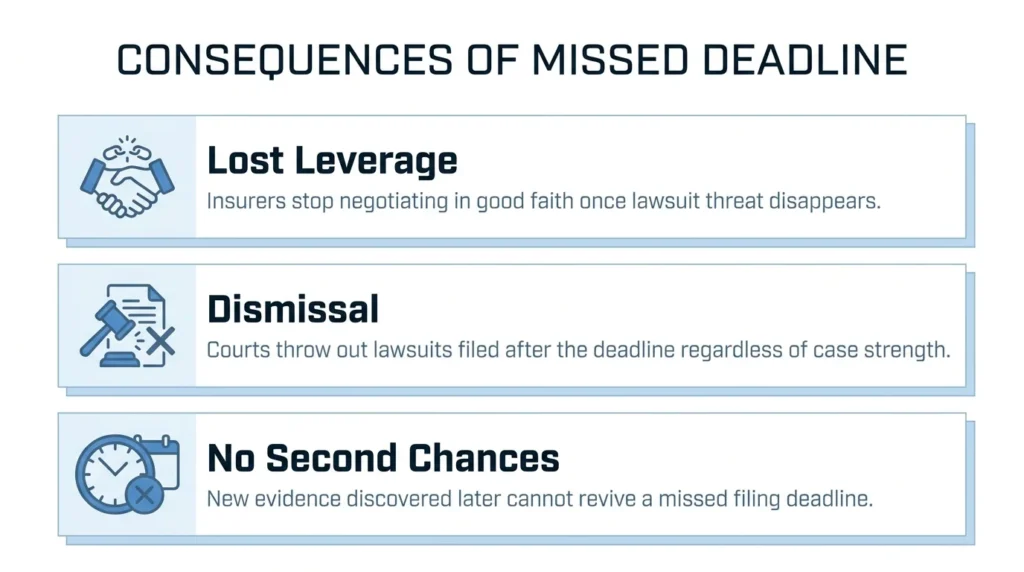
Missing the filing deadline can prevent you from recovering compensation, even when the evidence supports your claim.
- Lost settlement leverage: insurers stop negotiating in good faith once they know a lawsuit is no longer a real threat. Without that pressure, offers drop or disappear entirely.
- Dismissal: a court will throw out a lawsuit filed after the deadline, regardless of how strong your underlying case was.
- No second chances: once the window closes, it does not reopen. Even new evidence discovered later cannot revive a missed deadline.
Talk to a Truck Accident Lawyer
If you are still unsure whether you have time to file, do not wait to find out. Angel Reyes & Associates has spent decades representing Texas truck accident victims, with more than $1 billion recovered for clients. We work on a contingency basis, so you pay no upfront fees, and we only get paid if we win your case. That structure matters most when medical bills and missed paychecks are already piling up.
Contact us for a free case review today. We can tell you exactly how much time you have left and what evidence needs to be preserved right now.
Past results do not guarantee future outcomes.
Truck Accident Deadline FAQs
Can I still sue if the truck driver left Texas after the crash?
Texas law technically allows a defendant’s absence from the state to pause the deadline, but a 2023 Texas Supreme Court ruling held that a driver who remains subject to being served with a lawsuit in Texas is not considered legally absent. Because most drivers can still be served no matter where they move, this exception rarely helps in practice.
Does filing a claim with the trucking company's insurance extend my deadline to sue?
No. Filing an insurance claim does not pause or extend the two-year deadline, so you can still be negotiating with an adjuster on the day your right to sue expires.
What if the truck accident happened outside Texas?
If the crash happened in a state with a shorter deadline than Texas, a Texas court can apply that state’s shorter limit instead of the usual two years under Texas’s borrowing statute. It is worth confirming exactly where the collision occurred before assuming you have the full two years.
Is the deadline different if a U.S. Postal Service or other federal government truck hit me?
Yes. Claims against the federal government generally fall under the Federal Tort Claims Act, which requires filing a written administrative claim within two years of the crash before you can pursue a lawsuit.
Is there a different deadline if a defective truck part caused the crash?
The same two-year deadline still applies to your injury claim, but if you are suing the part’s manufacturer, Texas’s 15-year statute of repose can bar that claim entirely regardless of when the defect was discovered.
About the Authors

Alex Ivanov
Writer
Alex Ivanov is a personal injury attorney at Angel Reyes & Associates, focused on car, truck, and motorcycle accident cases. Licensed in Texas and multiple federal districts, Alex brings international legal experience and a global education to his practice. He earned his LL.M. from Texas A&M University School of Law after graduating from Belarussian State University in 2016. Alex is fluent in Russian, English, Ukrainian, and Belarussian, and is recognized by multiple national trial lawyer associations for his results and leadership under 40.

Kyle Nicolas
Editor
Kyle Nicolas is the Web Content & SEO Manager at Angel Reyes & Associates. He has more than 10 years of experience as a marketing co...

Angel Reyes
Reviewer
Angel L. Reyes, III is the Founder and Managing Partner of Angel Reyes & Associates. A nationally recognized trial attorney and business...