Uber and Lyft Accident Rates in Texas


Every article on this site is researched by our internal team, reviewed for legal accuracy against current Texas law, and held to State Bar of Texas advertising standards before publication. We do not publish content that overstates outcomes or makes promises about results.
Learn more about our
editorial standards .
Key Takeaways
- Uber and Lyft report crash fatality rates below the national driving average per mile.
- Texas does not track rideshare-specific crashes, so no direct state rate exists.
- Texas gives injured rideshare riders two years to file a personal injury claim.
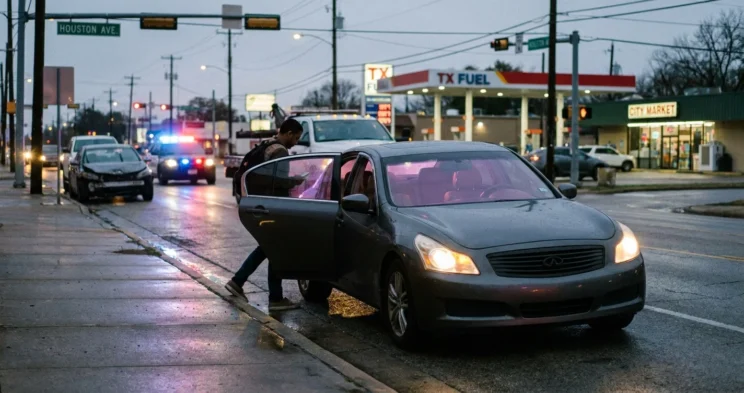
You hop into a Lyft outside a restaurant in Austin, glance up from your phone, and wonder for a second how safe this actually is. You have taken hundreds of these rides without a thought. Now a recent news story has you asking a simple question with a surprisingly complicated answer.
How often do rideshare crashes really happen?
What Rideshare Accident Data Actually Exists
There is no single public database that tracks every rideshare crash, either in the state or nationwide. No federal law requires rideshare companies to report crash data to one central source, so the picture comes from scattered pieces rather than one clean number.
Uber and Lyft each publish their own voluntary safety reports. Those reports are useful, but they are written by the companies being measured. A federal review of how rideshare safety data gets collected and shared shows the gaps in current reporting.
Texas data has its own blind spot. The Texas Department of Transportation tracks every reported motor vehicle crash in the state, but it does not flag which crashes involved a rideshare vehicle. That means no agency can hand you a clean “Texas rideshare crash rate” pulled straight from state records.
So you are left with two kinds of sources. One is the company-issued reports, and the other is independent peer-reviewed research. Each has real strengths and real limits, and reading the numbers well means knowing which kind you are looking at.
Both Uber and Lyft measure safety using fatality rates per 100 million vehicle miles traveled. That metric lets you compare their numbers against national driving benchmarks, which is the closest thing to an apples-to-apples view you will find.
If you were hurt in a rideshare vehicle, knowing how often these crashes happen can help you decide whether to speak with an attorney about your options.
What Safety Reports Reveal About Crash Rates
Both companies report fatality rates below the national driving average, but the two datasets are not identical and should not be read as interchangeable. The figures, the time periods, and the trends each tell a slightly different story.
Uber Safety Report Findings
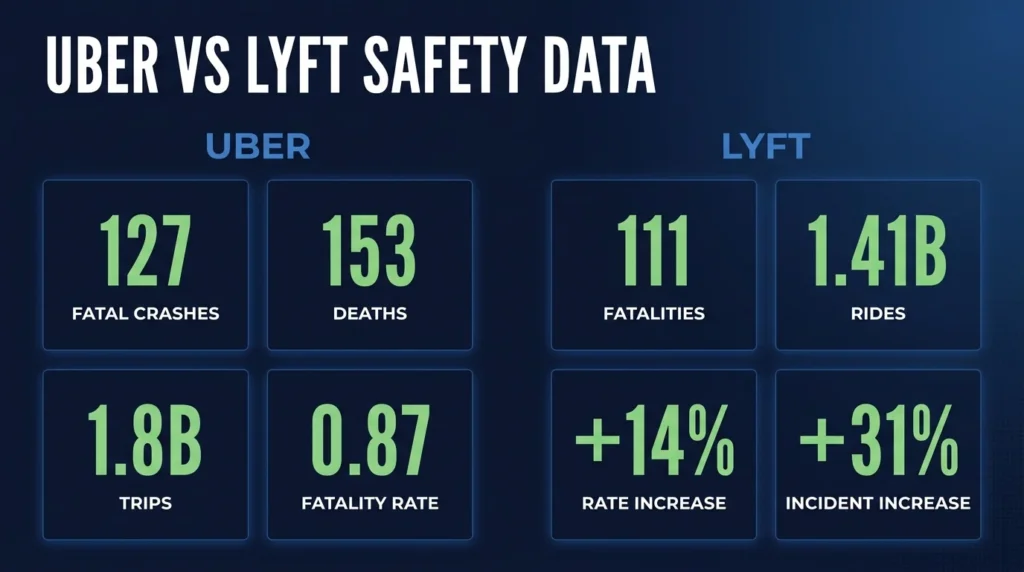
Uber’s Third U.S. Safety Report, released in 2024, covers 2021 and 2022. It reports 127 fatal crashes and 153 deaths across roughly 1.8 billion trips, detailed in its published U.S. safety report.
That works out to a fatality rate of 0.87 per 100 million vehicle miles traveled for the period. For context, the national average was approximately 1.35 per 100 million miles over the same window, according to the federal Fatality Analysis Reporting System.
One finding stands out for riders. In about 95% of fatal crashes involving an Uber vehicle, another driver was at fault rather than the Uber driver. If you were a passenger, that pattern matters for who you may be able to pursue a claim against.
Lyft Safety Report Findings
Lyft’s 2024 Safety Transparency Report covers 2020 through 2022. It reports 111 motor vehicle fatalities across roughly 1.41 billion rides, published in its annual safety transparency report.
The trend is where Lyft’s numbers deserve a closer look. Its fatality rate per 100 million miles rose 14% from the prior reporting period, and incident frequency climbed 31%. Both companies still report rates below the national average, but Lyft’s upward movement is worth knowing if you ride often.
If you are sorting out a claim, which insurance period was active during your trip can change everything, and reviewing a breakdown of rideshare coverage periods shows you how those windows work.
Independent Research on Rideshare Risk
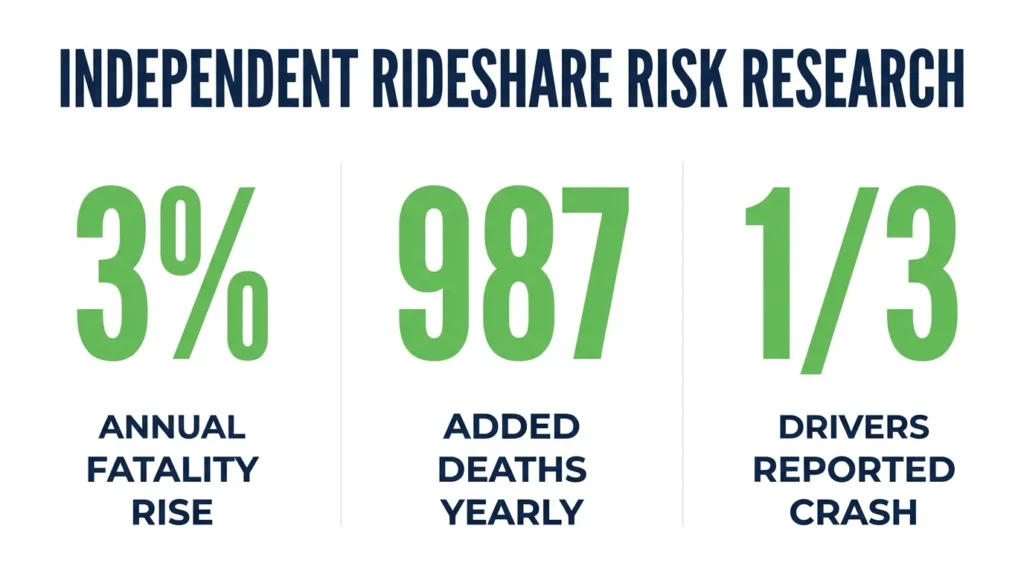
Independent studies tell a more complicated story than the company reports alone. A peer-reviewed study from the University of Chicago and Rice University found that rideshare adoption is linked to roughly a 3% annual rise in traffic fatalities nationally, equal to about 987 additional deaths a year.
That number reflects total road deaths, not just deaths inside rideshare cars. More vehicles circling for pickups means more traffic and more exposure for everyone on the road.
Driver behavior is part of the picture too. A 2024 University of Illinois Chicago survey found that one-third of rideshare drivers reported a crash while working, with cellphone use, fatigue, and unfamiliar roads named as the main risk factors.
Some research suggests rideshare drivers face a higher crash likelihood than the general driving population, a pattern often tied to app-based distraction. A driver glancing at navigation prompts and ride requests is a driver with divided attention.
These independent findings do not line up cleanly with the company rates. The studies use different methods and different time periods, so reading them side by side calls for some caution.
How Texas Crash Data Compares
Texas gives you a statewide baseline but no rideshare-specific breakdown. The Texas Department of Transportation recorded 4,150 traffic fatalities across the state in 2024, yet its standard annual reports do not isolate rideshare-involved crashes. No direct Texas rideshare fatality rate can be pulled from those records.
What Texas does spell out clearly is the legal framework. State law governs Uber and Lyft through a Transportation Network Company structure that sets the rules every rideshare driver must follow.
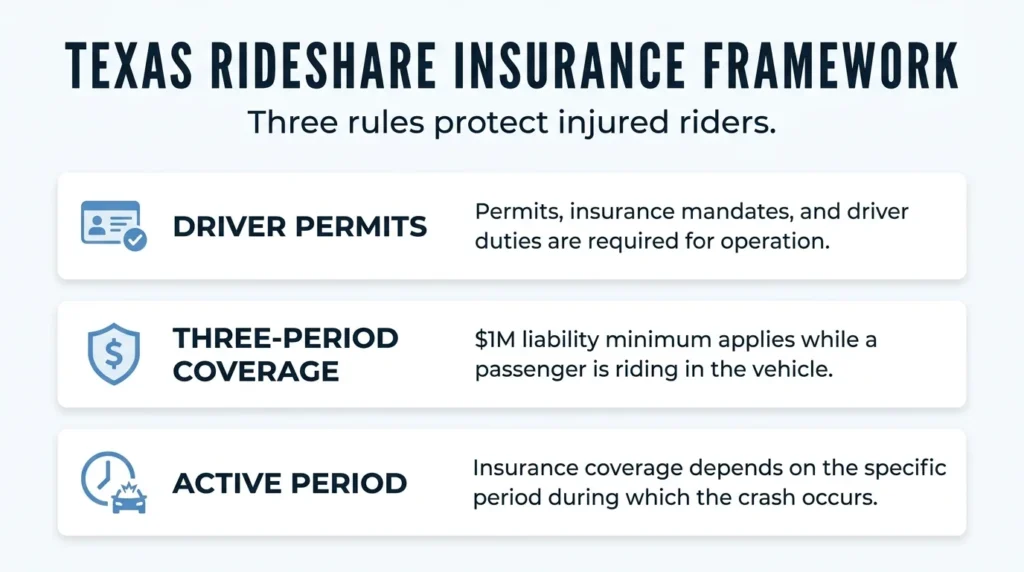
Three points define how that framework protects you as a rider.
- Driver permits and company duties. Texas Occupations Code Chapter 2402 sets permit requirements, insurance mandates, and the legal obligations rideshare companies owe their riders. Key provisions include permit requirements under § 2402.051, insurance mandates under § 2402.101, and driver qualification requirements under § 2402.107.
- Three-period insurance coverage. Texas Insurance Code Chapter 1954 builds a three-stage insurance structure for rideshare drivers, including a $1 million aggregate liability minimum while a rider is in the car. The coverage requirement is established specifically under § 1954.053.
- The active period decides your coverage. Which of those three periods was running at the moment of your crash drives how much coverage applies to your claim.
There is one more gap worth naming. Because Texas does not require rideshare companies to report crashes separately, the true statewide count of these incidents never fully reaches the public record.
Injured in a Texas Rideshare Accident?
The numbers can tell you rideshare travel is broadly safe, and they can still leave you sitting with real injuries and real bills. If that is where you are, review whether you can sue Uber after a Texas crash and who may be responsible. You do not have to sort out the insurance periods and fault questions alone.
Angel Reyes & Associates has spent over 30 years representing injured riders and passengers across Texas. We have achieved more than $1 billion recovered for clients, and we take rideshare injury cases on contingency, which means no fee unless we win.
Texas generally gives injured riders two years to file a personal injury claim under the Texas Civil Practice and Remedies Code (CPRC) § 16.003. You can see how we have handled past injury cases in our case results. You can also learn more about our team and approach.
If you or someone you know was hurt in a Texas rideshare accident, reach out for a free consultation.
Past results do not guarantee future outcomes.
Uber and Lyft Accident Rate FAQs
What if the Uber or Lyft app was off when the crash happened?
If the driver had the app off, no rideshare insurance applies, and the driver’s personal auto policy is the only coverage available. Texas law’s three-period insurance structure only activates once a driver opens the app.
Does Texas require Uber and Lyft to perform background checks on drivers?
Yes. Texas Occupations Code § 2402 requires TNCs to conduct background checks before drivers are permitted to accept rides. Disqualifying factors include certain criminal convictions and driving offenses.
Can a rideshare passenger file a claim against more than one party after a crash?
Yes. If another driver caused the crash, you may have a claim against that driver and their insurer in addition to any claim against the rideshare company’s insurance. Texas allows you to pursue multiple parties whose negligence contributed to your injuries.
What counts as "on a trip" for insurance purposes in a Texas rideshare crash?
A trip begins when a driver accepts a ride request and ends when the passenger exits the vehicle. The $1 million liability minimum under Texas Insurance Code § 1954 applies during that window, not during the time the driver is waiting for a match.
Does it matter if my Uber or Lyft driver was using a rental car instead of a personal vehicle?
It can. Coverage depends on whether the rental agreement and the driver’s TNC insurance policy extend to rideshare activity. Some personal auto and rental policies exclude commercial use, which could limit the coverage available to you after a crash.
About the Authors

Angel Reyes
Writer
Angel L. Reyes, III is the Founder and Managing Partner of Angel Reyes & Associates. A nationally recognized trial attorney and business leader, Angel has helped over 70,000 injury victims recover more than $1 billion since founding the firm in 1993. Named to the Texas Super Lawyers list annually since 2008, Angel brings Wall Street experience, Ivy League education, and a deep commitment to client advocacy. He is a frequent legal commentator and published author with extensive contributions to legal scholarship, trial strategy, and consumer protection.

Kyle Nicolas
Editor
Kyle Nicolas is the Web Content & SEO Manager at Angel Reyes & Associates. He has more than 10 years of experience as a marketing co...

Spencer Browne
Reviewer
Spencer Browne is a partner at Angel Reyes & Associates and a Board Certified personal injury trial lawyer with nearly 100 jury trials a...