Uber Driver Ratings as Accident Evidence


Every article on this site is researched by our internal team, reviewed for legal accuracy against current Texas law, and held to State Bar of Texas advertising standards before publication. We do not publish content that overstates outcomes or makes promises about results.
Learn more about our
editorial standards .
Key Takeaways
- A documented pattern of safety complaints can support your version of events and form the basis of a negligent retention claim against Uber.
- Uber's internal records are not public — getting them requires a preservation letter and subpoena, and waiting puts that evidence at risk.
- Texas law can split responsibility between the driver and Uber, so fault does not have to land on one party alone for your claim to succeed.
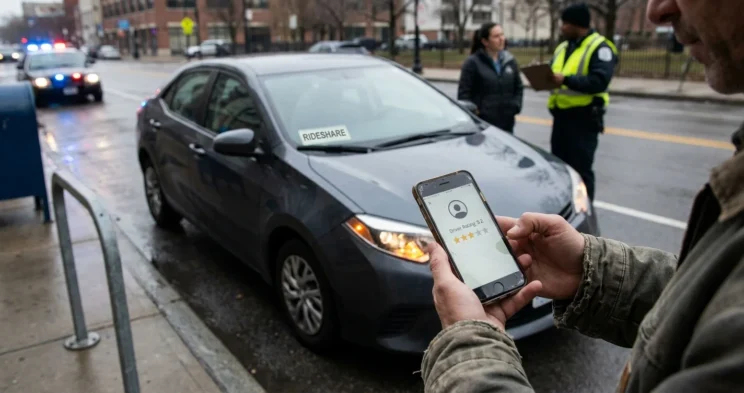
You took an Uber home from a late dinner near South Congress, and the driver was on his phone the whole ride before he rear-ended the car ahead on Lamar Boulevard. You remember thinking he seemed careless. Now you are wondering if anyone else noticed the same thing before you got in that car.
That feeling points to something real. A driver’s rating and complaint history can become evidence in your claim.
What an Uber Driver Rating Actually Records
The star rating you see is an average, but the account behind it holds far more. Uber stores each individual rider rating, written feedback, and safety report tied to that driver over time.
A single one-star trip proves almost nothing on its own. People leave low ratings for slow pickups or wrong turns, not just dangerous driving.
A documented pattern is different. When the same driver collects repeated complaints about speeding, distraction, or reckless lane changes, that record starts to show how the person drives.
You cannot see any of this after your trip ends. The data lives inside Uber’s system, not on your receipt, which is why proving the pattern takes more than a screenshot. If you are still sorting out the basics, review what to do after a rideshare accident in Texas.
How a Driver’s Rating History Supports a Claim
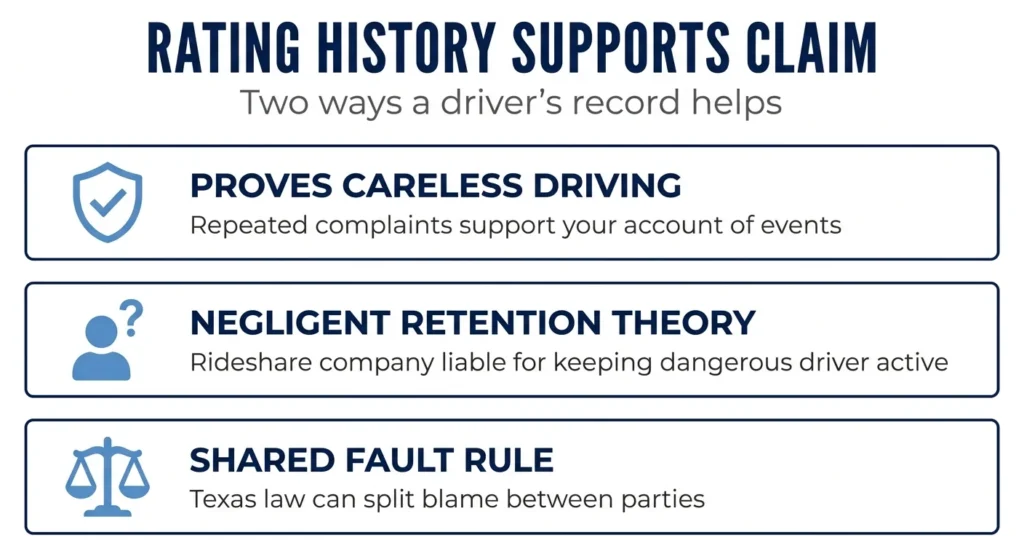
A driver’s record can support your claim in two ways. It can show that the driver was careless during your crash, and it can point to fault on the company itself.
Repeated low ratings and safety complaints back up your version of events. If you say the driver was distracted, a history of riders reporting the same thing makes that account harder for an insurer to wave away.
The second path reaches Uber directly. Under a legal theory called negligent retention, a company that keeps a dangerous driver active after learning about the danger can share responsibility for the harm that follows.
Texas law gives that theory teeth. Texas Occupations Code Chapter 2402 governs how rideshare companies operate in the state, including their duties around driver screening.
Companies must run a background check before a driver starts and again every year, and they must review each driver’s driving record under Texas Occupations Code Section 2402.107.
Fault does not have to land on one party alone. Under the Texas Civil Practice and Remedies Code Chapter 33, a court can split responsibility between the driver and the company based on each one’s share of the blame.
How to Obtain Uber Driver Records as Evidence
You get these records through a legal process, not by asking. Uber does not hand over rating histories or complaint logs voluntarily, and it often objects that the data is private or proprietary.
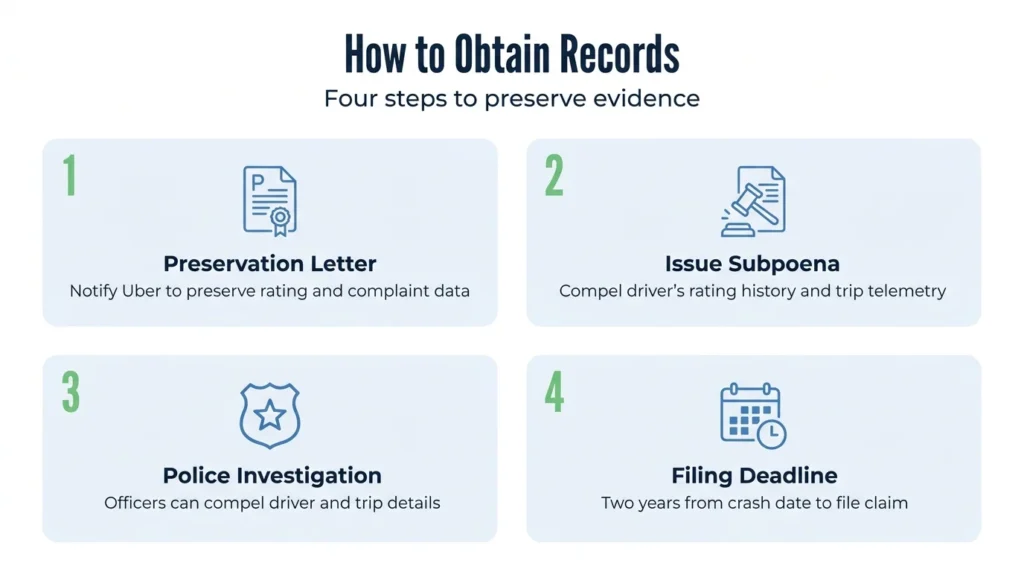
- Step 1: Send a preservation letter early. This formal notice tells Uber to hold onto rating data, rider complaints, and trip records so nothing gets deleted while your claim develops.
- Step 2: Issue a subpoena for the driver’s records. This compels Uber to produce the driver’s rating history, rider complaints, app-status logs, and trip telemetry.
- Step 3: Pull from the police investigation. Officers can often compel driver and trip details that reinforce the record you are building.
- Step 4: Watch the filing deadline. Texas generally gives you two years from the date of the crash to file under Texas Civil Practice and Remedies Code (CPRC) Section 16.003, and waiting puts the records at risk.
Texas Insurance Code Chapter 1954 sets the coverage rules for rideshare drivers.
Discuss Your Case With an Experienced Attorney
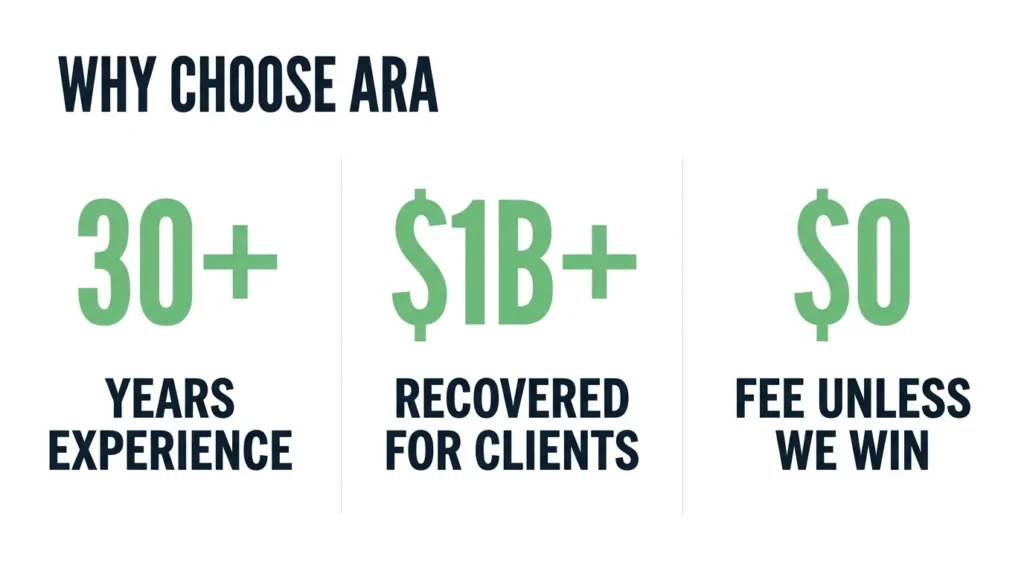
Building a rideshare claim around a driver’s history takes fast action and the legal tools to force records into the open. Angel Reyes & Associates has spent over 30 years helping injured Texans do exactly that, with more than $1 billion recovered for clients across the state.
We work on a contingency basis with no fee unless we win. Reach out for a free consultation.
Past results do not guarantee future outcomes.
Uber Driver Ratings & Accident Evidence: FAQs
Does this same approach apply to a Lyft crash?
Yes. Lyft stores driver complaint histories and safety reports the same way Uber does, and Texas Occupations Code Chapter 2402 applies to both companies equally. A preservation letter and subpoena for Lyft’s internal records follow the same process.
How fast can Uber delete a driver's data after a crash?
Uber retains trip records and safety reports indefinitely for active accounts, but data can be removed within about 90 days once an account is deleted. A preservation letter sent right after the crash creates a legal hold that prevents routine deletion.
What if the Uber app was off when the driver hit me?
When the app is off, Uber’s commercial insurance does not apply and your claim runs through the driver’s personal auto policy instead. A direct negligent hiring or retention claim against Uber may still be possible depending on what the driver’s background check would have revealed.
Does deleting the Uber app from my phone destroy the evidence?
No. Deleting the app removes it from your device but does not touch Uber’s servers. Trip records, app-status logs, and complaint histories are stored in Uber’s system and can be obtained through a formal subpoena.
Does Uber's coverage apply if I was hit as a pedestrian or in another car, not as a passenger?
Yes. Texas Insurance Code Chapter 1954 requires Uber to carry third-party liability coverage during active app periods, and that coverage extends to pedestrians and other drivers, not only passengers inside the vehicle.
About the Authors

Angel Reyes
Writer
Angel L. Reyes, III is the Founder and Managing Partner of Angel Reyes & Associates. A nationally recognized trial attorney and business leader, Angel has helped over 70,000 injury victims recover more than $1 billion since founding the firm in 1993. Named to the Texas Super Lawyers list annually since 2008, Angel brings Wall Street experience, Ivy League education, and a deep commitment to client advocacy. He is a frequent legal commentator and published author with extensive contributions to legal scholarship, trial strategy, and consumer protection.

Graham Griffin
Editor
Graham Griffin is the Web & Content Manager at Angel Reyes & Associates, where he oversees content strategy, AI-powered workflows, a...

Angel Reyes
Reviewer
Angel L. Reyes, III is the Founder and Managing Partner of Angel Reyes & Associates. A nationally recognized trial attorney and business...