Uber Driver Speeding Accident Claims in Texas


Every article on this site is researched by our internal team, reviewed for legal accuracy against current Texas law, and held to State Bar of Texas advertising standards before publication. We do not publish content that overstates outcomes or makes promises about results.
Learn more about our
editorial standards .
Key Takeaways
- Speed data from the Uber app can establish negligence per se under the Texas Transportation Code.
- Texas gives crash victims two years to file a personal injury lawsuit under CPRC § 16.003.
- A preservation letter must be sent quickly to prevent Uber's telematics data from being deleted.
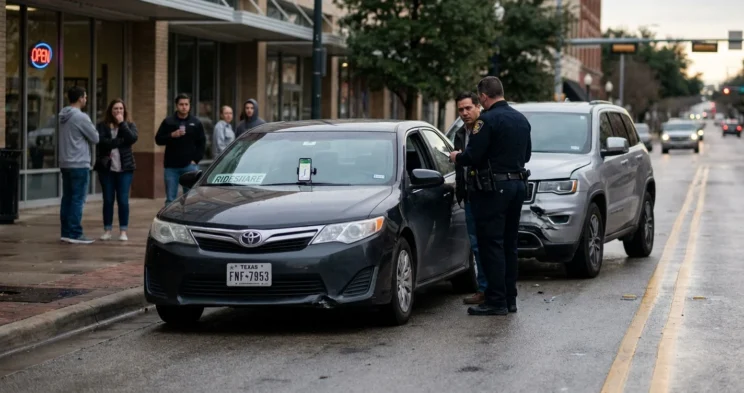
You were riding in an Uber on I-10 near the Galleria when the driver started weaving through traffic, pushing past 80 miles per hour in a 60-mph zone. Then came the impact. Now you’re dealing with medical bills and an insurance process that nobody prepared you for.
What you may not realize is that the speed data from that Uber trip exists, and it can change the outcome of your claim.
Speeding as Negligence in a Texas Uber Crash
When an Uber driver speeds, they are not just breaking a traffic rule. They are breaching a legal duty to every person in and around that vehicle.
Texas Transportation Code § 545.351 requires every driver to operate at a speed that is reasonable and prudent under the conditions at the time. When conditions call for caution and the driver speeds anyway, that statute is the standard they failed to meet.
When a driver exceeds a posted speed limit, Texas law may apply the doctrine of negligence per se. Under that doctrine, the statutory violation itself establishes the breach of duty. You do not need to argue separately over what a reasonable driver would have done. The speed limit set under Texas Transportation Code § 545.352 already defined it, and the driver crossed it.
Drivers sometimes rush to complete more rides and increase earnings. That pattern puts passengers and other road users at risk, and it is the kind of conduct that a documented speed record can expose.
How Uber App Speed Data Becomes Evidence
The Uber app does more than match you with a driver. It records GPS coordinates, timestamps, and accelerometer data during every trip.
From that data, an attorney can calculate or directly confirm the driver’s speed at any point during the ride. That record does not depend on witness memory or the driver’s account of what happened. The app recorded the truth in real time.
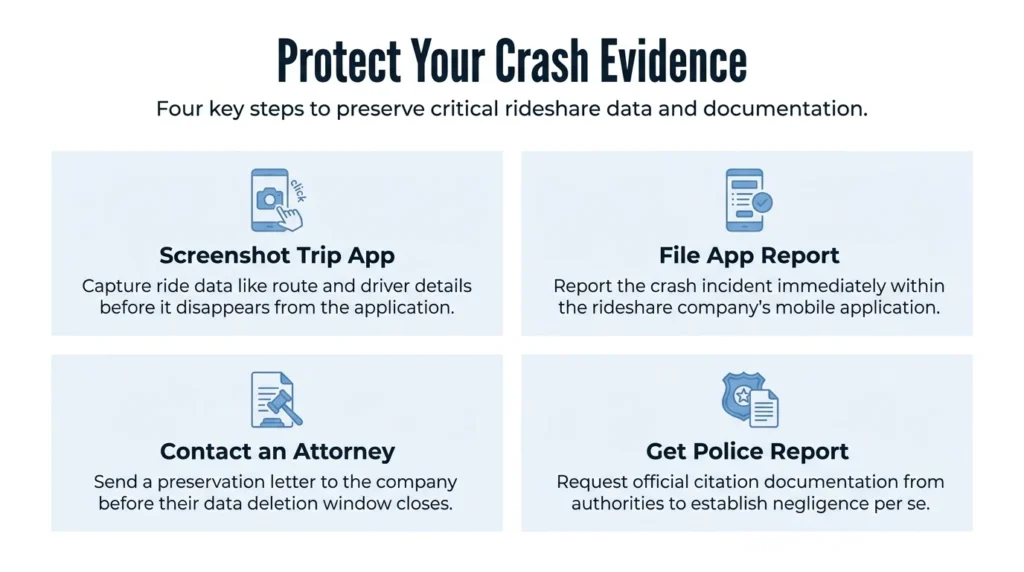
Take these steps to protect this evidence:
- Step 1: Screenshot what you can from the app immediately. Right after the crash, take screenshots of the trip in progress, including any route or timing data visible in the app. Once the trip closes, some visible data disappears from the passenger-facing view.
- Step 2: File a report through the Uber app. Reporting the crash through the app creates a record that the incident occurred on an active trip. Do this before closing the app session.
- Step 3: Contact an attorney before the evidence window closes. An attorney can send a preservation letter to Uber, legally requiring the company to retain trip records, GPS logs, and telematics data. Without that letter, server-side data may be deleted on Uber’s standard retention schedule. Acting fast is not optional here: the window between a crash and automatic data deletion can be short.
- Step 4: Get a copy of the police report. If the responding officer noted excessive speed or issued a citation, that document supports the negligence per se argument. Request a copy from the investigating department as soon as the report is available.
Driver Liability vs. Uber Liability for Speeding Crashes
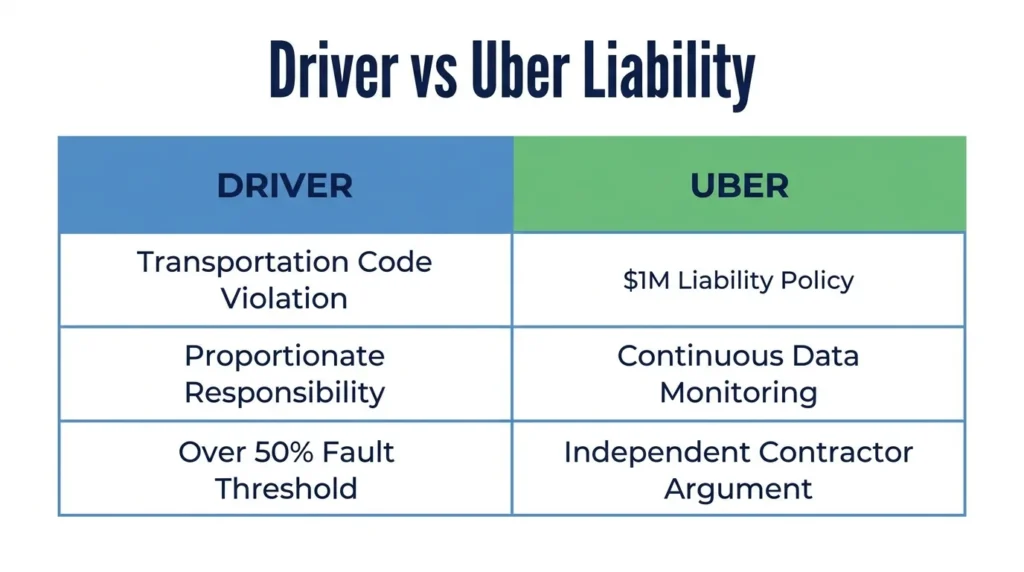
Speeding affects two separate liability arguments: one against the driver and one against Uber. They are related, but they are not the same claim. Understanding both gives you more options.
The Driver’s Personal Liability
The driver is always the first defendant when their speed causes the crash. Their liability stems directly from the Transportation Code violation and the duty of care they owed to everyone in that vehicle and on the road around them.
Texas uses a fault-sharing system known as proportionate responsibility, governed by Texas Civil Practice and Remedies Code (CPRC) § 33.001. Under that system, each party’s share of fault is assigned as a percentage. If the driver’s speeding accounts for most of the fault, the driver absorbs most of the financial liability. If the driver is found more than 50% responsible, they can be held liable for the full compensation awarded.
Speed data documented by the Uber app provides a concrete, objective basis for assigning a high share of fault to the driver. That shifts the argument from “he said, she said” to a data record.
Uber’s Potential Liability
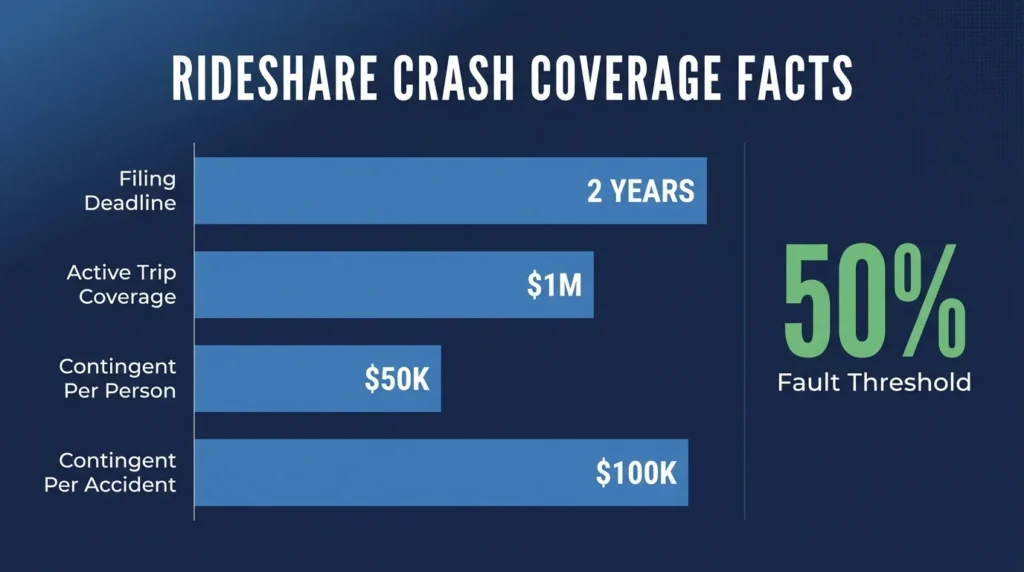
Once a driver accepts a ride, Uber’s commercial insurance is active. Texas Insurance Code Chapter 1954, which governs insurance requirements for Transportation Network Companies, requires Uber to carry at least $1 million in liability coverage once a trip is accepted. If the driver was speeding during an active trip and caused the crash, that policy is available for your injuries.
Speed data also supports a direct liability argument against Uber. The company collects driver behavior data continuously. An attorney can argue that Uber had access to information about the driver’s conduct and continued to dispatch them instead of terminating the contract.
Uber classifies its drivers as independent contractors, which limits some forms of vicarious liability. That classification is a legal argument and does not prevent you from seeking compensation. Courts have allowed direct liability claims to proceed against Uber where the company’s own data and monitoring role are at issue.
Filing Deadlines for Texas Rideshare Injury Claims
You have two years from the date of the crash to file a personal injury lawsuit. That deadline comes from Texas Civil Practice and Remedies Code (CPRC) § 16.003, and it is firm. Miss it, and your right to sue is almost certainly gone, regardless of how strong the evidence is.
The clock starts on the date of the crash, not the date you file an insurance claim or finish medical treatment. Insurance negotiations do not pause the deadline. While it may feel like progress is being made through the claims process, the two-year window continues running.
Two reasons push in favor of acting early. The first is the legal deadline. The second is the evidence window: telematics data, trip records, and GPS logs all face automatic deletion if a preservation letter is not sent in time. Both timelines are finite, and addressing one usually helps with the other.
Injured in a Texas Uber Speeding Crash?
If you were injured by an Uber driver who was speeding, speed data from the app may be your strongest piece of evidence. Obtaining and preserving that data is a time-sensitive step that requires legal action early in the process.
Angel Reyes & Associates has helped injured Texans handle rideshare claims for over 30 years. We work on a contingency basis, which means you pay nothing unless we recover compensation for you. We have recovered more than $1 billion for clients across Texas, and we offer free initial consultations so you can understand your options without any upfront cost.
Reach out today to schedule a free consultation.
Past results do not guarantee future outcomes.
FAQs About Uber Driver Speeding Accident Claims
Does it matter whether the Uber driver had accepted my trip when the speeding crash happened?
Yes. If the driver had accepted your trip and the crash occurred during that ride, Uber’s $1 million commercial liability policy is active under Texas Insurance Code Chapter 1954. If the driver was logged into the app but had not yet accepted any ride, only a lower contingent coverage tier applies: $50,000 per person and $100,000 per accident.
Can a traffic citation for speeding be used as evidence in my civil injury claim?
A traffic citation is generally not admissible as direct evidence in a Texas civil lawsuit, but the speed data from the Uber app and any police report documenting the driver’s conduct can serve that purpose independently. Your attorney will build the liability argument on the app data, crash reconstruction, and witness statements rather than on the citation itself.
Can someone other than the Uber passenger file a claim after a speeding crash?
Yes. Drivers, pedestrians, cyclists, or anyone else injured by the speeding Uber driver can pursue a personal injury claim against the driver and, where Uber’s insurance is active, against that policy as well. The same two-year filing deadline and fault rules under Texas law apply to all injured parties.
Does my own comparative fault affect my recovery if I was the Uber passenger?
As a passenger, you generally have no share of fault for the driver’s decision to speed, so Texas’s modified comparative fault rule would not reduce your compensation in most passenger scenarios. A reduction would only apply if your own conduct somehow contributed to the crash, which is rarely the case for passengers.
What types of damages can I recover in an Uber speeding crash claim in Texas?
You can pursue compensation for medical expenses, lost wages, pain and suffering, and property damage. If the driver’s conduct was especially reckless, punitive damages may also be available, though they require a higher legal standard of proof in Texas.
About the Authors

Angel Reyes
Writer
Angel L. Reyes, III is the Founder and Managing Partner of Angel Reyes & Associates. A nationally recognized trial attorney and business leader, Angel has helped over 70,000 injury victims recover more than $1 billion since founding the firm in 1993. Named to the Texas Super Lawyers list annually since 2008, Angel brings Wall Street experience, Ivy League education, and a deep commitment to client advocacy. He is a frequent legal commentator and published author with extensive contributions to legal scholarship, trial strategy, and consumer protection.

Kyle Nicolas
Editor
Kyle Nicolas is the Web Content & SEO Manager at Angel Reyes & Associates. He has more than 10 years of experience as a marketing co...

Spencer Browne
Reviewer
Spencer Browne is a partner at Angel Reyes & Associates and a Board Certified personal injury trial lawyer with nearly 100 jury trials a...