How UM/UIM Coverage Protects Drunk Driving Victims


Every article on this site is researched by our internal team, reviewed for legal accuracy against current Texas law, and held to State Bar of Texas advertising standards before publication. We do not publish content that overstates outcomes or makes promises about results.
Learn more about our
editorial standards .
Key Takeaways
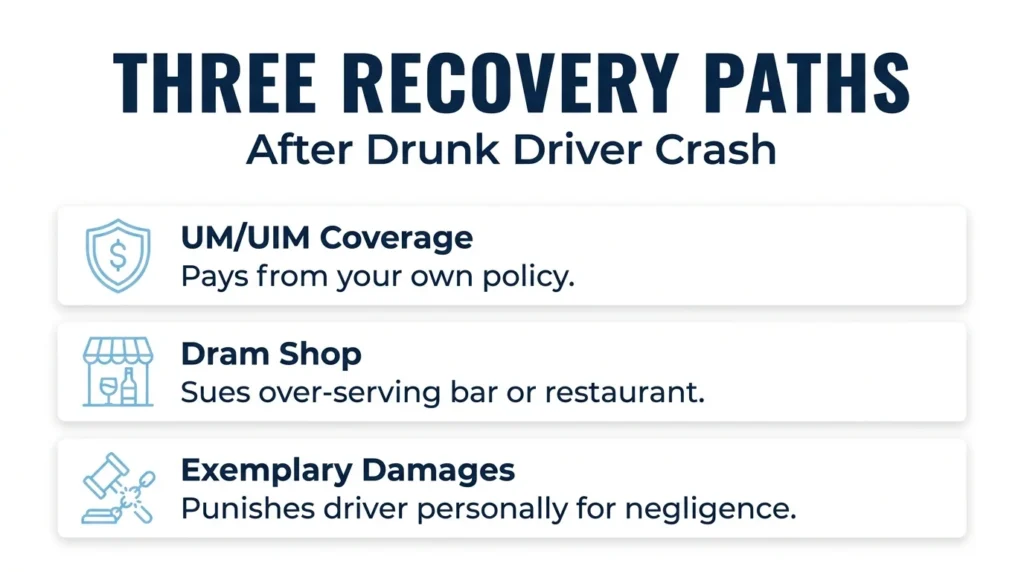
- Dram shop liability under TABC Chapter 2 allows victims to pursue the bar or restaurant that over-served the driver; a financially meaningful additional defendant.
- Exemplary damages are available in DWI cases under CPRC Chapter 41 (gross negligence) but must be collected from the driver personally, not the insurer.
- A criminal DWI conviction supports the civil case but does not compensate the victim; the civil claim must be filed and pursued independently.
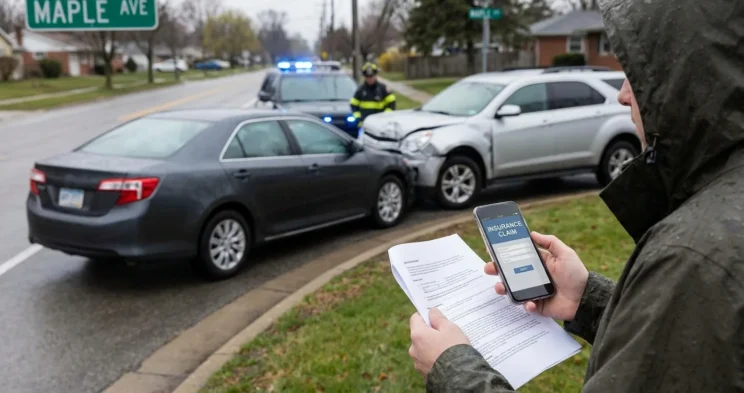
Getting T-boned by a drunk driver on the LBJ Freeway in Dallas is already a traumatic experience. Finding out that the at-fault driver had no insurance, or limits so low they barely cover a week of medical bills, compounds it significantly. Understanding what coverage is actually available, and how the pieces fit together, is the first step toward protecting your claim.
Why Drunk Drivers Are Often Uninsured or Underinsured
A drunk driver being uninsured is more common than most people realize, and there is a pattern behind it. Many DWI offenders have prior records that caused insurers to cancel their policies or reclassify them into a high-risk tier that carries premiums they cannot afford. SR-22 insurance, required after many DWI convictions, is significantly more expensive than standard coverage. Many drivers with prior DWI histories either let their coverage lapse, are dropped by their carrier, or choose to drive without insurance because of the cost.
Even when a drunk driver does have insurance, Texas minimum liability limits are $30,000 per person and $60,000 per accident. For a crash that results in surgery, hospitalization, and extended rehabilitation, those minimums are often exhausted within weeks. An underinsured drunk driver, one who has coverage but not enough, can leave victims with the same gap as no coverage at all.
The first question your attorney will investigate is whether the drunk driver had coverage and, if so, what the limits were. That answer determines whether uninsured motorist (UM) or underinsured motorist (UIM) coverage applies to your claim.
For a practical guide on what to do immediately after discovering the at-fault driver lacks adequate coverage, see our blog on the subject.
UM vs. UIM: Which One Covers Your Claim
The distinction between UM and UIM coverage matters because each triggers in a different scenario, though both are available under Texas Insurance Code Chapter 1952, which requires insurers to offer this coverage with every auto policy. Unless you reject it in writing, you almost certainly have it.
Texas Insurance Code Chapter 1952: Uninsured motorist (UM) coverage applies when the at-fault drunk driver has no valid insurance at all. Your UM coverage pays directly for your bodily injury damages, medical expenses, lost wages, pain and suffering, and other compensable losses, up to your policy limit.
Underinsured motorist (UIM) coverage applies when the drunk driver has some liability insurance but not enough to cover your damages. In a UIM claim, the at-fault driver’s insurer pays out their full policy limits first. Your UIM coverage then bridges the gap between what their policy paid and your actual losses, up to your UIM limit.
Texas does not require physical contact with the uninsured vehicle before UM coverage applies. And unlike some other states, Texas does not treat UM and UIM as mutually exclusive. Both exist on your policy and trigger based on the at-fault driver’s coverage status at the time of the crash.
For a full breakdown of how UM, UIM, and PIP each work and when each one applies, see our uninsured motorist accident guide.
Dram Shop Liability When the Bar Is Also Responsible
Many drunk driver crashes do not begin with a driver pouring their own drinks. They begin at a bar, restaurant, or other licensed establishment that served that driver past the point of obvious intoxication. Texas law provides a separate path of recovery against that establishment.
Texas Alcoholic Beverage Code Chapter 2 allows a crash victim to bring a civil claim against a bar, restaurant, or liquor retailer that provided alcohol to a person who was obviously intoxicated and who then caused a crash. The legal standard focuses on observable impairment, slurred speech, stumbling, inability to focus, erratic behavior, at the time the establishment continued serving.
You can learn more in Texas Alcoholic Beverage Code Chapter 2.
The practical importance of a dram shop claim is financial. An uninsured drunk driver may have no meaningful assets to satisfy a judgment. A commercial establishment with a liquor license typically carries commercial general liability coverage, which represents a much more substantial recovery source. Pursuing the bar does not preclude your UM/UIM claim; both can be pursued simultaneously.
The statute of limitations for a dram shop claim is two years under TABC § 2.04, the same as the general personal injury limitations period. Acting promptly matters: surveillance footage from bars is often overwritten on rolling loops within days to weeks.

For a broader look at how Texas law supports drunk driving victims beyond standard insurance claims, see our blog on drunk driving victim’s rights.
Exemplary Damages in Drunk Driver Cases
Drunk driving cases in Texas are not just negligence claims. They often support a finding of gross negligence, which opens the door to exemplary damages. Texas Civil Practice and Remedies Code Chapter 41 authorizes exemplary damages in cases involving fraud, malice, or gross negligence.
Texas courts have consistently held that driving while intoxicated, knowingly operating a vehicle in a state of impairment that endangers others, constitutes a conscious disregard for the rights and safety of others, which is the legal definition of gross negligence.
According to Texas CPRC Chapter 41, exemplary damages are not recoverable from the at-fault driver’s liability insurer. Texas law bars insurers from indemnifying policyholders for punitive damages arising from intentional or grossly negligent acts. This means exemplary damages must be pursued from the drunk driver personally.
The cap under CPRC § 41.008 is the greater of: two times the amount of economic damages plus $750,000 in non-economic damages, or $200,000. In a serious injury case, the cap based on economic damages can be substantial.
One important clarification: a DWI conviction or guilty plea in the criminal case is useful evidence but does not on its own resolve the civil case or entitle the victim to compensation. The criminal process, fines, license suspension, probation, incarceration, does not pay the victim’s bills. The civil claim must be brought separately.
Talk to a Texas Car Accident Lawyer
When the drunk driver had no insurance or limits far below your actual damages, the recovery picture involves multiple layers: your own UM or UIM coverage, a potential dram shop claim against the establishment that over-served the driver, and exemplary damages pursued directly against the driver. These tools are not mutually exclusive, and navigating them simultaneously is where having the right attorney matters.
Angel Reyes & Associates has handled drunk driving and uninsured motorist cases across Texas for over 30 years, with more than $1 billion recovered for clients. If a drunk driver left you with medical bills, lost income, and a claim that feels like it has nowhere to go, the firm can assess all available avenues.
We offer free consultations, and take no fee unless we win. Learn more on our car accidents page and then contact us.
UM/UIM Drunk Driver FAQs
What if I also had a few drinks, can I still file a UM/UIM claim?
Yes, but your recovery may be reduced. Texas uses a modified comparative fault system under CPRC Chapter 33. If you are found partially at fault, including due to your own impairment, your compensation is reduced by your percentage of fault. If you are found more than 50% at fault, you recover nothing. The drunk driver’s intoxication does not automatically assign all fault to them if evidence shows you contributed to the crash. The specifics of your case, including your BAC and driving behavior, will determine how fault is allocated.
Does the drunk driver's DWI conviction help my civil case?
Yes. A DWI conviction or guilty plea can be used as evidence in your civil personal injury case. It supports a negligence per se claim, the driver violated a statute (Texas Penal Code § 49.04) that caused your harm, and strengthens the gross negligence argument for exemplary damages. However, a conviction does not settle the civil case or automatically entitle you to a specific amount of compensation. You must still prove your damages separately.
What does "obviously intoxicated" mean for a dram shop claim against the bar?
Texas courts define “obviously intoxicated” as a condition that would be apparent to a reasonable observer at the time the establishment continued serving the patron. Indicators include slurred speech, stumbling, inability to concentrate, erratic or combative behavior, and glassy eyes. The standard is observable impairment, not a specific BAC level. Key evidence in a dram shop case includes surveillance footage from the establishment, server and bartender accounts, and witness testimony from others present during the hours before the crash.
Can I file my UM/UIM claim while the criminal DWI case is still pending?
Yes. Your UM/UIM claim is a civil matter with your own insurer and proceeds independently of any criminal proceedings against the drunk driver. You do not need to wait for the criminal case to conclude. In fact, waiting can harm your claim. Evidence fades, witnesses become harder to locate, and insurers expect timely notification. Notify your insurer promptly after the crash and let your attorney handle the parallel timelines.
Will my own insurer fight the UM/UIM claim?
Your insurer owes you a duty of good faith and fair dealing on a UM/UIM claim. However, disputes do arise, typically over the value of your damages or whether the at-fault driver truly qualifies as uninsured or underinsured. If your insurer unreasonably delays or denies a valid UM/UIM claim, Texas Insurance Code Chapter 542 may provide additional remedies including statutory interest and attorney fees for prompt payment violations. An attorney familiar with UM/UIM claims can negotiate with your insurer and, if necessary, pursue arbitration or litigation to enforce the coverage you paid for.
About the Authors

Angel Reyes
Writer
Angel L. Reyes, III is the Founder and Managing Partner of Angel Reyes & Associates. A nationally recognized trial attorney and business leader, Angel has helped over 70,000 injury victims recover more than $1 billion since founding the firm in 1993. Named to the Texas Super Lawyers list annually since 2008, Angel brings Wall Street experience, Ivy League education, and a deep commitment to client advocacy. He is a frequent legal commentator and published author with extensive contributions to legal scholarship, trial strategy, and consumer protection.

Kyle Nicolas
Editor
Kyle Nicolas is the Web Content & SEO Manager at Angel Reyes & Associates. He has more than 10 years of experience as a marketing co...

Angel Reyes
Reviewer
Angel L. Reyes, III is the Founder and Managing Partner of Angel Reyes & Associates. A nationally recognized trial attorney and business...