Was the Other Driver’s Policy Properly Cancelled?


Every article on this site is researched by our internal team, reviewed for legal accuracy against current Texas law, and held to State Bar of Texas advertising standards before publication. We do not publish content that overstates outcomes or makes promises about results.
Learn more about our
editorial standards .
Key Takeaways
- Check the notice, mailing proof, and effective date against your exact crash timeline.
- Ordinary midterm cancellation after 60 days requires a permitted ground and proper notice.
- If a valid cancellation holds, your own UM coverage may help, subject to policy terms.
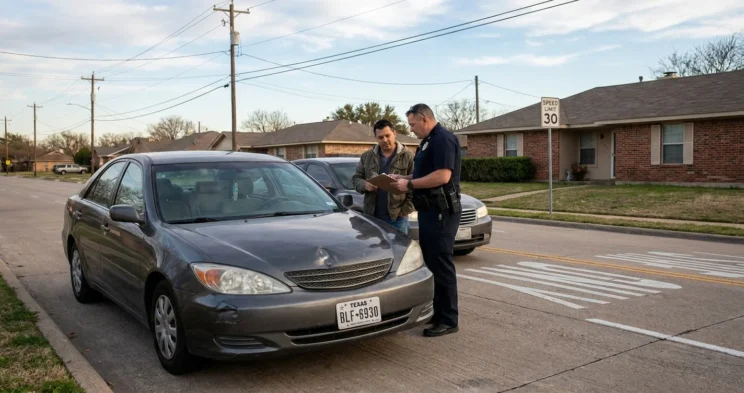
If the other driver’s insurer says the policy was cancelled before your accident, check the notice, mailing records, stated reason, and effective date before accepting that denial. Under Texas Insurance Code Chapter 551, a cancellation that violates the applicable personal auto rules has no effect.
An insurance denial can add financial stress while you recover from a crash. The documents can help establish whether the cancellation actually ended coverage before you were hurt.
What Does “Cancelled Before the Accident” Actually Mean?
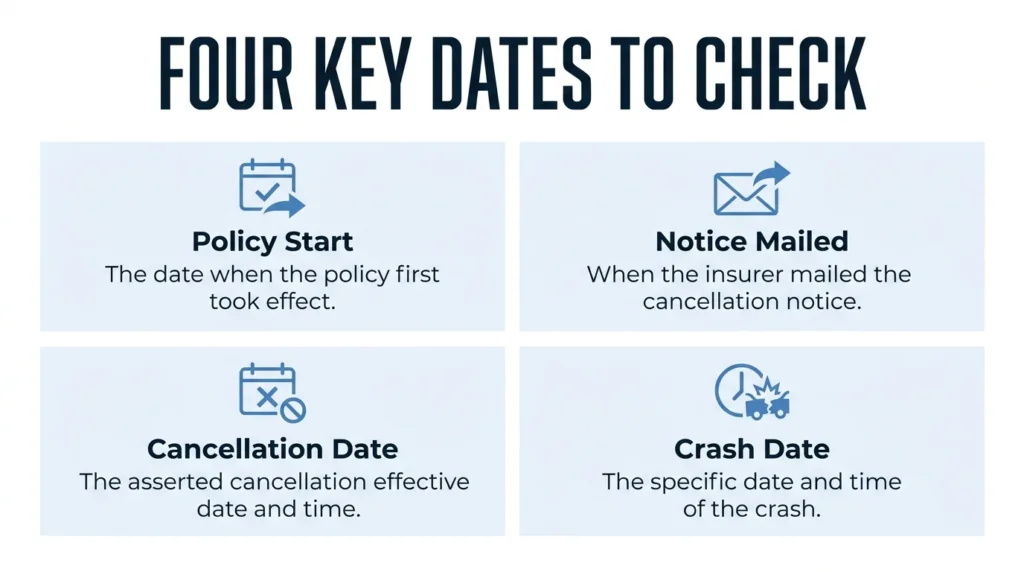
The insurer is claiming that coverage ended during the policy term and before your crash. The date you first heard about the cancellation does not decide whether that claim is correct.
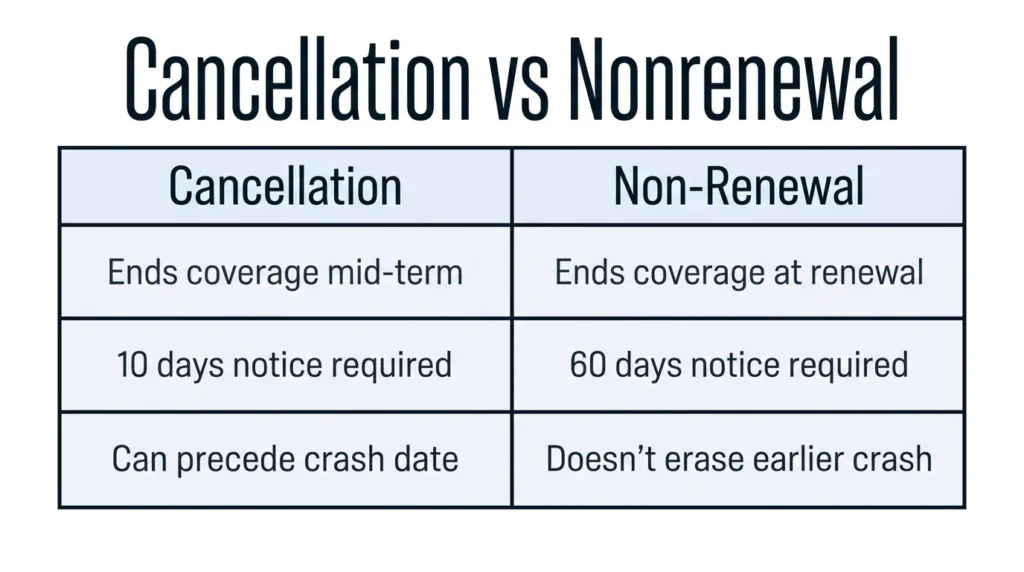
Cancellation ends coverage during the current policy term. Non-renewal means the insurer will not continue coverage into the next term.
Your review concerns personal auto policies under Subchapter C of Chapter 551. Commercial auto and Texas Automobile Insurance Plan Association policies follow different provisions.
Start with four dates:
- When the policy first took effect
- When the insurer mailed the cancellation notice
- The asserted cancellation effective date and time
- The crash date and time
A notice’s printed date does not prove when the insurer mailed it. A cancellation effective after your crash also differs from a pre-crash cancellation reported afterward.
If the insurer describes the cancellation as retroactive, compare its asserted effective date with the notice records. For ordinary midterm cancellations under Section 551.104(b)–(d), effectiveness is measured from mailing. Rescission and payment lapses require separate analysis.
When Can a Texas Insurer Cancel a Personal Auto Policy?
The permitted grounds depend on the policy’s age and the type of cancellation. Notice requirements also apply during the initial period.
Policies in Force 60 Days or More
The TDI personal automobile checklist identifies the initial period as less than 60 days. At 60 days or more, ordinary midterm cancellation grounds are limited to:
- Unpaid premium
- A fraudulent claim
- A TDI determination that continuing the policy would violate insurance law
- Specified license or registration suspension or revocation affecting the named insured, household operators, or customary operators, subject to an exception when the named insured consents to the relevant driver exclusion
A crash or general concern about driving risk is not itself on that list. Nonpayment is a statutory ground; the focus here is whether the insurer’s cancellation complied with the applicable rules.
How Much Notice the Insurer Must Give
A Texas car insurance cancellation notice must provide at least 10 days’ notice, including during the initial period, according to the TDI Personal Automobile Consumer Bill of Rights. Check whether the policy promises a longer period.
Section 551.104(f) separately allows cancellation on a policy’s 12-month anniversary with 60 days’ mailed notice. That anniversary rule differs from the ordinary midterm grounds above.
Nonrenewal at the Anniversary
Ordinary nonrenewal concerns the original policy’s annual anniversary and generally requires 60 days’ notice. Untimely notice requires renewal at the policyholder’s request, but §551.105 still ends the policy when replacement or succeeding coverage with another carrier takes effect. A later nonrenewal does not automatically erase coverage for an earlier crash.
Written Reasons & Electronic Notices
Section 551.109, amended effective January 1, 2026, requires written reasons for cancellation. Compare that explanation with the permitted grounds.
Section 551.008 permits electronic delivery in accordance with Chapter 35. Email alone does not always suffice. When §35.004 applies, cancellation notice must be delivered electronically and in paper or another nonelectronic form. The enacted amendment in HB 1040 confirms this requirement; conditions concerning consent or nonelectronic delivery, disclosures, and access also need review.
How Can the Cancellation Notice & Mailing Be Tested?
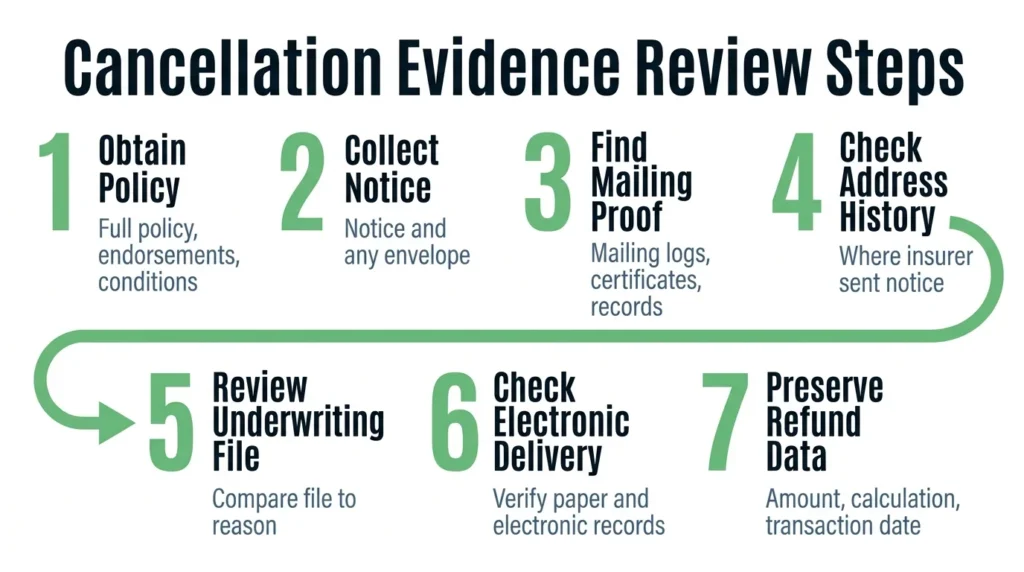
A lawyer can compare the insurer’s reason, policy terms, notice, mailing or delivery records, and effective date with the crash chronology. A generated letter does not prove mailing, and a denial of receipt does not automatically defeat cancellation.
The review includes these steps:
- Obtain the complete policy, endorsements, and cancellation condition.
- Collect the notice and any available envelope.
- Seek mailing logs, certificates, batch records, or testimony connecting this notice to mailing.
- Check the address history and where the insurer sent the notice.
- Review the underwriting and billing file against the stated cancellation reason.
- Seek electronic transmission records and paper-notice evidence where relevant.
- Preserve the premium refund amount, calculation, and transaction date.
The injured person does not automatically have access to the other driver’s full underwriting file. Texas car accident lawyers can identify records to seek and evaluate them alongside the crash evidence.
Why Mailing & Receipt Are Different Questions
In Sudduth v. Commonwealth County Mutual Insurance Co., the Texas Supreme Court reviewed a policy that made mailing sufficient notice. Evidence of nonreceipt could support an inference of nonmailing. An unsigned postal record did not independently establish the mailed contents, and the court reversed summary judgment for the insurer.
That collision-policy dispute illustrates why mailing proof deserves scrutiny. It does not mean denying receipt defeats cancellation. Do not assume certified mail or a signed delivery receipt is required; check the applicable law and policy language.
What a Premium Refund Shows
A refund supports the chronology but does not establish a valid cancellation by itself. Compare its calculation and transaction date with the notice, mailing records, and policy terms. An accounting entry cannot resolve whether the insurer met the cancellation requirements.
What Happens If the Cancellation Fails or Holds?
An ineffective cancellation allows counsel to challenge a denial based on that cancellation. If coverage validly ended before the crash, review your own uninsured motorist coverage. Neither path guarantees payment.
If the Cancellation Was Ineffective
Section 551.111 says a cancellation violating the applicable subchapter has no effect. Counsel can challenge the denial and evaluate whether the policy covers the injury claim.
Fault, damages, insured status, exclusions, and limits still count. Ineffective cancellation does not itself establish a right to immediate payment or a direct lawsuit against the liability insurer.
If the Cancellation Holds
Section 1952.101 requires uninsured and underinsured motorist coverage unless a named insured rejects it in writing, with separate rules for previously rejected coverage on renewal or reinstatement. Coverage protects insured people legally entitled to recover damages from uninsured or underinsured drivers.
The TDI Auto Insurance Guide explains how UM coverage addresses losses caused by an uninsured driver. Review your declarations, endorsements, any written rejection, covered-person status, limits, and claim duties.
Keep the other insurer’s denial and cancellation evidence. Notify your own carrier promptly so it can evaluate the claim under your policy.
Get Help Reviewing the Cancellation
Angel Reyes & Associates has served injured Texans for over 30 years. Bring the denial or cancellation correspondence, crash information, and your own auto policy to a free consultation to review the timeline, notice evidence, and potential UM coverage.
You can reach the firm 24/7. Contact Angel Reyes & Associates for your free consultation.
Past results do not guarantee future outcomes.
Other Driver’s Insurance Policy Cancellation FAQs
Can an insurance company cancel a Texas auto policy because the driver caused an accident?
A prior accident or general concern about driving risk is not, by itself, an authorized ground for ordinary midterm cancellation of a Texas personal auto policy that has been in force for 60 days or more. The insurer must identify a legally permitted reason and comply with the applicable cancellation requirements.
What if the other driver’s insurance company refuses to provide cancellation records after a car accident?
An injured person may need formal legal procedures, such as discovery in litigation, to seek relevant records that the insurer will not voluntarily provide. An attorney can evaluate which documents are relevant and what procedures are available to obtain evidence concerning the cancellation and the accident claim.
Can I file an uninsured motorist claim while disputing the other driver’s insurance cancellation?
You can notify your own insurer and ask it to evaluate potential uninsured motorist coverage while the other insurer’s denial is being reviewed. Follow your policy’s notice and cooperation requirements, and do not assume that a disputed cancellation automatically establishes eligibility for UM benefits.
About the Authors

Angel Reyes
Writer
Angel L. Reyes, III is the Founder and Managing Partner of Angel Reyes & Associates. A nationally recognized trial attorney and business leader, Angel founded the firm in 1993, which has gone on to help over 70,000 injury victims recover more than $1 billion. Named to the Texas Super Lawyers list annually since 2008, Angel brings Wall Street experience, Ivy League education, and a deep commitment to client advocacy. He is a frequent legal commentator and published author with extensive contributions to legal scholarship, trial strategy, and consumer protection.

Graham Griffin
Editor
Graham Griffin is the Web & Content Manager at Angel Reyes & Associates, where he oversees content strategy, AI-powered workflows, a...

Angel Reyes
Reviewer
Angel L. Reyes, III is the Founder and Managing Partner of Angel Reyes & Associates. A nationally recognized trial attorney and business...