Was the Car That Hit You Under Recall?


Every article on this site is researched by our internal team, reviewed for legal accuracy against current Texas law, and held to State Bar of Texas advertising standards before publication. We do not publish content that overstates outcomes or makes promises about results.
Learn more about our
editorial standards .
Key Takeaways
- A VIN-specific vehicle recall check shows more than a general model search
- Federal law requires manufacturers to fix an open recall for free
- A pattern of NHTSA complaints can support notice even without a recall
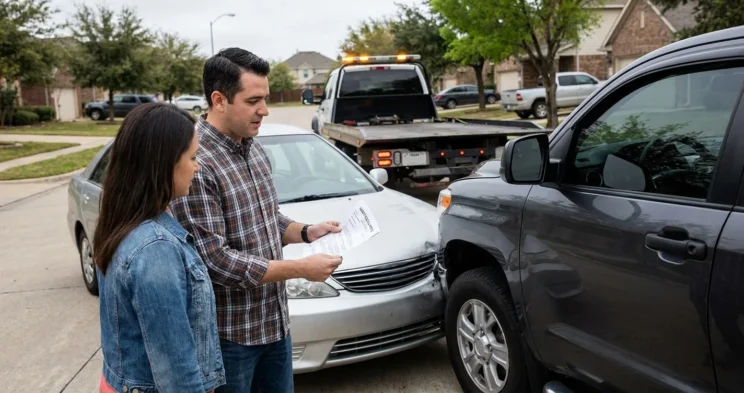
You’re still shaking from the crash, dealing with insurance calls, medical appointments, and a car that might not be drivable. Then someone mentions the words “safety recall,” and a new question hits you. Was the vehicle that hit you already known to be dangerous before the crash even happened?
That question matters. If an at-fault car had a known safety recall that was never fixed, that record can become strong evidence in your case. The same is true for a pattern of consumer complaints about the same make, model, and part, even when no recall was ever issued.
Here’s how a vehicle recall check works, what each government database actually shows, and how that evidence can support a claim.
How to Run a Vehicle Recall Check on the Car That Hit You
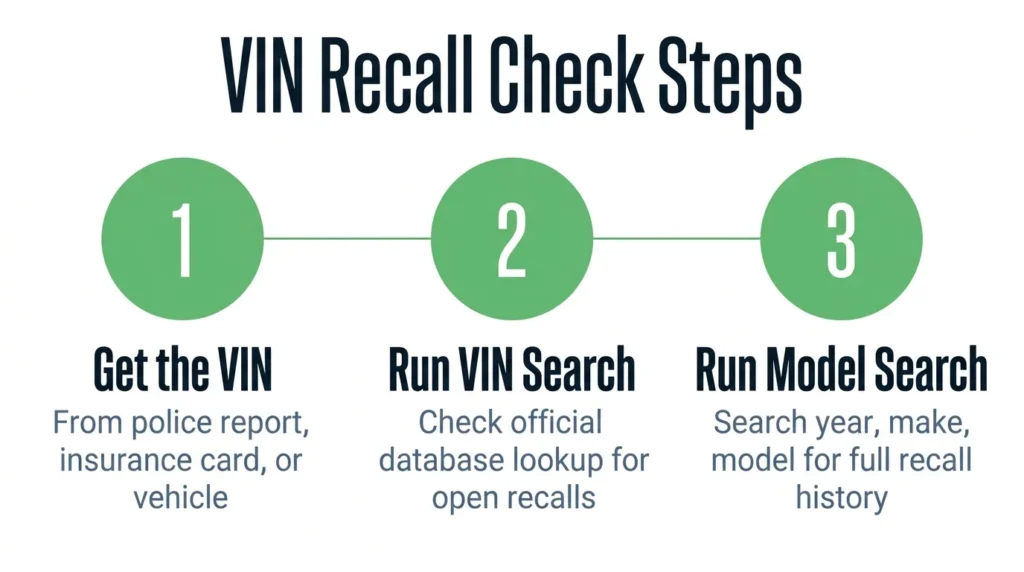
The most reliable vehicle recall check uses the car’s Vehicle Identification Number (VIN), not a general search by year, make, and model.
- Get the 17-character VIN from the police report, the other driver’s insurance card, or the vehicle itself.
- Run the VIN through the National Highway Traffic Safety Administration’s (NHTSA) recall lookup tool. A VIN-specific search ties results to that exact vehicle’s build. It shows whether that specific car has an open, unremedied recall, along with the recall campaign number, a description of the safety defect, and the required remedy.
- Run a general year, make, and model search as a second step. This type of search returns every recall ever issued for that broad production run. It helps you understand a vehicle line’s history, but it cannot tell you whether this specific car was part of the affected population or whether the repair was ever completed.
A recall’s “completed” status depends on a dealer updating NHTSA’s system after finishing the repair. A VIN search showing no open recall reflects what the system currently records, not a guarantee the work was done. That’s one reason dealer service records matter as independent proof, covered further below.
The car accident team at Angel Reyes & Associates regularly walks clients through this exact process after a Texas crash.
Technical Service Bulletins & the NHTSA Complaint Database
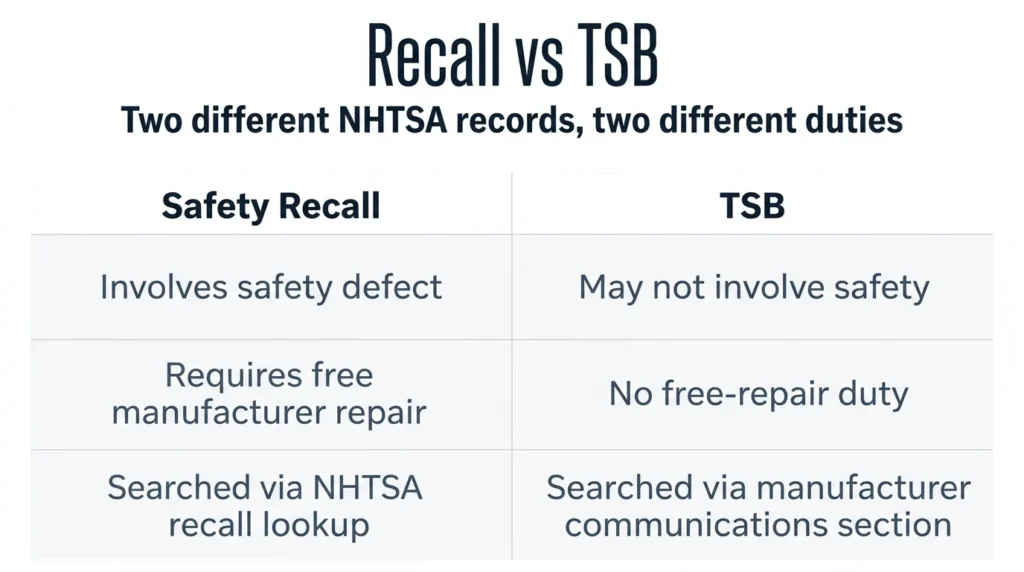
A VIN search only tells part of the story. Two other NHTSA records can round out the picture.
- Technical service bulletins (TSBs) are manufacturer-to-dealer communications about a known, recurring problem. A TSB does not necessarily involve a safety defect, and it does not by itself create a legal duty to repair the vehicle for free the way a recall does.
- Manufacturers report TSBs to NHTSA under a separate federal reporting framework, 49 CFR Part 579, and TSBs are searched through the same NHTSA portal used for recalls, typically under a manufacturer communications section.
- The NHTSA complaint database is a public record maintained by the agency’s Office of Defects Investigation. It covers complaints filed directly by drivers going back to 1949 and is updated daily, according to the Department of Transportation’s (DOT) public data catalog.
- NHTSA uses complaint volume and content, together with other data, to spot a possible defect trend. A pattern of complaints can point to a dangerous problem well before any formal recall exists.
The Manufacturer’s Duty to Repair a Recalled Vehicle for Free
Once a safety recall is triggered, federal law creates a clear obligation. Under 49 U.S. Code § 30120, the manufacturer must remedy the defect without charge to the vehicle owner.
The manufacturer chooses the remedy. It can repair the vehicle, replace it with an identical or reasonably equivalent vehicle, or refund the purchase price, less a reasonable depreciation allowance.
That duty has a limit. Under § 30120(g), the free-remedy requirement does not apply if the vehicle’s first owner bought it more than 15 calendar years before the recall notice, or more than 5 years for tires. An older vehicle’s recall can still appear in the database even after the manufacturer’s free-repair duty has expired.
Dealers play a role too. A manufacturer must fairly reimburse a dealer that performs a free recall repair. The manufacturer’s report to NHTSA opening the recall, required under 49 CFR § 573.6, must include the campaign number, the defect description, and the remedy program.
How Recall and Complaint Evidence Can Support Your Claim
This evidence can support a Texas injury claim in more than one way, depending on what you find.
An unrepaired recall against the manufacturer. An issued recall is the manufacturer’s own filing with NHTSA acknowledging a safety defect exists in that vehicle population. When that unrepaired defect helped cause your crash, it can support a products liability claim against the manufacturer under Texas Civil Practice and Remedies Code Chapter 82.
An ignored recall notice against the vehicle’s owner. General legal commentary discusses an owner’s failure to act on a known recall notice as a fact that can support a negligence claim. This is an application of ordinary negligence principles, rather than a settled Texas statute or reported appellate decision, where proof of actual receipt becomes central to the case.
A complaint pattern even without a recall. Under long-standing products liability doctrine, a manufacturer can be held responsible for a defect it reasonably should have known about, even without proof it actually knew. A documented pattern of complaints about the same model and component can support that kind of notice.
Whichever theory applies, Texas’s proportionate responsibility rule matters. Under Tex. Civ. Prac. & Rem. Code § 33.001, you cannot recover damages if you’re found 51% or more responsible for the crash.
Building the Evidence Record With VIN Status, Dealer History, & Complaints
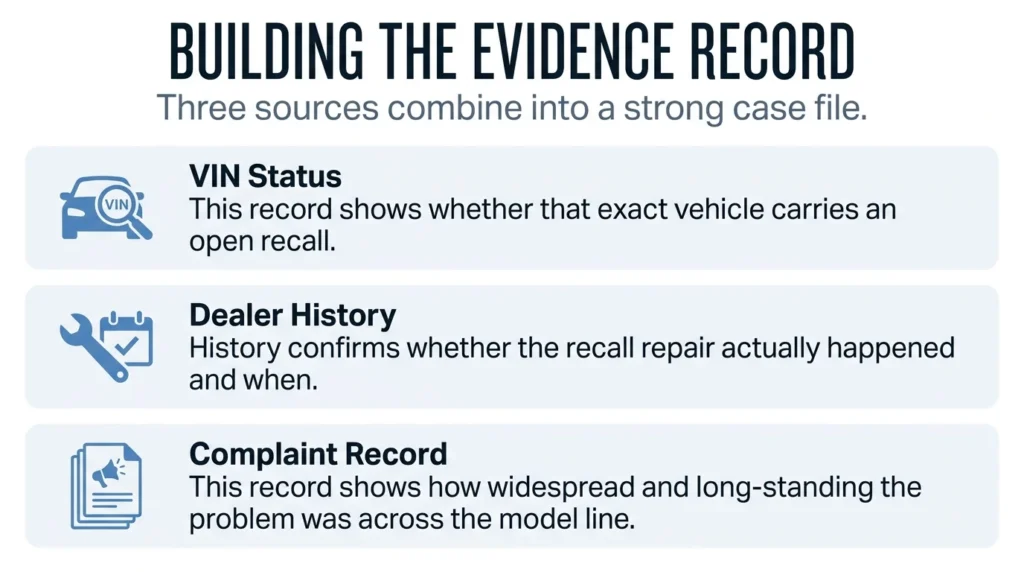
A strong case file combines three sources of proof.
- VIN-level recall status is the starting point. It shows whether that exact vehicle carries an open recall, though it depends on dealer reporting rather than a physical inspection of the car.
- Dealer service history corroborates or contradicts what the VIN search shows. Service records document whether the repair tied to a specific recall campaign number actually happened, and when.
- The complaint record for that model and component shows how widespread and long-standing the underlying problem was across the vehicle line, supporting the broader notice argument.
Together, these three pieces let your legal team show that a defect existed, that this specific vehicle was affected, and how long the manufacturer had reason to know about it.
Talk to a Texas Car Accident Attorney About a Recalled Vehicle
You shouldn’t have to run VIN searches and untangle federal recall law while you’re also recovering from a crash and fielding calls from an adjuster. Angel Reyes & Associates has guided injured Texans through complex situations like this for over 30 years. During a free consultation, our team can help review the VIN recall status, dealer records, and complaint history behind your crash and explain what they mean for your options.
Our firm features a team of more than 600 dedicated professionals across more than 20 offices in Texas, ensuring experienced local support wherever you are. We proudly offer full legal service in both English and Spanish to accommodate all injured victims across the state. We are available 24/7 to listen to your story and start investigating your options immediately.
Contact Angel Reyes & Associates today to speak directly with an experienced legal team. We stand ready, day or night, to review your claim and fight for the resolution you deserve.
Every case is different, and past results do not guarantee future outcomes.
Cars Under Recall FAQs
What is the difference between an open safety recall & a technical service bulletin (TSB)?
A safety recall covers a defect affecting vehicle safety and requires a free manufacturer repair. A TSB is a manufacturer-to-dealer communication about a known, recurring problem that does not necessarily involve safety and creates no free-repair duty. Both are searchable through NHTSA’s records by VIN or by year, make, and model.
Does a "no open recall" result on a VIN search guarantee the car was actually repaired?
No. A recall shows as completed only after a dealer updates the National Highway Traffic Safety Administration’s system following the repair, so a VIN search reflects what the system records, not confirmed proof the work was done. Dealer service history is the independent record that corroborates whether the repair actually happened.
Can a pattern of NHTSA complaints support a claim even if no recall was ever issued for that problem?
Yes. Under products liability doctrine, a manufacturer can be held responsible for a defect it reasonably should have known about, even without proof it actually knew, and a documented complaint pattern for the same model and component can support that kind of notice. The National Highway Traffic Safety Administration also uses complaint volume to spot defect trends that can lead to a recall later.
Can a vehicle owner be held responsible for an accident caused by an unrepaired recall notice?
General legal commentary discusses an owner’s failure to act on a known recall notice as a fact that can support a negligence claim, but this is not a settled rule under a specific Texas statute or reported Texas appellate decision. It is better understood as an application of ordinary negligence principles, where proof the owner actually received notice becomes central. Texas’s proportionate responsibility rule still applies to how fault is divided.
About the Authors

Angel Reyes
Writer
Angel L. Reyes, III is the Founder and Managing Partner of Angel Reyes & Associates. A nationally recognized trial attorney and business leader, Angel founded the firm in 1993, which has gone on to help over 70,000 injury victims recover more than $1 billion. Named to the Texas Super Lawyers list annually since 2008, Angel brings Wall Street experience, Ivy League education, and a deep commitment to client advocacy. He is a frequent legal commentator and published author with extensive contributions to legal scholarship, trial strategy, and consumer protection.

Kyle Nicolas
Editor
Kyle Nicolas is the Web Content & SEO Manager at Angel Reyes & Associates. He has more than 10 years of experience as a marketing co...

Spencer Browne
Reviewer
Spencer Browne is a partner at Angel Reyes & Associates and a Board Certified personal injury trial lawyer with nearly 100 jury trials a...