What Happens If You Have a Car Accident Out of State?


Every article on this site is researched by our internal team, reviewed for legal accuracy against current Texas law, and held to State Bar of Texas advertising standards before publication. We do not publish content that overstates outcomes or makes promises about results.
Learn more about our
editorial standards .
Key Takeaways
- The accident state's law, not Texas law, controls your claim by default.
- Texas allows two years to sue, but some states allow only one year.
- Texas liability coverage rises to meet a higher-limit state's minimums.
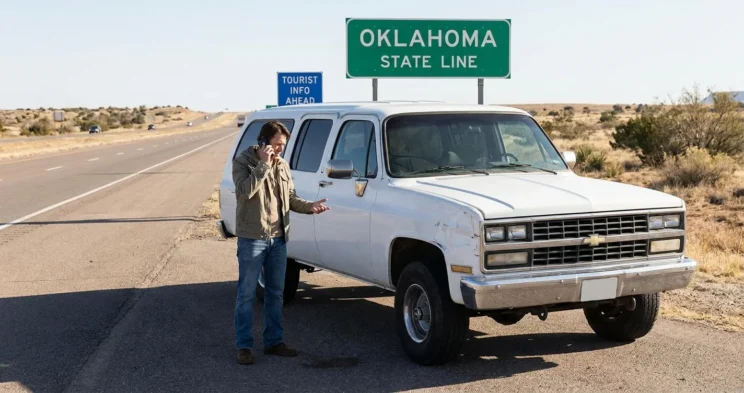
You pull out of Houston’s Energy Corridor before sunrise for a three-day business trip. Two states later, another driver rear-ends you on a Louisiana interstate. The officer’s report uses forms and terms you do not recognize, and your Texas insurer is already calling. You need to know who is responsible for what happens next.
Immediate Steps After an Out-of-State Crash
What happens first after a car accident out of state mirrors what happens at home. Confirm everyone’s safety, call 911, and check for injuries before anything else.
Once help is on the way, document the scene while details are fresh. Photograph vehicle positions, damage, and the surrounding road. Collect contact information from any witnesses you can find.
Get the responding officer’s name and the report number before you leave. Every state, including Texas, keeps an official file on the crash. Knowing how to request a copy of that report later saves time when your insurer or attorney asks for it.
Notify your insurer as soon as you safely can. This step starts your claim’s clock the same way it does after any car accident in another state.
Texas Insurance Coverage Out of State
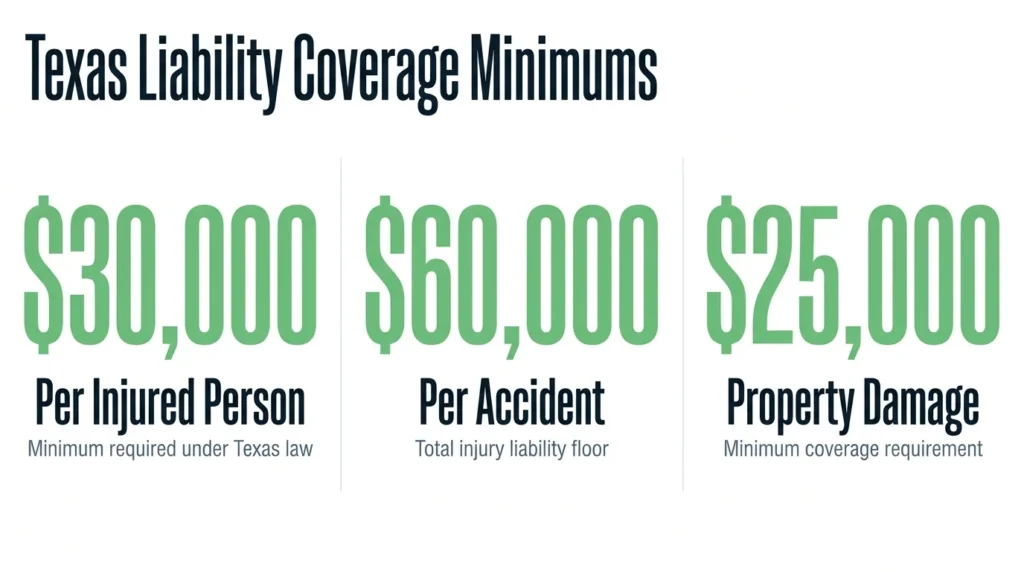
Your Texas auto policy does not stop protecting you once you cross state lines. Liability coverage adjusts upward automatically to meet a higher-limit state’s minimums.
Collision and comprehensive coverage generally travel with you too, at the same deductibles you carry in Texas. The Texas Department of Insurance publishes plain-language guidance on how these coverages respond to a claim.
Texas sets its own liability floor at $30,000 per injured person, $60,000 per accident, and $25,000 in property damage under Texas Transportation Code § 601.072. That floor travels with your policy into every other state.
Rental cars, business trips, and rideshare driving do not always carry the same protection as a personal errand. Some policies exclude business use or limit coverage on a rental vehicle. Confirm your specific coverage before you assume it carries over.
Which State’s Law Governs Your Claim?
The law of the state where the crash happened generally governs your claim. That holds true no matter where you live, and it applies by default.
That governing law includes fault rules, damages limits, and filing deadlines. Comparative negligence standards vary widely from state to state.
Texas bars you from recovering any compensation once your share of fault reaches 51 percent under Texas Civil Practice and Remedies Code § 33.001. Other states use different thresholds, and a few bar recovery at any shared fault at all.
This principle also runs in reverse. When an out-of-state driver causes a crash in Texas, Texas law governs that claim the same way.
At-Fault vs. No-Fault States
Most states, including Texas, are at-fault states, where the driver who caused the crash and their insurer pay for your damages.
A smaller group of states are no-fault states. There, you turn to your own policy first for medical bills and lost wages, regardless of fault. Knowing which type of state you are dealing with shapes who you file against first.
Statute of Limitations by State
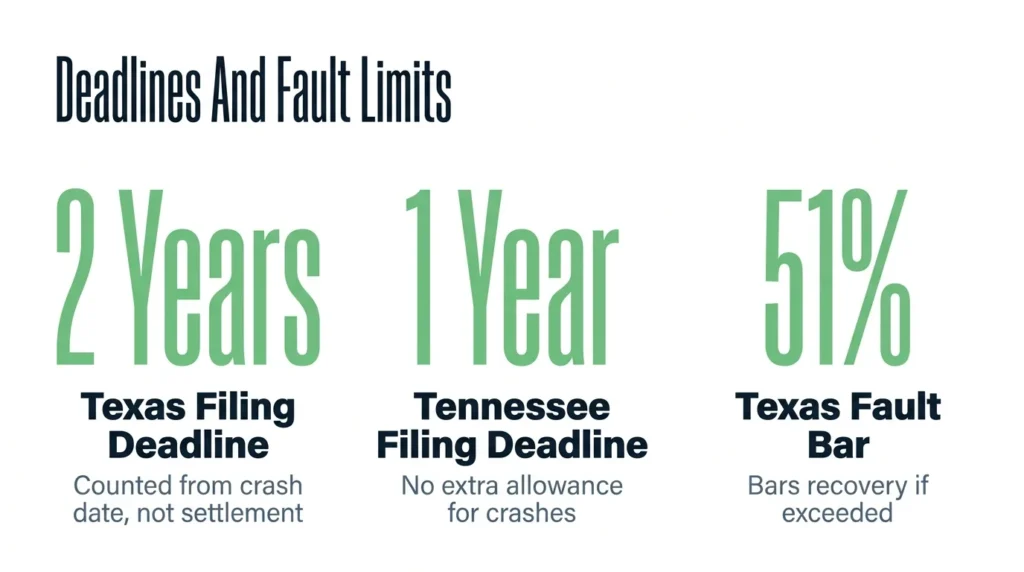
Texas gives you two years from the date of the accident to file a lawsuit. The out-of-state car accident deadline that actually controls your claim comes from the state where you crashed. That deadline can be far shorter than the two years you are used to.
The two-year window comes from Texas Civil Practice and Remedies Code § 16.003. It counts from the date of the crash, not the date you settle or finish treatment.
Some states allow far less time. Tennessee’s personal injury deadline under Tennessee Code Annotated Section 28-3-104 is one year, with no extra allowance for vehicle crashes. Miss that window, and you lose your right to sue, even though Texas would have given you another year.
Certain circumstances can pause or extend a Texas deadline, including active military service or the claimant’s age at the time of the crash. Texas law also recognizes other exceptions to this deadline, but other states do not guarantee the same protections.
If your crash happened outside Texas, confirm that state’s specific deadline right away. A Texas car accident attorney can check the accident state’s filing window before it closes.
Managing Your Out-of-State Crash Logistics
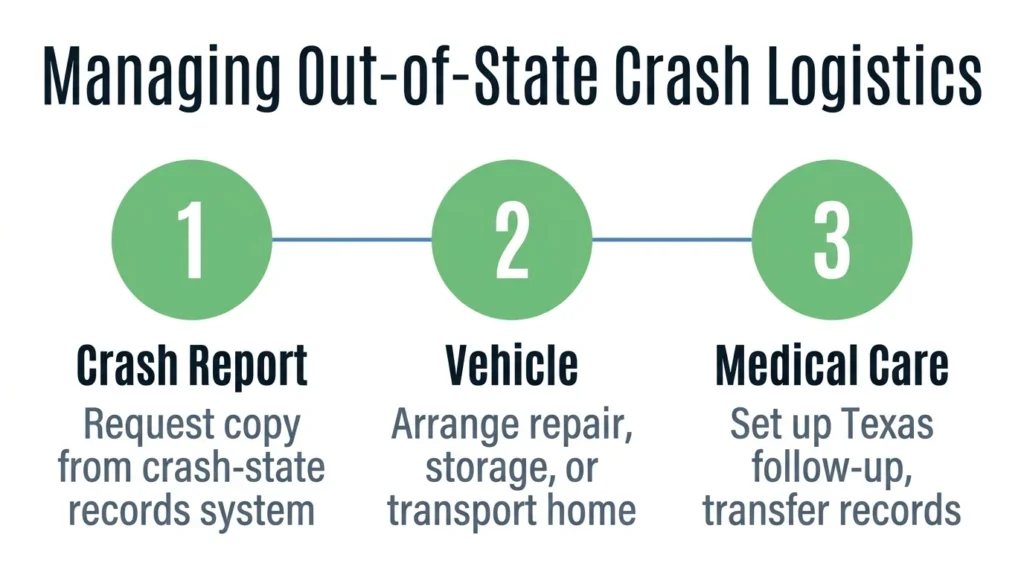
When your crash report, your vehicle, and your medical care all sit in another state, sorting them one at a time wastes time. Three tracks need attention at once:
- Crash report: Request and pay for the report from the state where the crash happened. Fees and procedures vary by state, so check that state’s crash-record system directly.
- Vehicle: If your car cannot be driven home, arrange repair, storage, or transport back to Texas. Confirm with your insurer which costs it covers before you authorize any work.
- Medical care: Set up follow-up care with a Texas provider as soon as you return home. Ask your out-of-state provider to send your treatment records directly to that new provider, so your care has no gap.
Coordinating a crash report, a vehicle, and medical records across two states is easier with the right guidance. The right attorney can help you manage all three tracks at once.
Talk to an Experienced Attorney Today
An out-of-state car accident adds deadlines, records, and logistics you should not have to sort out alone. Angel Reyes & Associates has spent more than 30 years helping Texas drivers handle crashes, wherever they happened. That record includes more than $1 billion recovered for clients.
We offer a free consultation, and you owe us nothing unless we win your case. We serve clients across the entire state of Texas, including drivers hurt while traveling outside it.
Contact Angel Reyes & Associates today to talk through your out-of-state accident before your filing deadline closes.
Past results do not guarantee future outcomes.
Out-of-State Car Accident FAQs
Can I file a lawsuit in Texas if my accident happened in another state?
Usually not. Courts in the state where the crash happened generally have authority over the case, so you typically must file there unless the at-fault driver has separate legal ties to Texas.
Will my lawyer be able to represent me in another state?
A lawyer must be licensed in the state where a lawsuit is filed. Your Texas-based attorney can guide your case from the start, but they may need to team up with a local attorney if the claim goes to court in another state.
Does uninsured motorist coverage on my Texas policy protect me out of state?
Yes, uninsured and underinsured motorist coverage generally travels with you across state lines. The coverage amount adjusts up to meet the state you are visiting’s minimum requirements.
Will an out-of-state accident raise my Texas insurance rates?
Yes. An at-fault accident typically raises your premium in Texas whether it happened in state or out of state, and the increase can last three to five years.
Does my Texas car insurance cover an accident in Mexico or Canada?
Canada is treated much like another state, so coverage typically applies there. Mexico is different, since most Texas policies only cover a narrow zone near the border for a short stay, so drivers heading farther into Mexico usually need separate Mexican insurance.
About the Authors

Angel Reyes
Writer
Angel L. Reyes, III is the Founder and Managing Partner of Angel Reyes & Associates. A nationally recognized trial attorney and business leader, Angel founded the firm in 1993, which has gone on to help over 70,000 injury victims recover more than $1 billion. Named to the Texas Super Lawyers list annually since 2008, Angel brings Wall Street experience, Ivy League education, and a deep commitment to client advocacy. He is a frequent legal commentator and published author with extensive contributions to legal scholarship, trial strategy, and consumer protection.

Graham Griffin
Editor
Graham Griffin is the Web & Content Manager at Angel Reyes & Associates, where he oversees content strategy, AI-powered workflows, a...

Angel Reyes
Reviewer
Angel L. Reyes, III is the Founder and Managing Partner of Angel Reyes & Associates. A nationally recognized trial attorney and business...