What Happens When a Trailer’s Landing Gear Fails?


Every article on this site is researched by our internal team, reviewed for legal accuracy against current Texas law, and held to State Bar of Texas advertising standards before publication. We do not publish content that overstates outcomes or makes promises about results.
Learn more about our
editorial standards .
Key Takeaways
- Landing gear carries a trailer's full nose weight whenever it is not coupled to a tractor.
- Driver vehicle inspection reports covering coupling devices are kept only three months.
- Texas allows two years to file, but the proof can vanish long before that deadline.
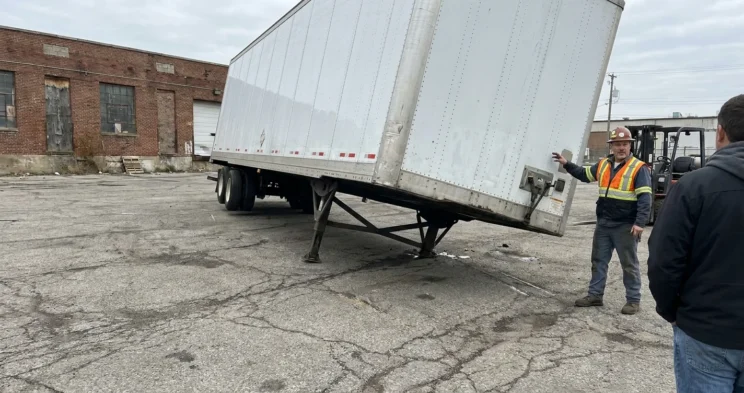
A parked semitrailer looks solid enough to lean on. It is not. The only thing holding up the front end of an uncoupled trailer is a pair of crank-down legs.
When a trailer’s landing gear fails, the nose drops to the pavement and the trailer can tip, roll, or upend. Anyone in the drop zone can be crushed, including the driver cranking the gear, a dock worker walking past the nose, a forklift operator inside the box, or a bystander standing in the yard.
If the gear fails at the moment of coupling or uncoupling, the same defect becomes a separation. A trailer drops off the fifth wheel, or a dolly-coupled unit comes loose and runs away.
What do federal and Texas rules actually require? How do these failures injure people, and which records prove what went wrong? Who can be held responsible?
What Landing Gear Does on a Trailer and How It Fails
Landing gear is the pair of crank-operated legs under the nose of a semitrailer, and it carries the full front weight of that trailer any time the trailer is not coupled to a tractor. Drivers and yard crews also call them trailer supports, front supports, or landing legs.
The reason a trailer needs landing gear at all is written into the federal definitions. 49 CFR 390.5 defines a semitrailer as one “constructed so that some part of its weight rests upon the self-propelled towing motor vehicle.”
Take the tractor away and that weight has to go somewhere. The landing gear is what it goes onto.
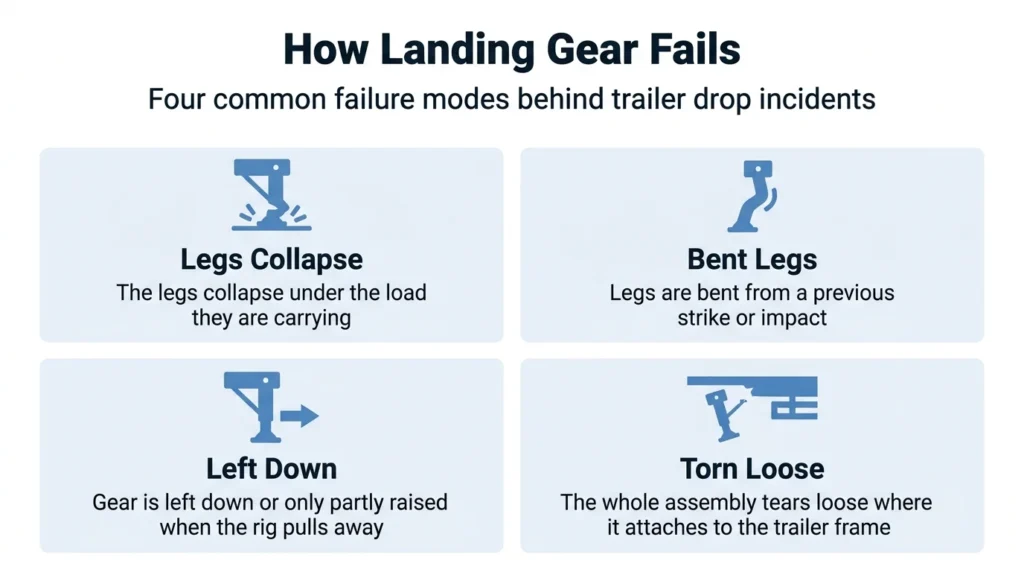
Failure shows up in a handful of plain ways. The legs collapse under load, they are bent from a previous strike, they are left down or only partly raised when the rig pulls away, or the whole assembly tears loose where it attaches to the trailer frame.
That last failure mode has its own rule. 49 CFR 393.201 requires that the frame of a commercial motor vehicle “shall not be cracked, loose, sagging or broken,” and that parts welded or attached to the frame follow the manufacturer’s specifications.
Two scenarios account for most of the harm, a parked or spotted trailer whose nose support gives way, and a separation during coupling or uncoupling.
A tractor-trailer-related wreck calls for Texas truck accident legal services.
What Federal Rules Actually Govern Coupling Equipment and Landing Gear
Two sets of federal rules do the work here, and they do different jobs. 49 CFR 393.70 and 393.71 set the standards for the coupling system. Part 396 supplies the duty that reaches the landing gear itself, along with the paper trail that proves a failure.
Start with the coupling hardware. 49 CFR 393.70 requires the lower half of a fifth wheel to be “secured to the frame of that vehicle with properly designed brackets, mounting plates or angles and properly tightened bolts,” plus a positive device that keeps the lower half from shifting on the frame.
The locking mechanism “must prevent separation of the upper and lower halves of the fifth wheel assembly unless a positive manual release is activated.” On readily separable designs, it has to lock automatically when the halves couple.
Tow-bars get the same treatment. A tow-bar must be structurally adequate for the weight it draws, properly and securely mounted, able to articulate without slack, and fitted with “a locking device that prevents accidental separation.”
Landing gear is not named in either of those sections. The duty that covers it sits in Part 396, and that is not the weaker hook. 49 CFR 396.3(a)(1) requires that “all parts and accessories shall be in safe and proper operating condition at all times.”
49 CFR 396.7(a) goes further and forbids operating a vehicle “in such a condition as to likely cause an accident or a breakdown.”
Coupling devices are also on the driver’s mandatory inspection list under 49 CFR 392.7 and 49 CFR 396.11(a)(1), and they face an annual inspection against fixed defect criteria under 49 CFR 396.17.
Those criteria live in Appendix A to Part 396, and they show what an inspector actually measures:
- Fifth wheels: “Horizontal movement between the upper and lower fifth wheel halves exceeds 1/2 inch.”
- Fifth wheels: “Any fasteners missing or ineffective.”
- Pintle hooks: “Cracks anywhere in pintle hook assembly.”
49 CFR 393.71 is the companion section, and its scope matters. It governs driveaway-towaway operations, meaning vehicles being delivered rather than an everyday Texas tractor-trailer hauling freight.
Inside that narrow world, tow-bars must permit motion in both horizontal and vertical planes, “at least two safety chains or cables” must be used and must be “crossed and attached to the vehicles near the points of bumper attachments,” and a saddle-mount bearing surface “shall not be less than 16 square inches.”
None of this stops at interstate carriers. 37 Texas Administration Code Sec. 4.11 adopts 49 CFR Parts 390 through 393 and 395 through 397 by reference, which brings both the coupling standards and the inspection duties into Texas intrastate law.
That adoption rests on Texas Transportation Code Sec. 644.051, which lets the Texas Department of Public Safety director adopt all or part of the federal safety regulations by reference.
The practical result is that a trailer running only between warehouses along I-35E and LBJ Freeway is held to the same coupling and maintenance standards as one crossing state lines.
Converter Dollies, Pintle Hooks, and Safety Chains: When a Unit Runs Away
Adding a converter dolly changes which rule applies, and that is the hinge of the whole runaway scenario. Under 49 CFR 390.5, “a semitrailer equipped with an auxiliary front axle (converter dolly) shall be considered a full trailer.”
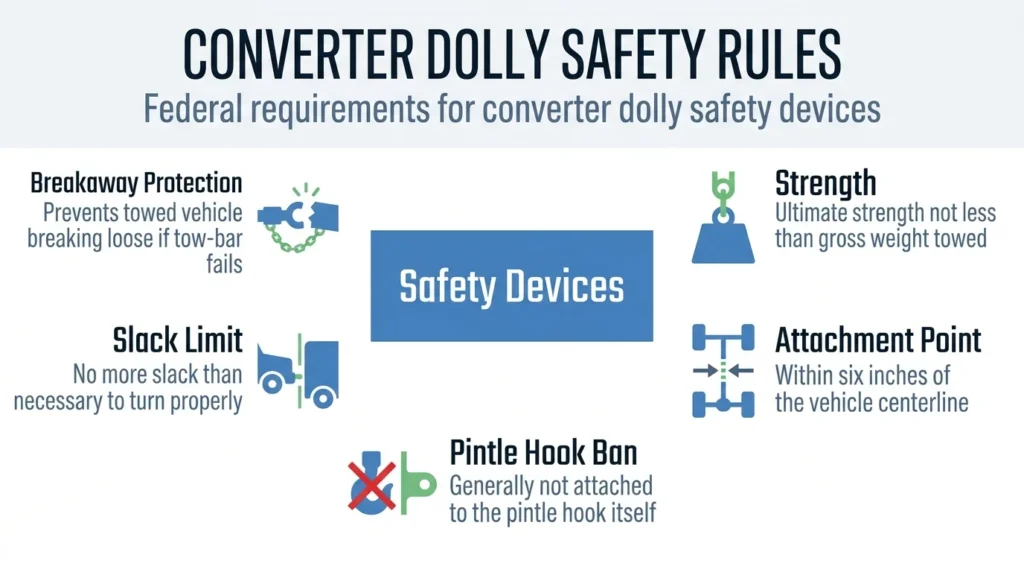
That reclassification pulls the second trailer of a set of doubles into 49 CFR 393.70(d), the safety device provision. Its requirements are specific:
- Safety devices must prevent the towed vehicle “from breaking loose in the event the tow-bar fails or becomes disconnected.”
- They must have “an ultimate strength of not less than the gross weight of the vehicle or vehicles being towed.”
- They may carry “no more slack than is necessary to permit the vehicles to be turned properly.”
- Attachment points on the towing vehicle must sit at or within 152 mm (6 inches) to the right of the centerline.
- Safety devices generally may not be attached to the pintle hook itself, apart from a narrow legacy exception for certain older equipment.
- A single chain or cable is allowed only for a solid-tongue converter dolly with no swivel, and only in line with the centerline of the tongue.
That pintle hook prohibition matters. The hook is often the component most likely to give out, so anchoring the backup to it removes the backup at the exact moment it is needed.
The dolly has its own gear support, and the standard procedure calls for securing it in the raised position before the unit moves. A dolly left improperly supported or improperly hooked is how a unit separates while it is being coupled.
Appendix A treats these items as inspection failures in their own right. It lists “safety devices missing,” devices “unattached or incapable of secure attachment,” worn or improperly repaired chains, hooks and cables, and, for pintle hooks, “mounting surface cracks extending from point of attachment.”
Texas adds a brake rule built for the runaway scenario. Texas Transportation Code Sec. 547.405 requires that a trailer or semitrailer with air or vacuum brakes, or with a gross weight heavier than 4,500 pounds, have brakes that are “promptly applied automatically and remain applied for at least 15 minutes in case of a breakaway from the towing vehicle.”
One Texas statute that does not apply is the towing safety chain rule. Texas Transportation Code Sec. 545.410 covers passenger cars and light trucks pulling trailers, but subsection (d) exempts vehicles operated under the federal motor carrier safety regulations. For a commercial rig or a converter dolly, 49 CFR 393.70(d) is the operative rule.
Trailer Drop, Dock Incidents, and the Coupling Sequence That Prevents Them
Landing gear injuries cluster in two places: under a trailer that was parked or spotted somewhere, and in the middle of the coupling sequence.
Federal regulators named the parked-trailer hazard directly. 29 CFR 1910.178(k)(3) states that “fixed jacks may be necessary to support a semitrailer and prevent upending during the loading or unloading when the trailer is not coupled to a tractor.”
The same OSHA standard requires at (k)(1) that “the brakes of highway trucks shall be set and wheel chocks placed under the rear wheels to prevent the trucks from rolling while they are boarded with powered industrial trucks.” Subsection (m)(7) repeats the fixed-jack requirement and adds that trailer flooring “shall be checked for breaks and weakness before” it is driven onto.
The mechanics are straightforward. Every time a forklift drives in and out of a trailer, it nudges the trailer away from the dock a little, and the landing gear is carrying the entire nose while that happens.
Dock crews call that trailer creep or dock walk. If the gear is bent, only partly lowered, or resting on soft or broken pavement, the nose can drop or the trailer can upend with a worker still inside the box.
That opens a responsible party beyond the motor carrier. The warehouse, shipper, or facility that spotted the trailer has duties of its own, which makes a dock collapse a premises liability question as much as a trucking one.
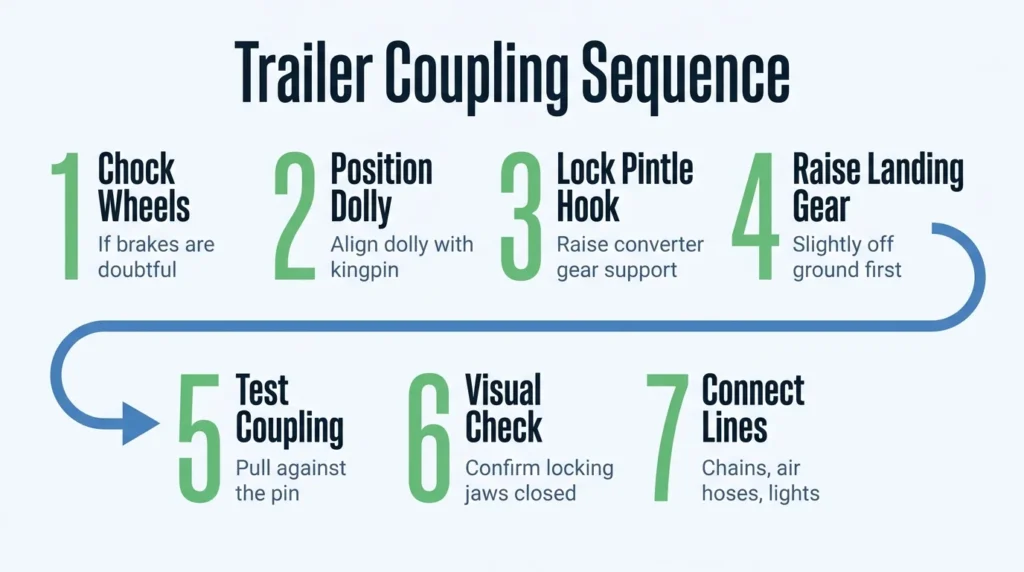
The standard CDL coupling procedure, published in state driver manuals including the Georgia Department of Driver Services CDL manual, is built to keep the nose supported at every moment. The steps that matter most:
- Chock the wheels if there is any doubt about the brakes.
- Wheel the dolly into position by hand so it lines up with the kingpin.
- Lock the pintle hook and secure the converter gear support in the raised position.
- “Raise landing gear slightly off ground to prevent damage if the trailer moves” before backing the dolly underneath.
- Test the coupling by pulling against the pin of the second semitrailer.
- Run the visual check, confirming no space between the upper and lower fifth wheel and the locking jaws closed on the kingpin.
- Connect the safety chains, air hoses, and light cords.
Uncoupling has its own order, and it exists to take weight off the dolly before anything is released:
- Chock the wheels of the second trailer if it has no spring brakes.
- “Lower landing gear of the second semitrailer enough to remove some weight from the dolly.”
- Disconnect and secure the dolly air and electric lines.
- Pull the tractor, first semitrailer, and dolly forward slowly to draw the dolly out from under the rear trailer.
The manual carries one warning in blunt terms: “Never unlock the pintle hook with the dolly still under the rear trailer. The dolly tow bar may fly up, possibly causing injury, and making it very difficult to re-couple.”
Skipping a step rarely looks dramatic at the time. A trailer that drops on someone, or a unit that runs away in a yard, can cause catastrophic or fatal injuries, and a family in that position may have a wrongful death claim alongside the injury claim.
The Records That Prove It and Who Can Be Held Responsible in Texas
The documents that prove a landing gear or coupling failure do not stay around long. A driver vehicle inspection report has to be kept for only three months. For most injured people, that window closes before they ever call a lawyer:
| Record | Rule that requires it | How long it is kept |
| Systematic inspection, repair, and maintenance records, with the date and nature of each | 49 CFR 396.3(b), (c) | One year where the vehicle is housed or maintained, and six months after it leaves the carrier’s control |
| Driver vehicle inspection report, which must cover coupling devices by name | 49 CFR 396.11(a)(1) | Three months from the date prepared, under 396.11(a)(4) |
| Carrier certification that a reported defect was repaired, or that repair was unnecessary, before the vehicle runs again | 49 CFR 396.11(a)(3)(ii) | Filed with the DVIR |
| Annual periodic inspection report or decal, measured against Appendix A criteria | 49 CFR 396.17 and 396.21 | Documentation must accompany the vehicle |
Behind those records sits an affirmative duty. 49 CFR 396.3(a) requires a carrier to “systematically inspect, repair, and maintain, or cause to be systematically inspected, repaired, and maintained” the vehicles under its control. That is an ongoing obligation, not a fix-it-when-it-breaks rule.
The driver carries a parallel duty. Under 49 CFR 396.13, a driver must be satisfied the vehicle is in safe operating condition before driving it, review the last inspection report, and sign it.
Intermodal equipment gets a named checklist. 49 CFR 392.7(b) requires the driver to inspect the “king pin upper coupling device,” the “rails or support frames,” the “locking pins, clevises, clamps, or hooks,” and the “sliders or sliding frame lock” before taking it over the road.
This is why the first call counts so much. A preservation letter sent inside the three-month window is often the difference between holding an inspection report that already flagged a coupling defect and arguing months later about why it no longer exists.
Responsibility depends on the facts, and more than one party often shares it:
- The motor carrier, under the systematic maintenance duty in 396.3, the unsafe operation ban in 396.7, and the defect certification requirement in 396.11.
- The driver, under 392.7, 396.13, and the coupling procedure itself.
- The trailer owner or lessor, when that is someone other than the operating carrier.
- The repair shop or third-party inspector that performed the annual inspection under 396.17.
- The facility, shipper, or warehouse that spotted the trailer, under OSHA 1910.178(k)(3) and (m)(7).
- The landing gear or coupling component manufacturer, on a product theory.
Sorting those parties out is its own piece of work.
Two Texas rules shape what a recovery can look like. Texas Civil Practice & Remedies Code Sec. 33.001 bars a claimant from recovering damages if the claimant’s “percentage of responsibility is greater than 50 percent.”
Sec. 33.003 then directs the fact finder to allocate responsibility among the claimant, the defendants, settling persons, and designated responsible third parties, including for conduct involving “any defective or unreasonably dangerous product.” That last clause is the route to a component manufacturer.
Timing is the other rule that controls everything. Texas Civil Practice & Remedies Code Sec. 16.003(a) gives two years from the day the cause of action accrues to bring a personal injury suit. Subsection (b) gives two years for an injury resulting in death, accruing on the death of the injured person.
Talk to Angel Reyes & Associates About a Trailer Landing Gear Injury
The inspection reports that show what a carrier knew about its coupling equipment run on a three-month clock, while Texas gives you two years to file. Those two timelines do not match, and the gap is where solid claims quietly fall apart.
Angel Reyes & Associates has guided injured Texans through situations like this for more than 30 years, from offices across the state. Contact us for a free consultation and we can start preservation work while the inspection and maintenance records still exist.
The first conversation costs you nothing. You can find out whether the inspection and maintenance records in your situation still exist, and what they show, before you decide on anything else.
Someone is available 24 hours a day, and our team serves clients in Spanish.
Past results do not guarantee future outcomes.
Trailer Landing Gear Failure FAQs
Who is responsible if a trailer's landing gear collapses at a warehouse instead of on the road?
Responsibility can reach past the motor carrier to the facility, shipper, or warehouse that spotted the trailer. OSHA’s powered industrial truck standard states at 29 CFR 1910.178(k)(3) and (m)(7) that “fixed jacks may be necessary to support a semitrailer and prevent upending during the loading or unloading when the trailer is not coupled to a tractor,” and at (k)(1) that brakes must be set and wheel chocks placed under the rear wheels before a powered industrial truck boards the trailer.
Can I bring a claim if I was the truck driver hurt while cranking or inspecting the landing gear?
It depends on whose failure puts the defective equipment in front of you. The candidates include the trailer’s owner or lessor when that is a different company from the one operating the rig, the repair shop or third-party inspector that performed the annual inspection required by 49 CFR 396.17, the facility that spotted the trailer, and the maker of a component that failed.
Do the federal coupling and maintenance rules apply to a trailer that never leaves Texas?
Yes. 37 Texas Administration Code Sec. 4.11 incorporates the Federal Motor Carrier Safety Regulations at 49 CFR Parts 390 through 393 and 395 through 397 by reference, and Texas Transportation Code Sec. 644.051 gives the Texas Department of Public Safety director the authority to adopt all or part of the federal safety regulations that way.
What if the landing gear or pintle hook was defective rather than poorly maintained?
A defect theory runs on its own track, and Texas law makes room for it beside a maintenance theory. Texas Civil Practice & Remedies Code Sec. 33.003 requires the trier of fact to assign a percentage of responsibility to each claimant, defendant, settling person, and responsible third party designated under Sec. 33.004 for conduct causing or contributing to the harm, including “any defective or unreasonably dangerous product.” That clause is the route to a landing gear or coupling component manufacturer.
How quickly do I need to act to keep the inspection and maintenance records from disappearing?
Much faster than the filing deadline suggests. A driver vehicle inspection report, which must cover coupling devices by name under 49 CFR 396.11(a)(1), is kept for only three months from the date it was prepared under 396.11(a)(4). Systematic inspection, repair, and maintenance records under 49 CFR 396.3(b) and (c) are kept where the vehicle is housed or maintained for one year, and for six months after the vehicle leaves the carrier’s control.
About the Authors

Angel Reyes
Writer
Angel L. Reyes, III is the Founder and Managing Partner of Angel Reyes & Associates. A nationally recognized trial attorney and business leader, Angel has helped over 70,000 injury victims recover more than $1 billion since founding the firm in 1993. Named to the Texas Super Lawyers list annually since 2008, Angel brings Wall Street experience, Ivy League education, and a deep commitment to client advocacy. He is a frequent legal commentator and published author with extensive contributions to legal scholarship, trial strategy, and consumer protection.

Kyle Nicolas
Editor
Kyle Nicolas is the Web Content & SEO Manager at Angel Reyes & Associates. He has more than 10 years of experience as a marketing co...

Angel Reyes
Reviewer
Angel L. Reyes, III is the Founder and Managing Partner of Angel Reyes & Associates. A nationally recognized trial attorney and business...