How Truck Accident Claims Work


Every article on this site is researched by our internal team, reviewed for legal accuracy against current Texas law, and held to State Bar of Texas advertising standards before publication. We do not publish content that overstates outcomes or makes promises about results.
Learn more about our
editorial standards .
Key Takeaways
- Carriers often send rapid response teams within hours to start their defense.
- Texas bars any recovery if you are found more than 50 percent at fault.
- A demand package bundles records, wage proof, and a settlement figure, not just a letter.

You are stopped in traffic on Interstate 10 near downtown Houston when an 18-wheeler rear-ends your car. Within minutes, you are dealing with a police officer, a tow truck, and calls from an insurance company you have never spoken to before.
A truck accident claim moves faster and involves more parties than a typical car crash claim.
What Makes a Truck Claim Different
A commercial truck crash is not a bigger version of a car accident claim. It involves layered insurance, corporate defendants, and federal safety rules a standard claim does not.
The trucking company, its insurer, and sometimes an umbrella carrier all have money at stake. That is one reason an 18-wheeler accident claim unfolds so differently from a standard car accident claim.
Right after a crash, your priority is medical care and documenting what happened. The deeper claim work starts almost as soon as the scene clears.
Large trucks are involved in a significant share of serious crashes nationwide, according to federal crash data. That scale explains why carriers respond so quickly and so formally after a wreck.
How a Carrier’s Rapid Response Team Works
Police are not the only ones investigating your crash. Texas troopers or local officers document the scene and file the official Peace Officer’s Crash Report, the baseline record every later step draws from.
Within hours, many trucking companies send their own carrier rapid response team. Investigators, forensic specialists, and sometimes defense counsel arrive to pull electronic logging device data, photograph the scene, and collect statements.
They often do this before you have hired an attorney. This early work is not neutral fact finding. It is the start of building the company’s defense.
That is exactly why having your own attorney start an investigation quickly means just as much.
How Truck Accident Liability Gets Apportioned
Fault in a truck crash rarely lands on one party alone. Several other parties can share the blame.
The trucking company, a maintenance contractor, a parts manufacturer, and a freight loader can each cover a different piece of the crash. Sorting out where truck accident liability actually falls is central to building your case.
Texas divides responsibility by percentage among every party found at fault. Under Texas Civil Practice and Remedies Code § 33.001, a claimant found more than 50 percent responsible recovers nothing.
A carrier’s own safety and inspection history often factors into how much fault it carries. Investigators and insurers can review a company’s federal safety rating as part of that assessment.
Some conduct goes beyond ordinary negligence. If a defendant’s conduct is grossly negligent, exemplary damages become available on top of standard compensation. Texas requires clear and convincing evidence to meet that standard under Texas Civil Practice and Remedies Code § 41.003.
Correctly identifying every liable party can change the total value of a claim. Past case results show why that step matters.
If more than one company might share blame for your crash, take a closer look at the full liability picture before you settle.
Preserving Evidence After a Truck Accident
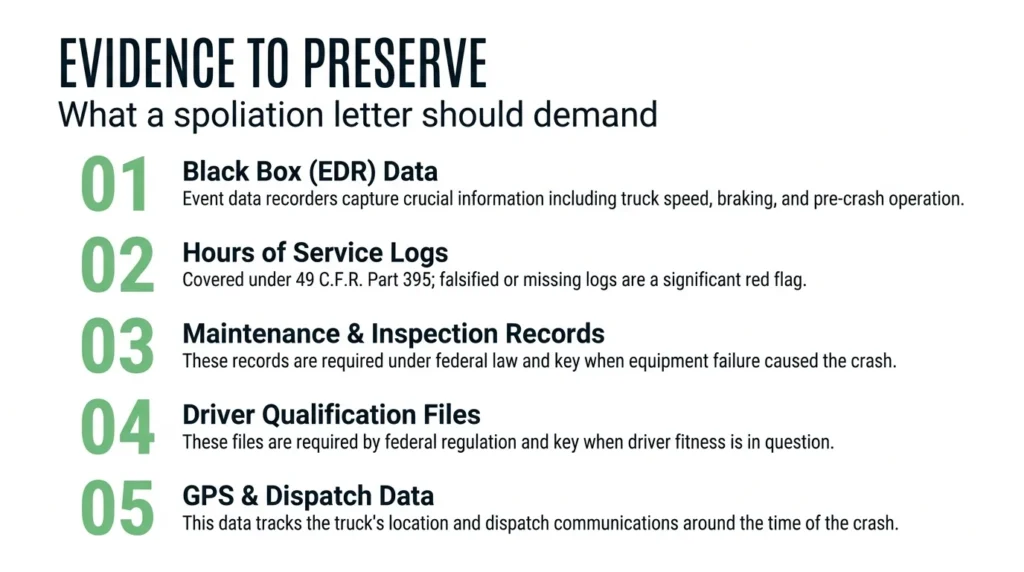
Evidence in a truck crash disappears fast unless someone forces the carrier to keep it. A spoliation letter puts the carrier on notice to preserve key records before they get erased or discarded.
That letter should demand preservation of:
- Black box and event data recorder information
- Hours of service logs
- Maintenance and inspection records
- Driver qualification and training files
- GPS and dispatch data
Hours of service logs are covered by federal recordkeeping rules under 49 C.F.R. Part 395. Falsified or missing logs are a red flag investigators look for.
Driver qualification files carry their own federal requirement under 49 C.F.R. § 391.51, and driver
training records fall under a separate federal training rule. These matter most when a driver’s fitness to operate the truck is in question.
Maintenance and inspection records fall under a separate rule, 49 C.F.R. § 396.3. This record set matters when equipment failure contributed to the crash.
These same categories also shape how fault ultimately gets determined in your case.
How the Demand Package Gets Built
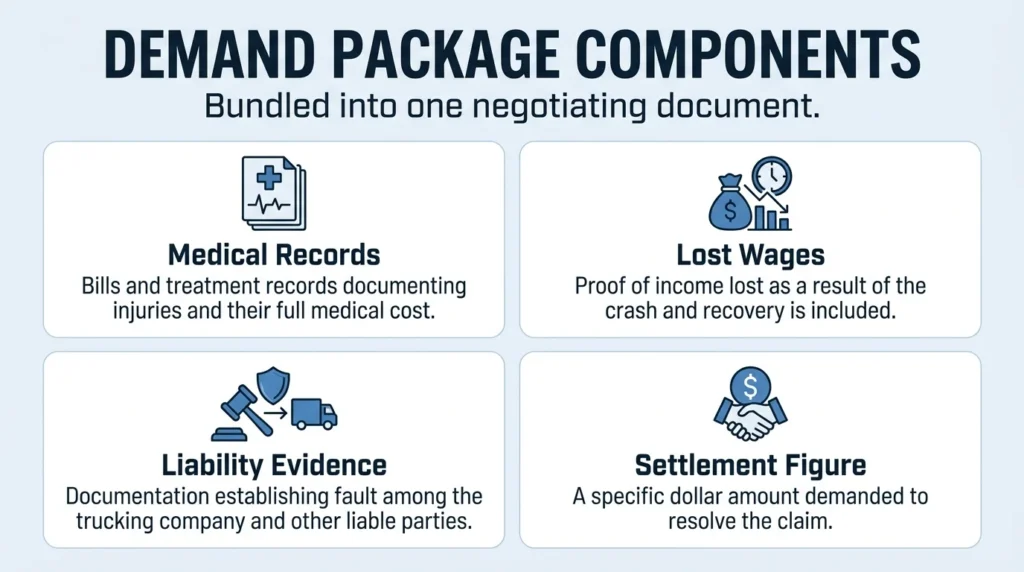
A demand package is not a single letter. It bundles medical records and bills, proof of lost wages, liability evidence, and a specific settlement figure into one negotiating document. That is more than a basic demand letter usually covers.
Commercial truck insurance claims often involve layered coverage across the driver, the carrier, and sometimes an umbrella policy. That layered structure is one reason a commercial truck insurance claim takes longer to negotiate than a personal auto claim.
Once the demand goes out, the carrier’s insurer and its defense counsel formally enter the process.
Their first offer is built to minimize payout, not to reflect the full value of your claim. That pattern is part of why insurance companies underpay so often in Texas.
Before accepting any offer, weigh it against the actual cost of ongoing treatment and lost income. A number that looks reasonable on paper may fall short once those costs are added up.
Texas law limits how long you have to file suit if negotiations stall. Under Texas Civil Practice and Remedies Code § 16.003, that deadline is generally two years from the crash. That timing shapes when a demand needs to go out.
Early, thorough case preparation affects how much negotiating leverage you have. See more about how the firm prepares cases from the start.
Talk to an Experienced Attorney Today
You do not have to sort out layered insurance policies and multiple defendants on your own. Angel Reyes & Associates investigates truck crashes quickly, identifies every party who may share fault, and negotiates with carriers and their defense counsel on your behalf.
You pay nothing upfront, and there is no fee unless Angel Reyes & Associates wins your case. That contingency structure means the cost of hiring help never competes with your medical bills or lost wages.
Contact Angel Reyes & Associates today for a free review of your truck accident claim.
Past results do not guarantee future outcomes.
Truck Accident Claim FAQs
How much insurance is a trucking company required to carry compared to a regular driver?
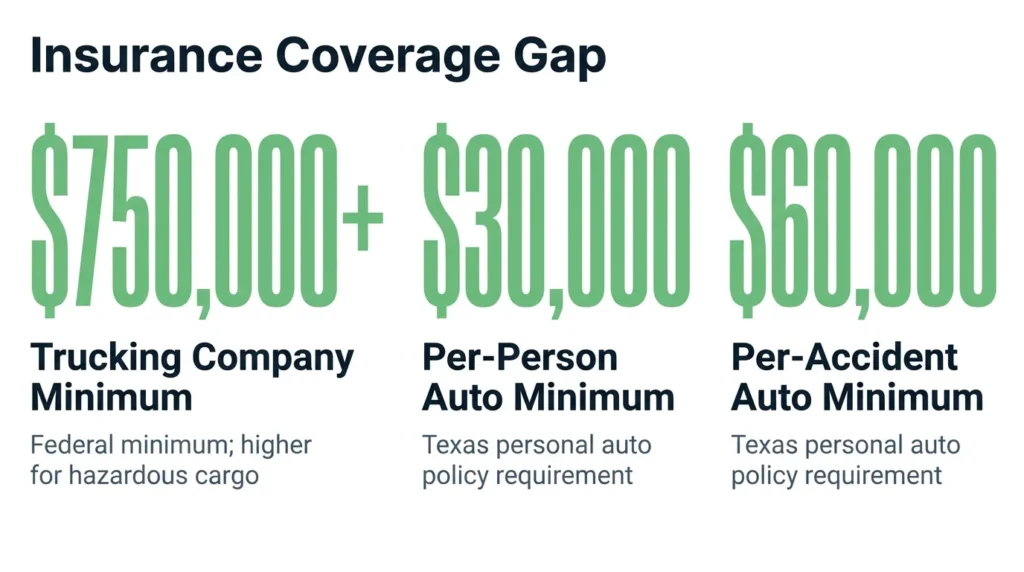
Federal law generally requires commercial trucking companies to carry at least $750,000 in liability coverage, and even more when hauling hazardous cargo, while Texas only requires personal auto policies to carry $30,000 per person and $60,000 per accident for injuries. That gap helps explain why so much more insurance money can be on the table after a truck crash than after a typical car accident.
Can a trucking company avoid responsibility by calling its driver an independent contractor?
Usually not. Federal rules generally hold a carrier responsible for a truck operating under its authority even when the driver is leased on as an owner-operator, so the label on the paperwork rarely changes who can be held liable.
Will my health insurance or my own auto policy help pay medical bills while my claim is pending?
Yes. Personal injury protection coverage on your own auto policy, or your health insurance, can often cover medical bills and some lost income right away, though your insurer may later seek reimbursement from your settlement.
What happens if the trucking company destroys evidence even after being asked to preserve it?
Texas courts can penalize a carrier for destroying evidence it was told to keep, including instructing the jury to assume the missing evidence would have hurt the company’s case. That penalty generally requires showing the carrier destroyed the evidence on purpose or lost it in a way that seriously damaged the injured person’s ability to prove the case.
If more than one person was hurt in the same truck crash, do we all share the same insurance payout?
Often yes. A commercial policy typically has one combined limit for the entire crash, so that amount gets divided among everyone injured rather than paid separately to each person in full.
About the Authors

Alex Ivanov
Writer
Alex Ivanov is a personal injury attorney at Angel Reyes & Associates, focused on car, truck, and motorcycle accident cases. Licensed in Texas and multiple federal districts, Alex brings international legal experience and a global education to his practice. He earned his LL.M. from Texas A&M University School of Law after graduating from Belarussian State University in 2016. Alex is fluent in Russian, English, Ukrainian, and Belarussian, and is recognized by multiple national trial lawyer associations for his results and leadership under 40.

Graham Griffin
Editor
Graham Griffin is the Web & Content Manager at Angel Reyes & Associates, where he oversees content strategy, AI-powered workflows, a...

Angel Reyes
Reviewer
Angel L. Reyes, III is the Founder and Managing Partner of Angel Reyes & Associates. A nationally recognized trial attorney and business...