What If a Mexican Trucking Company Caused Your Crash?


Every article on this site is researched by our internal team, reviewed for legal accuracy against current Texas law, and held to State Bar of Texas advertising standards before publication. We do not publish content that overstates outcomes or makes promises about results.
Learn more about our
editorial standards .
Key Takeaways
- A border-zone-only Mexican carrier crashing far inland was outside its authority.
- A valid Texas process agent means ordinary service. Without one, expect many months.
- Texas allows two years to sue, but foreign service does not pause that deadline.

The crash report lists a carrier you have never heard of, with an address in Mexico. Your first thought is that the company is out of reach.
It usually is not. A Mexico-domiciled trucking company can be held responsible in Texas for a crash that happened on a Texas road. What decides these cases is rarely the crash facts.
It comes down to what United States operating authority the carrier held that day, and whether the company can be served with a lawsuit without sending papers across the border. Those two answers set the schedule for everything else.
What a Mexican Trucking Company Is Actually Allowed To Do in Texas
A Mexico-domiciled motor carrier is a freight company whose principal place of business is located in Mexico (49 CFR 368.2). It does not hold one blanket right to drive in Texas.
It holds one of two very different grants, and which one it held on the day of your crash is often the first real issue in a commercial truck claim.
The narrower grant is a Certificate of Registration. It authorizes only interstate transportation of property in United States municipalities on the Mexico border and within those municipalities’ commercial zones (49 CFR 368.1). Operating outside that area subjects the carrier to applicable penalties and out-of-service orders.
Commercial zones are small. They are measured as a distance from a city’s corporate limits and scale with population, running from three miles for the smallest towns up to 20 miles for a city of a million or more (49 CFR 372.241).
A border-zone carrier involved in a crash well inland was, by definition, operating outside its authority. That fact can reshape a case before anyone argues about the driving.
Running deeper into Texas requires a separate grant, applied for on Form OP-1(MX) (49 CFR 365.501, 49 CFR 365.503). Federal rules condition that authority on the following (49 CFR 365.507T):
- A pre-authorization safety audit completed before any authority issues
- A distinctive USDOT number
- Proof of financial responsibility filed with federal regulators
- A designated United States process agent
- Safety monitoring that includes CVSA Level I inspections every 90 days
- Provisional authority first, with permanent authority available no earlier than 18 months later
Each of those conditions leaves a paper trail.
Cross-Border Carrier Liability: Can You Hold the Company Responsible in Texas?
Yes, in the ordinary case. Texas long-arm reach extends to a nonresident that commits a tort in whole or in part in this state (Texas Civil Practice & Remedies Code (CPRC) 17.042), and a crash on a Texas highway is the clean version of that. Jurisdiction is rarely the fight.
The harder questions are insurance and authority, and one investigation answers both.
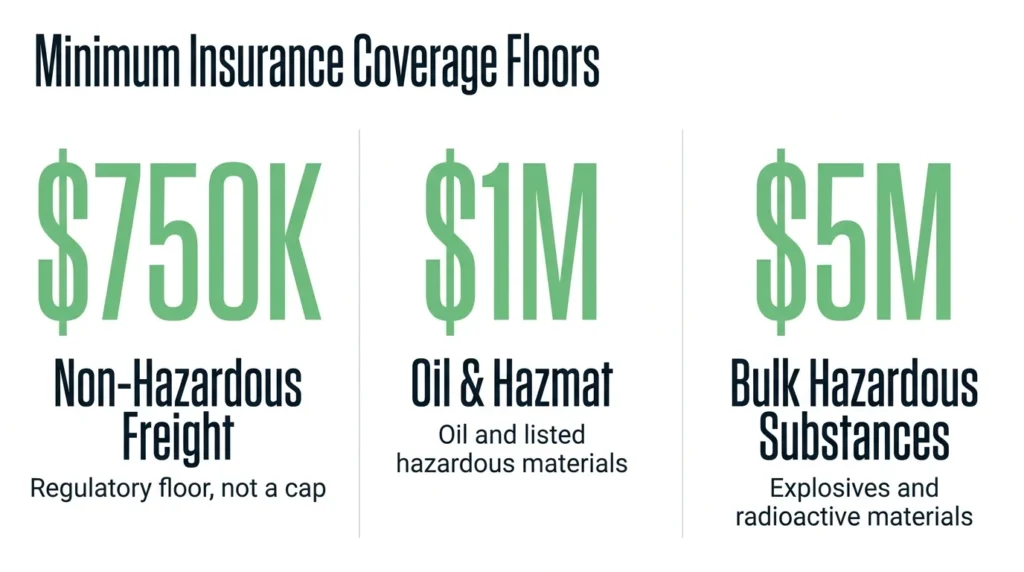
Federal law sets minimum coverage for for-hire interstate carriage at 10,001 pounds GVWR or more (49 CFR 387.9). The floor is $750,000 for non-hazardous property, $1,000,000 for oil and certain listed hazardous materials, and $5,000,000 for bulk hazardous substances, Division 1.1 to 1.3 explosives, and Class 7 materials.
Those figures are a floor, not a cap. They are a regulatory minimum, not a prediction of what any particular claim recovers.
A foreign carrier must also keep a legible copy, in English, of its proof of financial responsibility on board the vehicle, on Form MCS-90 or MCS-82. A motor vehicle without evidence of the required financial responsibility is to be denied entry into the United States (49 CFR 387.7).
Because insurance filings are a condition of the authority grant itself, the insurance record doubles as an authority record. Pulling one pulls the other.
If you were in a passenger vehicle when the tractor-trailer hit you, the carrier’s federal filings are the first place to look for coverage.
The Step That Decides These Cases: Serving a Mexican Trucking Company
Whether your case runs on a normal Texas schedule or a foreign one turns on whether the carrier has a live United States process agent.
Federal rules require a motor carrier to designate an agent for each state in which it is authorized to operate and for each state it travels through, including transportation between points in a foreign country (49 CFR 366.4T). The designation is made on Form BOC-3 or through an electronic process agent service, and it is part of both the border-zone application and the long-haul application.
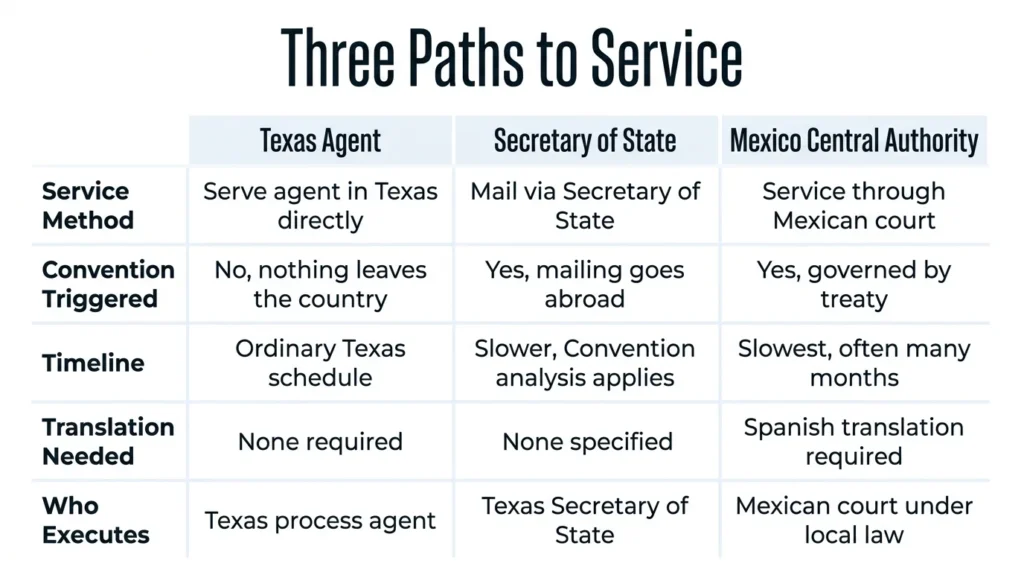
From there, three paths open, not one rule:
Path A: serve the designated agent in Texas. Nothing is transmitted abroad, so under Volkswagenwerk Aktiengesellschaft v. Schlunk the Hague Service Convention is not triggered, and the case proceeds on an ordinary Texas timeline.
Path B: substituted service on the Texas Secretary of State. Texas makes the Secretary an agent for service on a nonresident who does business here without a regular place of business or a designated agent (Texas Civil Practice & Remedies Code (CPRC) 17.044).
The Secretary must then mail the process to the nonresident at the address given for its home or home office, by registered or certified mail, return receipt requested (Texas Civil Practice & Remedies Code (CPRC) 17.045). That mailing goes to Mexico, which makes it transmittal abroad, so Convention analysis applies.
The Secretary’s office charges a per-party fee, forwards the papers by certified mail, and issues a certificate documenting the result (Texas Secretary of State, Service of Process).
Path C: service through Mexico’s Central Authority. The request goes to a government office in Mexico, and every document needs a Spanish translation.
Mexico has objected to Article 10 of the Convention, which removes service by postal channels, service directly through Mexican judicial officers, and service by any interested person (HCCH, Mexico declarations to the 1965 Service Convention).
The request is executed by a Mexican court under Mexican law, on a schedule neither you nor the Texas court controls. Texas courts do allow treaty-authorized service abroad, so this path is available. It is simply not quick, and it commonly takes many months.
Path A is fast because nothing leaves the country. Paths B and C are slow because something does.
The domestic shortcut is only as good as its upkeep. A stale BOC-3, an agent who has resigned, or a carrier that never registered at all erases Path A entirely.
Two things you may read online are wrong as stated. The Convention does not always apply, and a plaintiff cannot simply serve the Secretary of State and be finished. Compliance with the Convention is mandatory in every case to which it applies, and the forum’s own internal law decides whether it applies.
That is why a crash on a border-corridor route near McAllen and a crash on I-35 outside Dallas can follow completely different timelines even when the injuries look the same.
What To Pull First, and Why the Two-Year Deadline Bites Harder Here
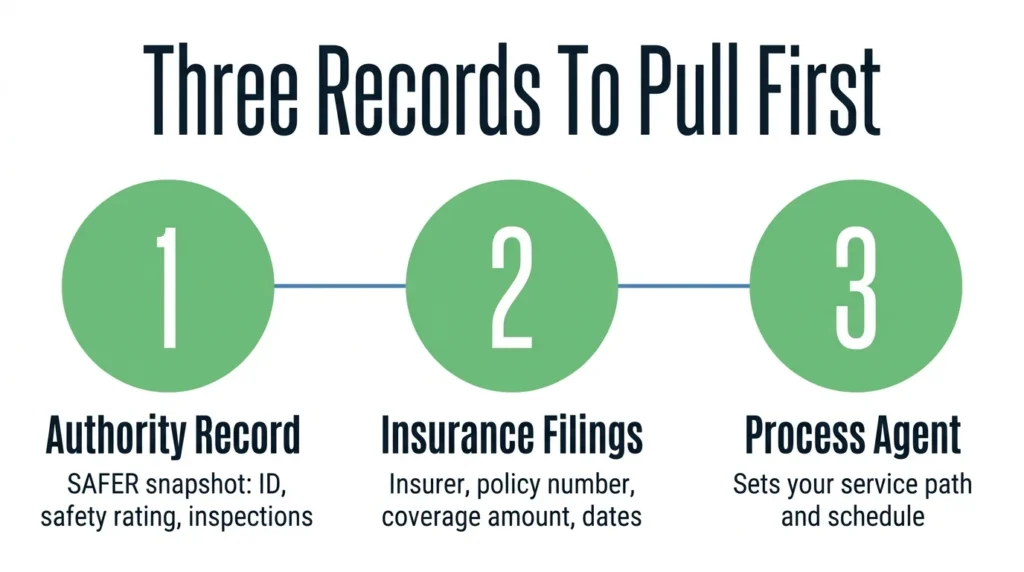
The early work in a Mexican truck accident case in Texas is documentary, and most of it is public and free. Three records decide the shape of the case, in this order:
- The cross-border authority record. FMCSA’s SAFER Company Snapshot is searchable by USDOT, MC, or MX number, or by company name. It shows identification, size, commodity information, safety rating, a roadside out-of-service inspection summary, and crash information.
- The insurance filings. FMCSA’s Licensing and Insurance public search shows the filing form, the insurer, the policy or surety number, the coverage amount, and the effective and cancellation dates. It also holds insurance history back to 1995, rejected filings from the prior 12 months, authority history, pending applications, and revocations.
- The process agent designation. This is the record that sets your service path, and therefore your schedule.
A lawyer can pull all three on day one, without waiting for an insurance company to volunteer them.
Then comes the deadline. Texas gives you two years from the day the cause of action accrues to bring a personal injury suit, and two years for a wrongful death action (Texas Civil Practice & Remedies Code (CPRC) 16.003). Families pursuing a fatal cross-border crash work inside that same window.
The deadline is fixed. Foreign service is not.
Texas courts expect a plaintiff who serves after the deadline to account for the delay, so the working instruction is straightforward: start early and document every step.
One narrow exception exists in federal court. Rule 4(m)’s 90-day service clock expressly does not apply to service in a foreign country under Rule 4(f) or 4(h)(2) (Fed. R. Civ. P. 4). That is a court-specific point, not a promise that late service is excused anywhere.
Talk To a Lawyer About a Cross-Border Claim
These claims are workable. The authority record, the insurance filings, and the process agent designation simply need to be pulled early enough that the service route can be chosen well inside the two-year window.
Angel Reyes & Associates has guided injured Texans for more than 30 years and serves the entire state, with attorneys reachable 24 hours a day. Initial consultations are free, and the firm handles truck accident claims statewide.
The team works in Spanish, which matters in a file built on Spanish-language documents and Convention translations. Angel Reyes & Associates has recovered more than $1 billion for clients.
Schedule a free consultation and bring whatever you already have: the crash report, the carrier’s name, and any photos showing the truck’s markings or plates.
Past results do not guarantee future outcomes.
Mexican Trucking Company Crash FAQs
Can a Mexican trucking company pick up a load in one Texas city and deliver it to another?
No. A Mexico-domiciled carrier may not provide point-to-point transportation services inside the United States, including express delivery services, for goods other than international cargo (49 CFR 365.501). Even a carrier that holds authority to run beyond the border municipalities and commercial zones is limited to freight moving between Mexico and points in the United States.
What paperwork is a Mexico-domiciled truck supposed to be carrying in the cab?
At minimum, two documents. A carrier operating under a Certificate of Registration must carry that certificate in the vehicle (49 CFR Part 368). Separately, a foreign motor carrier must have on board a legible copy, in English, of its proof of the required financial responsibility on Form MCS-90 or MCS-82, and a vehicle without that evidence is to be denied entry into the United States (49 CFR 387.7).
What does provisional authority mean for a carrier that recently started running beyond the border zones?
It means the carrier is authorized but still inside a federal probationary period. Before any authority issues, a Mexico-domiciled applicant must satisfactorily complete an FMCSA pre-authorization safety audit, receive a distinctive USDOT number, file proof of financial responsibility, and designate a United States process agent (49 CFR 365.507T).
About the Authors

Angel Reyes
Writer
Angel L. Reyes, III is the Founder and Managing Partner of Angel Reyes & Associates. A nationally recognized trial attorney and business leader, Angel has helped over 70,000 injury victims recover more than $1 billion since founding the firm in 1993. Named to the Texas Super Lawyers list annually since 2008, Angel brings Wall Street experience, Ivy League education, and a deep commitment to client advocacy. He is a frequent legal commentator and published author with extensive contributions to legal scholarship, trial strategy, and consumer protection.

Kyle Nicolas
Editor
Kyle Nicolas is the Web Content & SEO Manager at Angel Reyes & Associates. He has more than 10 years of experience as a marketing co...

Angel Reyes
Reviewer
Angel L. Reyes, III is the Founder and Managing Partner of Angel Reyes & Associates. A nationally recognized trial attorney and business...