What Should You Do After a Valet Driver Accident?


Every article on this site is researched by our internal team, reviewed for legal accuracy against current Texas law, and held to State Bar of Texas advertising standards before publication. We do not publish content that overstates outcomes or makes promises about results.
Learn more about our
editorial standards .
Key Takeaways
- A valet company may answer for its driver's crash if the driver was doing assigned work.
- Garagekeepers coverage protects customers' cars, not people injured by a valet driver.
- Save the valet ticket and request the operator's permit, insurance, and venue contract.
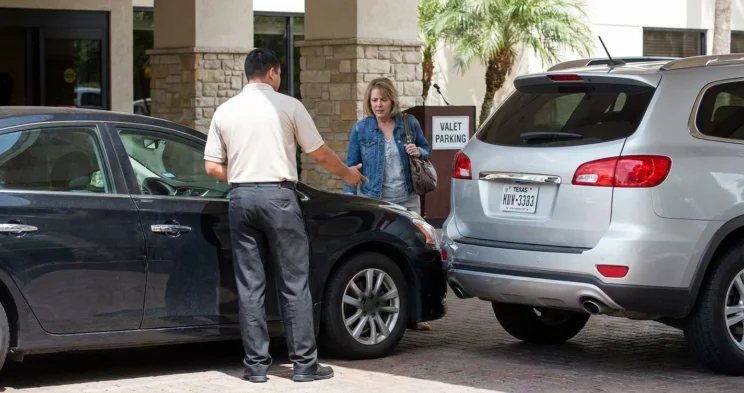
If a valet driver injures you, responsibility usually starts with the negligent driver and the company employing them. The company’s liability insurance may pay a covered claim, and a venue can sometimes share responsibility. When medical bills are arriving, identifying the employer and the applicable policies is an important first step.
Which insurer pays depends on the crash facts and each policy’s wording. A city permit can help you find the operator and insurance records, but it does not guarantee payment.
Who May Be Responsible When a Valet Driver Injures Someone?
The valet company may be responsible when its employee negligently injures someone while doing assigned work. That can apply whether you were hit by a valet driver at the stand or in a public-street crash.
Texas law can make an employer answer for an employee’s negligence within the scope of employment. In Cameron International Corp. v. Martinez, the Texas Supreme Court explained that scope depends on whether the employee was doing the job when the incident happened. A personal errand can fall outside it.
Two hypothetical examples illustrate the inquiry in a valet driver accident:
- Hypothetical one: A valet reverses a customer’s car out of the pickup lane and strikes a pedestrian waiting at the stand.
- Hypothetical two: A valet runs a red light while taking a customer’s car from a restaurant to an assigned offsite lot and hits another motorist.
Both involve injuries from vehicle operation. The assigned trip in the second example gives a strong basis for investigating employer responsibility away from the restaurant. That applies a general employment principle; the cited case did not involve a valet.
A public-street crash does not itself mean the driver abandoned the job. The employer, shift assignment, instructions, actual route, and destination help establish what happened in a Texas car accident injury claim involving a valet.
What Do Texas City Valet Rules Reveal About the Operator & Its Insurance?
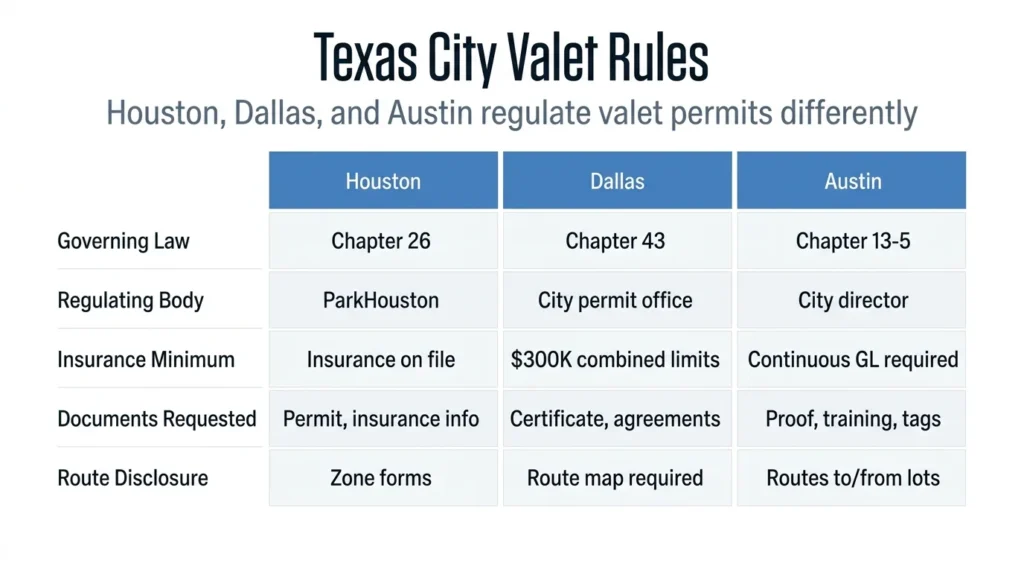
Houston, Dallas, and Austin license or permit certain valet operations. Their files can identify the operator, insurance records, and parking arrangements, though requirements differ by city and operation.
Houston’s Valet Permit Program
Houston regulates valet operators under Chapter 26 through ParkHouston. The city’s valet program page links to the ordinance and applications, and its application index lists valet service and zone forms.
Request the operator’s permit file and any insurance information submitted for the incident date. These records provide a starting point for identifying the business and investigating coverage.
Dallas’s Valet License Requirements
Dallas’s published permit guidance requires an annual Chapter 43 license when a commercial establishment’s valet operation uses public right-of-way, including maneuvering from private property. It requests venue/operator and storage agreements and an insurance certificate. Do not assume this rule covers an operation entirely on private property.
Section 43-126.12 specifies comprehensive general liability and garage insurance, each with at least $300,000 combined single limits or equivalent. It requires filing the policy or certificate, and the garage insurance addresses vehicles driven by or at the licensee’s direction.
These published minimums do not establish the amount available for your claim. The actual policies and circumstances still count.
Austin’s Valet Rules
Austin’s valet rules appear in Chapter 13-5. A 2012 ordinance amended section 13-5-4 to require continuous general liability insurance as specified by the director through eligible or authorized Texas insurers.
The city’s current right-of-way permit guidance requests proof of insurance, training material, and valet-tag information. Zone applications also request routes to and from parking and parking-facility contracts. Those records can help explain a crash on the way to an offsite lot.
Which Insurance Might Cover Injuries From a Valet Driver Accident?
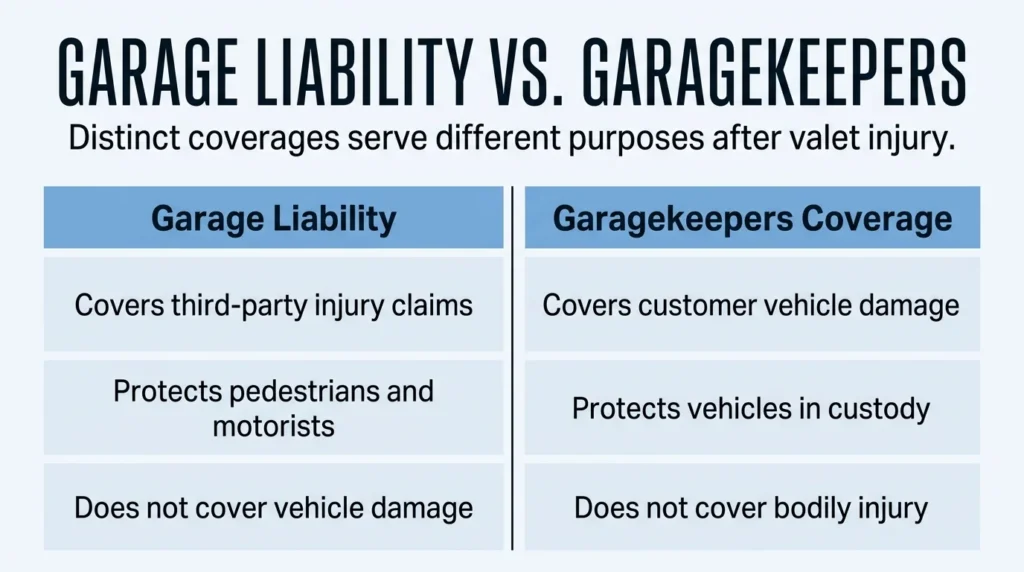
Examine the operator’s applicable vehicle or garage liability coverage for injuries to a pedestrian or another motorist. Garagekeepers coverage serves a different purpose, and the car owner’s policy needs its own review.
Garage Liability Versus Garagekeepers Coverage
Garage liability coverage can protect a business against covered third-party injury claims arising from its operations. Progressive distinguishes that protection from garagekeepers coverage for damage to customers’ vehicles. Travelers likewise describes garagekeepers protection for customer vehicles in a business’s custody.
Garagekeepers insurance, sometimes written as garage keepers insurance, does not substitute for bodily-injury coverage. Policies can bundle protections, so a certificate’s label alone cannot settle coverage.
Do not assume general liability covers an injury simply because it occurred at the stand. Review the automobile or garage provisions and exclusions for both curbside and street collisions.
Why the Car Owner’s Policy May Not Cover the Valet
A parking-business exclusion may limit the owner’s personal-auto liability coverage for the valet. One insurer-published Texas policy excludes a person engaged in businesses including parking vehicles in Part A, exclusion A.6.
Its exceptions concern use by the named insured, resident spouse, family member, or a partner, agent, or employee of the insured or family member. They do not automatically extend to every employee of the valet business.
That 2020 form is an example, not a rule for every Texas policy. Handing over the keys does not void all the owner’s protection; actual wording, relationships, and endorsements control.
Why the Certificate of Insurance Is Only a Starting Point
A certificate identifies reported insurance, but the full policies and endorsements determine whether it applies. Check effective dates and coverage for the driver, activity, vehicle, and location.
Valet insurance does not follow a universal payment order. An insurer pointing to another policy does not resolve which coverage applies to your injury.
Can the Restaurant or Venue That Hired the Valet Share Responsibility?
A venue may share responsibility if it employed the driver, controlled the specific work causing injury, or breached its own duty and caused harm. Hiring an independent valet company alone does not establish liability.
In JLB Builders v. Hernandez, the Texas Supreme Court explained that control must concern the relevant means, methods, or details of the work. General scheduling or safety oversight is insufficient. Although that case involved construction, its control principle informs the inquiry into a venue’s directions to an outside operator.
The court’s 2026 In re Home Depot decision also limits responsibility based solely on a commercial contract. It involved a shipper and motor carrier, not valet services.
Ask who employed the driver and directed the route or maneuver. Compare the contract with actual instructions to determine whether the venue controlled the injury-causing work. Any venue claim must connect a duty, breach, and injury.
If a dangerous property condition also contributed, such as a broken curb at the stand, that raises a separate premises liability question.
What Evidence Helps Identify the Responsible Parties and Coverage?
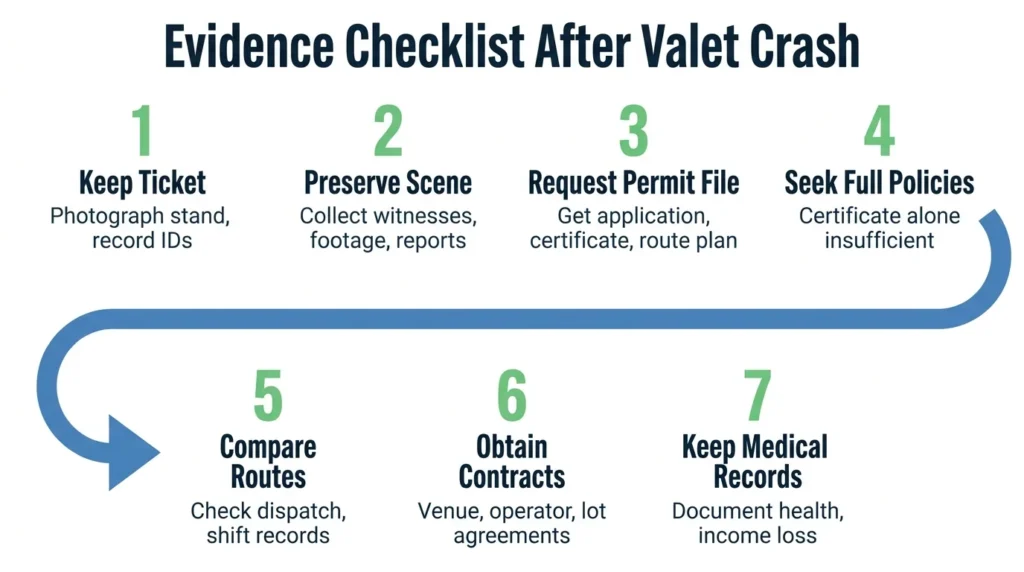
Preserve records connecting the driver, operator, venue, assigned route, and insurance in effect when you were hurt. Start with these steps:
- Keep the valet ticket or digital receipt. Photograph the stand and operator name, and record vehicle and driver identification when possible.
- Preserve scene evidence. Collect witness contacts, request available footage promptly, and obtain crash or incident reports.
- Request the city permit file. Seek the application, insurance certificate, and route or site plan applicable on the incident date.
- Seek full policies and endorsements. A certificate alone does not determine coverage.
- Compare the planned route with the actual trip. Shift and dispatch records can show the driver’s assignment.
- Obtain the venue/operator contract and lot agreement. These help identify responsibilities and parking arrangements.
- Keep medical and wage-loss records. Document the injury’s effect on your health and income.
Dallas’s valet license application specifically requests a route map, storage agreement, venue contract, and insurer-supplied proof. It illustrates the useful records a permit file may contain.
Talk With Angel Reyes & Associates About a Valet Injury
Angel Reyes & Associates can review potential responsible parties and coverage after a valet injury. Bring your ticket, incident details, and any permit or insurance information you have.
Contact Angel Reyes & Associates for a free consultation. The firm is available 24/7.
Past results do not guarantee future outcomes.
Valet Driver Accident FAQs
What happens if a valet driver causes an accident while driving my car without permission?
The driver’s actions and the scope of any authorization may affect liability and insurance coverage. The vehicle owner’s auto policy, the valet company’s policies, and the circumstances of the trip must be reviewed to determine which coverage may apply.
Can I recover lost wages and future medical expenses after a valet accident in Texas?
Depending on the evidence and applicable law, an injured person may seek compensation for documented lost income, reasonably supported future medical expenses, and other recoverable damages. Medical records, employment documentation, and expert opinions may help establish the extent of those losses.
How long do I have to file a personal injury lawsuit after a valet accident in Texas?
Texas generally imposes a two-year statute of limitations for personal injury claims, including many claims arising from valet-related accidents. Exceptions may apply, so identifying the correct deadline early is important.
What if a valet driver causes an accident and leaves the scene?
If a valet driver leaves after causing a crash, report the incident to law enforcement and preserve any available witness information, surveillance footage, valet receipts, and vehicle details. These records may help identify the driver, the valet operator, and potentially applicable insurance coverage.
About the Authors

Spencer Browne
Writer
Spencer Browne is a partner at Angel Reyes & Associates and a Board Certified personal injury trial lawyer with nearly 100 jury trials across Texas. He focuses on car, truck, and wrongful death cases, with notable verdicts including a landmark win in the Choctaw Casino bus crash case. A recognized speaker and legal educator, Spencer is a member of the American Board of Trial Advocates and has been honored as a Texas Super Lawyer and one of D Magazine’s Best Lawyers in Dallas. He brings deep trial experience and relentless advocacy to every client he represents.

Graham Griffin
Editor
Graham Griffin is the Web & Content Manager at Angel Reyes & Associates, where he oversees content strategy, AI-powered workflows, a...

Angel Reyes
Reviewer
Angel L. Reyes, III is the Founder and Managing Partner of Angel Reyes & Associates. A nationally recognized trial attorney and business...