What’s the Difference Between a Dry Van and a Reefer?


Every article on this site is researched by our internal team, reviewed for legal accuracy against current Texas law, and held to State Bar of Texas advertising standards before publication. We do not publish content that overstates outcomes or makes promises about results.
Learn more about our
editorial standards .
Key Takeaways
- Dry vans and reefers are sealed; curtainsides and conestogas stay inspectable.
- Federal rule 392.9 lets drivers skip cargo checks on sealed trailers mid-route.
- Trailer records, load photos, and temperature logs prove enclosed-trailer failures.
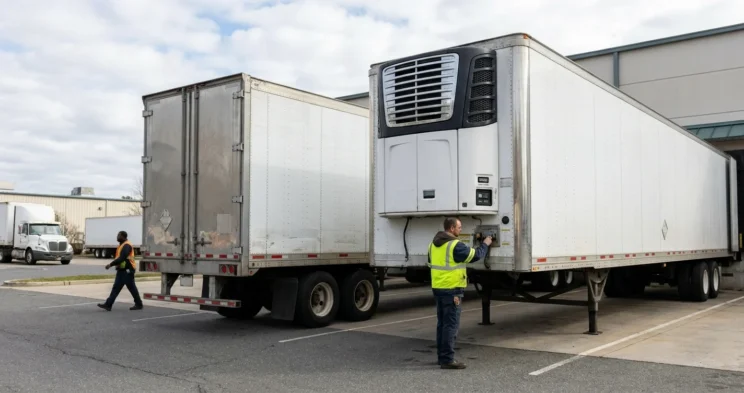
You’re standing on the shoulder of I-35 looking at the trailer that hit you, and it’s a sealed metal box with no windows and no way to see what happened inside before the crash. A dry van and a reefer trailer look almost identical from the outside.
A reefer carries its own refrigeration unit to keep temperature-sensitive freight cold, while a dry van relies only on its walls and roof to contain the cargo. After a crash, the type of trailer can affect how the cargo failed and which records may help prove what happened.
The Federal Rule Behind Every Trailer Comparison
49 CFR 393.100 is the federal rule that controls how any commercial trailer must contain its cargo, and it applies before a dry van or reefer ever leaves the dock. Section 393.100(a) covers trucks, truck tractors, semitrailers, full trailers, and pole trailers, which puts both dry vans and reefers squarely inside its scope as semitrailers.
The rule sets two performance duties. Under 393.100(b), cargo must be loaded and secured to prevent it from “leaking, spilling, blowing or falling from the motor vehicle.” Under 393.100(c), cargo must be “contained, immobilized or secured” to prevent shifting that affects the vehicle’s stability or maneuverability.
49 CFR 393.106 supplies the method for meeting that standard inside an enclosed trailer through dunnage, shoring bars, tiedowns, and chocking for anything that could roll. There is no separate rule written just for dry vans or reefers, because the commodity-specific sections of Subpart I cover things like logs, metal coils, and concrete pipe, not general boxed freight. That makes 393.100 and 393.106 the correct legal anchor for a Texas truck accident claim involving either trailer type.
How Dry Vans, Reefers, Curtainsides & Conestogas Contain Cargo
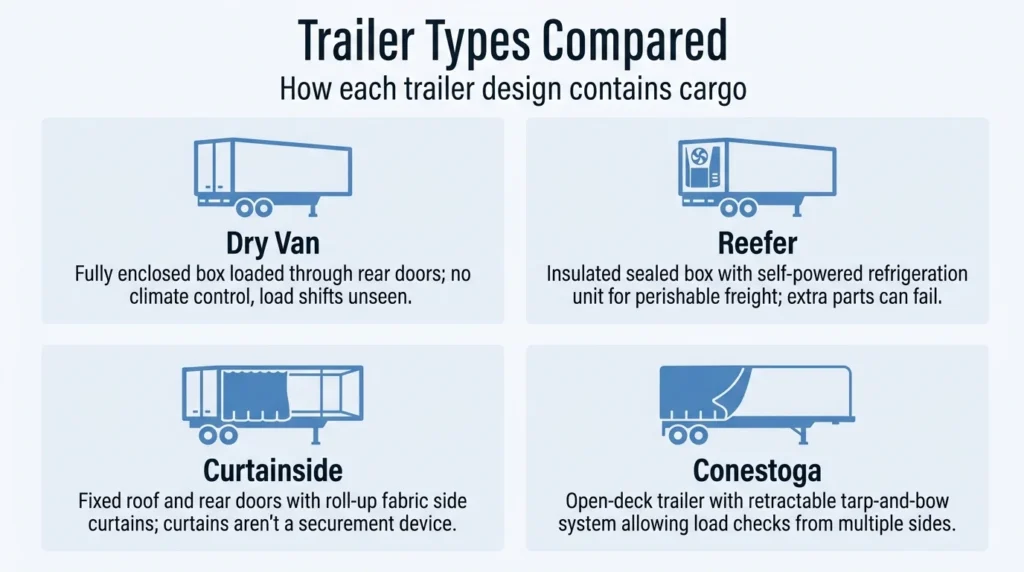
The “dry van vs reefer trailer” comparison comes down to how each trailer contains its load. Curtainsides and conestogas allow greater access to the freight during transit, while dry vans and reefers keep the freight enclosed behind solid walls and doors.
Dry van. A dry van is a fully enclosed box loaded through rear swing or roll-up doors at the dock. It has no climate control, and once the doors close, nobody can see whether the load has shifted.
Reefer. A reefer is structurally the same sealed box as a dry van, but it is insulated and equipped with a self-powered refrigeration unit that maintains temperature for perishable freight. That unit and its internal air-chute hardware are additional parts that can fail or get struck by a shifting load.
Curtainside (tautliner). A curtainside has a fixed roof, front wall, and rear doors, with roll-up fabric curtains on the sides instead of solid walls. The curtains protect against weather, but they are not a securement device, so the freight still needs its own blocking and bracing.
Conestoga. A conestoga is an open-deck trailer with a retractable tarp-and-bow system that slides to allow loading from the rear, front, side, or top. Because the deck stays open, the load can be checked at almost any point on the route, unlike a sealed van or reefer.
Industry sources do not always draw the line between curtainside and conestoga the same way, and some describe a conestoga as a type of curtainside with a full sliding roof. For a crash claim, the practical question is whether the trailer design allowed the cargo to be accessed and inspected during transit.
Why a Sealed Trailer Can Hide a Load Failure
49 CFR 392.9 puts the inspection duty on the driver, not just the shipper. Before a trip, the driver must confirm the cargo is properly distributed and secured, and that the doors, tailgate, and tarpaulins are fastened. The driver must check again within the first 50 miles and periodically during the rest of the trip.
That duty has an exception written directly into the rule. A driver of a sealed trailer, or one loaded so that inspection is impracticable, does not have to meet the re-inspection requirement.
That exception is why a dry van or reefer can hide a problem that a curtainside or conestoga driver would likely catch. A curtainside driver can glance through a gap in the curtain. A conestoga driver can check under the tarp. A dry van or reefer driver behind a sealed door often cannot, and under 392.9, is not required to try.
Enclosed-Trailer Failure Modes That Lead to Texas Truck Accident Claims
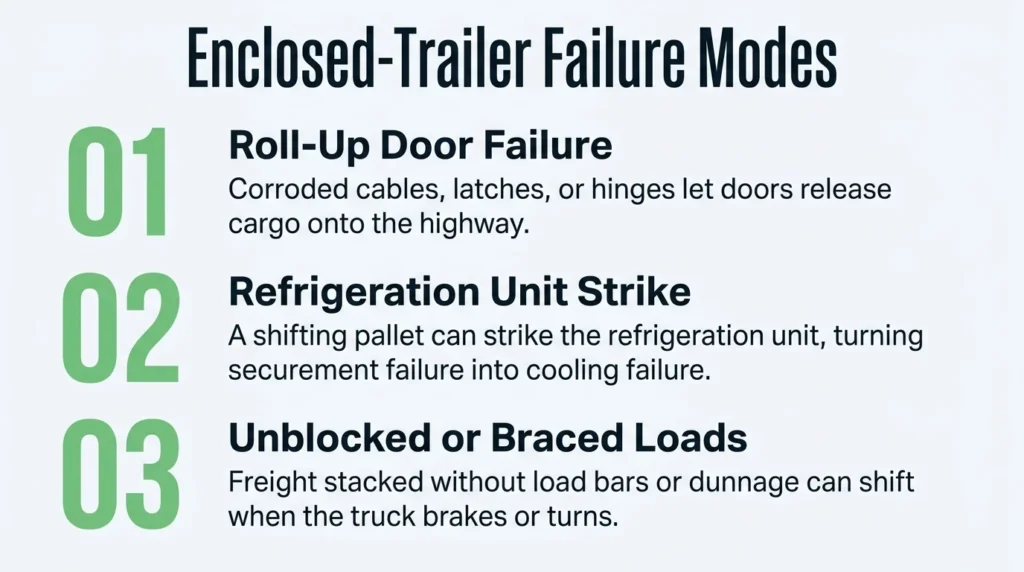
Because a dry van or reefer keeps its cargo out of sight, most enclosed-trailer failures in Texas truck accident claims trace back to a securement or maintenance problem inside the box.
Roll-up doors that release in transit. Door hardware, including support cables, latches, hinges, springs, and rails, corrodes from road salt, freeze-thaw cycling, and sun exposure without regular grease and cable-tension checks. A door that was not properly latched, or a cable that finally gives out, can swing open on the highway and release the load onto the road.
Refrigeration units struck by a shifting load. A reefer’s refrigeration unit and its air-chute hardware sit inside the same sealed box as the freight. A pallet that was never blocked against the front bulkhead can shift into that equipment during braking or a hard turn, turning a securement failure into a cooling failure.
Loads that were never blocked or braced. Under 393.106, cargo inside a dry van or reefer has to be held in place with dunnage, load bars, or blocking, not stacked and left to friction alone. Empty space can contribute to shifting-cargo truck accidents by allowing freight to move when the truck brakes or turns. The sealed box can keep this kind of failure out of sight until something goes wrong.
Consider a load of palletized goods stacked in a reefer trailer with no load bars and several feet of open space near the rear doors. If that load shifts hard enough during a sudden highway stop, it can push against the doors or the refrigeration unit with enough force to cause a failure the driver never saw coming.
Building the Case With Inspection Records, Load Photos & Temperature Logs
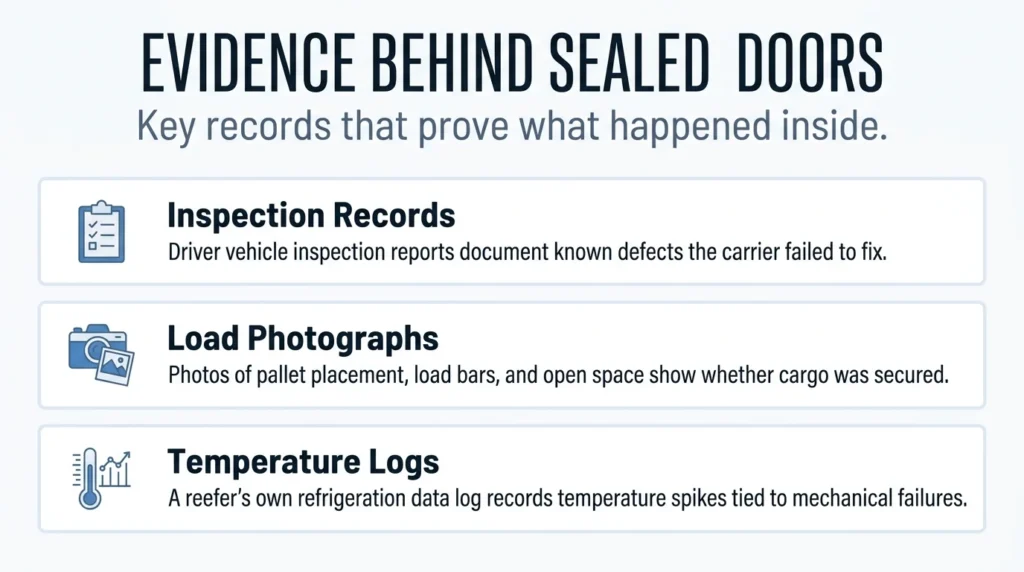
Inspection records, load photographs, and temperature logs can help establish what happened inside a sealed trailer.
Trailer inspection records. Federal rules require a driver vehicle inspection report that covers the trailer doors, and the driver has to be satisfied that the vehicle, including its cargo securement, is safe before the trip. A defect that was noted and never fixed is documentary proof of what the carrier knew.
Load configuration photographs. Photos of how the load was built, including pallet placement, the presence or absence of load bars and dunnage, and how much open space was left inside the trailer, show whether the load was secured as it should have been.
Temperature logs for reefer loads. A reefer’s refrigeration unit keeps its own data log of the set point and the supply and return air temperature. That log is generally treated as more reliable than a separate logger a shipper may place with the cargo. A temperature spike that lines up with a mechanical or securement problem is often central evidence in a refrigerated-cargo case.
Responsibility for an enclosed-trailer failure can fall on more than one party. The driver has a duty under 392.9 to inspect and confirm securement. The motor carrier is responsible for training, maintenance, and for allowing an improperly loaded trailer on the road. A third-party shipper or loader may also be responsible when it built or secured the load.
Texas gives these federal rules direct legal force. Texas Transportation Code Chapter 644 adopts the federal motor carrier safety regulations, including Parts 392 and 393, for commercial vehicles operating in Texas, and federal rules control when a vehicle is engaged in interstate commerce.
Injured in a Texas Dry Van or Reefer Trailer Accident? Talk to Angel Reyes & Associates
Reconstructing an enclosed-trailer accident may require inspection records, load photographs, and temperature logs showing what happened behind the sealed doors.
Angel Reyes & Associates has spent more than 30 years guiding injured Texans through truck accident claims. Contact Angel Reyes & Associates for a free consultation to discuss what happened and your options.
Past results do not guarantee future outcomes.
Dry Van & Reefer FAQs
Can a trucking company be liable if a shipper loaded and sealed the trailer?
Potentially. Liability can depend on who controlled the loading process, whether a cargo defect was apparent to the carrier or driver, and what each party knew or reasonably could have discovered before the trip.
What happens to cargo after a dry van or reefer truck accident?
Cargo may be unloaded, transferred, salvaged, or discarded after a crash, which can change or destroy evidence of how the load was positioned. Photographs, bills of lading, loading records, and other documentation can therefore become important evidence of the pre-crash configuration.
Can a truck's electronic data show whether shifting cargo contributed to a crash?
The electronic control module and other vehicle data may document information such as vehicle speed, braking, and other operating conditions around a crash. Investigators can compare that data with cargo and physical evidence to evaluate whether vehicle movement may have contributed to a load shift.
How long do I have to file a truck accident lawsuit in Texas?
Texas generally provides a two-year limitations period for personal injury claims under Texas Civil Practice and Remedies Code Section 16.003, although exceptions can affect the deadline. Waiting can also make truck-specific evidence more difficult to preserve.
What is a bill of lading, and why does it matter after a truck accident?
A bill of lading is a shipping document that identifies the freight, shipper, carrier, destination, and other details of the shipment. In a cargo-related truck accident investigation, it can help establish who handled the load and provide leads to additional shipping and loading records.
About the Authors

Angel Reyes
Writer
Angel L. Reyes, III is the Founder and Managing Partner of Angel Reyes & Associates. A nationally recognized trial attorney and business leader, Angel has helped over 70,000 injury victims recover more than $1 billion since founding the firm in 1993. Named to the Texas Super Lawyers list annually since 2008, Angel brings Wall Street experience, Ivy League education, and a deep commitment to client advocacy. He is a frequent legal commentator and published author with extensive contributions to legal scholarship, trial strategy, and consumer protection.

Kyle Nicolas
Editor
Kyle Nicolas is the Web Content & SEO Manager at Angel Reyes & Associates. He has more than 10 years of experience as a marketing co...

Angel Reyes
Reviewer
Angel L. Reyes, III is the Founder and Managing Partner of Angel Reyes & Associates. A nationally recognized trial attorney and business...