Who Is Responsible for a School Bus Accident in Texas?


Every article on this site is researched by our internal team, reviewed for legal accuracy against current Texas law, and held to State Bar of Texas advertising standards before publication. We do not publish content that overstates outcomes or makes promises about results.
Learn more about our
editorial standards .
Key Takeaways
- Who operated the bus, a district or private company, decides which rules control your claim.
- You must give a Texas school district written notice of your claim within six months.
- Tort Claims Act caps district recovery at $100,000 per person and $300,000 per crash.
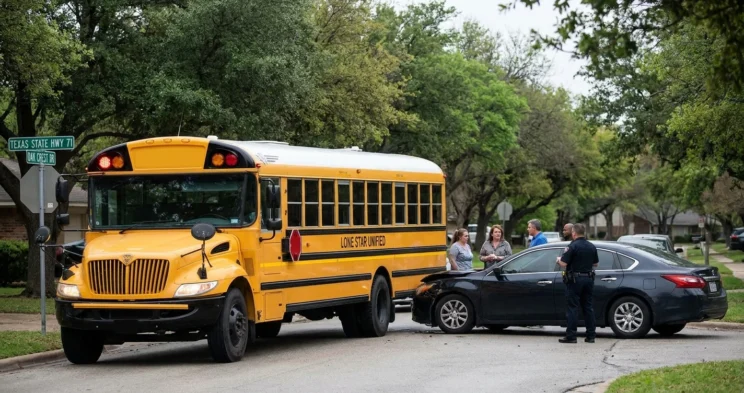
Your child rode the same bus home every afternoon, the one that turns off Camp Bowie Boulevard toward your neighborhood in Fort Worth. Today the call came instead: there was a crash, and your child is hurt. Now you are staring at medical bills and have one question you never expected to ask. Who do you hold responsible?
Who Can Be Liable for a Texas School Bus Crash?
More than one party can be responsible for a school bus crash, and figuring out who is responsible for your school bus accident injuries starts with a single question: who actually operated the bus?
That answer decides which legal rules control your entire claim. From there, the bus driver, the bus manufacturer, and any other driver involved can each carry a share of the fault.
School bus accident liability in Texas is rarely a one-defendant situation. A single crash can bring in the district, a private company, an individual driver, and a parts maker all at once. Sorting out each party’s role is the first real step toward getting your child what they are owed.

School District or Private Contractor?
The first legal question is whether a public school district or a private company ran the bus. This one fact changes everything that follows.
When the district owns and operates the bus, Texas Civil Practice and Remedies Code (CPRC) Chapter 101, known as the Texas Tort Claims Act, governs your claim. That law lets you sue a government body, but only for narrow reasons. It waives immunity for injuries caused by a district employee’s negligent operation of a vehicle, and it limits how much money you can recover.
The rules flip when a private transportation company runs the route under contract. Governmental immunity does not shield that company at all. No statutory damage caps limit your compensation, and your claim proceeds under standard negligence rules, the same as any other crash.
The district can still be on the hook even when it hires out the driving. If it was careless in choosing or supervising the contractor, that is a separate claim against the district itself.
Bus Driver, Manufacturer & Third-Party Drivers
Three more parties can share the blame: the driver behind the wheel, the company that built the bus, and any other motorist who helped cause the crash. Each one comes with its own legal path.
The bus driver can be sued in their own name. Under Texas Education Code § 22.051, certified school bus drivers qualify as professional employees of a school district. But Texas Education Code § 22.0511, which grants those employees immunity for discretionary acts, expressly excludes the operation, use, or maintenance of any motor vehicle. A driver who drove carelessly is personally responsible for it.
The company that built the bus may owe you too. When a defect in the brakes, seat belts, or emergency exits played a part in the crash, you may have a product claim under Texas Civil Practice and Remedies Code Chapter 82. Federal school bus safety rules can support that claim as well.
Any other driver who caused or added to the wreck is a direct defendant. No government immunity questions cloud a claim against a private motorist. When several parties share fault, Texas splits responsibility among them, so more than one check may be on the table for your school bus crash injury claim.
The Six-Month Notice Requirement
If a government-run district operated the bus, you must send it a written notice of your claim within six months of the crash. This deadline is separate from any lawsuit, and it can quietly end your case before it begins.
Under Texas Civil Practice and Remedies Code § 101.101, that notice has to describe the injury, name the time and place, and explain what happened. It is a formal step, not a phone call. Treat it as the clock that matters most in the early weeks.
Missing the deadline does not always kill the claim. If the district already had actual knowledge of the injury, a late filing might still stand. That exception is narrow, though, and no family should count on it.
Send the notice to the school district itself, not the bus driver and not the campus principal. Notice pointed at the wrong office may not count at all. Getting the recipient right is as important as getting the timing right.
These rules apply only to government defendants. A private contractor or another driver faces no six-month notice rule, though the requirement still applies to any district also named in the case.
The steps for pursuing a claim against a public body have their own path.
Damage Caps & Proportionate Responsibility
Two separate rules shape how much you can actually collect: a limit on money when the district is a defendant, and a fault-sharing system when several parties are to blame. Both can shrink the final number, so both deserve a look before you settle anything.
TTCA Damage Caps
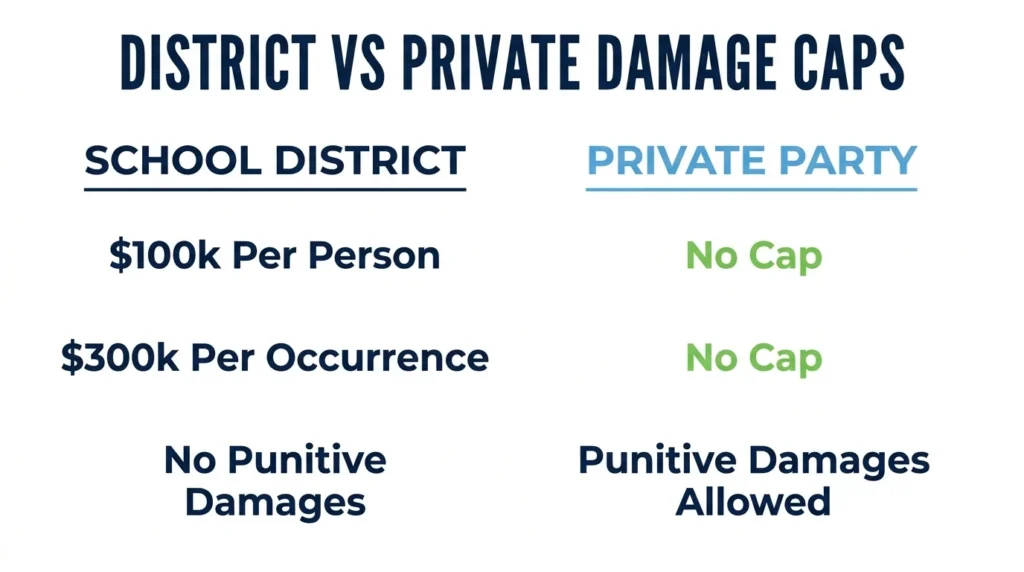
When the school district is liable, the Texas Tort Claims Act limits your compensation. The limit is $100,000 per person and $300,000 per single occurrence for personal injury or death, set by Texas Civil Practice and Remedies Code § 101.023.
These caps hit only the government. Private contractors, other drivers, and bus manufacturers face no such limit, so a claim against them can reach far higher. Punitive damages, or damages that punish the defendant for gross negligence, are also off the table against a government body.
Proportionate Responsibility in Multi-Defendant Cases
Texas splits fault among everyone responsible, and each defendant pays only their share. Under Texas Civil Practice and Remedies Code § 33.001, this proportionate responsibility system ties each party’s payment to their slice of the blame.
There is a limit on your own fault, too. You can recover only if your share of the blame is 50 percent or less. Reach 51 percent or more and your right to recover money disappears entirely.
When a crash involves both the district and another driver, a jury sorts out each party’s percentage. The Tort Claims Act cap then applies only to the district’s portion, not the whole verdict. That structure can matter a great deal in a serious school bus crash injury claim, especially where a family lost a loved one and may need to consider a wrongful death claim.
Steps to Protect Your School Bus Injury Claim
The strongest thing you can do in the first days after a crash is move quickly and keep records. The steps below are time-sensitive, and each one guards a piece of your claim:
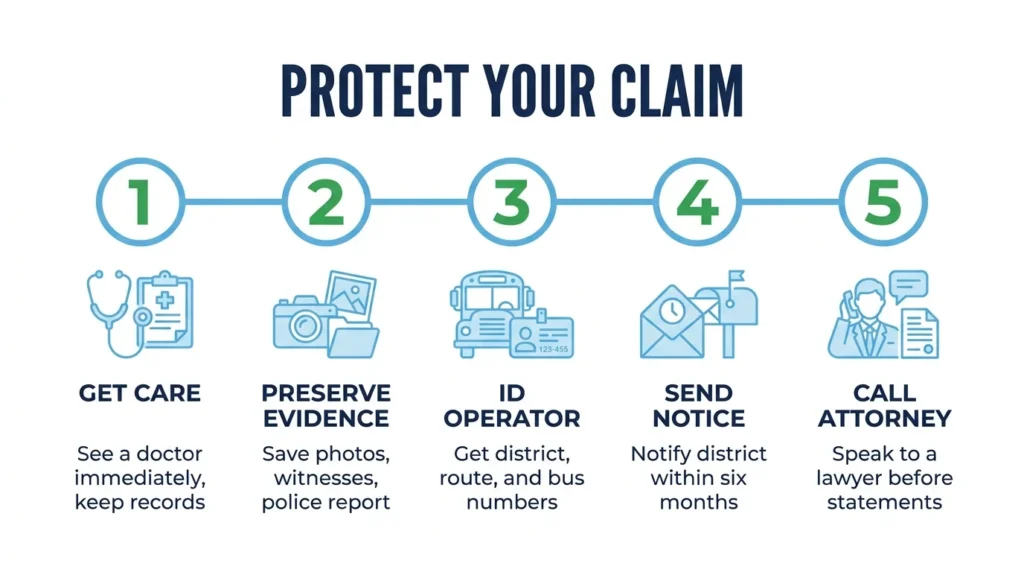
- Step 1: Get medical care right away. Have your child seen even if injuries look minor, and keep every diagnosis and treatment record. These documents anchor the whole claim.
- Step 2: Preserve the evidence. Save photos, witness contact information, and the police report number. Ask in writing for any dashcam or bus camera footage before it is erased.
- Step 3: Identify the operator. Get the district’s name, the route number, the bus number, and the contractor’s name if a private company ran the route. Operator identity decides which legal rules apply to you.
- Step 4: Send a written notice within six months. If the district operated the bus, deliver the formal notice to the district early. Do not wait for settlement talks to start.
- Step 5: Talk to an attorney before you give a statement. Speak with a personal injury attorney before you give any recorded statement to an insurer or district.
Talk to an Experienced Attorney Today
Angel Reyes & Associates has helped injured Texans for more than 30 years, with more than $1 billion recovered for clients in accidents across the state. We know how quickly a school bus claim can turn on a missed deadline or a wrong defendant, and we do not want that to happen to your family.
Our consultations are free, and we work on contingency, which means no fee unless we win. We are available 24/7, we serve families across Texas, and you can see what our clients say about working with us.
You do not have to sort out who is responsible on your own. Reach out to us for a free consultation so you understand your options before the six-month clock runs out.
Past results do not guarantee future outcomes.
School Bus Accident Liability FAQs
How long do you have to file a lawsuit after a school bus accident in Texas?
You have two years from the date of the crash to file a personal injury lawsuit under Texas Civil Practice and Remedies Code § 16.003. This is separate from the six-month notice deadline: you must meet both, and missing either one can end your claim.
Does the two-year filing deadline change when the injured person is a minor?
A minor child’s personal injury claim is tolled until the child turns 18, giving them until their 20th birthday to file. The parents’ own claim for medical expenses paid on behalf of the child is not suspended, so parents must act within two years of the crash to recover those costs.
Does the six-month notice deadline pause when the injured person is a minor?
Texas courts have generally held that the TTCA notice requirement is not automatically suspended because the injured person is a minor. A parent or guardian should not assume the six-month deadline extends simply because the child is under 18.
Do the same TTCA rules apply to a charter bus used for a school field trip?
No. A private charter company is not a governmental unit, so governmental immunity, the six-month notice requirement, and the TTCA damage caps do not apply to claims against it. Those claims proceed under standard negligence rules, with no statutory limit on compensation.
Can a parent file a separate claim for the medical bills paid after a school bus crash?
Yes. Medical expenses incurred for a minor child belong to the parents, not the child, so parents have a separate claim for those costs. That claim follows the standard two-year statute of limitations and is not suspended by the child’s age.
About the Authors

Angel Reyes
Writer
Angel L. Reyes, III is the Founder and Managing Partner of Angel Reyes & Associates. A nationally recognized trial attorney and business leader, Angel has helped over 70,000 injury victims recover more than $1 billion since founding the firm in 1993. Named to the Texas Super Lawyers list annually since 2008, Angel brings Wall Street experience, Ivy League education, and a deep commitment to client advocacy. He is a frequent legal commentator and published author with extensive contributions to legal scholarship, trial strategy, and consumer protection.

Graham Griffin
Editor
Graham Griffin is the Web & Content Manager at Angel Reyes & Associates, where he oversees content strategy, AI-powered workflows, a...

Angel Reyes
Reviewer
Angel L. Reyes, III is the Founder and Managing Partner of Angel Reyes & Associates. A nationally recognized trial attorney and business...