Why Drivers Can’t See Motorcycle Riders


Every article on this site is researched by our internal team, reviewed for legal accuracy against current Texas law, and held to State Bar of Texas advertising standards before publication. We do not publish content that overstates outcomes or makes promises about results.
Learn more about our
editorial standards .
Key Takeaways
- Inattentional blindness makes drivers miss motorcycles even with a clear line of sight.
- "I never saw you" is not a defense; Texas law requires drivers to keep a proper lookout.
- Texas gives injured riders two years from the crash date to file an injury claim.

You were riding home through Fort Worth one evening, headed toward Benbrook on Camp Bowie Boulevard, when a driver turned left across your lane. They hit you, then climbed out saying the same four words you keep hearing: “I never saw you.”
Now their insurance company is treating those words like an excuse that gets the driver off the hook. It does not.
Why Drivers Miss Motorcycles on the Road
Drivers miss motorcycles because of a documented limitation in how the human brain processes the road. Researchers call it inattentional blindness, and it means the brain filters out objects it does not expect to see.
Most drivers are mentally primed to look for car-sized vehicles. A motorcycle is smaller and narrower, so the brain can screen it out during a quick intersection scan even when the rider is in plain view. This is the “looked but failed to see” phenomenon, and it shows up in controlled research.

A 2018 study in the journal Human Factors put drivers in a simulator and tracked what they detected. The researchers found that 65% of participants missed a motorcycle, compared with 31% who missed a taxi. You can read the published findings through the National Library of Medicine.
This is not carelessness as a personality flaw. It is a predictable attention-related failure, and it happens to ordinary drivers who believe they were watching the road.
A research synthesis from SMARTER USA reached the same conclusion. After actively scanning the road, drivers were roughly five times more likely to fail to recall seeing a motorcycle than a car.
Federal crash data confirms how often this turns deadly. The Motorcycle Crash Causation Study published by the Federal Highway Administration found that an unsafe act by the other vehicle’s driver contributed to roughly 63% of multi-vehicle motorcycle crashes, and that driver perception failure specifically was a factor in approximately 30% of those wrecks.
The science shows that “I didn’t see them” describes a real perceptual failure. It does not describe a rider who was invisible or at fault. For a closer look at how often these crashes happen statewide, review a breakdown of Texas motorcycle accident statistics.
Crash Scenarios Linked to Driver Perception Failure
The same perception failure produces three crash patterns again and again. Each one starts with a driver who had a clear line of sight and still failed to register the rider.
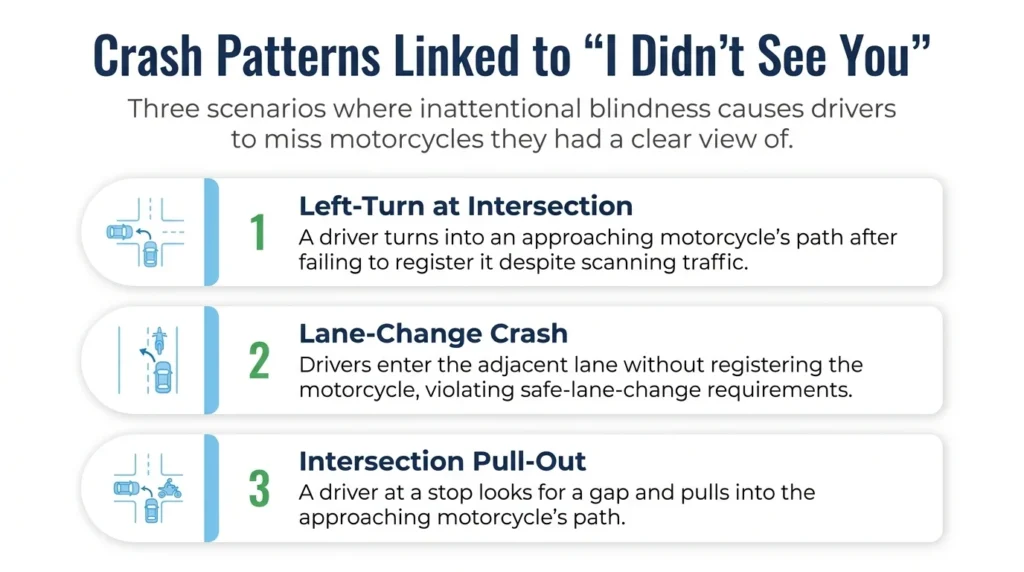
The first is the left-turn crash at an intersection. The driver looks left, does not register the oncoming motorcycle, and turns directly into its path. This is the most common multi-vehicle motorcycle fatality scenario and is among the most dangerous.
The second is the lane-change crash. A driver moves into the next lane without fully checking for a motorcycle in the blind spot. Texas law requires drivers to change lanes safely and only when the move can be made without interfering with other traffic, under Texas Transportation Code § 545.060.
The third is the intersection pull-out. A driver at a stop sign or driveway looks for a gap in traffic, fails to detect the motorcycle filling that gap, and pulls out. The rider is moving at full speed with no time to react. Drivers entering a roadway from a driveway or private road must yield to approaching traffic.
All three share one cause. The driver failed to allocate enough attention to detect the rider despite a clear view, which is why these collisions fall squarely within motorcycle accident claims.
“I Didn’t See You” Is Not a Legal Defense
A driver’s claim that they never saw you does not reduce or erase their liability. Texas law requires every driver to keep a proper lookout, which means seeing what a reasonably careful driver would have seen.
Claiming you were invisible does not satisfy that duty. The “looked but failed to see” problem is exactly what the duty-to-see standard exists to address. A driver who fails to notice a motorcycle that was present and visible has breached the duty of care, whether or not the lapse was deliberate.
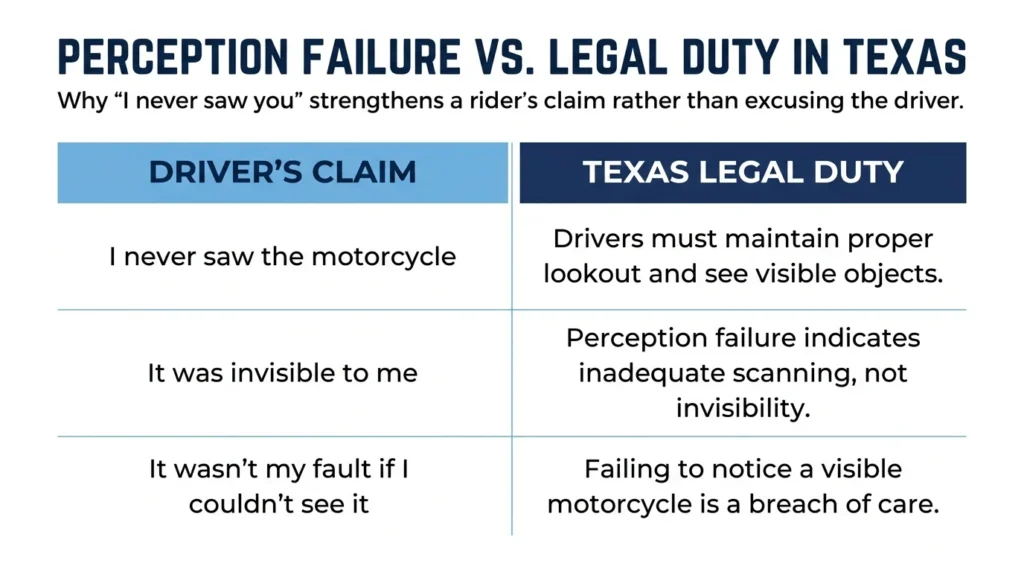
Courts and insurers in Texas apply the same test. The question is not whether the driver was paying attention in their own mind. The question is whether a reasonably careful driver in that situation would have seen the rider, which is central to how fault is determined in a Texas crash.
The research answers that question. A reasonably careful driver who scans the road properly can and does detect motorcycles. So a driver’s statement that they never saw you can actually strengthen your claim, because it confirms the required lookout was not maintained.
Texas Fault Rules & Your Right to Recover
You can recover compensation in Texas as long as you are found 50% or less at fault for the crash. Texas uses a modified comparative fault system under Chapter 33 of the Texas Civil Practice and Remedies Code (CPRC) § 33.001, which sets the threshold for compensation.
If the driver failed to keep a proper lookout and that failure caused the crash, the driver carries the majority of the fault. Your recoverable damages drop only by the percentage of fault assigned to you.
Insurance adjusters know this, so they work to shift fault onto you. Here is how the fault framework plays out when you push back:
- Understand the 51% bar. Under CPRC § 33.001, you recover nothing if you are found more than 50% at fault. Staying at or below that line protects your claim.
- Expect the common fault-shifting arguments. Adjusters routinely claim the rider was speeding, hiding in a blind spot, or wearing dark clothing to push the fault percentage higher.
- Know how the math works. If the driver is 80% at fault and you are 20%, you recover 80% of your proven damages. A working attorney can counter fault-shifting tactics with the facts of your specific crash.
- Watch the two-year deadline. Texas gives you two years from the date of the crash to file a personal injury claim, under CPRC § 16.003. Miss it and you lose the right to recover.
Knowing your fault percentage and your timeline matters before you negotiate, especially if you want to understand how motorcycle accident settlements work in Texas before you accept any payment.
Speak With an Experienced Attorney Today
If you are facing an insurer or a driver who insists “I never saw you,” you deserve representation that understands both the science and the law behind your crash. Angel Reyes & Associates has spent over 30 years handling motorcycle accident cases for injured Texans, with more than $1 billion recovered for clients across the state.
We work on contingency, so there is no fee unless we win, and you can reach us 24/7 from anywhere in Texas. Our team can walk you through your options and counter the excuses an insurer uses to shrink your claim. You can meet the attorneys who would handle your case or find one of our office locations near you.
Contact us for a free consultation so you understand where you stand before time runs out.
Past results do not guarantee future outcomes.
Motorcycle Accident Claim FAQs
Is lane splitting legal in Texas, and does it affect fault if I was doing it at the time of a crash?
Lane splitting is illegal in Texas under Transportation Code § 545.060, and if you were riding between lanes when the crash happened, an insurer may use that to argue your fault percentage should be higher. Whether it actually changes the outcome depends on how much the driver’s own failure to see you contributed to the collision.
What if the driver who hit me has no insurance?
You can file a claim through your own uninsured motorist (UM) coverage if you have it, which pays for medical bills, lost wages, and pain and suffering when the at-fault driver carries no insurance. Texas does not require UM/UIM coverage on motorcycles, so whether that option is available depends on your policy.
Can not wearing a helmet reduce how much I recover?
Texas uses comparative fault, so if an insurer argues that not wearing a helmet made your head or brain injuries worse, they may try to raise your fault percentage to reduce your payout. Not wearing a helmet does not bar you from recovering anything, but it can shrink the total if a jury finds it contributed to the severity of your injuries.
What types of compensation can I seek after a motorcycle crash?
Texas personal injury claims can include medical bills, future treatment costs, lost wages, reduced earning capacity, motorcycle repair or replacement, and non-economic losses like pain, mental anguish, and loss of enjoyment of life. Texas does not cap non-economic damages in standard injury cases, so the amount recoverable depends on the facts and severity of your crash.
What should I do at the crash scene to protect my claim?
Call 911, get a police report, photograph the vehicles, road conditions, and your injuries, and collect the other driver’s insurance and contact information. Do not admit fault or make guesses about what happened; stick to the facts when speaking with officers or the other driver’s insurer.
About the Authors

Angel Reyes
Writer
Angel L. Reyes, III is the Founder and Managing Partner of Angel Reyes & Associates. A nationally recognized trial attorney and business leader, Angel has helped over 70,000 injury victims recover more than $1 billion since founding the firm in 1993. Named to the Texas Super Lawyers list annually since 2008, Angel brings Wall Street experience, Ivy League education, and a deep commitment to client advocacy. He is a frequent legal commentator and published author with extensive contributions to legal scholarship, trial strategy, and consumer protection.

Kyle Nicolas
Editor
Kyle Nicolas is the Web Content & SEO Manager at Angel Reyes & Associates. He has more than 10 years of experience as a marketing co...

Angel Reyes
Reviewer
Angel L. Reyes, III is the Founder and Managing Partner of Angel Reyes & Associates. A nationally recognized trial attorney and business...