Why Motorcycle Accidents Become More Dangerous at Night


Every article on this site is researched by our internal team, reviewed for legal accuracy against current Texas law, and held to State Bar of Texas advertising standards before publication. We do not publish content that overstates outcomes or makes promises about results.
Learn more about our
editorial standards .
Key Takeaways
- Motorcycle fatalities at night are disproportionately high compared to miles ridden after dark.
- Texas law holds impaired drivers fully liable when their DWI caused your nighttime crash.
- Your motorcycle's headlamp must be on at all times in Texas, and lighting violations affect fault.
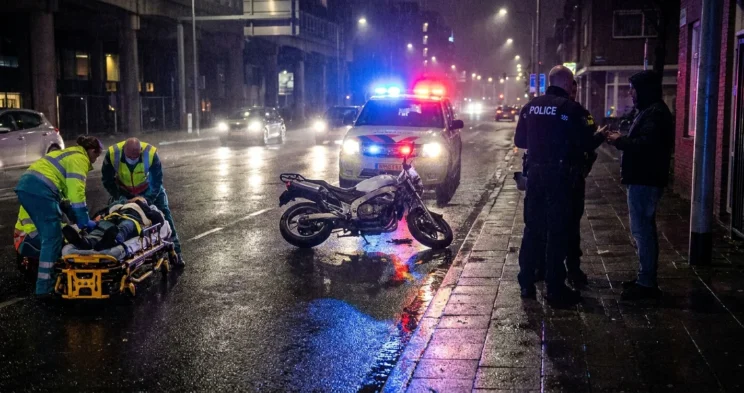
You were heading home from a late shift when a driver ran a light on South Lamar Boulevard near Barton Hills and hit your motorcycle. The collision happened before you had time to brake. Nighttime crashes tend to happen fast, and they tend to be more severe.
Nighttime Motorcycle Crash Risk Factors
Four specific conditions make riding after dark much more dangerous than riding in daylight, and each one can appear in the facts of a nighttime crash legal claim.
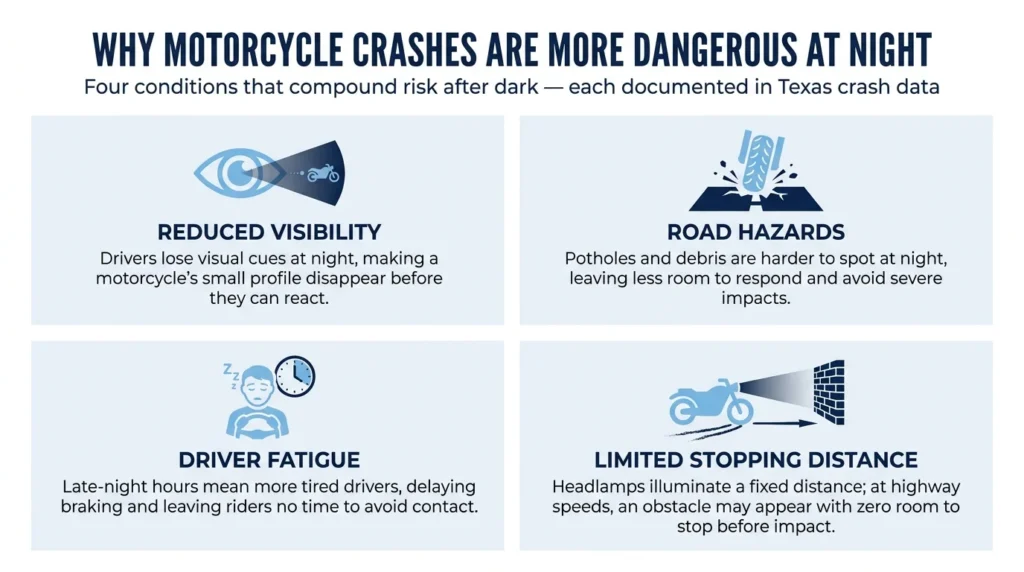
- Reduced visibility. Your bike is harder for other drivers to spot than most vehicles, even in full daylight. At night, that problem gets worse. Because vehicle drivers cannot see you that well, they cannot judge your speed and position accurately before they react.
- Road hazards. A pothole, loose debris, or a sudden change in pavement that you would see in daylight can appear without warning at night. You have less room to respond, and hitting something at a higher speed rarely ends without serious injury.
- Fatigue and slowed reaction time. Late-night hours bring more tired drivers alongside fatigued riders. Fatigue decreases attention and delays braking. A driver who had nothing to drink can still be a danger if they have been awake long enough.
- Limited stopping distance. Your headlamp illuminates a fixed distance ahead. At highway speed, an obstacle that appears outside or even near that range may leave you no room to stop.
NHTSA data shows that motorcycle riders account for a large share of nighttime traffic deaths relative to the miles ridden after dark. The per-mile risk is much higher at night than during the day. If you were hurt in a nighttime crash, reviewing the injuries common in motorcycle accidents can help you determine what you may be facing.
Nighttime Motorcycle Fatalities in Texas
Texas recorded 574 motorcyclist deaths in 2025, according to the Texas Department of Transportation, which works out to roughly one rider killed every day on state roads. Those annual motor vehicle crash statistics show that Saturdays account for the highest concentration of fatal motorcycle crashes.
The late evening through early morning window drives much of that count. The combination of nighttime riding and weekend activity creates conditions where both crash frequency and severity rise together.
NHTSA crash data shows that motorcycle riders killed at night are significantly more likely to be alcohol-impaired than those killed during the day. That pattern appears consistently in Texas crash records as well.
For a full breakdown of Texas motorcycle crash trends, learn about Texas motorcycle accident statistics and what they mean for riders.
Drunk Drivers & Nighttime Motorcycle Risk
Impaired drivers are more concentrated on Texas roads after dark, and motorcyclists deal with an unfortunate share of the consequences.
NHTSA data shows that 26 percent of motorcycle riders killed in traffic crashes in 2024 had a BAC (Blood Alcohol Content) at or above the legal limit. For crashes between midnight and 3 a.m., the numbers are more severe: more than half of all motor vehicle deaths in that window involve alcohol impairment.
Texas Penal Code § 49.04 defines driving while intoxicated and sets the .08 BAC threshold. A driver who meets that standard while causing your crash bears both criminal exposure and civil liability for what they did.
Texas also extends liability beyond the at-fault driver in some cases. A bar or restaurant that keeps serving a visibly intoxicated customer can share civil liability. That applies when that customer later causes a crash on a public road.
If an impaired driver hits you after dark, reviewing Texas motorcycle accident claims can give you a sense of how liability is evaluated and what your options look like.
How Lighting Affects Fault in Texas
Whether your motorcycle’s headlamp was on at the time of your crash can directly affect what you recover.
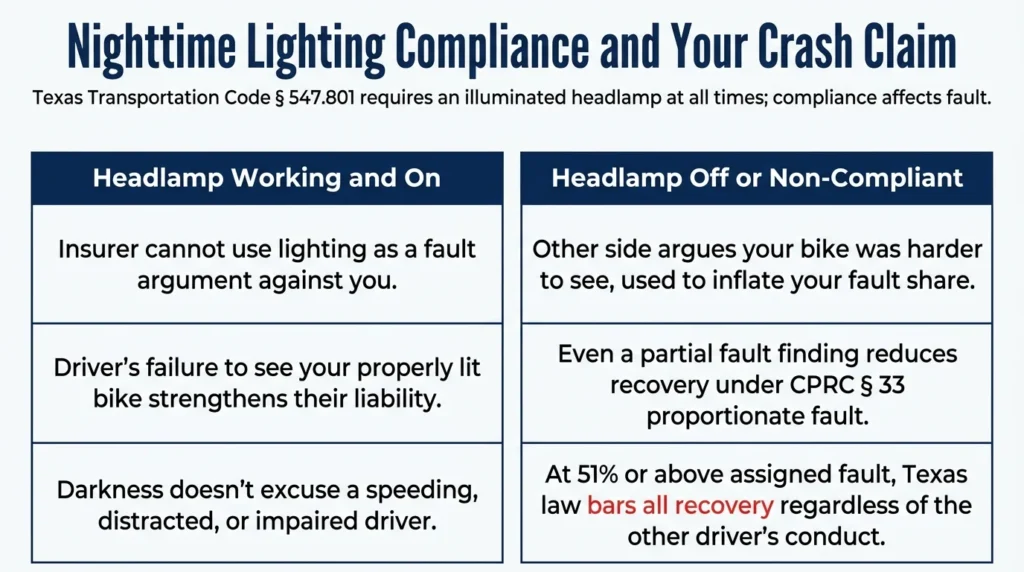
Texas Transportation Code § 547.801 requires motorcycles to operate with at least one illuminated headlamp at all times. If your lighting was not working, the other side may argue that your bike was harder to see. That argument can reduce your recovery under Texas fault rules.
Texas uses a proportionate responsibility system. Under the Texas Civil Practice and Remedies Code (CPRC) Chapter 33, your compensation is reduced by your percentage of fault for the accident. A rider found 51 percent or more at fault under CPRC rules recovers no compensation.
That standard also works in your favor when the other driver fails to see your properly lit motorcycle. Texas law holds drivers to a duty of reasonable care, or safe driving, including the duty to see what is there to be seen. Darkness does not excuse a driver who was speeding, distracted, or impaired.
If you were hit despite having your lights on, your claim is stronger. Reviewing how Texas motorcycle accident settlements work can help you assess whether the offer you’re receiving reflects your actual loss.
Work with an Attorney Today
A nighttime crash does not become less serious because it happened in low visibility. Proving what went wrong often requires a closer look at the crash report, the other driver’s record, and the physical evidence at the scene.
Angel Reyes & Associates has spent more than 30 years representing crash victims across Texas. We have recovered more than $1 billion for our clients. You can review outcomes from past cases to get a concrete sense of what we’ve handled.
We offer free initial consultations and take cases on a no-fee-unless-you-win basis. Contact us to talk through what happened and find out what your claim may be worth.
Past results do not guarantee future outcomes.
Nighttime Motorcycle Accident FAQs
How long do I have to file a motorcycle accident lawsuit in Texas?
Texas gives you two years from the date of the crash to file a personal injury lawsuit. Missing that deadline will almost always end your right to sue, regardless of how strong your case is.
What should I document at the scene of a nighttime motorcycle crash?
Get contact information for any witnesses before they leave, and note any signs the other driver may have been impaired. Request the police report as soon as it is available, since it will record the road and lighting conditions the responding officer observed.
Does not wearing a helmet affect my motorcycle accident claim in Texas?
Texas does not require helmets for riders 21 and older who meet certain insurance conditions, but the other side may still argue that riding without one contributed to your head injuries. If a jury agrees, your compensation for those injuries could be reduced by your share of fault.
Can a poorly lit road or missing streetlight affect who is liable for my crash?
It can. Texas allows claims against government entities for unsafe road conditions under the Texas Tort Claims Act, but those claims carry shorter deadlines and specific procedural requirements compared to standard personal injury suits.
What can I do if the driver who hit me at night was uninsured?
You may be able to file a claim through your own uninsured motorist coverage if you added that option to your policy, or you can pursue the at-fault driver directly in civil court. Whether uninsured motorist coverage applies depends on your specific policy terms.
About the Authors

Angel Reyes
Writer
Angel L. Reyes, III is the Founder and Managing Partner of Angel Reyes & Associates. A nationally recognized trial attorney and business leader, Angel has helped over 70,000 injury victims recover more than $1 billion since founding the firm in 1993. Named to the Texas Super Lawyers list annually since 2008, Angel brings Wall Street experience, Ivy League education, and a deep commitment to client advocacy. He is a frequent legal commentator and published author with extensive contributions to legal scholarship, trial strategy, and consumer protection.

Kyle Nicolas
Editor
Kyle Nicolas is the Web Content & SEO Manager at Angel Reyes & Associates. He has more than 10 years of experience as a marketing co...

Angel Reyes
Reviewer
Angel L. Reyes, III is the Founder and Managing Partner of Angel Reyes & Associates. A nationally recognized trial attorney and business...