Dealing With A State Farm Auto Accident Claim


Every article on this site is researched by our internal team, reviewed for legal accuracy against current Texas law, and held to State Bar of Texas advertising standards before publication. We do not publish content that overstates outcomes or makes promises about results.
Learn more about our
editorial standards .
Key Takeaways
- State Farm uses separate adjusters for property damage and bodily injury claims after a crash.
- Audatex software drives State Farm total loss values and is often disputed with local comparables.
- Texas gives you two years to file an injury lawsuit under Civil Practice & Remedies Code 16.003.

You’re stopped at a light near downtown Houston when a driver rear-ends you. The other driver hands you a State Farm insurance card. Within a day, an adjuster calls and gives you a claim number. They pressure you to settle quickly.
You have just experienced one small part of dealing with a State Farm auto accident claim. Understanding what to expect can help you decide what to do next.
State Farm’s Dual Adjuster System
State Farm assigns two separate adjusters to most accident claims: one for property damage and one for bodily injury. This split surprises many claimants who expect a single contact. It also changes how you communicate, document, and negotiate at every step.
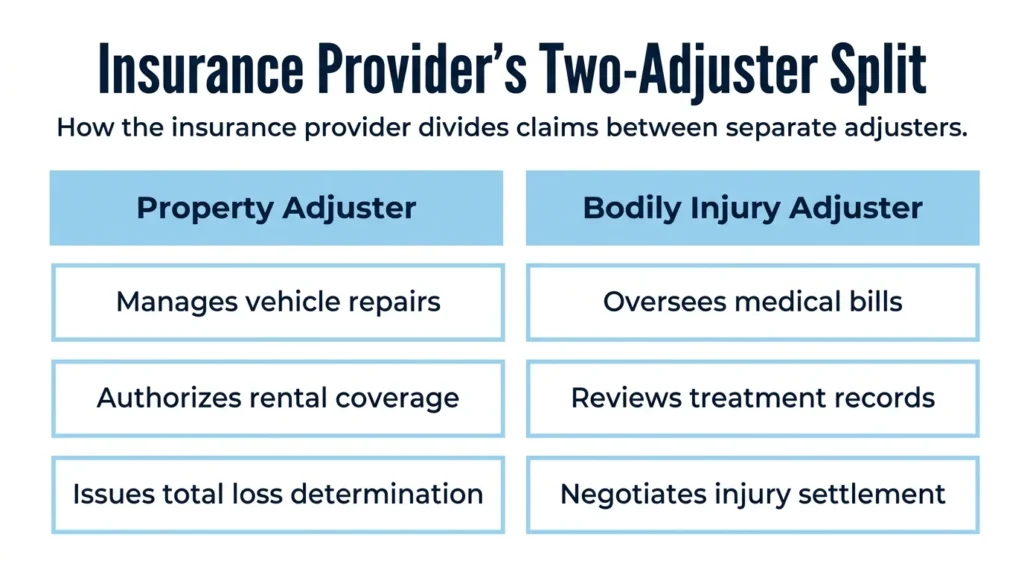
The property damage adjuster handles your vehicle repairs or total loss determination. They focus on estimates, shop authorizations, and rental coverage. Their authority stops at your car. A different person handles anything related to medical bills, lost wages, or pain and suffering.
The bodily injury adjuster handles the human side of the claim. This includes medical expenses, treatment records, and any settlement for auto accident injuries. This adjuster typically waits longer to engage, sometimes weeks after the crash, because they want to see how your treatment unfolds.
You should send each adjuster only what relates to their part of the claim. Mixing property and injury communications can cause confusion, delays, and sometimes contradictions that hurt your case. Keep a written log of every call, every email, and every document submitted. How insurance companies investigate claims often relies on inconsistencies between what you tell different people.
State Farm Total Loss Valuations & Audatex
When your vehicle is declared a total loss, State Farm uses Audatex software to calculate the vehicle’s actual cash value. The software pulls comparable listings from your local market and applies adjustments for mileage, condition, and options. The number produced is often lower than what claimants believe their car is worth.
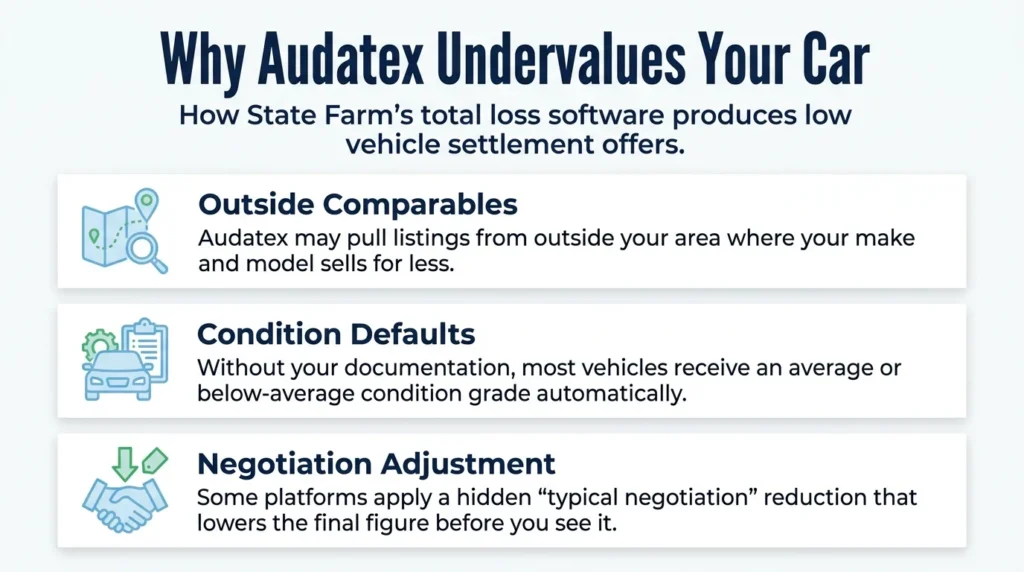
Audatex valuations sometimes use comparables from outside your immediate area or vehicles in worse condition than yours. The software also makes condition adjustments based on assumptions, not always on a hands-on inspection. Federal vehicle standards under 49 CFR Part 571 govern safety requirements but do not dictate how insurers value totaled vehicles.
To challenge a low offer, gather your own evidence. Pull listings for the same year, make, model, and trim in your zip code. Collect maintenance records, receipts for recent tires or repairs, and photos showing the pre-crash condition. Submit a written counter-demand with this documentation attached.
If State Farm refuses to adjust, you can request the underlying Audatex report and review each comparable used. Errors in mileage, trim level, or condition ratings happen often, and they are among the most common insurance company tactics used to reduce payouts.
State Farm Settlement Tactics & Claim Denials
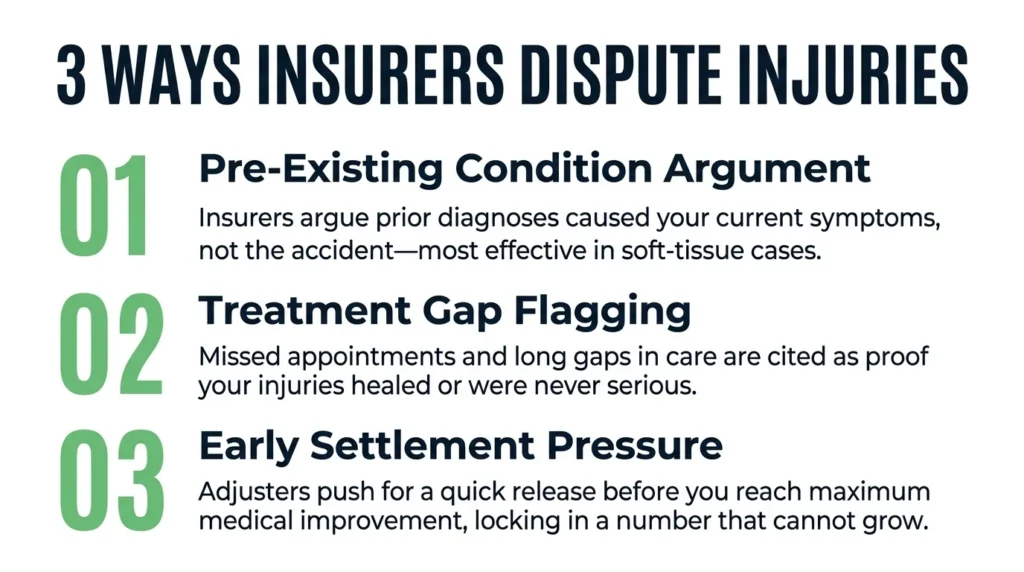
State Farm’s bodily injury adjusters frequently argue that pre-existing conditions caused your injuries instead of the crash. They often use this tactic in soft-tissue cases, back and neck injuries, and any claim involving a person who has previously seen a doctor for similar symptoms. Their goal is to reduce or deny your claim’s injury portion.
Strong medical documentation is the best defense. Ask your treating physicians to write a clear causation statement linking your current symptoms to the accident. Request records that show your baseline condition before the crash and any new findings after it. Diagnostic imaging, treatment notes, and a consistent treatment timeline all help.
Texas law limits how far insurers can push these tactics. Texas Insurance Code Chapter 541 prohibits unfair claim settlement practices, including misrepresenting policy provisions and failing to attempt a good-faith settlement. When State Farm’s conduct crosses these lines, it may rise to insurance bad faith.
Lowball offers and timeline pressure are common. Adjusters may push for a quick settlement before you finish treatment, knowing that future medical bills cannot be added once you sign a release. Do not accept an offer until doctors have cleared you or said you have reached maximum medical improvement.
Texas Laws Affecting State Farm Claims
Texas uses a modified comparative negligence rule that affects every claim against a State Farm policyholder. If you are found 51% or more at fault, you recover nothing. If you are found partially at fault under that threshold, your recovery is reduced by your fault percentage. Understanding Texas comparative negligence law helps you anticipate how State Farm will frame the facts.
You also have a deadline. Under Texas Civil Practice and Remedies Code § 16.003, most personal injury lawsuits must be filed within two years of the accident. Missing this deadline ends your claim, no matter how strong the underlying facts are.
If you believe State Farm is handling your claim improperly, you can file a complaint with the Texas Department of Insurance. The agency reviews complaints and can investigate unfair claim practices. A complaint does not replace a lawsuit, but it creates a record and sometimes prompts the insurer to act.
Get Help from a Skilled Attorney
State Farm’s adjusters are trained to settle for less. When the offers feel low, the denials feel unfair, or the back-and-forth is going nowhere, professional help can change the outcome. Angel Reyes & Associates has handled thousands of claims against major insurers across Texas. Our team knows how State Farm’s dual-adjuster system and valuation software actually work.
We work on a contingency basis, which means there’s no fee unless we win your case. With more than $1 billion recovered for clients, we have the experience to push back on lowball offers and bad-faith conduct. Contact us today for a free consultation about your State Farm claim.
Past results do not guarantee future success.
State Farm Claim FAQs
Can I switch to a different State Farm adjuster if I'm unhappy with mine?
You can request a different adjuster by calling State Farm’s claim department, though they may not always grant the request. Document your reasons for the change request in writing to create a record of any communication issues.
What happens if State Farm's policyholder has minimum coverage limits?
Texas only requires $30,000 per person for bodily injury, which may not cover serious injuries. You would need to personally pursue the at-fault driver for amounts above their policy limits, or use your own underinsured motorist coverage if available.
Does State Farm have to pay for a rental car during repairs?
State Farm only pays rental costs if their policyholder carries rental coverage or if you have rental coverage on your own policy. The coverage typically has daily and total limits that may not cover a luxury replacement vehicle.
Can State Farm require me to use their preferred repair shop?
No, Texas law allows you to choose your own repair shop. State Farm may recommend shops in their network, but they cannot force you to use them or reduce your settlement for choosing an independent shop.
What if my medical bills exceed State Farm's initial settlement offer?
You can reopen settlement discussions by providing updated medical bills and records to the bodily injury adjuster. However, once you sign a release, you cannot seek additional compensation even if new medical issues arise.
About the Authors

Angel Reyes
Writer
Angel L. Reyes, III is the Founder and Managing Partner of Angel Reyes & Associates. A nationally recognized trial attorney and business leader, Angel has helped over 70,000 injury victims recover more than $1 billion since founding the firm in 1993. Named to the Texas Super Lawyers list annually since 2008, Angel brings Wall Street experience, Ivy League education, and a deep commitment to client advocacy. He is a frequent legal commentator and published author with extensive contributions to legal scholarship, trial strategy, and consumer protection.

Kyle Nicolas
Editor
Kyle Nicolas is the Web Content & SEO Manager at Angel Reyes & Associates. He has more than 10 years of experience as a marketing co...

Spencer Browne
Reviewer
Spencer Browne is a partner at Angel Reyes & Associates and a Board Certified personal injury trial lawyer with nearly 100 jury trials a...