Is It Illegal to Drive Under the Speed Limit in Texas?


Every article on this site is researched by our internal team, reviewed for legal accuracy against current Texas law, and held to State Bar of Texas advertising standards before publication. We do not publish content that overstates outcomes or makes promises about results.
Learn more about our
editorial standards .
Key Takeaways
- Driving under the speed limit is not automatically illegal in Texas, but impeding normal traffic flow violates state law and can result in citations.
- The Texas Basic Speed Rule requires driving at reasonable speeds for current conditions, which may mean slowing below posted limits in bad weather or heavy traffic.
- Drivers who cause accidents by traveling at inappropriate speeds (too fast or too slow) can be held liable for injuries and damages under Texas negligence law.
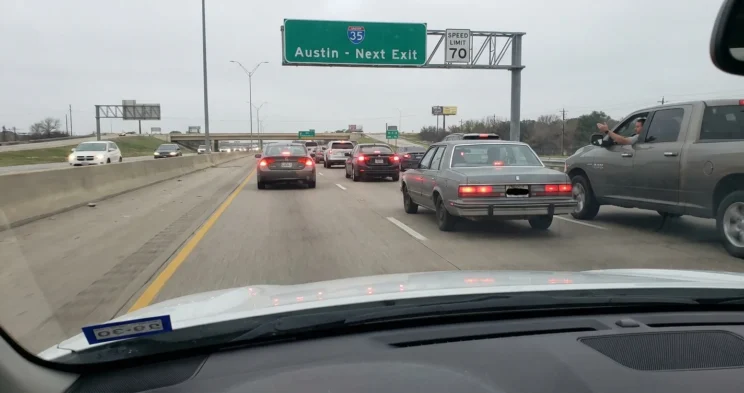
You’re driving on I-35 near Austin, keeping pace with traffic, when the car ahead of you suddenly slows to well below the posted speed. Brake lights flash across multiple lanes as drivers scramble to avoid a collision. You’ve probably wondered whether that slow driver is actually breaking the law.
The answer depends on the circumstances. Texas law does not make driving under the speed limit automatically illegal. However, driving too slowly can violate state traffic laws when it impedes the normal flow of traffic or creates dangerous conditions for other motorists.
Understanding Texas Speed Laws & the Basic Speed Rule
Posted speed limits in Texas represent the maximum legal speed under ideal conditions. They are not targets or minimums. A sign reading 70 mph means you cannot legally exceed that speed, but it does not require you to drive at that pace.
The Texas Basic Speed Rule, found in Texas Transportation Code § 545.351, requires drivers to operate at a speed that is “reasonable and prudent” given current conditions.
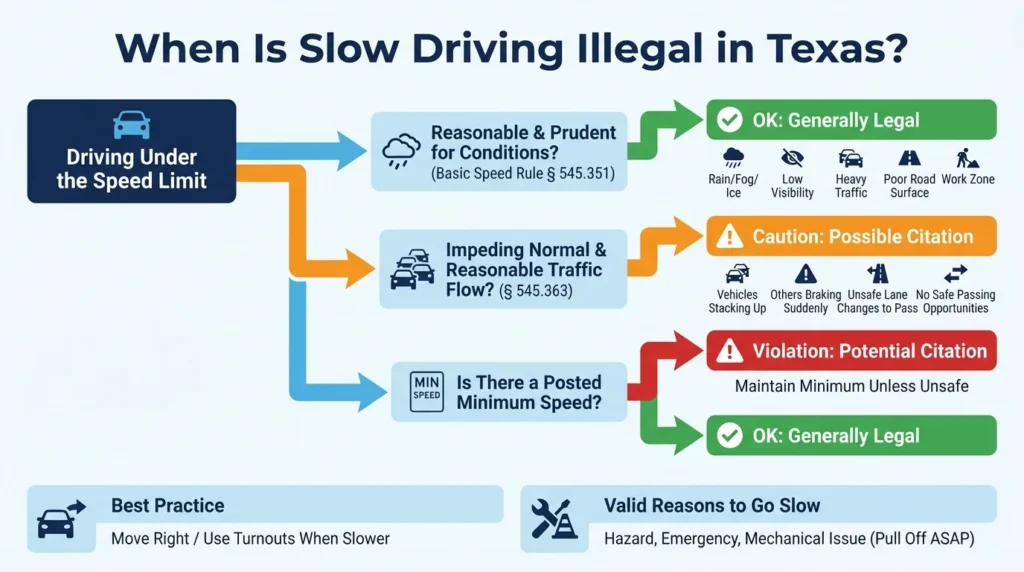
This means you should adjust your speed based on:
- Weather conditions (rain, fog, ice)
- Traffic density and flow
- Road surface conditions
- Visibility limitations
- Construction or work zones
During a heavy rainstorm on US-290 near Houston, driving 45 mph in a 65 mph zone may be the only reasonable choice. The Basic Speed Rule protects drivers who reduce their speed for legitimate safety reasons.
Impeding Traffic Laws in Texas
While slowing down for safety is legal, driving so slowly that you obstruct other vehicles violates Texas law. Texas Transportation Code § 545.363 prohibits driving at a speed so slow that it impedes the normal and reasonable movement of traffic.
This violation applies when a driver:
- Creates a line of vehicles unable to pass safely.
- Forces other drivers to brake suddenly or change lanes abruptly.
- Drives significantly slower than the surrounding traffic without justification.
- Refuses to use turnouts or move to the right lane when slower than the traffic flow.
A citation for impeding traffic typically carries fines ranging from $150 to $300, depending on the jurisdiction. Repeat violations can result in higher penalties.
Slow speed must serve a legitimate purpose. A driver traveling 40 mph on Loop 1604 in San Antonio while distracted may receive a citation. A driver traveling the same speed because of a mechanical problem or hazardous road conditions may have a valid defense against any citations.
Minimum Speed Requirements on Texas Roads
Texas does not impose a statewide minimum speed limit. However, certain highways do display posted minimum speeds, particularly on controlled-access freeways where slow-moving vehicles can create significant hazards.
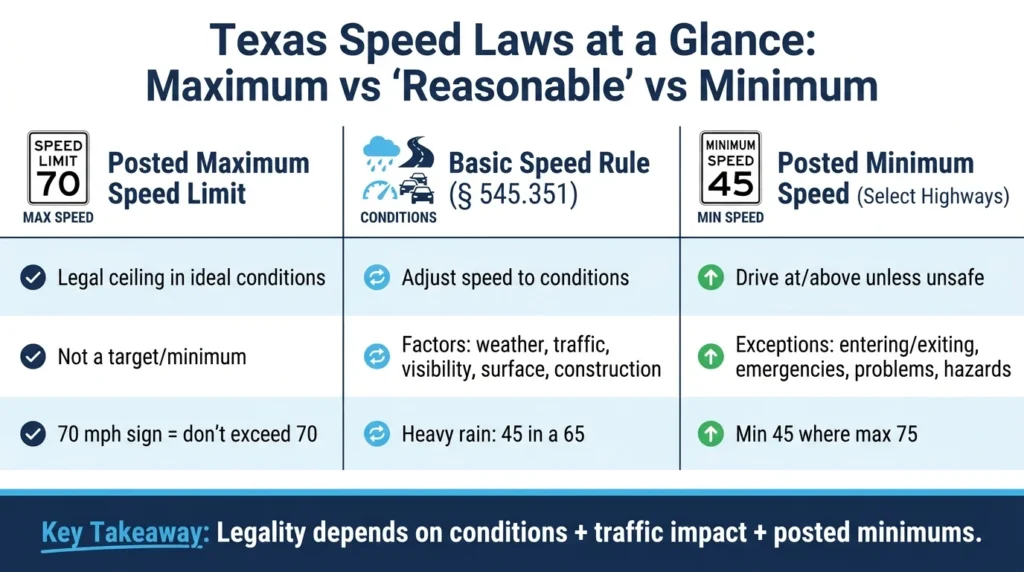
When a minimum speed is posted, drivers must maintain at least that speed unless conditions make it unsafe. Common exceptions include:
- Entering or exiting the highway
- Responding to emergency vehicles
- Mechanical problems requiring reduced speed
- Weather or road conditions requiring caution
Some Texas highways post minimum speeds of 45 mph on sections where the maximum is 75 mph. Driving below the posted minimum without justification can result in a traffic citation.
How Slow Driving Contributes to Accidents & Injuries
Huge discrepancies in speed between vehicles can create dangerous conditions on Texas roads. When one vehicle travels significantly slower than surrounding traffic, other drivers must react quickly to avoid collisions. This can cause a chain reaction that can lead to multi-vehicle pileups, particularly in heavy traffic.
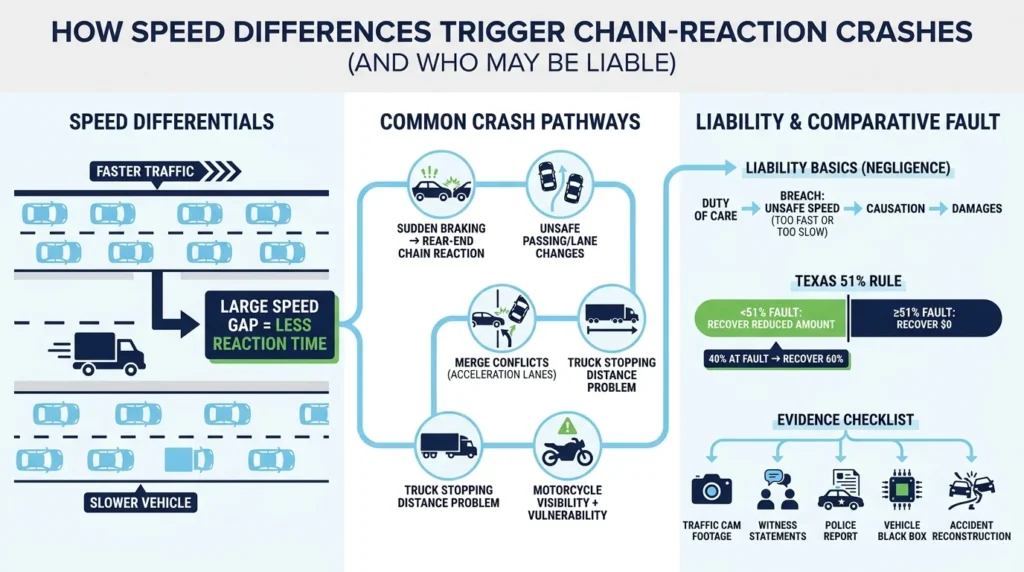
Slow-moving vehicles also contribute to:
- Unsafe lane changes as drivers attempt to pass
- Merge accidents when slow vehicles block acceleration lanes
- Sideswipe collisions during passing maneuvers
- Road rage incidents that escalate into reckless driving
Speed differences are especially dangerous when commercial trucks are nearby. Because semi-trucks require much longer stopping distances, a dangerously slow driver can force an 18-wheeler to brake suddenly, triggering a catastrophic chain-reaction pileup behind them.
Motorcyclists are also vulnerable to speed-difference crashes. Their smaller profile makes them harder to see, and they have less protection in any collision.
Legal Liability for Speed-Related Accidents
Drivers who violate Texas speed laws can be held financially responsible for accidents they cause. This applies whether the driver was traveling too fast or inappropriately slow for conditions.
To establish liability in a speed-related accident, the injured party must prove:
- The other driver owed a duty of care (all drivers owe this to others on the road).
- The driver breached that duty by driving at an unsafe speed.
- The unsafe speed directly caused the accident.
- The accident resulted in actual damages (injuries, wrongful death, property damage, lost wages, etc.).
Texas follows a modified comparative fault system (the 51% bar rule). If you are found 40% at fault for hitting a slow driver because you were tailgating, you can still recover 60% of your total damages. However, if a jury decides you were 51% or more at fault, Texas law bars you from recovering any money at all.
Evidence that can prove speed-related negligence includes:
- Traffic camera footage showing vehicle speeds.
- Witness statements about driving behavior.
- Police reports noting speed violations.
- Vehicle data recorders (black boxes).
- Accident reconstruction analysis.
What to Do If Speed Issues Caused Your Accident
If another driver’s inappropriate speed contributed to your crash, taking the right steps protects your ability to seek compensation.
Here’s what you should do:
- Document everything possible at the scene. Take photos of vehicle positions, road conditions, and any visible damage. Note the weather and traffic conditions. If witnesses saw the other driver traveling unusually slow or fast, get their contact information.
- Request a copy of the police report. Officers often note speed-related factors in their accident reports, which can serve as valuable evidence later.
- Seek medical attention promptly, even if injuries seem minor. Some injuries from car accidents do not show symptoms immediately. Medical records also document the connection between the accident and your injuries.
An experienced attorney can investigate whether speed violations contributed to your accident. This may involve obtaining traffic camera footage, analyzing vehicle data, or working with accident reconstruction experts to determine what happened.
Get Help After a Speed-Related Accident
Speed violations create real dangers on Texas roads. Whether another driver was traveling too fast or dangerously slow, their negligence can leave you dealing with injuries, medical bills, and lost income.
Angel Reyes & Associates has spent over 30 years helping Texas accident victims recover compensation for their injuries. We offer free consultations and work on a contingency basis, meaning you pay nothing unless we win your case. Our team has recovered more than $1 billion for clients across Texas.
If a speed-related accident left you injured, contact us today to discuss your options.
Past results do not guarantee future outcomes.
Driving Under the Speed Limit FAQs
Can you get a ticket for driving the exact speed limit in heavy rain?
No, but you could be cited if the speed limit is unsafe for the conditions. Texas Basic Speed Rule requires driving at reasonable speeds regardless of posted limits.
What happens if your vehicle breaks down and you must drive slowly to safety?
Experiencing an unexpected mechanical problem means your slow speed is a matter of safety, not negligence. Under Texas law, you are permitted to slow down to handle an emergency, but you must turn on your hazard lights and pull off the highway as soon as it is safe to do so.
Can insurance companies deny claims if you were driving significantly under the speed limit?
Insurance companies may reduce payouts under comparative fault rules if slow driving contributed to an accident, even if the other driver was primarily responsible.
Are there specific fines for blocking the left lane while driving slowly?
Texas Transportation Code § 544.011 requires slower traffic to keep right when passing signs are posted. Violating this rule is a traffic misdemeanor that carries a base fine of up to $200, plus local court costs.
About the Authors

Angel Reyes
Writer
Angel L. Reyes, III is the Founder and Managing Partner of Angel Reyes & Associates. A nationally recognized trial attorney and business leader, Angel has helped over 70,000 injury victims recover more than $1 billion since founding the firm in 1993. Named to the Texas Super Lawyers list annually since 2008, Angel brings Wall Street experience, Ivy League education, and a deep commitment to client advocacy. He is a frequent legal commentator and published author with extensive contributions to legal scholarship, trial strategy, and consumer protection.

Kyle Nicolas
Editor
Kyle Nicolas is the Web Content & SEO Manager at Angel Reyes & Associates. He has more than 10 years of experience as a marketing co...

Graham Griffin
Reviewer
Graham Griffin is the Web & Content Manager at Angel Reyes & Associates, where he oversees content strategy, AI-powered workflows, a...